





Folate deficiency symptoms are easy to miss, because they arrive slowly and look like ordinary tiredness. Folate is vitamin B9, the nutrient your body uses to build DNA and to make red blood cells, so when it runs low the tissues that renew themselves fastest suffer first. Before you reach for a bottle of folic acid, there is one thing you need to know. Folate deficiency and vitamin B12 deficiency look almost identical on a blood count, and treating the wrong one can allow permanent nerve damage to develop quietly.
In this article you’ll learn what folate does in the body, which symptoms suggest a shortage, why vitamin B12 has to be checked first, which causes are worth hunting down, what US public health bodies recommend before pregnancy, how fortification changed the picture, and which symptoms need assessment rather than a supplement.
What folate is and what it does
Folate is vitamin B9, a water-soluble vitamin found naturally in leafy greens, beans, citrus fruit, liver and fortified grain products. Folic acid is the manufactured form used in supplements and added to flour, bread, pasta and breakfast cereal. The body converts both into the active forms it uses.
Folate’s central job is to supply the chemical building blocks needed to assemble DNA. Every dividing cell must copy its DNA first, so folate is essential wherever cells are replaced quickly: the bone marrow, the lining of the mouth and gut, and a developing fetus.
Bone marrow shows the strain soonest. Without enough folate, developing red cells cannot finish copying their DNA, so they keep growing while their nuclei lag behind. The marrow releases fewer red cells than normal, and those that reach the bloodstream are abnormally large. On a complete blood count this shows up as anemia with a raised mean corpuscular volume, or high MCV. Doctors call the pattern megaloblastic anemia.
Folate deficiency symptoms, and why mild deficiency is quiet
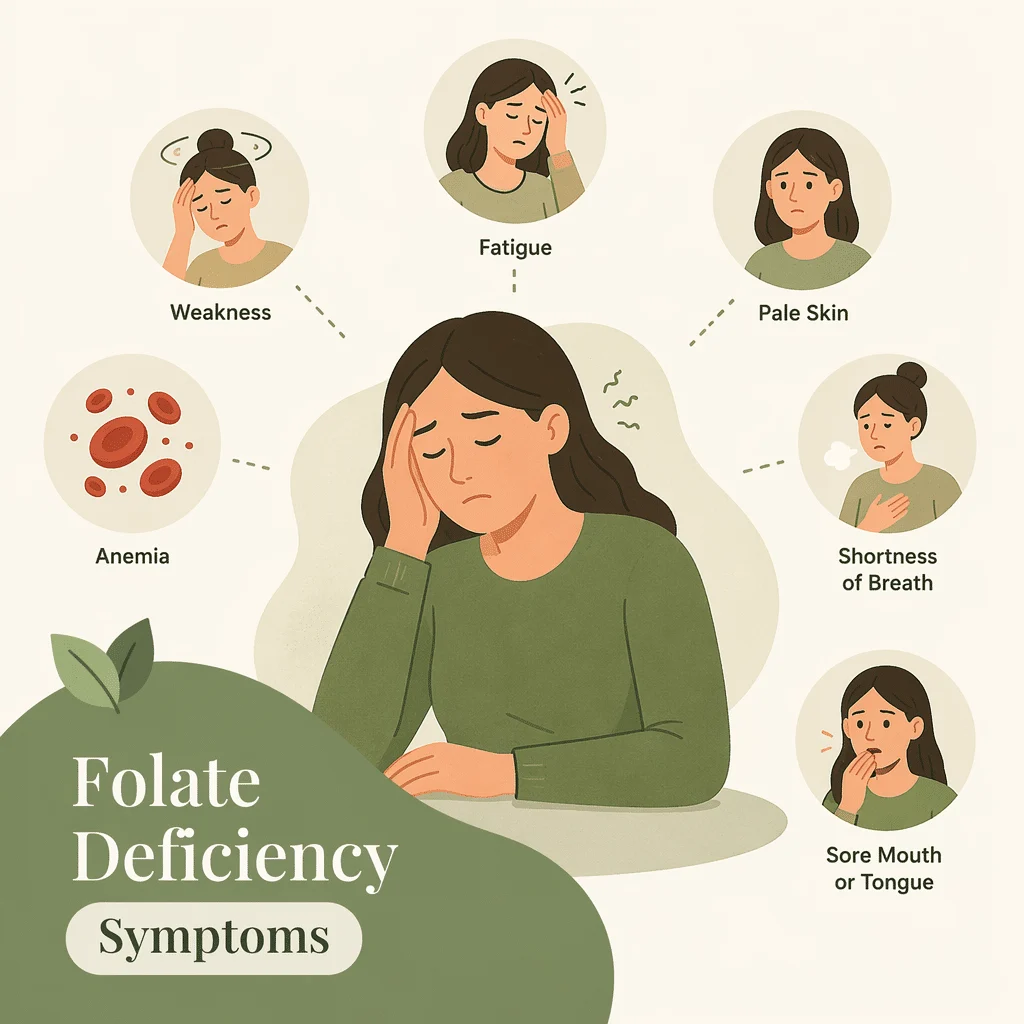
Most of what people notice is the anemia rather than the vitamin shortage itself. Symptoms build over weeks or months, so they are often put down to stress, poor sleep or aging.
- Fatigue that rest does not fix
- Breathlessness on exertion, such as climbing stairs or carrying groceries
- Pallor, most visible in the gums, the nail beds and the inside of the lower eyelid
- Mouth ulcers and a sore, smooth, red tongue, known as glossitis
- Irritability, low mood and difficulty concentrating
- Palpitations or a racing heart once the anemia is more advanced
Two points deserve saying plainly. Mild folate deficiency is frequently silent: levels can drift below normal with no symptoms at all, and the finding often turns up on a test ordered for another reason. Normal energy does not rule it out; feeling tired does not confirm it.
The second is that none of these symptoms is specific to folate. Low ferritin, thyroid disease, chronic infection and other forms of anemia all produce fatigue, breathlessness and pallor. A symptom list points toward a blood test. It never replaces one.
Why vitamin B12 must be checked before folate deficiency is treated
This is the single most important thing on this page.
Folate deficiency and vitamin B12 deficiency produce the same picture on a blood count. Both cause megaloblastic anemia, with large red cells and a raised MCV. Looking at the count alone, nobody can tell them apart. The two vitamins work as a pair in the same pathway, so a shortage of either stalls red cell production the same way.
Here is the dangerous part. Giving folic acid to a person whose real problem is vitamin B12 deficiency can correct the anemia. The blood count improves, the tiredness lifts and the person feels better. Meanwhile the neurological damage that vitamin B12 deficiency causes carries on unchecked, and it can become permanent. That damage shows up as numbness and pins and needles in the feet and hands, unsteadiness when walking, and problems with memory or thinking. The one result that would have raised the alarm has effectively been switched off.
That is why vitamin B12 is measured alongside folate whenever megaloblastic anemia is found, and why the sequence matters: establish which vitamin is missing before anything is replaced. It is also precisely why nobody should self-treat with over-the-counter folic acid on the strength of a symptom list. The symptoms overlap almost completely, the supplement is cheap and sold without a prescription, and the harm is silent while it is happening.
If you already take a supplement containing folic acid and still feel unwell, say so at your appointment. A normal or high folate result in someone who supplements does not mean all is well, and B12 results need reading in that context too. Nerve symptoms in particular, such as a persistently numb toe, point away from folate and toward low vitamin B12, and need assessing before any supplement is started.
The causes worth finding
The body stores little folate, so levels can fall within weeks of low intake, and the number alone tells you little. What matters is the reason behind it, and the reasons fall into four groups.
Diet and alcohol
A diet low in leafy greens, legumes and fortified grains is the most common cause worldwide. Folate is also fragile: prolonged boiling and light destroy it, so heavily overcooked vegetables deliver far less than the raw ingredient suggests. Alcohol use disorder is a major contributor, because alcohol interferes with folate absorption and with how the body handles it.
Problems with absorption
Folate is absorbed in the upper small intestine, so anything damaging that stretch of gut reduces uptake. Celiac disease is the classic example and is often undiagnosed for years. Crohn’s disease and other inflammatory bowel disease do the same, and bariatric surgery permanently reduces both intake and absorbing surface.
Higher demand
Pregnancy and breastfeeding raise requirements substantially, as does anything that speeds up red cell turnover, such as hemolysis, where red cells are destroyed faster than the marrow can replace them. People on dialysis lose folate during treatment and are monitored for it.
Medicines that interfere with folate
This group is easy to overlook. Several widely used drugs block folate metabolism or reduce absorption:
- Methotrexate, used for rheumatoid arthritis, psoriasis and some cancers, which works by blocking a folate enzyme
- Sulfasalazine, used in inflammatory bowel disease and inflammatory arthritis
- Trimethoprim, including the trimethoprim-sulfamethoxazole combination
- Phenytoin and other antiepileptic medicines, including carbamazepine and valproate
- Long-term heavy alcohol use, which acts like a drug effect on top of a dietary one
If you take any of these, that is information for your prescriber, not a reason to act. Never stop or reduce methotrexate, an antiepileptic or any other prescribed medicine because of a folate result. These interactions are well known and are managed deliberately.
Folate in pregnancy and neural tube defects
Pregnancy is the one place where a specific quantity belongs in an article like this, because it is a population-level public health recommendation rather than a treatment.
The neural tube becomes the brain and spinal cord, and it closes in the first few weeks after conception, generally before a person knows they are pregnant. Around half of pregnancies in the United States are unplanned, so waiting for a positive test is too late.
For that reason the Centers for Disease Control and Prevention recommend that all women who could become pregnant get 400 micrograms of folic acid every day, starting before conception and continuing into early pregnancy. The US Preventive Services Task Force supports the same recommendation. It applies whether or not a pregnancy is planned.
Two exceptions matter. People who have had a previous pregnancy affected by a neural tube defect, and people on certain medicines such as some antiepileptics, need a different and higher amount that only their doctor can determine. Nothing here applies to treating an established deficiency, where the amount and duration are decided by a clinician after vitamin B12 has been checked.
Fortification: what changed after 1998
In 1998 the United States began requiring folic acid to be added to enriched grain products, including flour, bread, pasta, cornmeal and rice. It is one of the most successful nutrition policies ever implemented: neural tube defect rates fell substantially afterwards, and dozens of countries have since adopted mandatory fortification of a staple food.
Fortification has a quieter consequence. Dietary folate deficiency became genuinely uncommon in the United States, so when a low result does turn up today, a specific cause is more likely to be found: malabsorption, a medicine, heavy alcohol use, or high demand. A low result is a prompt to look, not simply to supplement.
MTHFR testing and methylfolate, handled soberly
If you have searched for folate online, you will have met the claim that an MTHFR gene variant means you cannot process folic acid and must buy methylfolate instead. The claim is everywhere, and it deserves a calm answer.
MTHFR is a gene coding for an enzyme in the folate pathway. Common variants, particularly C677T, are genuinely common: more people in the United States carry at least one copy than do not. Carrying one is ordinary, not a diagnosis.
The CDC states that people with an MTHFR variant can process all types of folate, including folic acid, and that how much folic acid someone consumes matters more for their blood folate level than their MTHFR genotype does. Routine MTHFR testing is not recommended by major genetics and laboratory bodies for this purpose, and the common variants do not justify special supplementation in most people. Folic acid also remains the only form with direct trial evidence behind the neural tube defect recommendation.
None of that makes the marketing malicious, or methylfolate harmful. It means the test rarely changes what anyone should do, and that paying more for a different form on the strength of a gene result is not supported by the evidence.
What your doctor will do next
Confirming the deficiency is the straightforward part, and the folate blood test itself is covered separately in our guide to the folic acid blood test, including how serum and red cell folate differ. Here we stay with what happens around that result.
Expect three things. Vitamin B12 will be checked at the same time. The blood count will be reviewed for anemia and red cell size. And your doctor will look for a cause: a dietary and alcohol history, a full medicines review, and often celiac serology such as a tTG-IgA test. Iron studies are often added, because deficiencies travel together. Homocysteine is sometimes measured when the picture is unclear, and a result such as low globulin can add context about nutrition and gut absorption.
Once the cause is known, treating folate deficiency is straightforward. What a clinician chooses, and for how long, depends on the cause, on the vitamin B12 result, and on whether pregnancy is a consideration.
| Situation | What it usually means | What to do |
|---|---|---|
| Low folate, normal vitamin B12 | A genuine folate shortage, usually dietary, absorptive or drug-related | See your doctor to identify the cause; what is given follows from that |
| Low folate, low or borderline vitamin B12 | Both vitamins may be short, and the B12 side must be dealt with too | Do not start folic acid alone; this combination needs assessment first |
| Normal folate on a supplement, symptoms continuing | The supplement may be normalizing the number while something else drives symptoms | Tell your doctor what you take and for how long; B12 and iron deserve a look |
| Planning a pregnancy | Folate status matters before conception, not after a positive test | Follow the public health recommendation above at a preconception visit |
| Taking methotrexate, sulfasalazine or an antiepileptic | The medicine interferes with folate; this is expected and managed | Never change the dose yourself; ask how your folate is monitored |
Red flags: get assessed before taking anything
Some symptoms are not folate symptoms at all, and reaching for folic acid in these situations is exactly what this article exists to prevent.
Arrange prompt medical assessment, and do not start a folic acid supplement first, if you have:
- Numbness, pins and needles or burning in the hands or feet
- Unsteadiness on your feet, or a change in the way you walk
- New memory problems, confusion or a marked change in thinking
- Breathlessness at rest, chest pain or fainting
- A sore tongue together with weight loss and persistent diarrhea
- Pregnancy, or plans for one, after a previous pregnancy affected by a neural tube defect
The first three point toward vitamin B12 rather than folate, and timing matters. Chest pain, fainting or breathlessness at rest need same-day care.
Latest scientific advances in folate testing
Research published since 2023 has sharpened several points above. Every study below is listed in the sources.
A 2024 review in Food and Nutrition Bulletin, led by Joshua W. Miller, revisited this exact risk. What was found: clinical and epidemiological evidence indicates that a high folic acid intake alongside a low vitamin B12 level is associated with poorer cognitive test scores and with markers suggesting the B12 shortage is being made worse, not merely hidden. What this means for you: the masking problem is real today, and it is why your doctor wants a vitamin B12 result before folate is treated.
A 2023 review by Vijaya Kancherla in Child’s Nervous System summarized global neural tube defect prevention. What was found: maternal folate insufficiency before and during early pregnancy is the most common and the most preventable risk factor for neural tube defects, and the neural tube forms roughly 28 days after conception, before most people know they are pregnant. What this means for you: that timing is why the recommendation covers all women who could become pregnant.
A 2024 evidence-based review in Nutrients, led by Maria de Lourdes Samaniego-Vaesken, compared folic acid with 5-methyltetrahydrofolate, sold as methylfolate. What was found: folic acid has a well-established role in preventing neural tube defects, while clinical studies establishing the efficacy, timing and safety of methylfolate for the same purpose are still lacking. What this means for you: methylfolate is not a proven upgrade, and the marketing runs ahead of the evidence.
A 2024 cross-sectional study in the American Journal of the Medical Sciences, led by Aakash V. Patel, examined people with rheumatoid arthritis taking methotrexate together with folic acid. What was found: raised homocysteine was significantly more common in that group than in people with rheumatoid arthritis on other treatments, and homocysteine is a sensitive signal of vitamin B12 status. What this means for you: on methotrexate, both folate and vitamin B12 are worth watching, through your rheumatology team.
A 2025 prospective study in Nutrients, led by Maria Humiecka, followed patients for ten years after bariatric surgery. What was found: folic acid deficiency, vitamin B12 deficiency and iron deficiency all became significantly more common across the follow-up. What this means for you: after a sleeve gastrectomy or gastric bypass, nutrient monitoring is a long-term commitment, and folate is part of it.
Glossary of key terms
| Term | Definition |
|---|---|
| Folate (vitamin B9) | A water-soluble B vitamin found naturally in foods, needed to build DNA and make red blood cells |
| Folic acid | The manufactured form of vitamin B9 used in supplements and added to fortified grain products |
| Megaloblastic anemia | Anemia in which red cells are abnormally large because DNA production has stalled, typically from low folate or low vitamin B12 |
| MCV | Mean corpuscular volume, the average size of a red blood cell, reported on a complete blood count |
| Glossitis | A sore, smooth, unusually red tongue, a recognized sign of folate or vitamin B12 shortage |
| Neural tube defect | A birth defect of the brain or spine, such as spina bifida or anencephaly, arising in the first weeks of pregnancy |
| Fortification | Adding a nutrient to a staple food by law or policy, as with folic acid in US enriched grain products |
| Malabsorption | Reduced uptake of nutrients from the gut, for example in celiac disease or after bariatric surgery |
| MTHFR | A gene coding for an enzyme in the folate pathway; common variants are ordinary and rarely change management |
| Homocysteine | An amino acid that rises when folate or vitamin B12 is low, sometimes measured when results are unclear |
Frequently asked questions
Should I just take folic acid if I have folate deficiency symptoms?
No, and this is the main safety message of this article. Folate deficiency and vitamin B12 deficiency cause the same symptoms and the same blood count picture. Folic acid taken by someone who is actually short of vitamin B12 can correct the anemia and make them feel better, while nerve damage from the B12 shortage continues and may become permanent. Get folate and vitamin B12 measured together, then treat what the results actually show, with your doctor deciding what is needed.
What is the difference between folate and folic acid?
Folate is the general term for vitamin B9, including the forms occurring naturally in leafy greens, beans, citrus fruit and liver. Folic acid is the manufactured form used in supplements and added to fortified foods such as flour, bread and breakfast cereal. Folic acid is more stable and better absorbed, and it is the form with direct trial evidence behind the neural tube defect recommendation. The body converts both into the active forms it uses.
Do I need an MTHFR gene test?
For folate purposes, almost certainly not. Common MTHFR variants are widespread, and the CDC states that people who carry them can process all forms of folate, including folic acid. How much folic acid you consume affects your blood folate level more than your MTHFR genotype does. Major genetics bodies do not recommend routine MTHFR testing for this purpose. If a relative has been told about a rare MTHFR condition, that is a different situation and warrants genetic advice.
Can low folate cause numbness or tingling in the hands and feet?
Numbness, tingling and unsteadiness are far more characteristic of vitamin B12 deficiency than of folate deficiency, and they are exactly the symptoms that make self-treating with folic acid risky. If you have them, they deserve assessment before any supplement is started, not after. Other causes such as diabetes, nerve compression and thyroid disease are also worth ruling out, so describe the pattern and timing to your doctor.
Can you have low folate without anemia?
Yes, and it is common. Folate falls in the blood before the bone marrow runs into trouble, so a low result can appear while the complete blood count is still entirely normal. Many people with mildly low folate have no symptoms whatsoever, and the finding surfaces on a test ordered for something else. That is not a reason to ignore it; it is a reason to look for the cause calmly rather than to start supplements in a hurry.
Is treating folate deficiency complicated?
Usually not, once two questions have been answered: what the vitamin B12 result is, and what caused the folate to fall. When the cause is dietary, the fix is often simple. When it is celiac disease, inflammatory bowel disease, bariatric surgery or a medicine such as methotrexate, the underlying situation is what really needs managing, and folate is handled as part of that. Blood counts are usually rechecked to confirm the response.
Sources
- Centers for Disease Control and Prevention. About Folic Acid
- Centers for Disease Control and Prevention. MTHFR Gene Variant and Folic Acid Facts
- National Institutes of Health, Office of Dietary Supplements. Folate: Fact Sheet for Health Professionals
- MedlinePlus, US National Library of Medicine. Folate deficiency
- US Preventive Services Task Force. Folic Acid Supplementation to Prevent Neural Tube Defects: Preventive Medication
- Miller JW, Smith A, Troen AM, Mason JB, Jacques PF, Selhub J. Excess Folic Acid and Vitamin B12 Deficiency: Clinical Implications? Food and Nutrition Bulletin. 2024. https://doi.org/10.1177/03795721241229503
- Kancherla V. Neural tube defects: a review of global prevalence, causes, and primary prevention. Child’s Nervous System. 2023. https://doi.org/10.1007/s00381-023-05910-7
- Samaniego-Vaesken ML, Morais-Moreno C, Carretero-Krug A, Puga AM, Montero-Bravo AM, Partearroyo T, Varela-Moreiras G. Supplementation with Folic Acid or 5-Methyltetrahydrofolate and Prevention of Neural Tube Defects: An Evidence-Based Narrative Review. Nutrients. 2024. https://doi.org/10.3390/nu16183154
- Patel AV, Morgan SL, Green R, Danila MI, Merriman TR, Wanzeck K, Ahmed H, Gaffo AL. Vitamin B12 status and hyperhomocysteinemia in patients with rheumatoid arthritis treated with methotrexate and folic acid. The American Journal of the Medical Sciences. 2024. https://doi.org/10.1016/j.amjms.2024.03.020
- Humiecka M, Sawicka A, Kedzierska K, Binda A, Jaworski P, Tarnowski W, Jankowski P. Prevalence of Nutrient Deficiencies Following Bariatric Surgery: Long-Term, Prospective Observation. Nutrients. 2025. https://doi.org/10.3390/nu17162599
Further reading
- Folic acid (folate or vitamin B9): understanding your blood test
- High folate levels: causes, symptoms and risks
- Vitamin B12 blood test results explained
- Vitamin B12: benefits, sources and levels
- Gluten intolerance and celiac disease
Understand your lab results with AI DiagMe
A folate result rarely stands alone. It is read next to your vitamin B12, and next to the red cell numbers on your complete blood count, also called a full blood count, including the MCV. AI DiagMe helps you understand what those figures mean and which questions to bring to your appointment. It does not diagnose folate deficiency and it does not replace your doctor.
Get your results interpreted in minutes