

































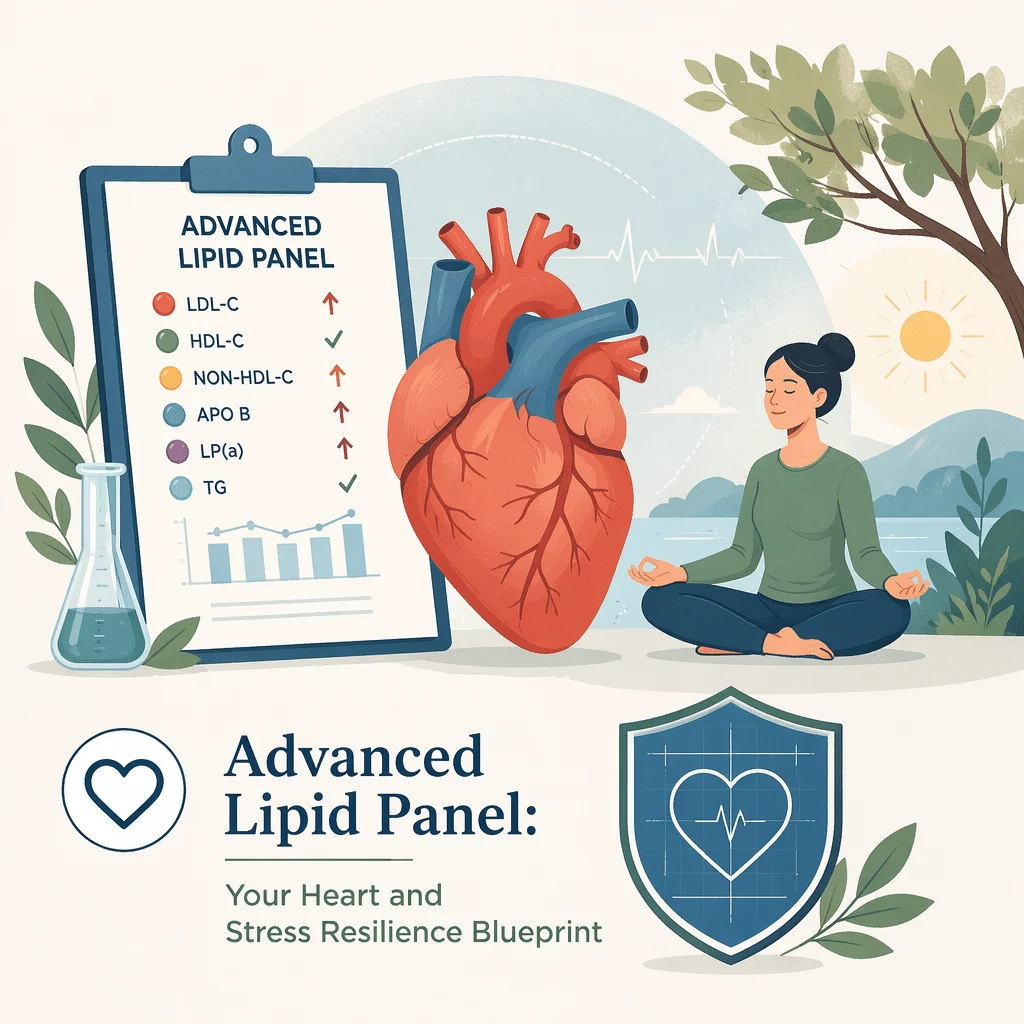
An advanced lipid panel goes beyond a standard cholesterol test to measure the markers most closely tied to plaque and heart attacks: apolipoprotein B (ApoB), lipoprotein(a), LDL particle number, and more. Where a basic panel estimates how much cholesterol you carry, an advanced lipid panel looks at how many harmful particles are present and what kind they are. That extra detail can uncover risk in people whose ordinary cholesterol results look reassuring. In this article you will learn what the panel measures, how it differs from a routine test, who benefits from it, and how to read the results.
What an advanced lipid panel measures
A standard panel reports total cholesterol, LDL cholesterol (LDL-C), HDL cholesterol, and triglycerides. An advanced lipid panel keeps those and adds markers that describe particle number, particle type, and inherited risk. The exact menu varies by laboratory, but the core additions are consistent.
| Marker | What it adds beyond standard cholesterol |
|---|---|
| ApoB | A direct count of atherogenic (plaque-forming) particles |
| Lipoprotein(a) | Inherited risk that a routine panel does not show |
| LDL particle number (LDL-P) | Total LDL particles, which can be high even when LDL-C looks normal |
| Small dense LDL | The smaller, more artery-penetrating LDL subfraction |
| Non-HDL-C | Cholesterol in every atherogenic particle combined |
| ApoA1 and ratios | The protective side, and the balance between harmful and protective particles |
How it differs from a standard lipid panel
The difference is particles versus cholesterol mass. A routine panel measures the cholesterol inside your particles, then estimates LDL-C with a formula. That works well for most people, but it can mislead when particles are small and dense or when triglycerides are high, because the same LDL-C number can hide very different particle counts. Advanced testing measures the particles more directly, which sharpens the picture in exactly those situations. To see the baseline that advanced testing builds on, review a standard lipid panel.
The key markers, one by one
ApoB: the particle count
Every atherogenic particle carries one ApoB molecule, so ApoB is the most direct measure of how many plaque-forming particles you have. Many lipid specialists treat it as the single most important number on an advanced panel. Because it deserves a full explanation, we cover targets and interpretation in a dedicated guide to the ApoB test.
Lipoprotein(a): the inherited marker
Lipoprotein(a), written Lp(a), is an LDL-like particle whose level is largely set by your genes and stays fairly stable for life. High Lp(a) raises heart and stroke risk independently of your other numbers, which is why guidelines suggest measuring it at least once in adulthood. If it runs high in your family, ask about lipoprotein(a) screening.
LDL particle number and small dense LDL
LDL particle number (LDL-P) counts LDL particles directly, and small dense LDL flags the subtype most likely to slip into artery walls. When LDL-P is high but LDL-C looks fine, that mismatch, called discordance, points to hidden risk. This is the core reason advanced testing exists.
ApoA1 and ratios
ApoA1 sits on protective HDL particles, so it reflects the helpful side of the balance. Comparing the harmful and protective fractions, or reading your cholesterol ratio, adds context that a single number cannot. People who also show low HDL cholesterol often gain the most from this fuller view.
Who should consider advanced lipid testing?
An advanced lipid panel is most useful when a standard test leaves questions unanswered. Your clinician may suggest it if you have:
- Diabetes, prediabetes, metabolic syndrome, or insulin resistance
- High triglycerides, or a normal LDL-C that seems inconsistent with your risk
- A personal or family history of early heart attack or stroke
- Known cardiovascular disease that you are actively managing
- Uncertainty about whether to start or intensify treatment
The 2026 ACC/AHA dyslipidemia guideline supports selective use of these extra tests. It recommends measuring Lp(a) at least once, and using ApoB to refine risk and guide treatment in people with cardiovascular-kidney-metabolic syndrome, type 2 diabetes, high triglycerides, or established heart disease who have already met their LDL-C and non-HDL-C goals.
How to read an advanced lipid panel
Read the panel as a set of related clues rather than isolated numbers. The most informative signal is often discordance: a marker of particle number, such as ApoB or LDL-P, that sits higher than the cholesterol numbers would predict. The targets below are commonly cited, but your own goals depend on your overall risk and should be set with your clinician.
| Marker | Commonly cited target or flag |
|---|---|
| ApoB | Often optimal under 80 mg/dL; 130 mg/dL or above is high |
| Lipoprotein(a) | High at 50 mg/dL or above (about 125 nmol/L) |
| LDL particle number | Read against LDL-C to spot discordance |
| Non-HDL-C | Under 130 mg/dL for many adults, lower with higher risk |
Fasting, cost, and how the test is done
An advanced lipid panel is a single blood draw. Fasting is often not required, though some laboratories ask for a 12-hour fast when triglycerides or a full lipid profile are included, so follow your lab’s instructions. Advanced testing costs more than a basic panel and is not always covered by insurance, so it helps to confirm price and coverage in advance and to discuss with your clinician which extra markers are worth adding for your situation.
Latest scientific advances
Research keeps refining how these extra markers improve risk prediction. Here is what recent work adds, in plain terms.
A 2025 study compared standard and advanced lipid measures, plus inflammation markers, in people with and without coronary heart disease. Models that added advanced markers, including small dense LDL, lipoprotein(a), and detailed HDL particle analysis, predicted disease better than models built on standard cholesterol alone. In everyday terms, the extra detail helped identify high-risk people whose ordinary numbers looked only slightly off. These are research findings that still need confirmation in broader groups, but they reinforce why particle-level testing can matter.
A 2025 analysis of more than 41,000 adults in the UK Biobank (a large group followed over time) found that when ApoB and LDL particle number disagreed, ApoB was the better predictor of heart attacks and blocked arteries, with risk rising even at small mismatches. What this means for you is that measuring particle number, not just cholesterol, can catch risk that a routine panel would miss.
These newer results build on a longstanding laboratory consensus that non-HDL-C, ApoB, and LDL particle number sharpen risk assessment through discordance analysis, especially in people with high triglycerides or very low LDL-C. The practical takeaway is consistent: advanced testing is most valuable when the standard picture is uncertain.
Glossary
- Advanced lipid panel: expanded blood testing that adds particle and inherited-risk markers to a standard cholesterol test.
- ApoB (apolipoprotein B): a protein on every atherogenic particle; a direct count of particle number.
- Lipoprotein(a): an inherited, LDL-like particle that adds independent cardiovascular risk.
- LDL particle number (LDL-P): the total count of LDL particles in the blood.
- Small dense LDL: the smaller, denser LDL subtype more likely to enter artery walls.
- Non-HDL-C: total cholesterol minus HDL, covering all atherogenic particles.
- ApoA1: the main protein on protective HDL particles.
- Discordance: a mismatch between cholesterol mass and particle number.
Frequently asked questions
What is an advanced lipid panel? It is expanded cholesterol testing that adds markers such as ApoB, lipoprotein(a), and LDL particle number to give a fuller view of heart risk than a standard panel.
How is it different from a standard lipid panel? A standard panel estimates the cholesterol your particles carry, while an advanced panel measures how many particles there are and what type, which can reveal risk that cholesterol numbers miss.
Do I need to fast for it? Often not, but some laboratories request a 12-hour fast when triglycerides or a complete lipid profile are included. Follow the instructions your lab gives you.
How much does it cost? It costs more than a basic panel and coverage varies, so confirm the price and your insurance benefits before testing.
Can lipoprotein(a) be lowered? Lp(a) is mostly genetic and changes little with lifestyle, so the focus is usually on managing your other risk factors well. New targeted therapies are being studied.
What if my standard panel is normal? An advanced panel can still uncover hidden risk, particularly high ApoB, high Lp(a), or a high particle number, in people who look fine on a routine test.
Further reading
- ApoB test: the single most important number
- Standard lipid panel explained
- Lipoprotein(a) screening
- Apolipoprotein A1 and protective particles
- High cholesterol: understand, prevent, act
Sources
- American College of Cardiology / American Heart Association. 2026 Guideline for the Management of Dyslipidemia (news release), 2026. https://newsroom.heart.org/news/accaha-issue-updated-guideline-for-managing-lipids-cholesterol
- Cleveland Clinic. Apo B Test. https://my.clevelandclinic.org/health/diagnostics/24992-apolipoprotein-b-test
- Devaraj S, Semaan JR, Jialal I. Biochemistry, Apolipoprotein B. StatPearls, NIH National Library of Medicine, 2023. https://www.ncbi.nlm.nih.gov/books/NBK538139/
- Langlois MR, et al. Quantifying Atherogenic Lipoproteins: EAS-EFLM Consensus Statement. Clinical Chemistry, 2018. https://consensus.app/papers/details/d00ab47984df5a5b941c198fdd1eb065/
- Stock E, et al. HDL Particles, Inflammation, and Coronary Heart Disease Risk. Nutrients, 2025. https://consensus.app/papers/details/d85453427e575146859d80f3c0e0c721/
- Epstein E, et al. Apolipoprotein B outperforms LDL particle number as a marker of cardiovascular risk in the UK Biobank. Eur J Prev Cardiol, 2025. https://consensus.app/papers/details/4b787ca8162d5dbe969b3f334d8ead3a/
Understand your lab results with AI DiagMe
An advanced lipid panel produces a lot of numbers, and their meaning lies in how they fit together. AI DiagMe reads your uploaded report and explains what your ApoB, lipoprotein(a), particle number, and cholesterol values may mean for your heart, in clear language, so you can prepare focused questions for your doctor. It helps you understand your results; it does not diagnose disease or replace your physician.
Get your results interpreted in minutes