



























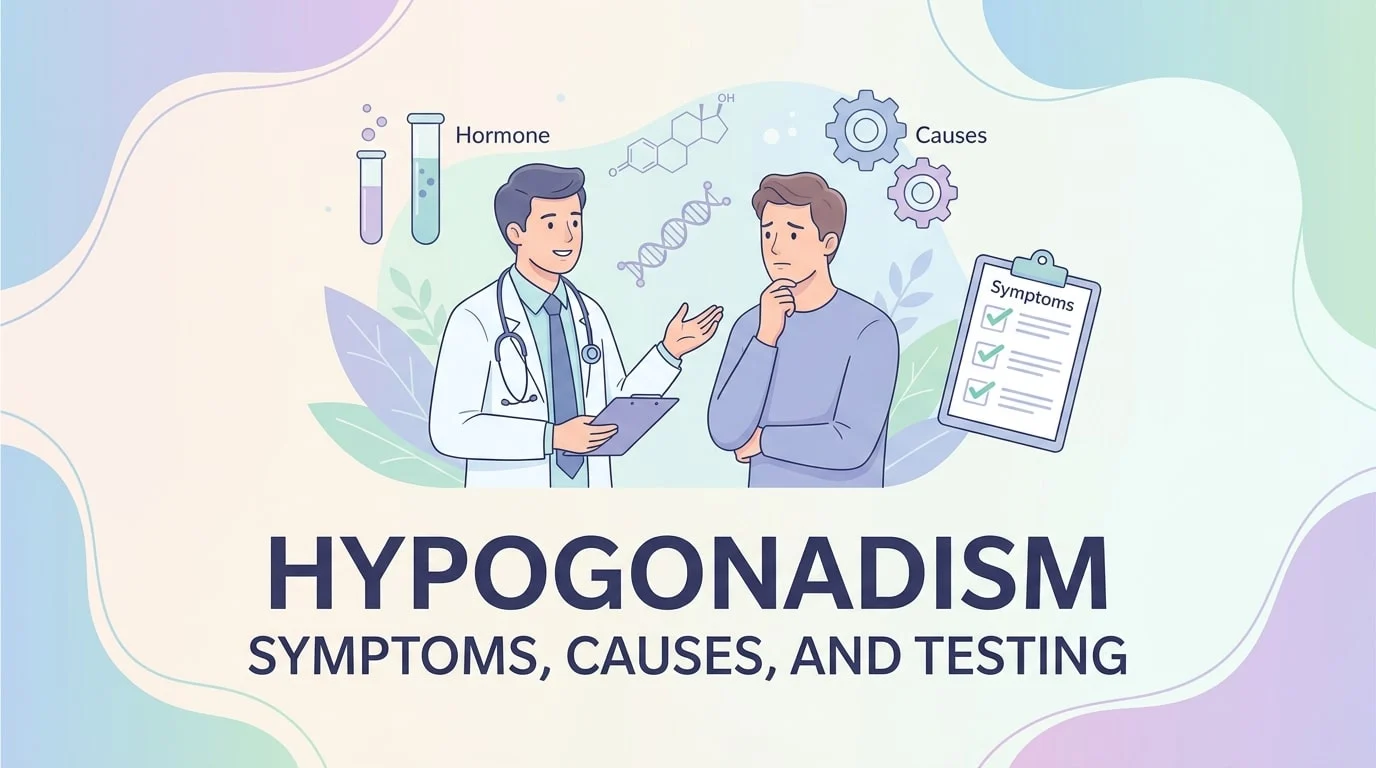
Hypogonadism is a condition in which the body’s sex glands (the testes in men, the ovaries in women) produce too little sex hormone, too few reproductive cells, or both. In men, that usually means low testosterone; in women, it often means low estrogen. In this article you will learn what hypogonadism is, the symptoms it causes, how doctors separate primary from secondary forms, which causes sit behind each type, the blood tests used to confirm it, when testing makes sense, and a high-level view of treatment. The aim is clear, factual information you can take to your own clinician.
What is hypogonadism?
Hypogonadism describes reduced function of the gonads, the glands that make sex hormones and gametes (sperm or eggs). According to MedlinePlus, it occurs when these glands produce little or no hormone. Sex hormones do far more than support reproduction. Testosterone and estrogen influence muscle and bone strength, mood, energy, sexual function, and body composition, so a lasting shortfall can affect the whole body.
This guide focuses mainly on male hypogonadism, the form most often discussed and tested, while noting where women are affected too. The hormone at the center of male hypogonadism is testosterone. Many readers also review our complete guide to the testosterone blood marker to understand how the hormone is measured.
Hypogonadism in women
Women can also develop hypogonadism. The most common form is the natural fall in ovarian hormones at menopause, which Cleveland Clinic and MedlinePlus both describe as a normal life stage rather than a disease. Earlier ovarian failure, pituitary disorders, very low body weight, and some genetic conditions can also lower estrogen before the usual age. Symptoms may include irregular or absent periods, hot flashes, vaginal dryness, and reduced bone density. Readers exploring this side of the topic often consult our complete guide to menopause symptoms.
Symptoms of hypogonadism
Symptoms depend on age at onset, sex, and how low hormone levels fall. In adult men, the Mayo Clinic lists early signs such as reduced sex drive, lower energy, and low mood. Over time, men may notice the following:
- Low libido and fewer spontaneous erections
- Erectile difficulties
- Fatigue and reduced motivation
- Loss of muscle mass and strength
- Increased body fat, sometimes with breast tissue growth (gynecomastia)
- Thinning bones, raising fracture risk over time
- Reduced facial and body hair
- Difficulty conceiving (infertility)
- Mood changes, irritability, or trouble concentrating
When hypogonadism begins before or during puberty, it can delay or limit development: less muscle growth, a voice that does not deepen, reduced penis and testicle growth, and slowed body and facial hair. Because many of these symptoms overlap with other conditions, doctors confirm the picture with blood tests rather than symptoms alone. Some men with low laboratory numbers have no obvious symptoms at all.
Primary vs secondary hypogonadism
One distinction shapes the entire diagnosis: where the problem lies. The brain controls the gonads through a chain often called the hypothalamic-pituitary-gonadal axis. The hypothalamus releases gonadotropin-releasing hormone, which prompts the pituitary gland to release luteinizing hormone (LH) and follicle-stimulating hormone (FSH). In men, LH tells the testes to make testosterone, and FSH supports sperm production.
In primary hypogonadism, the testes themselves do not work properly. The brain senses low testosterone and pushes harder, so LH and FSH rise. This pattern is called hypergonadotropic hypogonadism: high gonadotropins, low testosterone. In secondary hypogonadism, the signal from the brain is weak, so LH and FSH are low or inappropriately normal while testosterone is also low. This is called hypogonadotropic hypogonadism. Your clinician may order a luteinizing hormone (LH) blood test 及 a follicle-stimulating hormone (FSH) blood test to tell these two patterns apart.
| 特征 | Primary hypogonadism | Secondary hypogonadism |
|---|---|---|
| Where the problem is | In the testes or ovaries (the gonads) | In the pituitary gland or hypothalamus (the brain control center) |
| LH and FSH pattern | High (hypergonadotropic) | Low or inappropriately normal (hypogonadotropic) |
| Testosterone (men) | 低的 | 低的 |
| Example causes | Klinefelter syndrome, mumps infection of the testes, testicular injury, chemotherapy or radiation, hemochromatosis | Pituitary tumor, Kallmann syndrome, high prolactin, opioid or steroid medicines, significant obesity, severe illness |
Late-onset and age-related hypogonadism
Testosterone declines gradually as men age. MedlinePlus notes that the normal range in a man aged 50 to 60 is much lower than in a man aged 20 to 30. When low testosterone appears later in life alongside symptoms, clinicians sometimes call it late-onset hypogonadism. It often overlaps with so-called functional causes such as obesity, type 2 diabetes, and other chronic illness, where the hypothalamic-pituitary-testicular axis is structurally intact but underperforming. Distinguishing this from disease of the testes or pituitary matters, because the best first step is frequently to treat the underlying condition.
What causes hypogonadism?
Causes fall into the two groups above. Primary (testicular) causes described by the Mayo Clinic and MedlinePlus include Klinefelter syndrome, undescended testicles that were not corrected in early childhood, mumps infection affecting the testes, injury to both testicles, hemochromatosis (iron overload), and the effects of chemotherapy or radiation. Autoimmune disease and some genetic conditions can also damage the gonads.
Secondary (central) causes affect the pituitary or hypothalamus. These include pituitary tumors and their treatment, Kallmann syndrome (often paired with a reduced sense of smell), inflammatory diseases such as sarcoidosis and tuberculosis, HIV/AIDS, certain medicines such as opioids and glucocorticoids, rapid weight loss, obstructive sleep apnea, and significant obesity. A pituitary tumor that overproduces prolactin can also suppress the axis; readers can review our guide to high prolactin levels for that mechanism. Chronic conditions such as our complete guide to diabetes describes are frequently linked with lower testosterone in men.
How is hypogonadism diagnosed?
Diagnosis combines symptoms with blood tests, interpreted together. Because testosterone peaks in the morning and varies day to day, the timing and number of tests matter.
The core blood tests
- Morning total testosterone, ideally drawn between about 7 a.m. and 10 a.m., is the usual starting point. A low result is repeated on a separate morning to confirm it, since a single low value can be misleading.
- Free testosterone and sex hormone-binding globulin (SHBG) help when total testosterone sits in a borderline range or when conditions such as obesity shift binding proteins. Readers often consult our explainer on sex hormone-binding globulin levels to understand this nuance.
- LH and FSH separate primary from secondary hypogonadism, as the comparison table shows.
- Prolactin and estradiol add context, especially when a pituitary cause or gynecomastia is suspected. Estradiol also protects bone in men, a point covered in our guide to the estradiol marker.
Doctors may add other tests to find a cause or contributing condition: iron studies, a check for anemia, thyroid function, blood sugar, a sperm count, genetic testing such as a karyotype, and, when a pituitary problem is suspected, an MRI of the brain. The Cleveland Clinic notes that abnormal LH and FSH levels usually point toward hypogonadism, with high gonadotropins signaling a gonadal problem and low gonadotropins signaling a pituitary or hypothalamic one.
A note on reference ranges
Laboratory reference ranges for testosterone, LH, FSH, and related hormones vary between laboratories and assay methods. Values also shift with age and, in women, with the menstrual cycle. MedlinePlus highlights that interpreting testosterone in older men and in men with obesity can be difficult, which is why results are best discussed with a clinician, often an endocrinologist, rather than read in isolation. A number slightly outside a printed range is a prompt for conversation, not an automatic diagnosis.
When to test and when to see a doctor
Testing is generally considered when symptoms suggest low sex hormones rather than as a routine screen in men without symptoms. Make an appointment if you notice a persistent drop in sex drive, erectile difficulties, unexplained fatigue, loss of muscle mass, breast tenderness or enlargement, or, in women, hot flashes before the expected age or absent periods. The Mayo Clinic advises that finding the cause is an important first step toward the right treatment.
Some signs deserve prompt attention. Both men and women should contact a clinician for new headaches or vision changes, milky breast discharge, or breast enlargement in men, since these can point to a pituitary cause. If you hope to have children, raise fertility before starting any testosterone treatment, because certain therapies reduce sperm production.
治疗概述
Treatment depends on the cause, the symptoms, your age, and whether you want children, and the goal here is only to outline the landscape, not to recommend a specific therapy. For confirmed male hypogonadism with symptoms, testosterone replacement therapy (TRT) can raise levels and may improve energy, sexual desire, mood, muscle mass, and bone density. It comes as gels, skin patches, injections, or implanted pellets, each with a different dosing pattern. TRT requires monitoring, because it can raise the red blood cell count and suppress sperm production.
Fertility-sparing options matter when a man wants to conceive. Because standard testosterone replacement can shrink sperm production, clinicians may instead use medicines that stimulate the body’s own pathway, and men may consider storing sperm before treatments such as chemotherapy. When hypogonadism is functional, treating the underlying problem, including weight loss, better diabetes control, and treatment of sleep apnea, is often the first step. For a broader view of the male picture, many readers turn to our guide to low testosterone in men, and women exploring the topic often read our guide to low testosterone in women. Any treatment decision belongs with a qualified clinician.
词汇表
| 学期 | 定义 |
|---|---|
| Hypogonadism | Reduced function of the gonads, leading to low sex hormones, reduced fertility, or both. |
| Gonads | The sex glands: testes in men and ovaries in women. |
| 睾酮 | The main male sex hormone, also present in smaller amounts in women. |
| Primary hypogonadism | Low sex hormones caused by a problem in the testes or ovaries; LH and FSH are high. |
| Secondary hypogonadism | Low sex hormones caused by a problem in the pituitary or hypothalamus; LH and FSH are low or normal. |
| 黄体生成素(LH) | A pituitary hormone that signals the testes to make testosterone. |
| 卵泡刺激素(FSH) | A pituitary hormone that supports sperm production and ovarian follicles. |
| 性激素结合球蛋白 | Sex hormone-binding globulin, a protein that binds sex hormones and affects how much is active. |
| Testosterone replacement therapy (TRT) | Treatment that supplies testosterone to men with confirmed low levels. |
常见问题解答
What is hypogonadism?
Hypogonadism is a condition in which the gonads, meaning the testes in men or the ovaries in women, make too little sex hormone, too few reproductive cells, or both. In men it usually shows up as low testosterone, while in women it often means low estrogen. The result can affect energy, mood, sexual function, muscle, and bone. Doctors confirm it with blood tests and look for an underlying cause, because the right management depends on why hormone levels are low.
What causes hypogonadism?
Causes split into two groups. Primary causes affect the gonads directly and include Klinefelter syndrome, mumps infection of the testes, injury, chemotherapy or radiation, and iron overload. Secondary causes affect the brain’s control center and include pituitary tumors, Kallmann syndrome, high prolactin, certain medicines such as opioids and steroids, significant obesity, and severe illness. Age-related decline in testosterone is also common in men. Identifying the group guides testing and treatment.
Can hypogonadism be treated or reversed?
It depends on the cause. Some forms are treatable and have a good outlook, as MedlinePlus notes for many cases. When a reversible factor such as obesity, uncontrolled diabetes, sleep apnea, or a medication is responsible, addressing it can raise hormone levels. Genetic or structural causes are usually not reversible, but symptoms can often be managed, for example with testosterone replacement therapy in men. A clinician tailors the plan to the cause, symptoms, and personal goals.
Can hypogonadism cause infertility?
Yes. Because the same hormonal pathway supports both sex hormones and the production of sperm or eggs, hypogonadism can reduce fertility in men and women. In men, low testosterone and impaired sperm production can make conception harder. Importantly, standard testosterone replacement can further lower sperm counts, so men who want children should discuss fertility-sparing options before starting treatment. A specialist can test reproductive hormones and recommend targeted approaches.
Does hypogonadism cause weight gain?
Low testosterone in men is associated with increased body fat, reduced muscle mass, and sometimes breast tissue growth, so weight changes can accompany hypogonadism. The relationship runs both ways: significant obesity can itself lower testosterone, creating a cycle. This is one reason clinicians often address weight and metabolic health as part of management. Lifestyle steps that improve overall health may modestly raise testosterone and support any medical treatment.
Can women have hypogonadism?
Yes. The most common form in women is the natural fall in ovarian hormones at menopause, which is a normal life stage. Hypogonadism can also occur earlier from premature ovarian insufficiency, pituitary disorders, very low body weight, or genetic conditions. Symptoms may include irregular or absent periods, hot flashes, vaginal dryness, and reduced bone density. As in men, a clinician confirms the cause with blood tests before recommending treatment.
最新科学进展
Recent research, indexed in PubMed, has focused heavily on the safety of testosterone replacement therapy. These studies describe directions of evidence rather than personal advice, and several are recent. Always read them as context for a conversation with your doctor.
The most influential is the TRAVERSE trial, published in the New England Journal of Medicine in 2023. According to PubMed, this multicenter randomized, placebo-controlled trial enrolled 5,246 middle-aged and older men with hypogonadism and pre-existing or high cardiovascular risk. Over a mean follow-up of about 33 months, testosterone gel was noninferior to placebo for major adverse cardiac events, although the testosterone group showed higher rates of atrial fibrillation, acute kidney injury, and pulmonary embolism (DOI). A companion analysis of the same trial, in JAMA Network Open in 2023, found that rates of high-grade and any prostate cancer were low and did not differ significantly between testosterone and placebo in men carefully screened to exclude high prostate-cancer risk (DOI).
Two evidence syntheses add context. According to PubMed, a 2024 systematic review and meta-analysis in Expert Opinion on Drug Safety concluded that, across placebo-controlled trials, testosterone therapy was not linked with an overall increase in major cardiovascular events, with a possible signal for atrial fibrillation seen mainly in the one trial designed around cardiovascular safety (DOI). A 2024 review in The Lancet Diabetes & Endocrinology summarized current thinking on diagnosis and management, noting that testosterone produces modest improvements in sexual function in men with functional hypogonadism without raising short-to-medium-term cardiovascular or prostate-cancer risk, while evidence remains insufficient to recommend it for preventing fractures or type 2 diabetes (DOI).
来源
- MedlinePlus (U.S. National Library of Medicine). Hypogonadism. https://medlineplus.gov/ency/article/001195.htm
- Mayo Clinic. Male hypogonadism: Symptoms and causes. https://www.mayoclinic.org/diseases-conditions/male-hypogonadism/symptoms-causes/syc-20354881
- Cleveland Clinic. Follicle-Stimulating Hormone (FSH). https://my.clevelandclinic.org/health/articles/24638-follicle-stimulating-hormone-fsh
- Lincoff AM, Bhasin S, Flevaris P, et al. Cardiovascular Safety of Testosterone-Replacement Therapy (TRAVERSE). New England Journal of Medicine, 2023 (via PubMed). DOI
- Bhasin S, Travison TG, Pencina KM, et al. Prostate Safety Events During Testosterone Replacement Therapy in Men With Hypogonadism. JAMA Network Open, 2023 (via PubMed). DOI
- Corona G, Rastrelli G, Sparano C, et al. Cardiovascular safety of testosterone replacement therapy in men: an updated systematic review and meta-analysis. Expert Opinion on Drug Safety, 2024 (via PubMed). DOI
- De Silva NL, Papanikolaou N, Grossmann M, et al. Male hypogonadism: pathogenesis, diagnosis, and management. The Lancet Diabetes & Endocrinology, 2024 (via PubMed). DOI
延伸阅读
- Our complete guide to low testosterone in men
- Our guide to the luteinizing hormone (LH) blood test
- Our guide to the follicle-stimulating hormone (FSH) blood test
- Our explainer on sex hormone-binding globulin levels
- Our guide to low testosterone in women
If a hormone panel ever leaves you unsure, understanding the numbers is the first step toward a useful conversation with your clinician. AI DiagMe can read results such as total and free testosterone, LH, FSH, and prolactin and explain them in plain language. It is built to help you understand your results, not to diagnose you, and it does not replace your doctor.