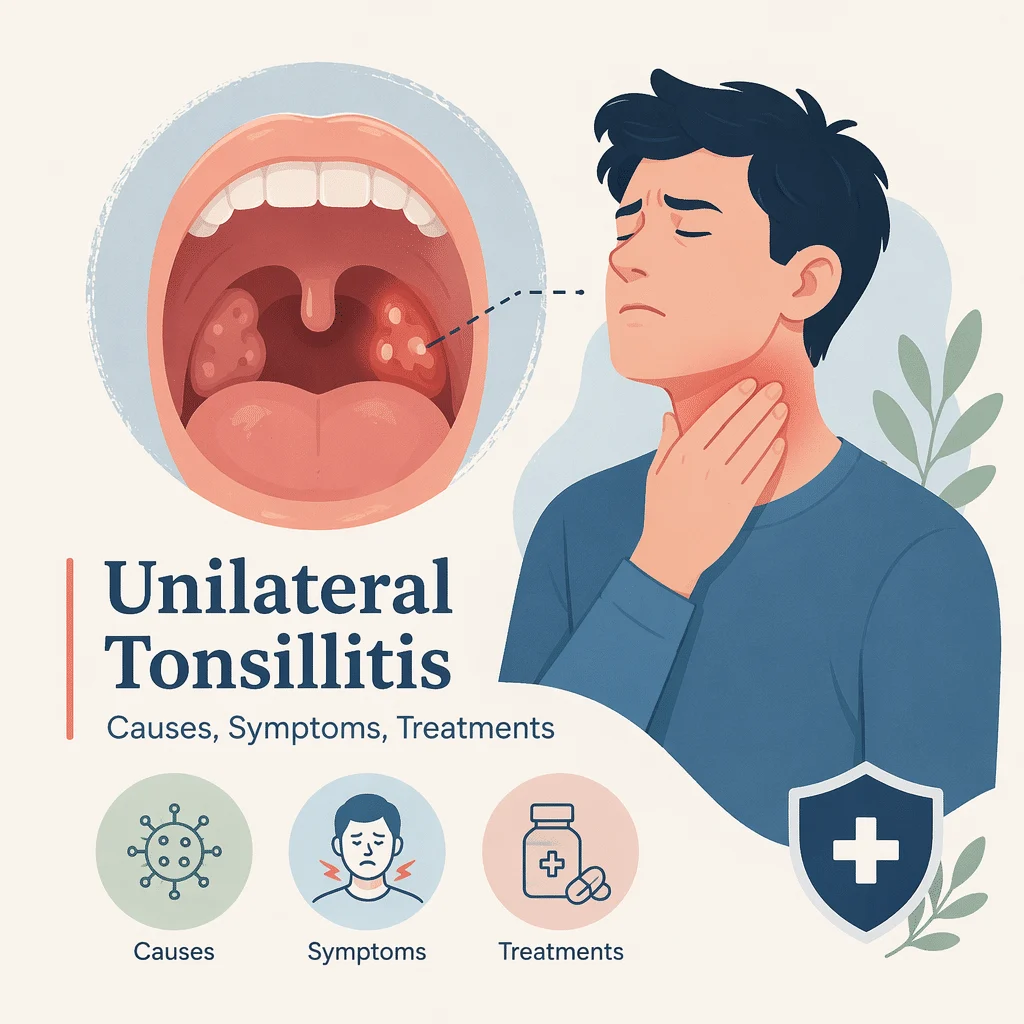
Unilateral tonsillitis is inflammation that affects one tonsil while the other stays normal, and that single detail changes what a doctor looks for. A sore throat on both sides usually points to an ordinary viral or bacterial infection. When only one side hurts, the list of possible explanations widens: a pocket of pus beside the tonsil, a trapped tonsil stone, a long-standing infection inside the tonsil crypts, or, far less often, a growth that needs specialist assessment. Most one-sided sore throats are still ordinary infections that settle within a week or two. In this article you will learn what causes unilateral tonsillitis, which warning signs need same-day care, how doctors tell the possibilities apart, which lab tests help, and when lasting tonsil asymmetry deserves an ear, nose, and throat opinion.
Why unilateral tonsillitis is assessed differently
The palatine tonsils are two pads of immune tissue on either side of the back of the throat. They meet the same air, food, and germs at the same time, so an infection that reaches them usually inflames both. When the inflammation stops at the midline, something is acting on one side only.
What one-sided really tells a clinician
Asymmetry is a signal about mechanism, not about severity. A localized collection of pus, a stone wedged in a single crypt, or tissue growing in one tonsil are all one-sided by nature. A virus circulating in the bloodstream is not. That is why a clinician examining a one-sided sore throat asks a different set of questions: how fast did it start, can you open your mouth fully, has your voice changed, and how long has the difference been there.
Symmetric swelling is a separate problem
Enlarged tonsils on both sides that touch in the middle are a different condition with different causes and a different workup. Our team covers the causes and grading of kissing tonsils. This article deals only with the one-sided picture.
What causes unilateral tonsillitis
Viral infections
Viruses cause most sore throats. They usually affect both sides, but early in the illness one tonsil can look angrier than the other, and pain often feels worse on the side you sleep on or swallow toward. Viral sore throats build over a day or two, come with a runny nose or cough, and settle on their own.
Bacterial infection with group A streptococcus
Strep throat classically brings fever, painful swallowing, red swollen tonsils, and white patches of pus. It can start asymmetrically. According to the Centers for Disease Control and Prevention, strep accounts for roughly 1 in 10 sore throats in adults and 3 in 10 in children, so most sore throats, even convincing-looking ones, are not strep.
Tonsil stones
Tonsilloliths are hardened plugs of debris and bacteria that lodge in a tonsil crypt. A single stone in one crypt produces exactly the pattern people describe: a persistent one-sided irritation, a feeling of something stuck, bad breath, and sometimes a visible white speck. Our guide explains the symptoms of hidden tonsil stones.
Peritonsillar abscess
A peritonsillar abscess, historically called quinsy, is a collection of pus between the tonsil and the muscle wall behind it. It is the most important treatable cause of severe one-sided throat pain, and it is a same-day problem rather than a wait-and-see one. It often follows a sore throat that seemed to be improving and then sharply worsened on one side.
Infectious mononucleosis
Mononucleosis, caused by the Epstein-Barr virus, produces dramatic tonsil swelling, heavy grey-white coating, swollen neck glands, and profound fatigue. The swelling is often lopsided enough to look one-sided at first glance. Mono typically lasts far longer than an ordinary sore throat.
Less common causes
Chronic inflammation of one tonsil, a dental infection tracking backward, a viral ulcer, or an irritated crypt can all sit on one side. Our team also describes the bumpy appearance of cobblestone throat, which patients sometimes mistake for a one-sided infection.
Emergency red flags that need urgent care
The following signs suggest a peritonsillar abscess or a spreading deep-neck infection. They are not reasons to wait until morning. Seek urgent or emergency care if a one-sided sore throat comes with any of them.
- Inability to open the mouth fully, or pain on trying to open it. Clinicians call this trismus, and according to StatPearls it occurs in nearly all peritonsillar abscesses.
- A muffled, thickened voice, often described as a hot potato voice.
- Drooling, or being unable to swallow your own saliva.
- The uvula, the small flap hanging at the back of the throat, pushed over toward the opposite side.
- Severe pain on one side with a high fever.
- Any difficulty breathing, noisy breathing, or a need to sit upright and lean forward to breathe comfortably.
- Swelling of the neck, or pain and stiffness when turning the head.
Difficulty breathing is the highest priority of all. Airway safety is assessed before any scan or blood test.
Telling the possibilities apart
Five features do most of the work in separating the common causes of a one-sided sore throat: how fast it started, whether there is fever, whether the mouth opens normally, whether the voice has changed, and how long it has lasted. The table below is an orientation aid, not a diagnosis.
| Feature | Viral infection | Strep infection | Peritonsillar abscess | Persistent asymmetry |
|---|---|---|---|---|
| Onset speed | Builds over one to two days | Fairly sudden, within a day | Rapid, often worsening over hours after a sore throat | Very slow, noticed over weeks or months |
| Fever | Absent or mild | Often present | Usually present and high | Usually none |
| Opening the mouth | Normal | Normal or mildly sore | Restricted and painful, sometimes nearly impossible | Normal |
| Voice | Normal | Normal or slightly hoarse | Muffled, hot potato quality | Normal |
| Typical course | Settles within five to seven days | Improves within one to two days of antibiotics | Does not settle without medical treatment or drainage | Unchanged for weeks, without infection |
When persistent tonsil asymmetry needs an ENT opinion
This is the question that brings most people to this page late at night, so it deserves a plain answer. A one-sided sore throat that comes with fever and settles within two weeks is an infection. It is persistent, painless enlargement of one tonsil in an adult, with no infection to explain it, that occasionally signals something else, including cancer of the tonsil. Cancers of this area are frequently linked to the human papillomavirus, and the National Cancer Institute lists the tonsils among the sites where oropharyngeal cancer develops. Our guide covers the transmission and prevention of HPV.
Two points keep this in proportion. First, the eye is unreliable: in a multi-center series of tonsils removed for suspected asymmetry, a third of the tonsils that looked larger were not actually larger once measured. Second, in published series of one-sided tonsil enlargement, essentially every case that turned out to be serious had additional warning signs alongside the swelling, rather than swelling by itself.
Arrange a non-urgent ENT assessment if one-sided enlargement is accompanied by any of the following:
- Asymmetry that lasts several weeks with no sore throat or infection to explain it.
- Enlargement that is painless, or that is growing rather than stable.
- A lump in the neck, or a neck gland that does not settle.
- Unexplained weight loss, drenching night sweats, or persistent fevers.
- Ear pain on the same side as the affected tonsil, with a normal ear examination.
- Blood-stained saliva, a white patch, an ulcer, or a visible change in the surface of the tonsil.
- Difficulty swallowing that is worsening, or a change in speech.
Swollen neck glands can accompany ordinary infections and lymphatic conditions alike. This resource describes the early symptoms of lymphoma. Ear pain that travels from the throat is common and usually harmless, but a genuine ear infection looks different on examination; our team explains the signs of a middle ear infection.
Which lab tests help with unilateral tonsillitis
No blood test diagnoses a one-sided sore throat by itself. Tests are used to answer specific questions: is this bacterial, is this mononucleosis, and how much inflammation is present.
Rapid strep test and throat culture
A swab of the tonsil gives a result within minutes. A throat culture takes a day or two and catches cases the rapid test misses. A positive result identifies a sore throat that antibiotics will shorten.
Complete blood count with differential
This test counts the white cells that fight infection and sorts them by type. A rise in neutrophils leans bacterial; a rise in lymphocytes, particularly atypical ones, leans viral and raises the possibility of mononucleosis. Our guide explains how to read a complete blood count, and our team details the causes of high neutrophil counts alongside the meaning of high lymphocyte counts.
Monospot test and EBV serology
The monospot detects antibodies produced during mononucleosis. It can be falsely negative in the first week, so Epstein-Barr virus serology is used when the picture fits but the monospot is negative. Confirming mono matters practically: it changes advice about contact sports and about which antibiotics to avoid.
C-reactive protein
CRP rises with inflammation and falls as it resolves. It does not identify a cause, but a markedly raised level in someone with severe one-sided pain supports a significant bacterial process such as an abscess. This article covers the C-reactive protein inflammation marker in detail.
Imaging
When an abscess is suspected, ultrasound performed at the bedside can confirm a pocket of pus quickly, and a contrast-enhanced CT scan is used when the picture is unclear or a deeper neck space may be involved.
How unilateral tonsillitis is treated
Treatment follows the cause rather than the side.
- Viral sore throats need pain relief, fluids, and rest. Antibiotics do not help and are not prescribed.
- Confirmed strep is treated with a narrow-spectrum antibiotic, usually penicillin or amoxicillin. Symptoms typically improve within a day or two, and the full course is completed regardless.
- A peritonsillar abscess is treated with intravenous antibiotics, pain control, and drainage by needle aspiration or a small incision when a defined collection is present. Most people improve within several days.
- Tonsil stones are usually managed with gargling and gentle dislodging. Repeated stones that cause ongoing symptoms are sometimes treated with a procedure to smooth the crypts.
- Tonsillectomy is considered for frequently recurring infections, repeated abscesses, or obstruction, and diagnostic removal is reserved for asymmetry with warning signs.
Home measures that genuinely help are simple: warm salt-water gargles, cold or soft foods, adequate fluids, and over-the-counter pain relief taken as directed.
Latest scientific advances
Recent research has focused on a practical question: which one-sided tonsils actually need surgery, and which can safely be watched.
Isolated asymmetry, with no other signs, is usually harmless
A 2025 review of seventeen years of children’s tonsil surgery at a UK children’s hospital looked at every child operated on for one-sided tonsil enlargement. Among more than three hundred children, lymphoma was found in about one in eighty, and every single one of those children had other warning signs at the time: a swollen neck gland in all cases, and often a visibly abnormal-looking tonsil, snoring, or difficulty swallowing. What this means for you: isolated one-sided enlargement, with nothing else alongside it, is the pattern the authors recommend watching rather than operating on.
The tonsil that looks bigger often is not
A multi-center study of 323 patients whose tonsils were removed for suspected asymmetry compared what clinicians saw with what was measured afterward. In roughly a third of cases the tonsil judged larger by eye turned out to be the smaller one. Rapid enlargement, rather than enlargement itself, was the feature that tracked with a serious result. What this means for you: an eyeball impression in a bathroom mirror is a weak measurement, and change over time matters far more than a single look.
Throat abscesses have become more common since the pandemic
A study across two US centers found that head and neck abscesses in children, peritonsillar abscesses among them, became roughly three times more common after pandemic restrictions ended than they had been before. This is an early observation from two hospitals rather than a national count, so the size of the rise is still uncertain. What this means for you: severe one-sided throat pain is worth taking seriously, and clinicians are seeing more of these infections than they used to.
Bedside ultrasound is changing how abscesses are confirmed
A 2026 review of deep neck infections in children concluded that ultrasound performed at the bedside is accurate enough to confirm a peritonsillar abscess in most cases, reserving CT scanning for unclear or more complex situations. The review also restates the order of priorities: the airway is assessed first, before any imaging. What this means for you: confirming an abscess often no longer requires a scan, which spares both radiation and time.
Glossary
| Term | Definition |
|---|---|
| Unilateral | Affecting one side of the body only. The opposite, bilateral, means both sides. |
| Palatine tonsils | The two pads of immune tissue visible on either side at the back of the throat. These are the tonsils people mean in everyday speech. |
| Peritonsillar abscess | A collection of pus between a tonsil and the muscle wall beside it. Also called quinsy. It needs same-day medical care. |
| Trismus | Restricted opening of the mouth caused by spasm or inflammation of the chewing muscles. |
| Tonsillolith | A tonsil stone. A hardened plug of debris, cells, and bacteria lodged in a tonsil crypt. |
| Crypt | One of the deep folds in the surface of a tonsil, where debris and bacteria can collect. |
| Otalgia | Ear pain. When it comes from the throat rather than the ear itself, it is called referred otalgia. |
| Cervical lymphadenopathy | Swelling of the lymph glands in the neck, usually a normal response to infection nearby. |
| Oropharynx | The middle part of the throat behind the mouth. It includes the tonsils, the soft palate, and the back of the tongue. |
| Exudate | The white or yellow coating seen on an infected tonsil, made of fluid, immune cells, and debris. |
Frequently asked questions
Is unilateral tonsillitis common?
One-sided throat pain is very common, and a genuinely one-sided infection is a normal variation rather than a rarity. Many two-sided infections also start on one side and even out over a day or two. What is less common is the situation people worry about most: one tonsil that stays visibly enlarged for weeks, without pain and without any infection to explain it. That pattern is uncommon, and it is the one worth having examined rather than watched at home.
Can you have unilateral tonsillitis without a fever?
Yes. Many viral sore throats produce little or no fever, and tonsil stones and chronic crypt irritation typically cause none at all. The absence of fever is reassuring against a spreading bacterial infection, but it does not rule out a tonsil stone or a lasting asymmetry. If a one-sided sore throat has no fever but persists beyond two weeks, it is worth an examination even though you feel otherwise well.
Why does a one-sided sore throat cause ear pain on the same side?
The throat and the ear share nerve pathways, so the brain can misread a signal coming from an inflamed tonsil as coming from the ear on that side. This is called referred pain, and it is one of the most common patterns in one-sided throat problems. The ear itself is usually completely normal on examination. Ear pain becomes more significant when it persists alongside a painless enlarged tonsil rather than alongside an obvious sore throat.
Is tonsillitis contagious when only one side is affected?
It depends entirely on the cause, not on the number of sides involved. Viral and streptococcal infections are contagious and spread through droplets from coughing, sneezing, and close contact. Strep is generally no longer contagious after about 24 hours of antibiotics. Tonsil stones, chronic crypt inflammation, and tonsil asymmetry are not contagious at all, because no transmissible infection is involved.
Can COVID-19 cause a one-sided sore throat?
COVID-19 commonly causes a sore throat, and like other viral infections it can feel worse on one side, especially in the first day or two. On its own, a one-sided sore throat does not distinguish COVID-19 from any other virus. Testing is the only way to tell. The features that would change the plan are the same regardless of which virus is involved: trouble opening the mouth, a muffled voice, drooling, or difficulty breathing.
One tonsil has looked bigger than the other for months. Should I worry?
Long-standing, stable asymmetry with no other symptoms is usually harmless, and research suggests the difference is often smaller than it appears in a mirror. What matters is company and change: an enlarged tonsil accompanied by a neck lump, weight loss, one-sided ear pain, bleeding, or a visible surface change, or one that is clearly growing, should be assessed by an ENT specialist. Stable and symptom-free asymmetry is generally monitored rather than operated on.
Sources
- MedlinePlus, National Library of Medicine — Tonsillitis — https://medlineplus.gov/tonsillitis.html
- Centers for Disease Control and Prevention — About Strep Throat — https://www.cdc.gov/group-a-strep/about/strep-throat.html
- National Cancer Institute — Oropharyngeal Cancer Treatment (PDQ), Patient Version — https://www.cancer.gov/types/head-and-neck/patient/adult/oropharyngeal-treatment-pdq
- Gupta G, McDowell RH — Peritonsillar Abscess — StatPearls, NCBI Bookshelf — https://www.ncbi.nlm.nih.gov/books/NBK519520/
- Nelson A, Bujoreanu I, Gaskin J — Clinical significance and diagnostic approach for paediatric unilateral tonsillar enlargement: insights from a retrospective analysis — Annals of the Royal College of Surgeons of England, 2025 — https://doi.org/10.1308/rcsann.2024.0113
- Edwards D, Sheehan S, Ingrams D — Unilateral tonsil enlargement in children and adults: is routine histology tonsillectomy warranted? A multi-centre series of 323 patients — The Journal of Laryngology and Otology, 2022 — https://doi.org/10.1017/S002221512200216X
- DiBlasi M, Higgins RC, Welch N, Jones D, Chang AJ — Increased Pediatric Head and Neck Abscesses Following the COVID-19 Pandemic — The Laryngoscope, 2026 — https://doi.org/10.1002/lary.70742
- Darawish SM, Shahid MA, Aziz N, et al. — Deep neck space infections in children: peritonsillar, retropharyngeal, parapharyngeal, and Ludwig’s angina emergencies in the pediatric emergency department — American Journal of Otolaryngology, 2026 — https://doi.org/10.1016/j.amjoto.2026.104864
Further reading
- Throat herpes: symptoms, causes, and treatments
- HPV on the tongue: symptoms, risks, treatments
- Sinus infection: symptoms, causes, and treatments
- Sleep apnea: understanding, diagnosis, and treatment
- Erythrocyte sedimentation rate (ESR): understanding this marker
Understand your lab results with AI DiagMe
A one-sided sore throat is often assessed with a throat swab and a few blood tests, and the numbers that come back can be hard to place. AI DiagMe reads your results and explains them in plain language, whether that is a complete blood count showing which white cells are raised, a C-reactive protein level reflecting how much inflammation is present, or antibody testing for mononucleosis. It helps you understand what your results say and what to ask about. It does not diagnose, and it does not replace your doctor.
Get your results interpreted in minutes