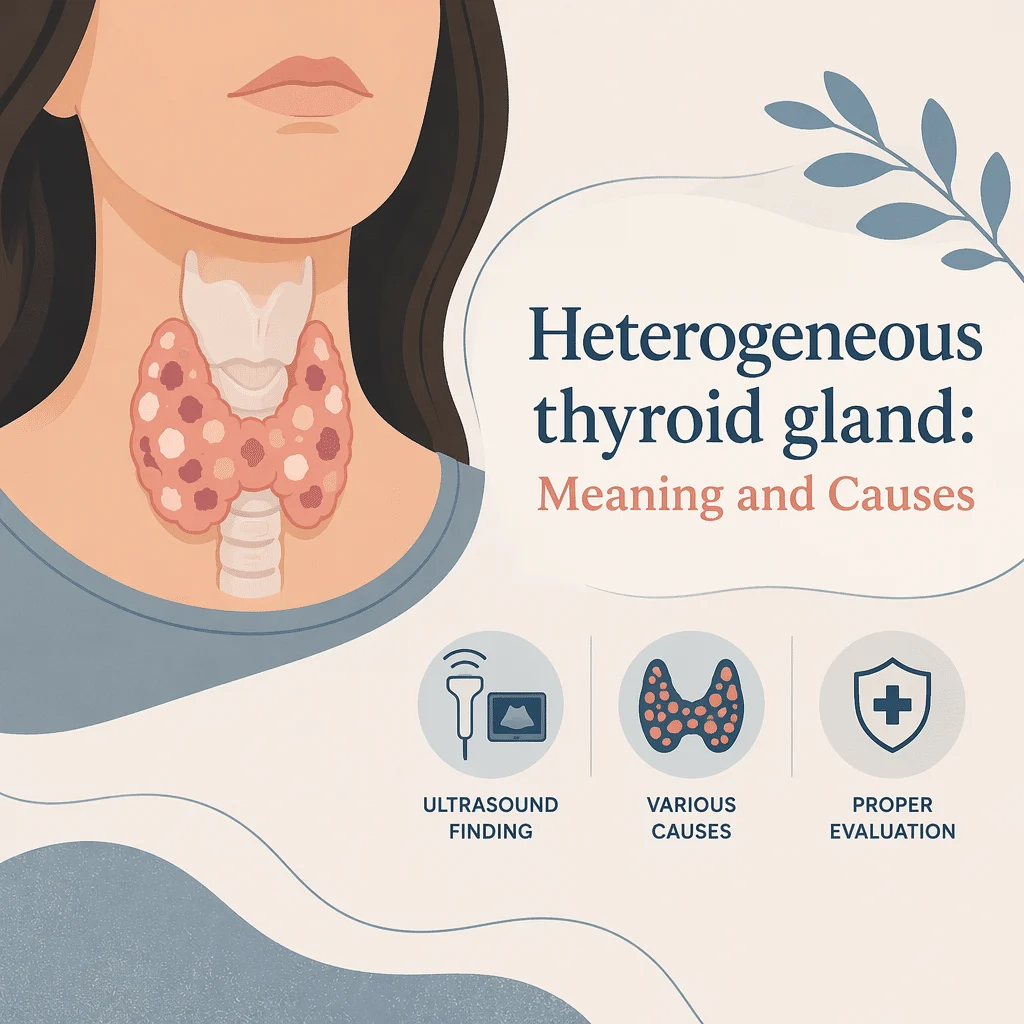
A heterogeneous thyroid is one of those phrases that sends people straight to a search engine, usually within minutes of opening an ultrasound report. Here is the short answer: it describes what the gland looked like on the screen, not what is wrong with you. Radiologists use the word when the thyroid’s texture appears uneven rather than smooth and uniform. It is an observation about an image. On its own it does not name a disease, it does not predict cancer, and it does not call for treatment.
In this article you will learn what the term actually means, which conditions most often explain it, why background texture is not what drives cancer risk, what your doctor usually checks next, and which symptoms genuinely deserve a prompt appointment.
What a heterogeneous thyroid means on an ultrasound report
Ultrasound builds a picture from sound waves bouncing off tissue. Denser structures send back stronger echoes and appear brighter; softer or fluid-filled areas appear darker. The overall pattern of light and dark within an organ is called its echotexture.
A healthy thyroid usually looks homogeneous: an even, slightly bright, fine-grained pattern across both lobes. When that evenness breaks up into patches, bands, darker streaks or a coarser grain, the radiologist writes heterogeneous.
You may see softened versions of the word. Mildly heterogeneous, minimally heterogeneous or slightly coarsened echotexture all describe a small departure from the usual pattern. Diffusely heterogeneous means the change affects the whole gland rather than one spot. These are gradations of appearance, not grades of danger.
Two practical points are worth knowing. First, the description is partly subjective: different radiologists, different machines and different settings can nudge the same gland from “normal” to “mildly heterogeneous”. Second, the word describes the background tissue. It is not the same as reporting a nodule, and it carries none of the meaning that a nodule description carries.
Why a thyroid gland looks uneven: the common causes
Most heterogeneous glands have an explanation that is both common and benign. The list below runs roughly in order of how often each cause turns up.
Chronic autoimmune thyroiditis (Hashimoto’s disease)
Hashimoto’s disease is the classic reason for a diffusely heterogeneous thyroid, and by a wide margin the most frequent. The immune system produces antibodies that gradually infiltrate and remodel the gland, and that remodelling is exactly what shows up as an uneven texture. According to the National Institute of Diabetes and Digestive and Kidney Diseases, Hashimoto’s disease is the most common cause of an underactive thyroid, it runs in families, and it is several times more common in women than in men.
Two things often surprise people. Hashimoto’s can produce a strikingly uneven scan while thyroid hormone levels remain perfectly normal. And because it belongs to a wider group of conditions, some readers will want our overview of autoimmune disease.
Multinodular goiter and ordinary age-related change
Nodules are extremely common. The American Thyroid Association notes that by age 60 roughly half of all people have a thyroid nodule detectable by examination or imaging, and that more than nine in ten of those nodules are benign. Once a gland contains several nodules of different sizes, its overall texture stops looking uniform almost by definition. Reports often call this a multinodular goiter, which simply means an enlarged gland containing more than one nodule.
Iodine, earlier thyroiditis and Graves’ disease
Iodine matters in both directions. Long-standing shortage encourages nodule formation, while sudden excess can disturb the gland. Past episodes of thyroiditis, including subacute thyroiditis after a viral illness and silent or postpartum thyroiditis, can leave a permanently patchy texture behind even after hormone levels return to normal. Graves’ disease, the autoimmune cause of an overactive thyroid, typically produces a coarse, darker gland with busy blood flow.
One caution belongs here. Do not start iodine, kelp or seaweed supplements to “correct” a heterogeneous thyroid. The National Institute of Diabetes and Digestive and Kidney Diseases warns that people with autoimmune thyroid disease can be sensitive to harmful effects from iodine, and that large amounts from seaweed or supplements may cause or worsen an underactive thyroid. Supplement decisions belong with your clinician. The same applies to a selenium blood test, which people with Hashimoto’s often read about but should discuss rather than act on alone.
Why an uneven texture is not a cancer finding
This is the part that matters most, so it deserves plain language: a heterogeneous echotexture, by itself, is not a cancer finding. It is a description of the background tissue, and background tissue is not what cancer risk assessment is built on.
What imaging specialists actually assess is discrete nodules, one at a time, using a specific short list of features. The American College of Radiology’s Thyroid Imaging Reporting and Data System, known as ACR TI-RADS, scores five of them: composition (solid, part-fluid or sponge-like), echogenicity (how bright or dark the nodule is compared with surrounding tissue), shape (whether it is taller than it is wide), margin (whether the edge is smooth, irregular or extends beyond the gland) and echogenic foci (tiny bright dots inside the nodule). The points are added up, the nodule lands in a category, and that category, combined with its size, is what determines whether a biopsy or a follow-up scan is advised. The American Thyroid Association uses a similar feature-based approach in its own guidance.
Notice what is not on that list: the texture of the gland around the nodule. The system was designed to reduce unnecessary biopsies by focusing attention on the nodules that warrant it, and the ACR describes exactly that goal in its published materials.
It follows that you cannot score your own report. The features are judged from live images and stored clips, not from the summary paragraph you were handed, and several of them depend on measurements taken in two planes. If your report mentions a category or a recommendation, take it to the clinician who ordered the scan and ask what it means for you specifically. That conversation is the point; a self-assigned score is not.
Decoding the words in your thyroid ultrasound report
Radiology language is compressed and unfamiliar, which is a large part of why it frightens people. The table below translates the phrases that turn up most often on thyroid scans.
| Phrase in your report | What the radiologist means | Does it usually matter? |
|---|---|---|
| Heterogeneous echotexture | The grey pattern of the gland looks uneven rather than smooth | Common; usually points to autoimmune thyroiditis or nodules, not cancer |
| Homogeneous echotexture | The pattern looks even throughout both lobes | The usual appearance of a healthy gland |
| Coarsened echotexture | The unevenness is chunky rather than fine-grained | Often seen in long-standing autoimmune thyroiditis |
| Hypoechoic | Darker than the tissue around it | Purely descriptive; carries weight only when applied to a distinct nodule |
| Isoechoic or hyperechoic | The same brightness as, or brighter than, surrounding tissue | Generally among the more reassuring nodule descriptions |
| Increased vascularity | Colour Doppler shows brisk blood flow in the gland | Typical of active inflammation and of many benign nodules |
| Multinodular | Several nodules are present rather than one | Very common with age; each nodule is judged on its own merits |
| Spongiform or colloid cyst | A sponge-like or fluid-filled nodule | Among the most reassuring appearances a nodule can have |
| Punctate echogenic foci | Tiny bright dots inside a nodule | One of the scored features; interpretation belongs to your doctor |
| Taller-than-wide | The nodule is deeper than it is broad on a cross-section | Another scored feature, meaningful only alongside the others |
| TR1 to TR5, or TI-RADS 1 to 5 | The summed risk category for one specific nodule | Guides biopsy or follow-up decisions; it never applies to background texture |
| Correlate with thyroid function tests | Please check the blood work alongside this scan | Routine wording on thyroid reports, not a warning |
What usually happens next
An uneven gland almost always prompts blood tests rather than a needle. The first step is measuring thyroid-stimulating hormone (TSH), the pituitary signal that rises when the thyroid is underperforming and falls when it is overactive. If that result is outside the expected range, your clinician will usually add a free T4 measurement, and in suspected overactivity may also request a T3 test.
To explain why the texture changed, clinicians commonly order thyroid peroxidase antibodies (anti-TPO). A positive antibody result alongside a heterogeneous gland points strongly toward Hashimoto’s disease and often ends the diagnostic search. Occasionally, results that do not fit the clinical picture lead to a thyroxine-binding globulin test, because the protein that carries thyroid hormone in the blood can distort total hormone readings. If tests confirm an underactive gland, our dedicated guide explains hypothyroidism.
Many people with a heterogeneous thyroid have entirely normal function and need nothing beyond periodic checks. Where nodules are present, guideline criteria decide the next move: some are biopsied, many are simply re-scanned after an interval, and a large proportion are small enough or reassuring enough that they need neither. Reflex biopsy of every nodule is no longer standard practice, and that shift is deliberate.
The overdiagnosis problem, stated honestly
There is a genuine tension in thyroid imaging, and it is fairer to name it than to hide it. Thyroid nodules are so common that looking hard almost guarantees finding something. Neck ultrasound performed for unrelated reasons, and scans of the chest and neck for other complaints, now uncover enormous numbers of small nodules in people with no symptoms.
Some of those turn out to be small cancers that would never have grown, spread or caused any harm in a person’s lifetime. Detecting and removing them brings surgery, lifelong medication and anxiety without extending life. This is what specialists mean by overdiagnosis, and it is a recognised problem rather than a fringe opinion.
The professional response has been to intervene less, not more: stricter thresholds for biopsy, size cut-offs below which nodules are simply watched, and monitoring offered as a legitimate option even for some confirmed small, low-risk cancers. If your care team recommends waiting and rescanning rather than acting immediately, that is modern practice working as intended.
Red flags and when to see a doctor
Reassurance has to be honest, which means being equally clear about what does need attention. A heterogeneous texture is not the alarm; the features below are.
Arrange medical assessment if you have any of these
- A neck lump that feels hard, does not move when you swallow, or is growing quickly
- New hoarseness or a voice change that does not settle within a few weeks
- Difficulty swallowing, difficulty breathing, or a choking sensation when lying flat
- A neck lump together with enlarged or firm lymph nodes
- A nodule your report describes as suspicious, or one that has clearly grown between scans
- Radiation treatment to the head or neck in childhood, or a family history of thyroid cancer
- Marked symptoms of thyroid over- or underactivity, such as a racing heart, unexplained weight loss or severe fatigue
Seek urgent care for breathing difficulty or a rapidly enlarging neck mass.
Outside those situations, the right next step is an ordinary appointment with the doctor who requested the scan. Bring the full report rather than a remembered phrase, and ask three questions: what caused the texture change, do my blood tests need repeating, and is anything being followed.
Latest scientific advances in thyroid ultrasound
Research indexed in PubMed over the past few years has focused on making thyroid ultrasound more consistent and less likely to trigger unnecessary procedures. Five studies capture where things stand.
Comparing the scoring systems head to head
A team pooled 39 studies covering close to fifty thousand patients and compared six different ultrasound scoring systems using a network meta-analysis, a method that ranks several approaches against each other even when no single study tested them all directly. ACR TI-RADS came out on top for overall diagnostic performance. What this means for you: the category in your report comes from a system that has been measured against real biopsy results, and it grades individual nodules rather than the background of the gland.
How much two radiologists actually agree
A separate systematic review examined inter-rater reliability, meaning how often two readers looking at the same scan place a nodule in the same category. Agreement was moderate rather than excellent, and the authors noted that the underlying studies varied in quality and method. What this means for you: descriptive words on imaging reports carry a margin of interpretation. That is one reason a single term like heterogeneous should not be over-read, and why follow-up scans are ideally done on the same equipment.
Counting the cost of finding too much
A population-based study drawing on cancer registries across 63 countries compared how thyroid cancer diagnoses and thyroid cancer deaths have moved over time. Diagnoses climbed steeply in many countries while deaths stayed low and largely flat, a pattern that points to detection of tumours that were never going to cause harm. What this means for you: something being visible on a scan is not the same as something being dangerous.
Watching instead of operating
A prospective cohort, meaning a group enrolled and then followed forward in time, tracked 200 people with small, low-risk papillary thyroid cancer at a Canadian centre for around six years on average. Most of those who chose monitoring stayed on monitoring, and there were no thyroid cancer deaths and no spread to distant organs. The researchers also recorded one case where a Hashimoto-related heterogeneous background made a nodule hard to measure accurately, which illustrates that uneven texture complicates measurement rather than signalling danger. What this means for you: even a confirmed small cancer does not automatically mean surgery. As a single-centre study of selected patients, its findings need confirmation elsewhere.
Artificial intelligence as an assistant, not a decision-maker
A systematic review of 28 studies involving more than 130,000 patients assessed software that analyses thyroid ultrasound images. The tools separated benign from suspicious nodules well on average, but results differed considerably between studies, many were built on retrospective data, and few were tested on images from hospitals other than the ones that trained them. What this means for you: these systems may eventually make reports more consistent, but today they support the radiologist rather than replace anyone in your care.
Glossary of key terms
| Term | Definition |
|---|---|
| Echotexture | The overall pattern of light and dark that an organ shows on an ultrasound image |
| Heterogeneous | Uneven or mixed in appearance; the opposite of homogeneous |
| Parenchyma | The working tissue of an organ, as distinct from any lumps within it |
| Nodule | A discrete lump within the thyroid, distinguishable from the tissue around it |
| Goiter | An enlarged thyroid gland, whatever the underlying reason |
| Hashimoto’s disease | Autoimmune inflammation of the thyroid, also called chronic lymphocytic thyroiditis |
| ACR TI-RADS | The American College of Radiology system that scores five features of a nodule to guide biopsy decisions |
| Fine-needle aspiration | A thin-needle sample of cells taken from a nodule for examination under a microscope |
| Euthyroid | Having normal thyroid function, regardless of how the gland looks on imaging |
| Overdiagnosis | Detection of a condition that would never have caused symptoms or harm during a person’s life |
Frequently asked questions
Does a heterogeneous thyroid mean cancer?
No. On its own, a heterogeneous echotexture is not a cancer finding, and in the large majority of people it reflects something benign, most often Hashimoto’s disease or the presence of several ordinary nodules. Cancer risk on ultrasound is assessed from the features of individual nodules, not from the texture of the gland behind them. That said, a report can mention both an uneven background and a nodule that needs attention, so the sensible move is to read the whole report with the doctor who ordered it rather than fixing on one word.
Do I need a biopsy if my thyroid is heterogeneous?
Usually not. A biopsy targets a specific nodule, and guideline criteria based on a nodule’s appearance and size decide whether one is warranted. Background texture is not a biopsy trigger. If your scan shows no nodules, or only nodules with reassuring features, blood tests and a repeat scan later are the more likely plan. Where a nodule does meet the criteria, fine-needle aspiration is a short outpatient procedure using a very thin needle.
Can a heterogeneous thyroid go back to normal?
Sometimes. When the unevenness follows a temporary inflammation such as subacute or postpartum thyroiditis, the appearance can settle over months as the gland recovers. When it results from long-standing autoimmune change or established nodules, the structural pattern usually persists. That is not a bad sign in itself: a permanently uneven gland can function perfectly well for decades, and the goal of follow-up is normal hormone levels rather than a normal-looking picture.
What is the difference between a homogeneous and a heterogeneous thyroid?
Homogeneous means the gland shows an even, consistent pattern across both lobes, which is the typical healthy appearance. Heterogeneous means that evenness is interrupted by patches, bands or a coarser grain. The distinction is descriptive and to some degree a judgement call, since machine settings and the individual radiologist both influence where the line falls. Neither word is a diagnosis, and neither predicts how your thyroid is working.
Is a mildly heterogeneous thyroid less serious than a diffusely heterogeneous one?
The two phrases describe extent, not severity. Mildly heterogeneous suggests a small departure from the usual pattern; diffusely heterogeneous means the change involves the whole gland, which is characteristic of autoimmune thyroiditis. Neither wording tells you whether hormone levels are normal, and neither says anything about cancer. Blood tests answer the function question, and any nodule descriptions answer the risk question.
Does a heterogeneous thyroid need to be removed?
No. Surgery is not a treatment for an uneven texture. Thyroid operations are considered for specific reasons, such as a nodule proven or strongly suspected to be cancerous, a gland large enough to press on the windpipe or oesophagus, or overactivity that other approaches have not controlled. Those decisions are made by an endocrinologist or surgeon after full assessment, never on the basis of an echotexture description.
Sources
- National Institute of Diabetes and Digestive and Kidney Diseases (NIDDK). Hashimoto’s Disease.
- American Thyroid Association. Thyroid Nodules.
- American College of Radiology. Thyroid Imaging Reporting and Data System (TI-RADS).
- MedlinePlus, National Library of Medicine. Thyroid Diseases.
- Kim DH, Kim SW, Basurrah MA, Lee J, Hwang SH. Diagnostic Performance of Six Ultrasound Risk Stratification Systems for Thyroid Nodules: A Systematic Review and Network Meta-Analysis. AJR Am J Roentgenol. 2023;220(6):791-803.
- Staibano P, Ham J, Chen J, Zhang H, Gupta MK. Inter-Rater Reliability of Thyroid Ultrasound Risk Criteria: A Systematic Review and Meta-Analysis. Laryngoscope. 2023;133(3):485-493.
- Li M, Dal Maso L, Pizzato M, Vaccarella S. Evolving epidemiological patterns of thyroid cancer and estimates of overdiagnosis in 2013-17 in 63 countries worldwide: a population-based study. Lancet Diabetes Endocrinol. 2024;12(11):824-836.
- Sawka AM, Ghai S, Rotstein L, et al. Long-Term Durability of Active Surveillance of Small, Low-Risk Papillary Thyroid Cancer. JAMA Surg. 2025;160(10):1117-1124.
- Zhan J, Zhang J, Zhu S, Ni L, Zhang C, Hu J. Diagnostic performance of ultrasound characteristics-based artificial intelligence models for thyroid nodules: a systematic review and meta-analysis. Front Oncol. 2025;15:1614603.
Further reading
- Normal thyroid levels and reference ranges
- High TSH symptoms, causes and risks
- Low TSH levels explained
- The autoimmune panel
- The calcitonin blood test
Understand your lab results with AI DiagMe
A thyroid ultrasound almost always arrives with blood work beside it, and the numbers are often the harder part to read. AI DiagMe interprets laboratory results such as TSH, free T4 and thyroid antibodies in plain language, so you arrive at your appointment with better questions.
To be clear about the limits: AI DiagMe does not read or interpret ultrasound images, it cannot tell you what a heterogeneous echotexture means in your case, it does not diagnose or rule out any condition, and it does not replace your doctor.
Get your results interpreted in minutes