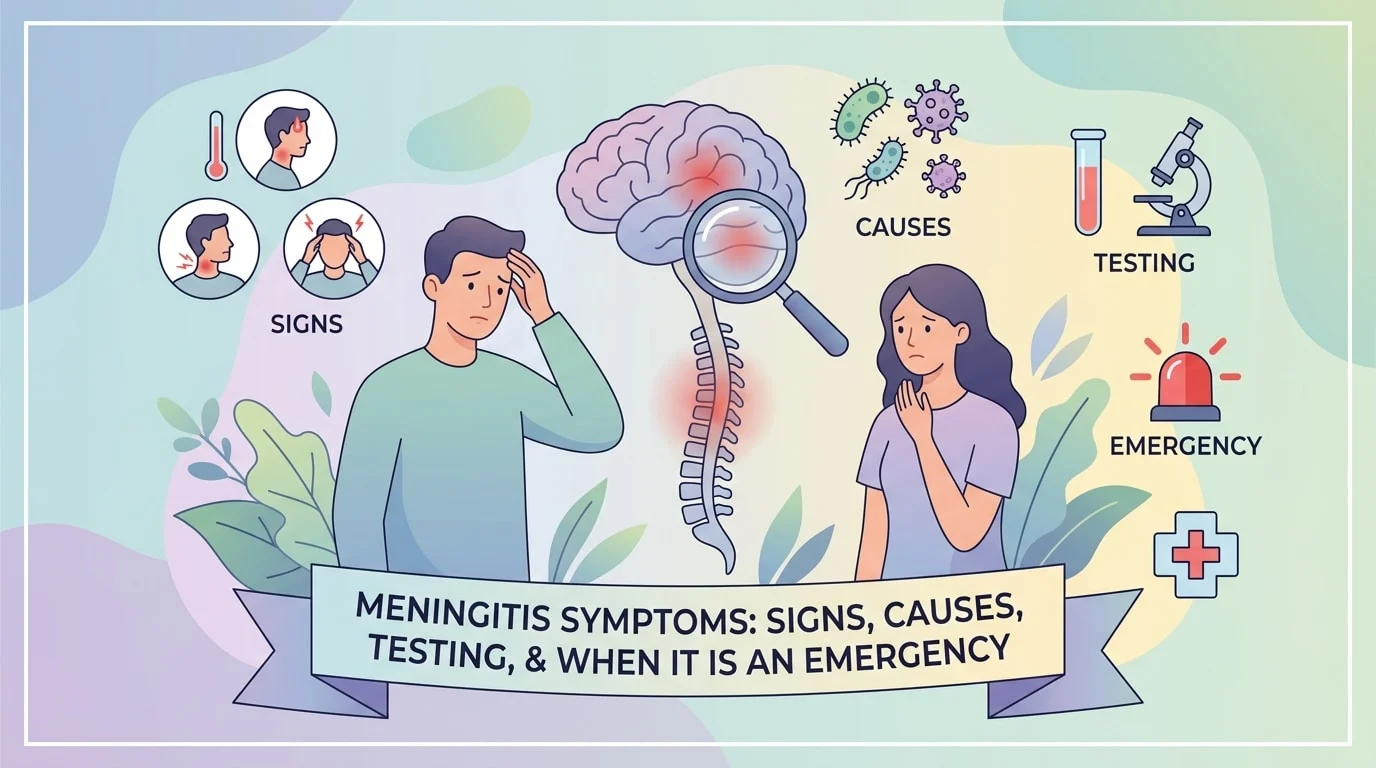
Meningitis symptoms usually start like the flu and then escalate fast, which is why they deserve attention rather than alarm. Meningitis is inflammation of the meninges, the protective membranes that surround the brain and spinal cord, and it can be triggered by viruses, bacteria, fungi, parasites, or non-infectious causes. Most cases in the United States are viral and self-limiting, but bacterial meningitis is a medical emergency that can progress within hours. In this article you will learn how to recognize meningitis symptoms early, how bacterial and viral forms differ, how clinicians confirm the diagnosis with a spinal tap and blood tests, and which laboratory markers help separate a serious infection from a milder one.
What is meningitis, and what are the early meningitis symptoms?
Meningitis means swelling of the lining around the brain and spinal cord. According to the U.S. Centers for Disease Control and Prevention, the classic triad of meningitis symptoms is fever, headache, and a stiff neck, often joined by nausea, vomiting, sensitivity to light (photophobia), and confusion or altered mental status. These meningitis symptoms may build over a few hours or across one to two days, which is part of what makes the condition deceptive in its earliest stage.
The picture looks different in the very young. Newborns and infants may not show a stiff neck at all. Instead, caregivers should watch for a high fever, constant crying, extreme sleepiness or irritability, poor feeding, vomiting, body stiffness, and a bulging fontanelle, the soft spot on the top of a baby’s head. Because young children cannot describe how they feel, any cluster of these changes warrants prompt medical evaluation.
How do you get meningitis, and is it contagious?
How you get meningitis depends on the cause. Many bacteria and viruses that lead to meningitis first cause an ordinary upper respiratory infection, then travel through the bloodstream to the meninges. Bacteria can also reach the lining directly through a nearby focus of infection or after a head injury, which is one reason doctors take seriously an untreated sinus infection or a severe ear infection. Contagiousness varies: meningococcal and several viral forms can spread person to person through saliva, respiratory droplets, kissing, coughing, or sharing drinks and utensils, while fungal and parasitic meningitis generally do not pass between people. People in close contact with someone diagnosed with meningococcal meningitis are usually offered preventive antibiotics.
Bacterial versus viral meningitis: a comparison
The single most important distinction is between bacterial and viral meningitis, because it changes both the urgency and the treatment. Viral meningitis, most often caused by enteroviruses, is usually milder and frequently resolves on its own. Bacterial meningitis, caused by organisms such as Streptococcus pneumoniae, Neisseria meningitidis, Haemophilus influenzae type b, and Listeria monocytogenes, can cause stroke, hearing loss, permanent brain damage, and death without rapid antibiotics. The table below summarizes how the two compare, drawing on guidance from the CDC, Mayo Clinic, and the National Institute of Neurological Disorders and Stroke.
| Feature | Bacterial meningitis | Viral meningitis |
|---|---|---|
| Typical cause | Streptococcus pneumoniae, Neisseria meningitidis, Haemophilus influenzae type b, Listeria | Enteroviruses most often; also herpes, mumps, influenza, West Nile |
| Severity | Medical emergency; can be fatal within days | Usually mild; often resolves without specific treatment |
| Onset | Sudden, can progress over hours | Flu-like, develops over one to two days |
| Cerebrospinal fluid findings | High white cells (neutrophils), high protein, low glucose | Moderately high white cells (lymphocytes), normal or near-normal glucose |
| Treatment | Urgent intravenous antibiotics, sometimes corticosteroids | Supportive care; rest and fluids; antivirals only for specific viruses |
| Contagiousness | Some forms contagious; close contacts may need preventive antibiotics | Many forms spread through droplets and stool |
What causes meningitis beyond infection?
Not every case comes from a germ. The CDC and Mayo Clinic note that meningitis can also follow certain medications, autoimmune and rheumatological diseases, some cancers, and chemical irritation of the meninges. These non-infectious forms still produce inflammation of the lining around the brain, so they can mimic infectious meningitis and require the same careful workup to identify the true cause. Knowing the cause matters because treatment differs sharply depending on whether bacteria, a virus, a fungus, or a non-infectious trigger is responsible.
Meningitis symptoms that signal an emergency
Certain red flags mean you should seek emergency care immediately rather than wait. Bacterial meningitis can cause death within days, and delays raise the risk of lasting brain damage, so it is safer to be evaluated and reassured than to hesitate. Call your local emergency number or go to the nearest emergency department if you or someone you are with develops the following meningitis symptoms.
- A stiff or rigid neck, especially with difficulty touching the chin to the chest
- A high fever together with a severe headache that will not ease
- Marked sensitivity to light (photophobia)
- Confusion, drowsiness, difficulty waking, or seizures
- Repeated vomiting alongside the symptoms above
- A rash of small reddish or purplish spots that does not fade when pressed under a clear glass, sometimes called the glass test, which can accompany meningococcal disease
- In babies: a bulging soft spot, constant high-pitched crying, body stiffness, or being floppy and hard to rouse
The non-blanching rash deserves a plain-language explanation. Press the side of a clear drinking glass firmly against the spots. If they stay visible through the glass rather than fading, that is a warning sign and you should get emergency help without delay. The rash can appear late or not at all, so never wait for it before acting on the other symptoms. If you have a new spreading rash without these danger signs, it still helps to understand the common causes of a skin rash, though a meningitis-related rash is an emergency.
How is meningitis tested and diagnosed?
Because several conditions can imitate meningitis symptoms, diagnosis relies on examining the cerebrospinal fluid that bathes the brain and spinal cord, supported by blood work. NINDS explains that a clinician typically performs a neurological examination, reviews recent exposures and travel, and then orders specific tests. The central test is a lumbar puncture, also called a spinal tap, in which a small sample of cerebrospinal fluid is withdrawn from the lower back and analyzed for white cells, protein, glucose, and the responsible organism. Brain imaging with a CT or MRI scan is sometimes performed first to look for swelling or other findings.
Blood tests run alongside the spinal tap and help gauge how the body is responding to infection. They typically begin with a complete blood count, which can reveal a raised white-cell count, while blood cultures may grow the bacteria responsible. Two inflammation markers are especially useful for separating a likely bacterial infection from a viral one, and both rise when the body fights a serious infection. The first is a C-reactive protein inflammation marker, which clinicians read alongside the spinal-tap results to judge how much inflammation is present.
What do CRP, procalcitonin, and other markers indicate?
C-reactive protein is an acute-phase protein that climbs sharply during bacterial infection and inflammation. Markedly elevated values, alongside the clinical picture, push clinicians toward a bacterial cause and prompt urgent treatment; if you want to dig deeper, our guide reviews the causes of high CRP levels. Procalcitonin is a second blood marker that tends to rise more specifically with bacterial infection than with viral illness, which is why many emergency teams check a procalcitonin infection marker when meningitis or sepsis is suspected.
Cerebrospinal fluid lactate, measured directly in the spinal-tap sample, is another value that tends to be higher in bacterial than viral meningitis. None of these numbers diagnoses meningitis alone; they are interpreted together with the spinal-tap findings, cultures, and the patient’s symptoms. Clinicians may also order an erythrocyte sedimentation rate, a slower-moving inflammation marker, when they want a broader picture of inflammation. For context on the wider panel, it helps to learn how to read general blood test results and which figures fall inside normal blood test ranges.
Latest scientific advances
Research since 2023 has sharpened how clinicians confirm meningitis and prevent it, though much of this work is still being validated. A 2024 systematic review and meta-analysis of diagnostic test accuracy in Clinical Microbiology and Infection pooled 112 studies covering 113 biomarkers in children with suspected central nervous system infection. It reported that cerebrospinal fluid C-reactive protein and procalcitonin discriminated bacterial from viral meningitis with high accuracy, while no single blood marker performed as well on its own. The authors stressed that these markers still need confirmation in prospective studies before they replace established tests.
A separate 2025 meta-analysis in Infection and Chemotherapy examined 22 studies of C-reactive protein in adults. It found that cerebrospinal fluid C-reactive protein outperformed the blood version for confirming bacterial meningitis, with pooled sensitivity of 0.89 and specificity of 0.96. On the laboratory side, a 2024 evaluation in Diagnostics tested a rapid multiplex polymerase chain reaction panel against reference methods on 50 cerebrospinal fluid samples and reported high agreement, suggesting such panels can speed pathogen identification; because the sample was small, larger studies are still needed before broad conclusions.
Prevention is advancing too. A 2024 phase 3 randomized trial in The Lancet Infectious Diseases enrolled 3651 adolescents and young adults and found that a pentavalent MenABCWY vaccine produced immune responses against five meningococcal serogroups that were non-inferior to existing vaccines given separately, which supports a simpler combined schedule. As a single trial in a specific age group, it informs but does not by itself change national vaccination policy.
Glossary
| Term | Definition |
|---|---|
| Meninges | The three protective membranes that surround the brain and spinal cord. |
| Cerebrospinal fluid | The clear fluid that cushions the brain and spinal cord and is sampled to diagnose meningitis. |
| Lumbar puncture | A spinal tap that withdraws cerebrospinal fluid from the lower back for analysis. |
| Photophobia | Discomfort or pain in the eyes when exposed to light. |
| Procalcitonin | A blood marker that tends to rise more with bacterial than viral infection. |
| C-reactive protein | An acute-phase protein that increases during inflammation and bacterial infection. |
| Meningococcal disease | Illness caused by Neisseria meningitidis bacteria, which can but does not always include meningitis. |
| Enterovirus | A common group of viruses that cause most cases of viral meningitis in the United States. |
Frequently asked questions
What is meningitis?
Meningitis is inflammation of the meninges, the membranes surrounding the brain and spinal cord. It can be caused by viruses, bacteria, fungi, parasites, or non-infectious factors such as certain medications and autoimmune disease. Viral meningitis is the most common form in the United States and is usually mild, while bacterial meningitis produces the most dangerous meningitis symptoms and needs emergency care.
How do you get meningitis?
Many cases begin as an upper respiratory infection that spreads through the bloodstream to the meninges. Bacteria can also enter the lining directly after a head injury or from a nearby infection such as a sinus or ear infection. Some viral and parasitic forms are acquired through contaminated surfaces, food, water, or insect bites.
Is meningitis contagious?
Some forms are. Meningococcal meningitis and several viral causes can spread between people through saliva, respiratory droplets, coughing, kissing, or sharing utensils and drinks. Fungal and parasitic meningitis generally do not spread person to person. Close contacts of someone with meningococcal meningitis are often given preventive antibiotics.
What causes meningitis?
Infections cause most cases: enteroviruses for the majority of viral meningitis, and bacteria such as Streptococcus pneumoniae and Neisseria meningitidis for the most serious bacterial forms. Fungi and parasites cause rarer cases, more often in people with weakened immune systems. Non-infectious triggers include some cancers, medications, and inflammatory diseases.
How is meningitis tested and diagnosed?
Doctors confirm meningitis mainly through a lumbar puncture, which samples cerebrospinal fluid for white cells, protein, glucose, and the causative organism. Blood tests such as a complete blood count, C-reactive protein, procalcitonin, and blood cultures support the diagnosis, and a CT or MRI scan may be done to assess swelling. These tests together identify the cause and guide treatment.
Is meningitis fatal, and how serious is it?
It depends on the type. Viral meningitis is rarely life-threatening and most people recover fully. Bacterial meningitis is a medical emergency that can cause death within days and lead to lasting complications such as hearing loss, brain damage, and seizures, which is why rapid treatment is essential. Anyone with warning meningitis symptoms should seek emergency care at once.
Sources
- Centers for Disease Control and Prevention, About Meningitis
- Mayo Clinic, Meningitis: Symptoms and causes
- National Institute of Neurological Disorders and Stroke, Meningitis
- Groeneveld NS, et al. Biomarkers in paediatric bacterial meningitis: a systematic review and meta-analysis of diagnostic test accuracy. Clinical Microbiology and Infection. 2024. doi:10.1016/j.cmi.2024.12.009
- Singh S, et al. Diagnostic Test Accuracy of Serum and Cerebrospinal Fluid C-Reactive Protein in Bacterial Meningitis: A Systematic Review and Meta-Analysis. Infection and Chemotherapy. 2025. doi:10.3947/ic.2024.0139
- Cuesta G, et al. An Assessment of a New Rapid Multiplex PCR Assay for the Diagnosis of Meningoencephalitis. Diagnostics. 2024. doi:10.3390/diagnostics14080802
- Nolan T, et al. Breadth of immune response, immunogenicity, reactogenicity, and safety for a pentavalent meningococcal ABCWY vaccine in healthy adolescents and young adults. The Lancet Infectious Diseases. 2024. doi:10.1016/S1473-3099(24)00667-4
Further reading
- Understand the C-reactive protein inflammation marker
- Learn how the procalcitonin infection marker works
- Review what a complete blood count measures
- See how to read your blood test results
- Find out what happens during the blood test process
Understand your lab results with AI DiagMe
A meningitis workup leans on the laboratory: a spinal tap examines cerebrospinal fluid, while blood tests track how your body is fighting infection. AI DiagMe can help you make sense of the everyday markers that appear on those reports, including a complete blood count that counts your white cells, a C-reactive protein level that flags inflammation, a procalcitonin reading that leans toward bacterial infection, and blood cultures that check for bacteria in the blood. These explanations help you understand your numbers in plain language; they do not diagnose meningitis and do not replace urgent medical care, so always seek emergency help for the red-flag symptoms described above.
Get your results interpreted in minutes