





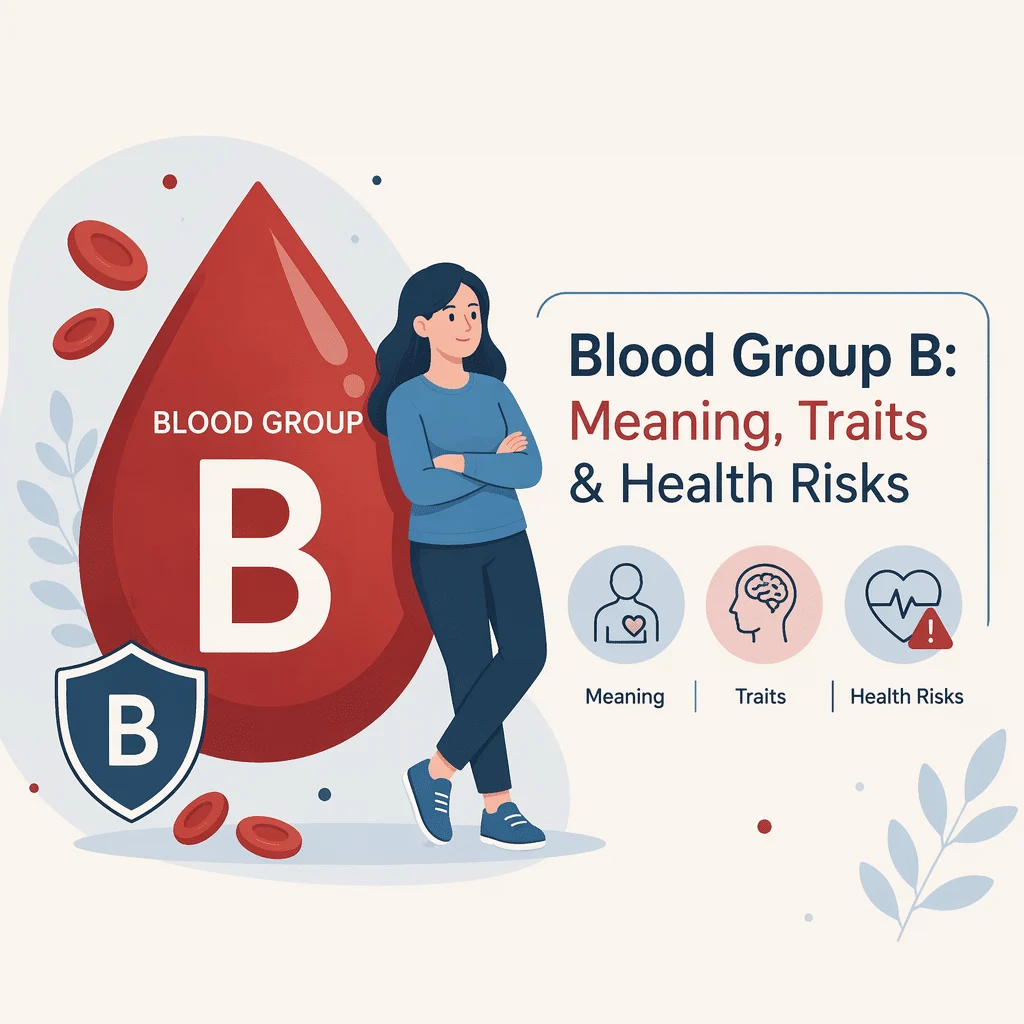
Blood group B is one of the four main ABO blood types, defined by a single marker — the B antigen — sitting on the surface of your red blood cells. If you have type B blood, you probably have questions: Is it rare? Do the “personality traits” linked to it hold up? Which blood can you safely receive? And does your type change your health risks? This guide answers each one in plain language. You will learn how the B antigen forms, how type B is inherited and how common it is, the transfusion rules that keep you safe, what science actually says about blood type “traits,” the modest health associations researchers track, and what blood group B means for pregnancy and testing.
Here is the short version before we go deeper:
- Type B red blood cells carry the B antigen, while type B plasma carries anti-A antibodies.
- About 1 in 11 people in the United States have B-positive blood, and B-negative is much rarer.
- For red cell transfusions, type B can receive B and O blood, matched for the Rh factor.
- The popular idea that blood type shapes your personality is a myth with no solid scientific support.
- Any health “risks” tied to your blood type are small and matter far less than lifestyle and family history.
What blood group B means
Blood group B means your red blood cells display the B antigen, a specific sugar-based marker recognized by your immune system. At the same time, your plasma (the liquid part of your blood) carries anti-A antibodies. Those antibodies are defense proteins that would attack type A cells if they ever entered your bloodstream, which is exactly why transfusions must be matched.
Type B is one piece of the wider ABO blood group system, which sorts everyone into A, B, AB, or O based on which antigens their red cells carry. A second marker, the Rh factor, is then layered on top: if it is present you are B positive (B+), and if it is absent you are B negative (B−).
This combination is not just trivia on a lab report. Your ABO and Rh type guides safe blood transfusions, organ transplants, and pregnancy care. Knowing it can save time in an emergency and prevent dangerous immune reactions. It is also one of the few inherited traits you can state in a single letter, which is part of why it attracts so many myths — from special diets to personality charts — that this guide untangles below.
How the B antigen forms
The B antigen is built by a tiny molecular machine. Your ABO gene carries the instructions for an enzyme called a glycosyltransferase, whose job is to attach a specific sugar to a base structure already present on the red cell surface, known as the H antigen.
In people with blood group B, this enzyme adds a sugar called galactose. That single addition creates the B marker. In type A, a different enzyme adds a different sugar. In type O, the enzyme does not work, so no A or B marker is added and only the underlying H structure remains. That H structure is the foundation every ABO type is built on. In a very rare condition called the Bombay phenotype, the H structure itself is missing, so the B enzyme has nothing to work with and routine typing can be misleading — one reason labs confirm unusual results with extra care.
This is why the difference between blood types comes down to chemistry, not quality. One type is not stronger or healthier than another. The B antigen is simply the result of which sugar your inherited enzyme happens to attach.
How blood group B is inherited and how common it is
You inherit one ABO gene copy, called an allele, from each parent. The A and B alleles are codominant, meaning both show up if you carry them, while the O allele is recessive and stays hidden behind A or B. So a person with blood group B carries either two B alleles (BB) or one B and one O allele (BO).
This explains a question many families ask: two type B parents can have a child who is type O. If both parents are BO, each can pass on the hidden O allele, giving an OO child. It also means you cannot reliably guess your own type from a grandparent’s, because hidden O alleles can pass quietly down the generations. The same logic separates type B from blood group A and from type AB, which carries both A and B alleles.
Type B is a minority blood type in much of the world. In the United States, roughly 9% of people are B positive, and fewer than 2% are B negative. Type B is noticeably more common across parts of Asia, including India and Central Asia, which is one reason blood banks plan their supply around regional patterns. Whether you are B+ or B− depends on the Rh factor, and that distinction becomes important for both transfusions and pregnancy.
Blood group B and transfusion compatibility
Transfusion teams match donor and recipient blood to avoid a reaction in which antibodies destroy the transfused cells. Because your type B plasma contains anti-A antibodies, you must not receive type A or type AB red cells. You can, however, safely receive B and O red cells, matched for your Rh type. Unlike most antibodies, the anti-A in your plasma forms naturally in the first months of life, probably from exposure to similar sugars in everyday surroundings, which is why even a first, never-before-transfused mismatch can trigger a reaction.
The table below summarizes the red cell rules for type B.
| Your blood type | Red cells you can receive | You can donate red cells to |
|---|---|---|
| B positive (B+) | B+, B−, O+, O− | B+, AB+ |
| B negative (B−) | B−, O− | B+, B−, AB+, AB− |
Plasma follows the opposite logic, because plasma carries the antibodies rather than the antigens. Type B plasma can go to B and O recipients. For reference, type O negative is the universal red cell donor, while AB is the universal plasma donor.
In a true emergency, when there is no time to confirm your type, clinicians may give O-negative red cells because they carry no A, B, or Rh markers. Before planned procedures, a lab still performs a crossmatch — a quick test that mixes donor and recipient samples to confirm they are compatible. This is part of the routine blood work before surgery and one reason it helps to know your type in advance. For platelet and plasma transfusions the matching rules differ again, but your blood bank manages those details so the right product reaches the right patient.
Blood type B “traits” and personality: myth versus fact
Many people searching for blood group B are really asking about “traits” in the personality sense. In Japan and several East Asian cultures, a popular belief holds that your blood type shapes your character, with type B often described as creative, independent, and spontaneous. The idea dates back to the 1920s, when Japanese professor Takeji Furukawa proposed it.
The science does not support it. Large, careful studies — including ones using the well-established Big Five personality model — have failed to find any reliable link between ABO blood type and personality. The few positive findings do not repeat across different groups, which is a classic warning sign of a false pattern. Researchers classify the blood type personality theory as pseudoscience.
There is also a reason to be especially skeptical. Historians note that the theory gained traction partly in reaction to an early European claim that type B people were biologically “inferior” — a baseless and prejudiced idea. Sorting people by blood type tells you nothing about who they are.
One more point clears up frequent confusion. The “Type B personality” you may have heard about — the calm, relaxed style contrasted with the driven “Type A” — comes from a 1950s heart-health concept and has nothing to do with having blood group B. The only true “traits” of type B are biological: the B antigen, your anti-A antibodies, and the compatibility rules that follow from them.
Blood group B and health risks: what the research actually shows
It is fair to be curious about health risks, but the honest answer is that your blood type is a very small factor. Researchers have spotted statistical patterns across ABO types, yet these describe groups, not individuals, and they rarely change everyday medical advice.
The clearest signal involves blood clotting. People with non-O blood types — A, B, and AB — tend to carry higher levels of two clotting proteins, von Willebrand factor and factor VIII. Large population studies link this to a modestly higher chance of venous clots, such as a deep vein thrombosis or pulmonary embolism, compared with type O. The increase is real but small, and a clotting picture is far better assessed with a coagulation panel and your personal history than with your blood type.
Some studies also report slightly higher rates of certain arterial events and a few cancers, including pancreatic cancer, in non-O groups. Again, the effects are modest and not destiny. Researchers have also explored whether ABO type nudges susceptibility to some infections, since certain bacteria and viruses interact with these sugar markers, but the findings are mixed and do not change how anyone is screened or treated. Type O is not risk-free either: it tends to mean lower clot risk but a somewhat greater tendency to bleed. Every type carries trade-offs.
The practical takeaway is reassuring. Blood pressure, smoking, weight, physical activity, cholesterol, and family history shape your health far more than whether you are type B. Standard prevention applies to everyone, regardless of blood group.
Blood group B, pregnancy, and your baby
Prenatal care routinely includes ABO and Rh typing early in pregnancy, as part of the standard blood tests during pregnancy. This helps your care team plan ahead and watch for two separate issues.
The first is ABO incompatibility. If a baby inherits a different ABO type from the mother, the mother’s antibodies can cross to the baby and cause a usually mild form of hemolytic disease of the newborn, often seen as jaundice in the first days of life. This is most common when the mother is type O, and for a type B mother it is uncommon and generally mild. During pregnancy, an antibody screen checks whether the mother has formed antibodies that could affect the baby; after birth, doctors watch the newborn’s bilirubin, the pigment behind jaundice, and use light therapy if it climbs. Clinicians monitor newborn jaundice and treat it when needed.
The second issue is Rh incompatibility, which follows a completely different path. It can occur when an Rh-negative mother carries an Rh-positive baby, and it is prevented with a targeted injection of Rh immunoglobulin during and after pregnancy. A B-positive mother is Rh positive and not at risk on this front. A B-negative mother, however, should make sure her care team knows, so the Rh system is managed correctly.
How blood type B is tested, and when it matters most
Labs confirm blood group B with two complementary checks. In forward typing, your red cells are mixed with reagents containing anti-A and anti-B; type B cells react with the anti-B reagent. In reverse typing, your plasma is tested against known A and B cells to confirm the antibody pattern. Point-of-care kits can give fast answers, and if a result is unclear, labs can read the ABO gene directly. Note that blood typing is a separate test from a complete blood count (CBC), which measures your cells rather than your antigens. Before a transfusion, hospitals often run a type-and-screen to confirm your ABO and Rh type and look for unexpected antibodies, then a crossmatch if blood will actually be given. A type you state from memory is always re-checked, because a labeling or recall error at this step can be dangerous.
Newborns are a special case. Babies have not yet made their own ABO antibodies, so reverse typing is unreliable in the first months, and clinicians lean on the antigen test and, sometimes, the parents’ types.
Your blood type matters most in a handful of clear situations. It is worth knowing and recording before the following:
- Any planned transfusion or operation, where the lab confirms your type during the blood work before surgery.
- Pregnancy, so ABO and Rh issues can be managed early.
- Emergencies, where carrying your type on a card or phone can save time.
- Organ or blood donation, where compatibility is essential.
A few simple steps put you in control: keep a digital or physical note of your type, tell care teams before scheduled procedures, check local demand if you donate, and keep up with routine screenings. And when a result leaves you unsure, it helps to know how to read your blood test results so you can ask better questions.
Glossary
| Term | Definition |
|---|---|
| ABO blood group system | The main system that sorts blood into A, B, AB, or O based on antigens on red blood cells. |
| Antibody | A blood protein that recognizes and binds to a specific foreign marker. Type B plasma contains anti-A antibodies. |
| Antigen | A marker on a cell surface that the immune system can recognize. The B antigen defines blood group B. |
| Crossmatch | A lab test that mixes donor and recipient blood to confirm they are compatible before a transfusion. |
| Factor VIII | A protein that helps blood clot. Levels tend to be higher in non-O blood types. |
| Glycosyltransferase | The enzyme that attaches a sugar to red cells to create the A or B antigen. |
| Hemolytic disease of the newborn (HDN) | A condition in which a mother’s antibodies break down a baby’s red cells, often causing mild jaundice. |
| Rh factor | A second red cell marker that makes blood positive (present) or negative (absent), as in B+ or B−. |
| von Willebrand factor (VWF) | A clotting protein linked to ABO type; non-O groups tend to have higher levels. |
Frequently asked questions
Is blood type B rare?
It is a minority type. In the United States, about 9% of people are B positive, and fewer than 2% are B negative, which makes B-negative one of the less common types. Frequencies vary widely by ancestry and region, and type B is more common in parts of Asia. Rarity mainly matters for blood supply: because B-negative donors are scarce, blood centers work to keep enough on hand for patients who need it.
Can my blood group B change during my life?
No. Your ABO type is set by the genes you inherit at conception and stays the same for life. The rare exceptions involve a bone marrow or stem cell transplant, where new donor cells can shift the type over time, or certain serious illnesses and cancers that temporarily alter how blood cells are made. For everyday purposes, you can treat your blood group B as permanent.
Can two parents with blood group B have a baby with a different blood type?
Yes. Many people with type B carry one B allele and one hidden O allele. If both parents pass on the O allele, their child will be type O, even though both parents are type B. This is normal genetics and not a cause for concern. A child’s type can be B or O when both parents are type B, depending on which alleles they pass on.
Is the “blood type B diet” backed by science?
No. The idea that each blood type should follow a specific diet is not supported by good evidence. Studies that tested these diets found that any benefits came from the diet being healthier overall, not from matching it to a blood type. There is no need to choose foods based on having blood group B. The usual advice — plenty of vegetables, whole foods, and balance — applies to everyone.
Does blood group B raise my risk of blood clots or heart disease?
Slightly, at most. Non-O blood types, including B, are linked to modestly higher levels of clotting proteins and a small increase in venous clot risk compared with type O. The effect is minor and does not, on its own, mean you will have a problem. Your weight, blood pressure, smoking status, activity level, and family history influence your risk far more, and those are what to focus on.
Do I need to do anything special day-to-day because I have type B?
Not really. Having blood group B does not call for a special diet, supplements, or extra worry. The main value is practical: know your type, keep it on record, and share it before surgery, during pregnancy, or in an emergency. Beyond that, the same healthy habits and routine checkups recommended for everyone are exactly what serve you best.
Sources
- B Blood Type (B positive and B negative facts) — American Red Cross
- Blood Types: Differences, Rarity and Compatibility — Cleveland Clinic
- Blood Safety and Matching — American Society of Hematology
Further reading
- Blood Groups Explained: Types, Risks, and Testing
- Understanding the Rh System: Causes and Risks
- Blood Group A: Understanding Traits and Risks
- Blood Type O: Meaning, Risks and Benefits
- Blood Type AB: Meaning, Traits and Health Risks
Understand your lab results with AI DiagMe
Knowing your blood group B is a useful start, but most lab reports go far beyond your type — covering your blood count, clotting tests, and many other values that are easy to misread. AI DiagMe turns those results into clear, plain language, highlighting what stands out so you can have a more focused conversation with your doctor. It helps you understand your results; it does not diagnose, and it never replaces your physician’s judgment.
➡️ Get your results interpreted in minutes