





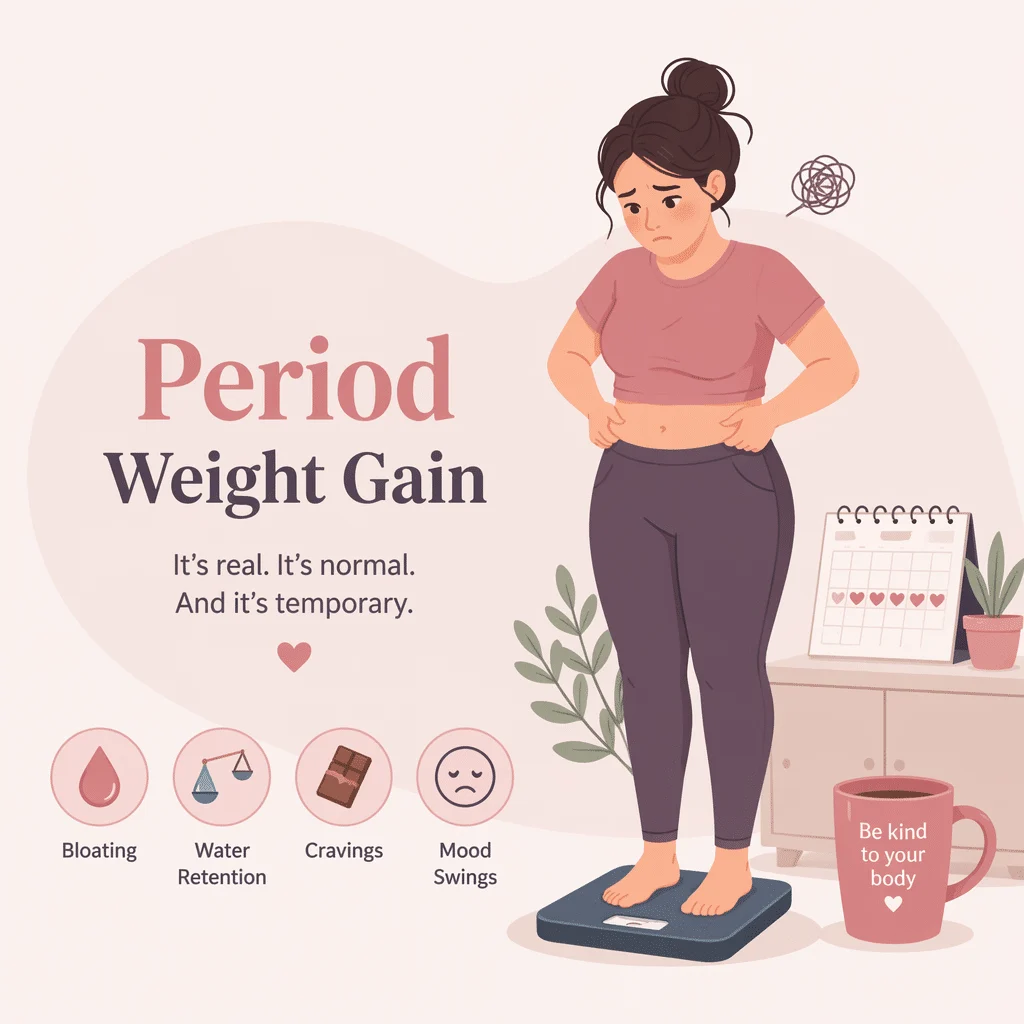
Period weight gain is one of the most searched and least well explained experiences in women’s health, so here is the short version first: it is fluid, not fat. In the days before your period and around the time bleeding starts, shifting hormones change the way your kidneys handle salt and water, and your body holds on to a little more of both. The number on the scale moves. What your body is actually made of does not.
In this article you’ll learn what is really happening during those days, why gaining real fat that quickly is physiologically impossible, why bloating and the scale are two separate experiences, why appetite genuinely rises in the second half of your cycle, how ordinary premenstrual symptoms differ from PMDD, and how to spot the rare situations worth raising with a doctor.
What is actually happening in your body before a period
Your cycle has two halves. In the first, the follicular phase, an egg matures. After ovulation comes the luteal phase, the roughly two weeks ending when your period starts, during which progesterone rises and estrogen follows a second, smaller peak before both drop away.
Those hormones do more than manage the uterine lining. They also influence the system that tells your kidneys how much sodium to keep and how much to pass into urine. When more sodium stays in the body, water follows it, because water moves toward salt. That extra water sits in the spaces between your cells, in the abdomen, hands, feet, face and breast tissue.
The result is a small, temporary rise in body weight, for most people on the order of a couple of pounds and occasionally a little more. It usually peaks in the last days before bleeding or the first day or two of the period, then resolves on its own within a few days as hormone levels reset. Nothing has to be done to make that happen. If you have ever watched the same two or three pounds appear and disappear at the same point every month, you have been watching fluid.
Why period weight gain is fluid, not fat
This is the part that almost never gets said plainly, so we will say it plainly. Building body fat is slow, and requires a sustained energy surplus over weeks. Adding two or three pounds of actual fat tissue in the space of two or three days is not something the human body can do. It is not a matter of willpower or metabolism or bad luck. It is physiologically impossible.
Water, by contrast, is heavy and moves fast. A single liter weighs about two and a quarter pounds, and your body can hold or release that much within a day without anything being wrong. Premenstrual weight appears quickly, sits for a few days and leaves quickly, which is exactly the behavior of fluid and exactly not the behavior of fat.
| What you notice | What it usually is | What to do |
|---|---|---|
| A couple of pounds up in the days before your period | Fluid held in the tissues as estrogen and progesterone shift | Nothing. It settles within days of bleeding starting |
| You feel bigger but the scale has barely moved | Distension from slower gut transit, which changes shape not weight | Comfort measures if you want them. It passes with the cycle |
| Rings tight, ankles puffy, breasts tender | The same fluid shift, in the hands, feet and breast tissue | Expected. Mention it if it is painful or new for you |
| Weight that never comes back down after your period | Not cyclical, and not explained by the menstrual cycle | Raise it with a doctor, who can look for other explanations |
| Severe mood symptoms the same week every month | Possibly PMDD, a distinct condition that responds to treatment | Record symptoms across two cycles and take that to a clinician |
Bloating and the scale are two different experiences
Period weight gain and period bloating overlap, but they are driven by different mechanisms and can happen independently. Progesterone relaxes smooth muscle throughout the body, including the wall of the intestine. When gut motility slows, food and gas move through more slowly, producing abdominal distension, a gassy or full feeling, and constipation, sometimes followed by looser stools once bleeding begins. If that swing is familiar, our guide to period diarrhea and the bowel changes that come with menstruation covers it in detail.
This matters because distension changes your shape without changing your weight. Your waistband can feel tighter while the scale reads exactly what it read last week. Many people assume bloating must correspond to pounds gained. Often it does not.
Alongside the abdomen, fluid gathers where it is easy to notice: fingers, so rings feel snug; ankles, especially by evening; and the breasts, which can become tender and heavier. All of it belongs to the same physiological event.
Appetite and cravings in the luteal phase are real, not a lack of willpower
An enormous amount of internet content treats premenstrual hunger as a discipline problem. It is not. The luteal phase is a metabolically different state from the first half of the cycle, and appetite reflects that.
The amount of energy your body uses at rest tends to run modestly higher after ovulation than before it. Appetite genuinely increases for many people, and food can become more appealing, more noticeable and harder to ignore. Wanting more to eat in the week before your period is a physiological signal, not a character flaw, and eating in response to it is not a failure of self-control. You have not let yourself go, and you do not owe anyone an explanation.
Two things often get tangled together here. Extra food eaten over a handful of days is not what moves the scale during your period; the fluid shift described above is far faster and far larger than anything eating could produce on that timescale. The hunger is real, and the weight is still water.
For some people, cyclical changes in weight, appetite and body shape are genuinely distressing, particularly if the relationship with food or with the scale has been difficult in the past. If that describes you, you are not being oversensitive, and this is worth mentioning to a clinician you trust. Support exists, and it works better when someone knows what you are dealing with.
When it is PMS, and when it might be PMDD
Premenstrual syndrome
Premenstrual syndrome, or PMS, describes the physical and emotional changes that appear after ovulation and ease within a few days of a period starting. The great majority of people who menstruate report at least some premenstrual symptoms, and for most they are mild. Bloating, tender breasts, headaches, tiredness, appetite changes and shifts in mood are all part of the familiar picture, and none require treatment if they are not bothering you.
Premenstrual dysphoric disorder
Premenstrual dysphoric disorder, or PMDD, is something else. It is a distinct, diagnosable condition affecting a small minority of people who menstruate, defined by severe mood symptoms rather than physical ones: marked irritability or anger, hopelessness, tension, panic, feeling out of control, and sometimes thoughts of self-harm. Symptoms appear in the week or two before bleeding, lift within a few days of the period starting, and repeat month after month.
PMDD is badly under-recognized. People live with it for years assuming it is just how they are, without knowing it has a name, a diagnosis and effective treatments. Diagnosis rests on tracking symptoms day by day across at least two cycles, and that record is the most useful thing you can bring to an appointment.
What makes cyclical swelling more noticeable
The underlying hormonal shift is the same for everyone, but several ordinary circumstances make the fluid more obvious. None of these are things you have done wrong.
How much salt happens to be in what you are eating influences how much water your body holds, so a period coinciding with saltier meals often feels puffier. Heat matters too: warm weather dilates blood vessels and encourages fluid to pool, which is why premenstrual ankle swelling is more noticeable in summer. Long stretches of sitting or standing let fluid gather in the legs through gravity, and air travel combines several of these at once. Some hormonal contraceptives soften or sharpen premenstrual fluid retention, so mention it to whoever prescribes yours if the pattern changed when you started or switched methods.
What is not period weight
Cyclical fluid retention has a signature: it arrives, peaks around the period, and resolves. When weight does something different, the menstrual cycle is no longer the explanation, and that is the useful boundary. Weight that climbs month on month without returning to a baseline is not period weight, and neither is swelling that never goes away between cycles. Neither is cause for alarm on its own, but both are reasons to talk to a doctor.
Thyroid and hormonal conditions
An underactive thyroid slows metabolism and can produce steady weight change, tiredness, cold intolerance and puffiness unrelated to the calendar; a TSH blood test is usually where a doctor starts. Polycystic ovary syndrome is another consideration alongside irregular cycles, acne or unwanted hair growth, and that assessment may include measuring testosterone levels in women. Raised prolactin can disturb cycles too, and clinicians often read luteinizing hormone and follicle-stimulating hormone together. If cycles have become unpredictable, our guide to a positive ovulation test result explains tracking. If a period has not arrived at all, see our article on a period that is five days late.
Less common but important causes
Rarely, persistent swelling reflects a problem with the heart, kidneys or liver rather than hormones. The distinguishing features are that it is not cyclical, affects both legs, leaves a dent when pressed, or comes with breathlessness. Such cases are uncommon, but they are why the red flags below are worth knowing. Heavy periods sustained over months can deplete iron stores, and a low ferritin level is a common finding. Persistent stress affects cycles too, and a doctor may consider cortisol.
Living through the swollen days more comfortably
There is no protocol here, and nothing below is a treatment for weight. These are simply things people find make the premenstrual days easier to sit inside. Gentle movement, in whatever form you already enjoy, tends to feel better than stillness when fluid is pooling in the legs. Clothes that do not press on your waist make distension far less noticeable, and a few looser things you like wearing mean those days need not start with a fight in front of the wardrobe. Warmth soothes cramping and the heavy feeling low in the abdomen. Rest is not indulgence.
On weighing: stepping on the scale daily in the premenstrual days mostly produces anxiety, because it captures a fluid shift and presents it as something else. If you do weigh yourself for a specific reason, doing so at the same point in your cycle each time avoids misreading a normal fluctuation as a change in your body. That is about less upsetting information, not closer monitoring.
Some people find persistent premenstrual symptoms improve once an underlying deficiency is addressed. Magnesium deficiency is one a clinician can assess rather than guess at, and the way your body handles sodium sits at the center of cyclical fluid retention.
When to see a doctor about a change in weight
Most cyclical weight change needs no medical attention. The situations below are different, and worth acting on rather than waiting out.
Contact a doctor if you notice any of the following.
- Weight that continues to rise between periods and does not resolve after bleeding ends
- Swelling of both legs that leaves a dent when you press it with a finger
- Breathlessness, especially when lying flat or on mild exertion
- Swelling together with a noticeable drop in how much you are passing urine
- Severe mood symptoms each month, including hopelessness or thoughts of harming yourself, which warrant a prompt appointment because PMDD can be serious and is treatable
- Periods so heavy or so painful that they interfere with work, school or daily life
If you are ever thinking about harming yourself, reach out to a clinician or emergency service straight away. That is not something to wait out until your period arrives.
Latest scientific advances in understanding cyclical weight changes
Research on premenstrual symptoms has moved noticeably in recent years, partly because large symptom-tracking datasets now make it possible to study what people actually experience rather than what they recall. The studies below were identified through PubMed.
A clinical guideline for premenstrual disorders
What was found: in 2023 the American College of Obstetricians and Gynecologists published a clinical practice guideline covering both PMS and PMDD, weighing the evidence behind hormonal and non-hormonal medicines, psychological therapy and patient education (DOI).
What this means for you: premenstrual disorders are a legitimate clinical topic with graded, evidence-based options, not something you are expected to absorb quietly.
How common PMDD really is
What was found: a 2024 systematic review and meta-analysis in the Journal of Affective Disorders pooled dozens of studies and found that PMDD affects a small minority of people who menstruate, and that estimates run considerably higher when diagnosis is provisional, based on a questionnaire, than when confirmed by tracking across two cycles (DOI).
What this means for you: a screening questionnaire can suggest PMDD but cannot confirm it. A daily record across two full cycles is what turns a suspicion into a diagnosis.
Which premenstrual symptoms people report most
What was found: a 2025 cross-sectional study in BJOG surveyed tens of thousands of women across Brazil. Emotional symptoms such as anxiety, irritability and anger were reported more often than physical ones, and among physical symptoms, weight gain and edema, meaning visible fluid swelling, were reported most (DOI).
What this means for you: if the premenstrual scale reading and the puffiness are what you notice most, you are in the majority.
Gut symptoms and mood move together across the cycle
What was found: a 2024 study in Hormones and Behavior analyzed more than thirty thousand menstrual cycles logged in a tracking app. Gastrointestinal symptoms including bloating, constipation and nausea were reported significantly more often in the luteal phase, in people with and without PMS alike, and gut and mood symptoms rose and fell together (DOI).
What this means for you: premenstrual bloating is measurable rather than imagined, and feeling low and feeling bloated in the same week is a recognized pattern, not a coincidence.
Energy use, appetite and cravings across the cycle
What was found: a 2025 study in Appetite measured resting metabolic rate by indirect calorimetry, meaning direct measurement of energy use at rest, alongside weighed food intake. Resting energy use tended to run higher in the mid-luteal phase, though in this small group the difference did not reach statistical significance (DOI). Separately, a 2025 study in the Journal of Nutritional Science found that women with PMS reported markedly stronger responsiveness to food cues and stronger cravings in the luteal phase (DOI).
What this means for you: premenstrual hunger is well documented, and more pronounced in people with PMS. Nothing here supports the idea that wanting to eat more before your period is a failure of discipline.
Frequently asked questions
How much weight do you gain on your period?
Most people who notice a change see something on the order of a couple of pounds, occasionally a little more, appearing in the last days before bleeding and settling within a few days after it starts. That figure is fluid held in the tissues, not tissue added to your body. Because it depends on how your kidneys are handling sodium that week, it varies from person to person and from cycle to cycle in the same person. Some people notice nothing at all. There is no target number here and no amount that is too much, provided the pattern resolves after your period.
Is period weight gain fat or water?
Water. Body fat is built slowly, over weeks of sustained energy surplus, and cannot appear in the two or three days before a period no matter what you eat. Fluid, by contrast, can shift by a pound or two within a day, because water follows sodium and hormones change how much sodium your kidneys keep. The speed of the change is itself the clue: anything that arrives in days and leaves in days is fluid.
When does period weight go away?
Usually within a few days of bleeding starting, and almost always within the first week of your period. Once estrogen and progesterone fall at the end of the luteal phase, the hormonal signal telling your kidneys to hold sodium eases, and the extra water leaves on its own. You do not have to do anything to bring this about. If the weight has not returned to its usual level by the time your period ends, and that keeps happening cycle after cycle, that is the pattern worth mentioning to a doctor.
Why do I weigh more on my period than before it?
For most people the peak sits in the final premenstrual days or the first day or two of bleeding, so weighing on day one or two catches the fluid at its highest point. Bowel changes can add to it, since slowed transit in the luteal phase means more sits in the gut at any given moment. Both effects are temporary. Comparing a reading taken on day two of your period with one taken mid-cycle is comparing two different hormonal states, not two different bodies.
Can birth control change premenstrual fluid retention?
It can, in either direction. Because hormonal contraceptives alter the estrogen and progestogen signals that drive sodium handling, some people find premenstrual swelling becomes less noticeable on a given method and others find it becomes more so. The type of progestogen matters, and individual responses vary a great deal. If your pattern changed clearly when you started, stopped or switched a method, that is useful information for whoever prescribes it, and a reason to ask about alternatives rather than to assume nothing can be done.
Do I need a blood test for period weight gain?
Not for cyclical fluid retention on its own. There is no blood test that measures premenstrual water retention, and a normal cyclical pattern does not need investigating. Testing becomes useful when the pattern is not cyclical, or when other symptoms point somewhere specific: a thyroid check if there is persistent tiredness and steady weight change, iron studies if periods are heavy, or hormone tests if cycles have become irregular. Your doctor decides which, if any, are worth doing. AI DiagMe does not diagnose PMS or PMDD, and no blood test can.
Glossary
| Term | Definition |
|---|---|
| Luteal phase | The second half of the menstrual cycle, from ovulation until your period begins, when progesterone is at its highest |
| Follicular phase | The first half of the cycle, from the start of your period until ovulation, while an egg matures |
| Progesterone | A hormone that rises after ovulation, prepares the uterine lining and relaxes smooth muscle, including in the intestine |
| Estrogen | A hormone that varies across the cycle and influences, among many other things, how the kidneys handle sodium |
| Fluid retention | Extra water held in the spaces between cells, which raises body weight temporarily without changing body composition |
| Edema | Visible swelling caused by fluid collecting in tissue, most often noticed in the ankles, fingers or face |
| Bloating | A feeling of abdominal fullness or pressure, often with visible distension, driven by gut contents and gas rather than by weight |
| Gut motility | The speed at which the intestine moves its contents along, which slows in the luteal phase |
| PMS | Premenstrual syndrome, the common cluster of physical and emotional changes appearing after ovulation and easing once a period starts |
| PMDD | Premenstrual dysphoric disorder, a distinct and treatable condition defined by severe premenstrual mood symptoms, diagnosed by prospective tracking across two cycles |
| Resting metabolic rate | The energy your body uses at rest, which tends to run slightly higher in the luteal phase |
Sources
- Office on Women’s Health, U.S. Department of Health and Human Services. Premenstrual syndrome (PMS)
- Office on Women’s Health, U.S. Department of Health and Human Services. Premenstrual dysphoric disorder (PMDD)
- MedlinePlus Medical Encyclopedia, U.S. National Library of Medicine. Premenstrual syndrome
- Eunice Kennedy Shriver National Institute of Child Health and Human Development. About Menstruation
- American College of Obstetricians and Gynecologists. Management of Premenstrual Disorders: ACOG Clinical Practice Guideline No. 7. Obstetrics and Gynecology, 2023 (via PubMed)
- Reilly TJ, Patel S, Unachukwu IC, Knox CL, Wilson CA, Craig MC, Schmalenberger KM, Eisenlohr-Moul TA, Cullen AE. The prevalence of premenstrual dysphoric disorder: systematic review and meta-analysis. Journal of Affective Disorders, 2024 (via PubMed)
- Pedro AO, Verdade RC, Lapa MG, Brandao JDP, Castilho VC. Premenstrual dysphoric disorder prevalence and symptoms across age groups: a cross-sectional study. BJOG, 2025 (via PubMed)
- Hannan K, Li X, Mehta A, Yenokyan G, Payne JL, Shea AA, Hantsoo L. Mood symptoms and gut function across the menstrual cycle in individuals with premenstrual syndrome. Hormones and Behavior, 2024 (via PubMed)
- Smith M, Aghayan M, Little J, Prior JC, Cohen TR, Soon Z, Bomide H, Purcell S. Energy intake and appetite in laboratory and free-living conditions may be consistent across menstrual cycle phases. Appetite, 2025 (via PubMed)
- Candan E, Metin ZE, Tengilimoglu-Metin MM. The role of premenstrual syndrome in hedonic hunger and food craving during the menstrual cycle. Journal of Nutritional Science, 2025 (via PubMed)
Further reading
- PCOS: symptoms, causes, diagnosis and tests
- Hypothyroidism: what an underactive thyroid does
- Estradiol: what this hormonal marker shows
- Frequent urination before your period
- The female hormone panel explained
Understand your lab results with AI DiagMe
When a pattern is not cyclical, a doctor may order thyroid tests such as TSH, a ferritin level to look at iron stores after heavy periods, or hormone tests to understand what a cycle is doing. Those reports arrive full of numbers and reference ranges that are hard to read on your own. AI DiagMe explains what each marker measures and what your result means in plain language, so you can arrive at your appointment able to ask better questions. It helps you understand your results; it does not diagnose you, and it does not replace your doctor.
Get your results interpreted in minutes