



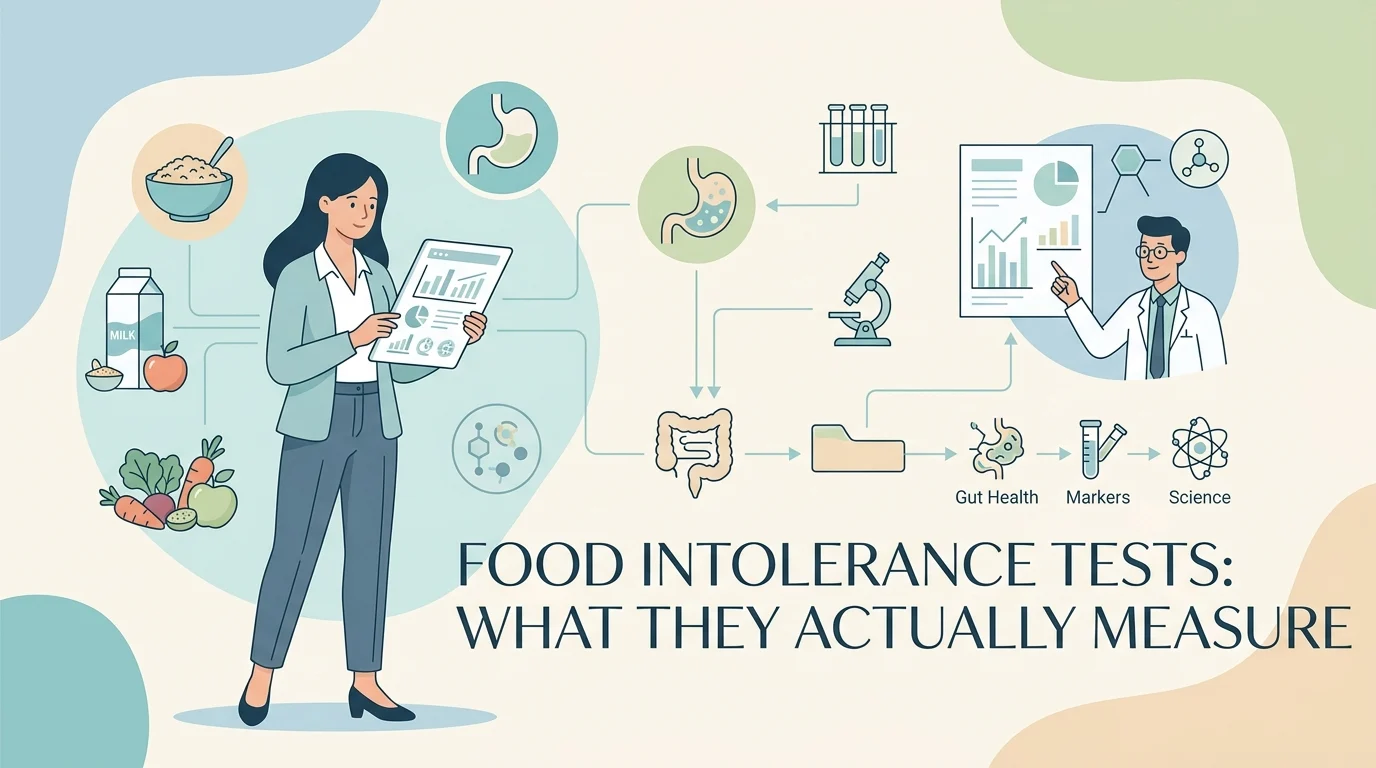
Most people who order a food intolerance test get a list back. It usually names somewhere between a handful and a few dozen foods, often ranked by color or by level, and the foods on it tend to be the ones eaten most often: milk, egg, wheat, yeast. The report looks like a diagnosis. Whether it is one depends entirely on a question most kits never answer on the box, which is what the laboratory actually measured.
The phrase food intolerance test covers several unrelated technologies. Some measure something real and useful, such as whether your gut absorbs lactose. Others measure something real but with no established link to symptoms. This guide goes through what each kind of test detects, what it can and cannot tell you, and what the evidence says about the most widely sold version.
Three different problems that get called food intolerance
Much of the confusion starts here. Allergy, intolerance and sensitivity are used interchangeably in advertising, but they describe different mechanisms, carry different risks and need different tests.
| Type of reaction | What is happening | How fast and how serious | Test that actually applies |
|---|---|---|---|
| Food allergy | The immune system makes IgE antibodies against a food protein | Usually within minutes to two hours; can be life-threatening | Skin prick test, IgE blood test, supervised oral food challenge |
| Food intolerance | The digestive system cannot fully break down or absorb a food component | Hours; uncomfortable but not dangerous | Breath tests for specific sugars, structured elimination and reintroduction |
| Celiac disease | An autoimmune reaction to gluten that damages the small intestine | Variable; causes long-term harm if untreated | Celiac antibody blood tests, then intestinal biopsy |
| Food sensitivity (as marketed) | Usually defined by the kit itself as a raised IgG antibody level | No agreed mechanism or timescale | No validated test |
Cleveland Clinic draws the central line clearly: unlike a food allergy, an intolerance does not involve the immune system and is linked instead to digestion. It lists lactose, histamine, gluten, FODMAPs, fructose and food additives among the common culprits, and notes that there are no standard skin or blood tests for food intolerance. Diagnosis relies on a food diary, an elimination diet and, for specific sugars, breath testing.
That last point is the key to reading any result. A blood test sold as a food intolerance test is, by the mainstream definition, measuring something other than intolerance. If you are trying to work out whether you have a true allergy, our guide to IgE allergy blood testing covers that side in detail.
What most at-home food sensitivity tests measure
The large majority of consumer food sensitivity panels, whether finger-prick at home or drawn at a clinic, measure IgG antibodies against dozens or hundreds of food extracts. IgG is the most abundant antibody in the blood, and our guide to what an IgG blood test measures explains its normal role. The food-specific version reports how much of that antibody binds to each food.
The difficulty is what that binding means. The American Academy of Allergy, Asthma and Immunology states that the presence of IgG is likely a normal response of the immune system to exposure to food, that the test has never been scientifically proven to do what it reports to do, and that higher IgG4 levels to a food may simply be associated with tolerance of that food. The American College of Allergy, Asthma and Immunology makes the same point in plainer terms: IgG tests reflect food exposure, not allergy, and at-home panels are not reliable and should not be used to diagnose food allergies.
Why nearly everyone gets a list
If IgG tracks exposure, most people should test positive to something, and the foods flagged should be the foods they eat most. The research, including research by groups who support IgG testing, shows exactly that.
According to PubMed, a 2024 study that tested 90 food-specific IgG antibodies found that 95.40 percent of the healthy control group registered as intolerant to at least one food, with an average of 9.57 foods each (DOI). These were healthy volunteers, not patients. A 2026 analysis of 6,575 people in Italy found the highest IgG responses to cow’s milk at 30.8 percent, brewer’s yeast at 23.4 percent, mozzarella at 22.4 percent and wheat at 20.4 percent, which the authors attributed to how widely those foods are used in Italian cooking. Reactivity to the most common foods also fell with age (DOI).
A study in BMJ Open Gastroenterology adds another piece: people with reduced overall IgG levels were strongly protected from forming food-specific IgG at all (DOI). The result partly reflects how vigorously your immune system makes antibodies in general, not just what you eat.
Put together, a long IgG list is what a healthy immune system that has met a varied diet would be expected to produce. It is not evidence that those foods are causing your symptoms.
The IgG4 twist
Some panels report IgG4 specifically, a subclass of IgG. In allergy research, IgG4 is associated with the immune system learning to tolerate a food, which is the opposite of what a sensitivity report implies. According to PubMed, a 2025 study of 415 children with suspected allergies found that for milk protein and egg white, children who ate the food without symptoms had higher IgG4 relative to IgE than children who reacted (DOI). Eating a food regularly and tolerating it can raise the very number a kit flags as a problem.
The 2025 trial that complicates the picture
It would be inaccurate to say no study has ever found a benefit from IgG-guided diets. One of the most rigorous trials so far found one, and it deserves a fair account.
According to PubMed, a randomized, double-blind, sham-controlled trial published in Gastroenterology in 2025 randomized 238 people with irritable bowel syndrome at eight centers. Everyone had tested positive to at least one food on a purpose-built 18-food IgG assay designed for IBS. Participants were assigned either a diet excluding their positive foods or a sham diet excluding other foods, for eight weeks. A 30 percent or greater reduction in abdominal pain was reached by 59.6 percent on the IgG-guided diet against 42.1 percent on the sham diet, with the clearest difference in constipation-predominant and mixed-type IBS (DOI).
Three things limit how far this travels. The assay was a new, IBS-specific 18-food panel, not the 100-plus food panels sold to the general public. The participants had diagnosed IBS, so the result says nothing about people with vague symptoms or none. And the sham group improved substantially too, which shows how much of any diet’s effect comes from expectation and attention. The authors themselves call for a larger study. The trial is a reason to keep researching the question, not a validation of consumer sensitivity panels.
Other methods sold for the same purpose
Hair analysis, bioresonance devices and muscle-testing methods such as applied kinesiology are also marketed for identifying food sensitivities. None of them appears among the tests that allergy or gastroenterology organizations use to diagnose food reactions.
Tests that measure something clinically useful
Several tests do answer a specific question about food reactions. Each answers only its own question, which is why the right test depends on what you are trying to find out.
| Test | What it measures | What it can answer | Main limitation |
|---|---|---|---|
| Lactose hydrogen breath test | Hydrogen produced when unabsorbed lactose is fermented in the colon | Whether you absorb lactose | Malabsorption and symptoms often do not match |
| Fructose hydrogen breath test | The same principle, using fructose | Whether you absorb a test dose of fructose | Results vary considerably between devices |
| Celiac antibody blood tests | Autoantibodies raised in untreated celiac disease | Whether celiac disease is likely | Only valid while you are still eating gluten |
| IgE blood test or skin prick test | Allergic sensitization to a specific food | Whether a true allergy is possible | Sensitization is not the same as allergy |
| Supervised oral food challenge | Your actual reaction to eating the food | Whether you are allergic | Must be done under medical supervision |
| Fecal calprotectin | A protein released by white cells in an inflamed bowel | Whether symptoms come from gut inflammation rather than intolerance | Does not identify any food |
| Serum diamine oxidase (DAO) | An enzyme that breaks down histamine | Proposed for histamine intolerance | Too variable to confirm or exclude the diagnosis |
Lactose and fructose breath tests
For lactose, NIDDK describes the hydrogen breath test as drinking a liquid containing a known amount of lactose and breathing into containers every 30 minutes over a few hours. Lactose intolerance may be diagnosed if both breath hydrogen rises and symptoms worsen during the test. It also notes that a doctor may first suggest stopping milk and milk products for a period to see whether symptoms resolve.
The two parts of that definition matter separately, because they often disagree. According to PubMed, a 2025 study of 753 people with functional gut disorders found lactose malabsorption in 40.9 percent and lactose-triggered symptoms in 55.4 percent, but 45.3 percent of those with symptoms absorbed lactose normally, and 26.0 percent of those who malabsorbed it had no symptoms (DOI). A positive breath test tells you about absorption; it does not, on its own, tell you that lactose is the cause of your symptoms.
Fructose testing is less dependable. According to PubMed, when 53 fructose breath tests in children were measured on both a handheld and a laboratory device, the two agreed on the result only 81.1 percent of the time, and the laboratory device found malabsorption far more often, compared with 93.6 percent agreement for lactose tests in the same study (DOI). The authors advise caution in using fructose breath tests clinically.
Celiac disease testing
Celiac disease is not an intolerance, and it is the condition most worth excluding when gut symptoms involve wheat. NIDDK explains that blood tests look for antibodies that are often raised in untreated celiac disease, that an intestinal biopsy confirms the diagnosis, and that doctors do not recommend starting a gluten-free diet before testing because it can affect the results. Genetic testing for the DQ2 and DQ8 variants can help rule celiac disease out, but most people who carry them never develop it.
This creates a real risk with IgG panels: a kit that flags wheat can lead someone to cut out gluten before a proper celiac test, which then comes back falsely reassuring. Our guides to celiac disease and gluten intolerance and to the IgA blood test used alongside celiac antibodies explain the sequence.
Allergy testing
If your reactions involve hives, swelling, vomiting or breathing difficulty soon after eating, the question is allergy, not intolerance. The American College of Allergy, Asthma and Immunology describes skin prick tests and IgE blood tests as ways of detecting sensitization, cautions that the level of IgE does not necessarily predict how severe a reaction will be, and calls the oral food challenge, done under strict supervision by an allergist, the gold standard for diagnosis. It should never be attempted at home. Allergy often sits alongside other atopic conditions, as our guides to eczema and to eosinophils in the blood count describe.
Histamine intolerance and the DAO test
Histamine intolerance is among the most searched food reactions, and serum DAO is often offered to diagnose it. The evidence for that use is weak. According to PubMed, a 2023 study gave 59 people with suspected histamine intolerance a single-blind, placebo-controlled histamine challenge. The diagnosis was excluded in 84.7 percent, and 62.7 percent developed symptoms after the placebo. DAO activity tended to be lower in those who did react, but was so variable in those who did not that its value as a biomarker was limited (DOI). A 2024 crossover trial similarly found that DAO measurement had only a limited capacity to reflect dietary changes, while a histamine-restricted diet with structured reintroduction remained the useful diagnostic approach (DOI).
Why a positive result is not the same as a cause
The breath test data above illustrate a principle that applies to every test in this area. A measurable difference in how your body handles a food does not prove that food is behind your symptoms, and the absence of a measurable difference does not prove it is not.
According to PubMed, a 2024 study of people diagnosed with lactose or fructose intolerance using a validated symptom questionnaire found that 46 percent recovered fully and a further 32 percent improved by more than half on a targeted diet over two months, and that the response was independent of whether their breath test showed malabsorption (DOI). The study was small and uncontrolled, but it points the same way as the larger one: symptoms after a food, recorded carefully, matter more than a laboratory flag.
In people with irritable bowel syndrome, positive breath tests are common but may not be what drives the illness. According to PubMed, a 2025 multicenter study found positive lactose breath tests in 85.7 percent of the IBS patients tested for it, yet severe IBS was associated with small intestinal bacterial overgrowth and with depression rather than with lactose or fructose malabsorption (DOI). Our overview of irritable bowel syndrome and its tests covers the wider picture.
What actually identifies a food intolerance
For most intolerances, the most informative test is not a laboratory test at all. It is a structured elimination and reintroduction, ideally with the help of a doctor or registered dietitian.
- Keep a food and symptom diary for a few weeks before changing anything, noting timing, quantity and other factors such as stress or menstruation.
- Exclude one suspected food or food group at a time, for a defined period, rather than everything on a long list at once.
- Reintroduce it deliberately, in measured amounts, and record what happens. Symptoms that return on reintroduction are far more convincing than symptoms that eased on removal.
- Rule out conditions that need different treatment first, including celiac disease and bowel inflammation, which a fecal calprotectin test can help screen for.
The reason for doing it this way is that avoiding a long list of foods at once carries real costs. Restricting dairy without replacing it can leave calcium and vitamin D intake short, and our guide to the calcium blood test explains what low levels can mean. Broad restriction of animal foods can lower vitamin B12. Children are especially vulnerable to the nutritional effects of unnecessary restriction, and in anyone a long avoidance list can make eating more anxious than it needs to be.
When symptoms need a doctor rather than a kit
Some symptoms are not explained by any intolerance, and a test that attributes them to food can delay the right diagnosis. See a doctor rather than ordering a panel if you have any of the following.
- Unintended weight loss, blood in the stool, or black stools
- Diarrhea that wakes you at night or lasts more than a few weeks
- Signs of anemia, such as unusual tiredness or breathlessness
- New bowel symptoms after the age of 50, or a family history of celiac disease, inflammatory bowel disease or bowel cancer
- Reactions within minutes to two hours of eating that involve hives, lip or tongue swelling, vomiting, wheezing or faintness, which need an allergist
Our guides to Crohn’s disease, diarrhea patterns and their causes and lower abdominal pain and its warning signs cover the conditions most often mistaken for food intolerance.
Latest scientific advances
Beyond the IBS trial described above, research over the past three years has moved in two directions: clarifying where antibody findings might fit, if anywhere, and replacing single laboratory markers with measurements of how people actually respond to food.
On the antibody side, a 2026 study of 552 children examined food-specific IgG alongside stool markers of inflammation and gut permeability and abdominal ultrasound. According to PubMed, widespread IgG reactivity was more common in children who also had raised fecal calprotectin, zonulin and ultrasound changes such as bowel wall thickening, but the authors explicitly did not interpret IgG as a marker of allergy or intolerance, noted that international guidelines discourage its use as a standalone test, and describe the findings as exploratory (DOI). Laboratory methods are also changing: the 2026 Italian study above used a microarray that analyzes finger-prick samples at high throughput, which makes testing cheaper and faster but does not by itself answer what the result means clinically.
On the symptom side, the Vienna and Graz group behind the lactose studies above has argued that diagnosis should rest on standardized symptom measurement during a controlled challenge, rather than on breath hydrogen alone. Their data show that symptom-defined intolerance and measured malabsorption are distinct and frequently disagree, and that symptom-defined intolerance predicts diet response.
For histamine intolerance, a randomized, double-blind, placebo-controlled trial of 400 patients is testing a low-histamine diet and DAO enzyme supplements, separately and together, over three months, with serum DAO, plasma histamine, urinary histamine metabolites and the gut microbiome measured throughout. According to PubMed, the protocol notes that around twenty earlier studies have been limited by small numbers, missing control groups and short follow-up (DOI).
ClinicalTrials.gov lists further work on intolerances that standard testing misses. One trial is examining sucrase-isomaltase deficiency, an under-recognized inability to digest sucrose and starch, as a cause of IBS symptoms, comparing a starch- and sucrose-reduced diet with a low-FODMAP diet (NCT05159115). Another, at the University of Michigan, where the 2025 IgG trial was led, is developing objective markers of whether people actually follow an elimination diet, a recurring weakness in diet research (NCT07494968).
Questions worth asking your doctor
- Given my symptoms, is this more likely to be an allergy, an intolerance, celiac disease or something else?
- Should I be tested for celiac disease before I change what I eat?
- Would a lactose breath test help, and how will we interpret it if it disagrees with my symptoms?
- Is there any sign of bowel inflammation that should be checked first?
- If I try an elimination diet, which single food should I start with and for how long?
- Could I see a registered dietitian so that the diet does not leave gaps?
Frequently asked questions
Are food sensitivity tests accurate?
The laboratory measurement of IgG itself can be reproducible. The problem is that IgG reflects exposure to foods and is found in almost everyone, so an accurate measurement of it does not identify which foods cause symptoms. The American Academy of Allergy, Asthma and Immunology and the American College of Allergy, Asthma and Immunology both advise against using them to diagnose food reactions.
What is the most accurate food intolerance test?
It depends on the intolerance. For lactose, a hydrogen breath test combined with symptom recording during the test. For celiac disease, antibody blood tests followed by biopsy while you are still eating gluten. For allergy, a supervised oral food challenge. For most other suspected intolerances, a carefully structured elimination and reintroduction diet is more informative than any blood test.
What does a high IgG result mean?
Usually that you eat that food regularly. The highest IgG results in population studies are to the most commonly eaten foods, and some research links raised IgG4 to tolerance rather than to intolerance. A high result on its own is not a reason to stop eating a food.
Is a food intolerance test the same as a food allergy test?
No. A true allergy test measures IgE antibodies, which drive fast and potentially dangerous reactions, or tests your response under medical supervision. Most food intolerance kits measure IgG, which is a different antibody with no established link to symptoms. A negative intolerance kit result does not rule out an allergy.
Should I stop eating the foods my test flagged?
Not all at once, and not before ruling out celiac disease if wheat is on the list. If you want to test whether a food matters, remove one at a time for a defined period and then reintroduce it, ideally with advice from a doctor or dietitian. Long avoidance lists risk nutritional gaps without improving symptoms.
Is histamine intolerance real?
It is a recognized diagnosis, but it appears to be made far more often than it is confirmed. In a placebo-controlled challenge study, the diagnosis was excluded in 84.7 percent of people suspected of having it, and the DAO blood test is too variable to settle the question. A structured low-histamine diet with reintroduction is currently the more useful approach.
Can a blood test diagnose lactose intolerance?
Not usually. Lactose intolerance is usually assessed with a hydrogen breath test and by seeing whether symptoms settle when dairy is reduced. An IgG antibody result against milk does not measure lactose digestion at all.
Key points to remember
- Allergy, intolerance, celiac disease and marketed sensitivity are different problems with different tests.
- Most at-home food sensitivity panels measure IgG antibodies, which reflect exposure to food and are found in nearly everyone.
- In one study, 95.4 percent of healthy people registered as intolerant to at least one food on an IgG panel.
- A 2025 randomized trial found benefit from an IgG-guided diet in people with IBS using a purpose-built assay; it does not validate general consumer panels.
- Breath tests measure absorption, and malabsorption often does not match symptoms; fructose breath tests vary widely between devices.
- Test for celiac disease before cutting out gluten, because a gluten-free diet can make the test falsely negative.
- For most intolerances, a structured elimination and reintroduction, one food at a time, is more informative than any blood test.
Sources
- American Academy of Allergy, Asthma and Immunology: The myth of IgG food panel testing
- American College of Allergy, Asthma and Immunology: Food allergy testing and diagnosis
- NIDDK: Diagnosis of lactose intolerance
- NIDDK: Diagnosis of celiac disease
- Cleveland Clinic: Food intolerance
- PubMed, Singh et al., Gastroenterology 2025, an IBS-specific IgG ELISA-based elimination diet, randomized sham-controlled trial: DOI
- PubMed, Yan et al., Frontiers in Nutrition 2024, food-specific IgG in Hashimoto’s thyroiditis and healthy controls: DOI
- PubMed, Mantovani et al., Food Technology and Biotechnology 2026, microarray assay of food-reactive IgG in the Italian population: DOI
- PubMed, Carson et al., BMJ Open Gastroenterology 2022, food-specific IgG and immune competence: DOI
- PubMed, Kim et al., Children 2025, specific IgG4 and the IgG4 to IgE ratio as markers of tolerance: DOI
- PubMed, Ion et al., Biomolecules 2026, food-specific IgG within an immune-gut inflammatory profile in children: DOI
- PubMed, Hammer and Hammer, Neurogastroenterology and Motility 2025, symptom-based assessment in suspected lactose intolerance: DOI
- PubMed, Hammer et al., European Journal of Gastroenterology and Hepatology 2025, reliability of hydrogen breath test devices: DOI
- PubMed, Klare et al., Digestive Diseases 2024, symptom-diagnosed carbohydrate intolerance and diet response: DOI
- PubMed, Loo et al., Journal of Gastroenterology and Hepatology 2025, breath test results and symptoms in IBS: DOI
- PubMed, Bent et al., Journal of Allergy and Clinical Immunology: In Practice 2023, placebo-controlled histamine challenge: DOI
- PubMed, Rentzos et al., European Journal of Clinical Nutrition 2024, diamine oxidase on low-histamine and ordinary diets: DOI
- PubMed, Duelo et al., Nutrients 2024, protocol for a randomized trial of low-histamine diet and DAO supplementation: DOI
- ClinicalTrials.gov: Sucrase-isomaltase deficiency as a cause of irritable bowel syndrome (NCT05159115)
- ClinicalTrials.gov: Objective markers of compliance for dietary therapies in IBS (NCT07494968)
Food intolerance results rarely arrive alone; they sit beside a blood count, iron studies, celiac antibodies or inflammation markers that together say far more than any single panel. Understand your lab results with AI DiagMe, which reads your report line by line and explains each value in plain language, with interpretation reviewed by a committee of physicians.