



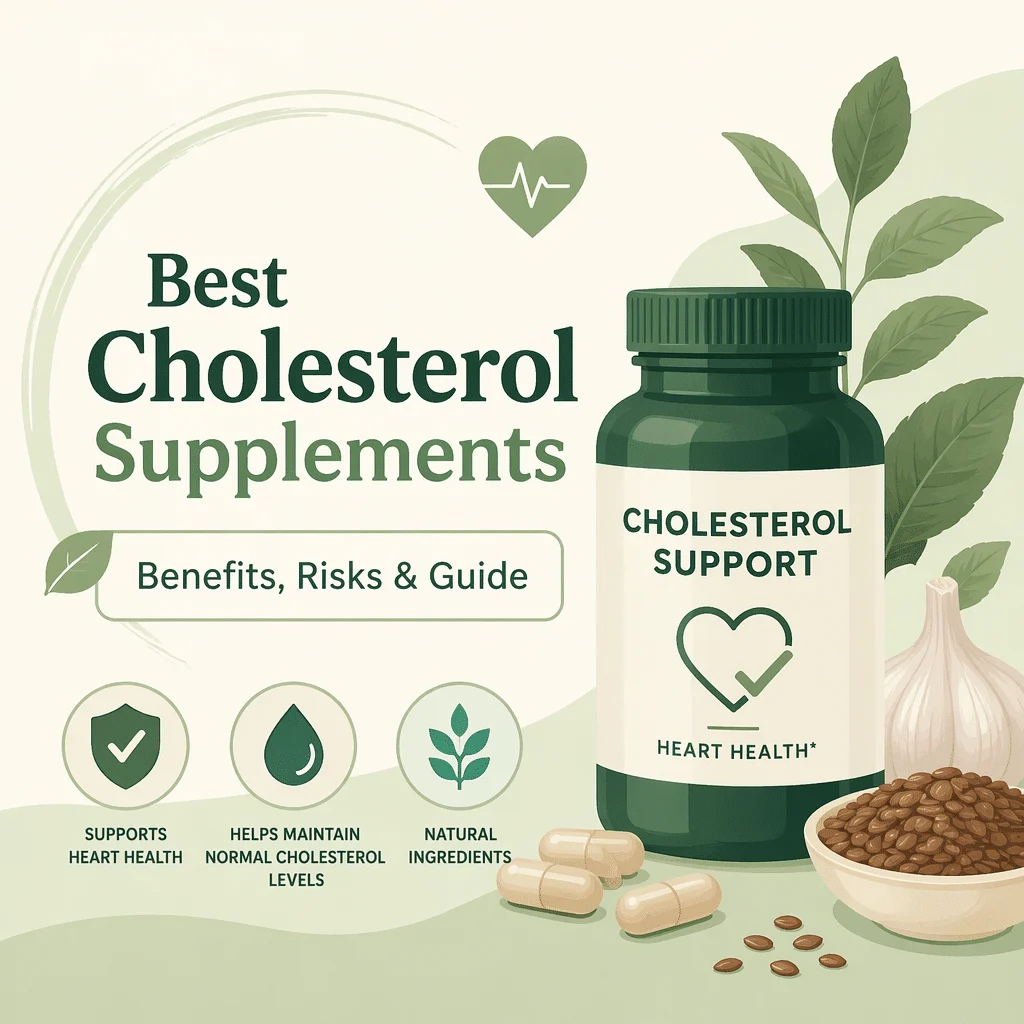
Searching for the best cholesterol supplements usually turns up a ranked list. The science does not work that way. A few of these products have decades of controlled trials behind them, several rest on a handful of small studies, and one is chemically the same molecule as a prescription statin. This article explains what the evidence actually shows for red yeast rice, plant sterols and stanols, soluble fiber, omega-3 fatty acids, niacin, berberine, bergamot, garlic, and green tea extract. You will also learn how United States regulation affects what ends up inside the bottle, which products interact with common medications, and which blood tests tell you whether anything is changing. No supplement replaces a treatment your doctor has prescribed, and the size of any effect varies a great deal from one person to the next.
What people mean by the best cholesterol supplements
When someone asks about the best cholesterol supplements, they usually want one of three things: a product that will bring an LDL number down, an alternative to a statin they would rather not take, or something safe to add on top of what they already do. Those are three different questions, and the evidence answers them very differently.
The National Center for Complementary and Integrative Health puts the overall picture plainly: several dietary supplements can nudge cholesterol in the right direction, but their effects are small compared with those of cholesterol-lowering medicines. That single sentence reframes the whole category. Supplements sit alongside diet, physical activity, and prescribed treatment. They do not sit in place of them.
Why a ranked list is misleading
A ranking implies that one product wins for everyone. In practice, the supplement with the best evidence for lowering LDL is not the one with the best evidence for lowering triglycerides, and neither is the one you should reach for if you already take an anticoagulant. Starting cholesterol levels matter too: pooled trial data consistently show larger changes in people who begin with higher numbers and almost nothing in people whose lipids are already close to target.
There is also a quality problem that no ranking captures. Two bottles carrying the same botanical name can contain wildly different amounts of the active compound, which means a trial result does not automatically transfer to the product on the shelf.
The three questions that actually matter
- What does the controlled trial evidence show for this specific compound, and how large is the effect?
- Can this product interact with anything else you take, including prescribed lipid-lowering therapy, blood thinners, or diabetes medication?
- How will you and your doctor know whether it did anything, and over what timeframe?
How US regulation shapes what is in the bottle
This is the part most buying guides skip, and it changes how you should read every claim on a label. Under the Dietary Supplement Health and Education Act, the Food and Drug Administration does not have the authority to approve dietary supplements before they are marketed. Manufacturers are responsible for making sure their products are not adulterated or misbranded, and the FDA generally acts after a product is already on sale.
The practical consequence: a supplement reaching the shelf is not evidence that anyone verified it works, that the dose matches the label, or that it is safe alongside your medication.
What the label does not tell you
Red yeast rice is the clearest illustration. The National Center for Complementary and Integrative Health reports that a 2017 analysis found none of the tested products listed the quantity of monacolin K on the label, and among the 26 brands that contained it, levels ranged more than sixty-fold across products. A separate 2021 analysis found that only one of 37 products met European safety standards. Some batches have also been contaminated with citrinin, a mold byproduct that can damage the kidneys.
That variability is not a minor labeling technicality. It means two people following the same instructions on two different bottles can be taking doses that differ by an order of magnitude.
What the evidence shows, supplement by supplement
The table below summarizes where each of the commonly promoted options actually stands. It reflects systematic reviews and meta-analyses published in the last three years, together with the consumer guidance from the National Institutes of Health, the National Center for Complementary and Integrative Health, and the FDA. Read the safety column as carefully as the evidence column.
| Supplement | What the evidence actually shows | How it is thought to work | Safety cautions and interactions |
|---|---|---|---|
| Red yeast rice (monacolin K) | Reviews consistently find an LDL-lowering effect, but it depends entirely on how much monacolin K a given product contains, and that is rarely stated on the label | Monacolin K blocks the same liver enzyme that statins block | Same risk profile as a statin, including muscle, liver, and kidney injury; possible citrinin contamination; products with meaningful monacolin K are treated as unapproved new drugs in the United States |
| Plant sterols and stanols | Among the best supported options for LDL; effects are modest and depend on taking them consistently with meals | They compete with cholesterol for absorption in the gut, so less of it enters the bloodstream | Generally well tolerated; can reduce absorption of some fat-soluble vitamins; not recommended in the rare inherited condition sitosterolemia |
| Psyllium (soluble fiber) | Large pooled analyses of randomized trials show a reliable, dose-related fall in total and LDL cholesterol | It forms a gel that traps bile acids, forcing the liver to pull cholesterol from the blood to replace them | Bloating and gas are common at first; take it with plenty of water and separate it from other medications by a couple of hours |
| Oat beta-glucan | Trial evidence supports a modest improvement in LDL and total cholesterol, with moderate certainty | Same bile acid mechanism as psyllium, delivered through a food rather than a capsule | Very safe; the main caution is choosing products with added sugar |
| Omega-3 (EPA and DHA) | Clearly lowers triglycerides; it does not lower LDL, and in some analyses LDL edges up slightly | Reduces the amount of triglyceride the liver packages and releases | The NIH Office of Dietary Supplements notes that high doses may cause bleeding problems with warfarin or other anticoagulants, and the FDA advises no more than 5 grams a day of combined EPA and DHA from supplements |
| Niacin (vitamin B3) | MedlinePlus rates it likely effective for high cholesterol, with the largest changes in HDL and triglycerides at prescription-level doses; large outcome trials did not show the expected benefit for heart events | Reduces the liver’s release of fat-carrying particles into the blood | Flushing is common; MedlinePlus warns that doses above 3 grams a day can cause liver problems, gout, digestive ulcers, vision loss, and high blood sugar, and reports a large study in which high-dose niacin was linked to a doubled stroke risk |
| Berberine | Pooled trials suggest improvements in LDL and triglycerides, but the studies are mostly small and heavily concentrated in a few regions, so the finding is not yet settled | Appears to increase the number of LDL receptors on liver cells, which clear LDL from the blood | Digestive upset is frequent; it affects liver enzymes that process many medications, so interaction risk is real; avoid in pregnancy and while breastfeeding |
| Bergamot extract | Promising but preliminary; the recent trials are small and short, and formulations differ from one another | Its citrus flavonoids are thought to act on the same liver enzyme pathway as statins, far more weakly | Short-term tolerability looks good, but long-term safety data are limited; citrus compounds can interfere with drug metabolism |
| Garlic | The National Center for Complementary and Integrative Health states it can lower cholesterol if taken for more than two months, though the effect is modest and results across studies are inconsistent | Sulfur compounds appear to slow cholesterol production in the liver | Can increase bleeding risk, which matters before surgery and alongside anticoagulants; breath and body odor are common reasons people stop |
| Green tea extract | Weak and inconsistent for lipids; a recent trial found that adding green tea catechins to exercise gave no extra benefit to the lipid profile | Catechins may modestly reduce cholesterol absorption in the gut | Concentrated extracts have been linked to liver injury in rare cases, particularly when taken on an empty stomach |
Where the evidence is strongest
Three options stand out, and none of them are exotic. Plant sterols and stanols have the longest and most consistent record for lowering LDL, which is why they are added to spreads, yogurts, and fortified drinks rather than sold only as capsules. Soluble fiber, and psyllium in particular, is supported by some of the largest pooled analyses in this whole field. Omega-3 fatty acids reliably lower triglycerides, and that is a genuinely useful effect for people whose triglycerides are the problem.
Notice what that means in practice. The strongest evidence points toward the numbers other than LDL as often as toward LDL itself, so knowing which of your lipid values is out of range decides which option is even worth discussing. Our team explains the complete lipid panel.
Where the evidence is mixed or thin
Berberine, bergamot, garlic, and green tea extract sit in a different tier. There are positive trials for the first three, but the studies tend to be small, short, and hard to compare because every product uses a different extract and dose. Green tea extract is the weakest of the group for lipids specifically.
Mixed evidence is not the same as no evidence, and it is not the same as proof that something does not work. It means the honest answer is that we do not yet know how much benefit a given person would get, which is exactly the situation where a supplement should never displace a treatment that has been shown to prevent heart attacks and strokes.
Red yeast rice is a special case
Red yeast rice deserves its own paragraph because of a chemical fact that most product pages do not mention. Monacolin K, the active compound in red yeast rice, is the same molecule as lovastatin, a statin approved as a prescription medicine in 1987. Chemical databases list monacolin K directly as a synonym of lovastatin. The National Center for Complementary and Integrative Health describes it as structurally identical to that medicine.
Everything follows from that. Red yeast rice with meaningful monacolin K content is a statin in a supplement bottle, with a statin’s benefits and a statin’s risks of muscle, liver, and kidney injury, but without a verified dose. This is also why products containing appreciable monacolin K are considered unapproved new drugs and are not legally sold in the United States. Taking it on top of a prescribed statin means doubling up on the same mechanism without anyone knowing the total dose.
Interactions and safety signals worth knowing
The interaction risks in this category are concrete, not theoretical. The ones worth memorizing:
- Anticoagulants and antiplatelet drugs: the NIH Office of Dietary Supplements notes that high doses of omega-3s may cause bleeding problems when taken with warfarin or other anticoagulant medicines. Garlic raises the same concern.
- Statins and other prescribed lipid-lowering therapy: red yeast rice adds a second source of the same drug. Berberine can alter how the liver processes other medications.
- Diabetes medication: berberine can lower blood sugar, so combining it with glucose-lowering drugs can push levels too low.
- Surgery: garlic and high-dose omega-3s are usually stopped in advance because of bleeding risk. Tell the surgical team about every supplement, not just the prescriptions.
- Pregnancy and breastfeeding: berberine and red yeast rice should be avoided.
When to stop and call your doctor
Some symptoms warrant a call rather than a wait-and-see approach: unexplained muscle pain, tenderness, or weakness, especially if it is widespread; dark or cola-colored urine; yellowing of the skin or eyes; persistent nausea with pain in the upper right abdomen; unusual bruising or bleeding that will not stop. Our team describes the warning signs of high ALT.
The blood tests that show whether anything changed
You cannot feel cholesterol. The only way to know whether a supplement did anything is to measure, and to measure the same way before and after.
Before you start
A baseline lipid panel gives you total cholesterol, LDL, HDL, triglycerides, and non-HDL cholesterol. This guide covers the normal LDL cholesterol ranges, and our team also describes the causes of high triglyceride levels. Two further measurements refine the picture: apolipoprotein B counts the actual number of cholesterol-carrying particles rather than the cholesterol inside them, and lipoprotein(a) is largely inherited and worth checking once in a lifetime. This article explains the ApoB blood test and heart disease risk.
Baseline liver enzymes, ALT and AST, are worth having on file before starting anything that can affect the liver, red yeast rice and concentrated green tea extract in particular.
After eight to twelve weeks
Lipids respond slowly. Repeating the panel sooner than about eight weeks usually measures day-to-day variation rather than a real change. When you retest, compare the same markers under the same conditions, and interpret the result against your starting point rather than against someone else’s.
If muscle symptoms appear at any point, creatine kinase is the test that distinguishes ordinary soreness from muscle injury. This guide explains the CPK blood test. And because supplements only ever address part of the picture, we cover the everyday causes of high cholesterol.
Questions to ask your doctor before starting any supplement
Bring the actual bottle to the appointment. The label is more informative than the product name. Then work through this list:
- Given my lipid results, is LDL, triglycerides, or something else the number we are trying to change?
- Does this product interact with anything else I take, including over-the-counter medicines?
- What is a realistic expectation here, and how would we know if it is not working?
- Which blood tests should I have before I start, and when should I repeat them?
- If I already take a prescribed lipid-lowering medicine, does this add anything, or does it just duplicate it?
- Are there symptoms that should make me stop immediately and call you?
- Is there a food-based version of this, such as fortified foods or oats, that would achieve the same thing?
Latest scientific advances
Research published in the last three years has sharpened the picture considerably. Here is what changed, in plain language.
Soluble fiber now has the largest evidence base in the category
A 2023 dose-response analysis pooled 181 randomized trials covering more than 14,000 participants and found that soluble fiber supplementation consistently improved total and LDL cholesterol, with bigger doses producing bigger changes. A separate 2024 analysis of 29 trials looked specifically at psyllium and reached the same conclusion, and a 2024 review of oat trials found a moderate-certainty benefit. What this means for you: of everything in this category, fiber has the most trial evidence behind it, it is inexpensive, and the main obstacle is tolerating enough of it. Start low and build up.
Omega-3s are a triglyceride tool, not an LDL tool
A 2023 dose-response analysis combining 90 randomized trials and more than 72,000 participants confirmed that omega-3 intake lowers triglycerides, while its effect on LDL runs in the opposite direction. A randomized trial means participants were assigned by chance to the supplement or to a comparison, which is the strongest design for answering this kind of question. What this means for you: if your triglycerides are high, this is a reasonable thing to discuss. If LDL is your problem, omega-3s are the wrong tool.
Red yeast rice: the safety conversation has caught up with the efficacy one
A 2024 systematic review examined both the safety and the effectiveness of red yeast rice extract and confirmed the recurring theme: the benefit is real where monacolin K content is adequate, and so is the statin-type risk. A separate 2024 review looked at what happens when red yeast rice preparations are combined with statins. What this means for you: treat red yeast rice as a medicine rather than a food supplement, tell your doctor you are taking it, and never stack it on top of a prescribed statin without medical supervision.
Berberine is being tested properly for the first time
Two recent reviews, one in 2023 pooling 41 randomized trials with nearly 5,000 patients and one in 2025 covering the components of metabolic syndrome, both point toward a genuine effect on lipids while flagging that the underlying studies are small and geographically narrow. A large late-stage trial of berberine in more than 2,000 people at high cardiometabolic risk, run by China’s National Center for Cardiovascular Diseases, is under way with results expected after 2026. What this means for you: berberine is promising and not yet proven. The bigger trial will tell us far more than anything currently available.
Bergamot and artichoke: small trials, cautious optimism
A 2024 randomized, double-blind, placebo-controlled trial in 90 participants tested dry artichoke and bergamot extracts on lipid profiles, and further trials of the same combination are recruiting. What this means for you: this is early-stage evidence from small groups. It is worth watching, not worth substituting for something established.
Garlic and green tea: the picture got clearer, not better
A 2026 review pooled 108 trials with more than 7,000 participants on garlic and cardiovascular risk factors, and a 2024 trial found that adding green tea catechins to an exercise program produced no additional improvement in the lipid profile. What this means for you: garlic may help a little over a period of months, green tea extract probably will not do much for your lipids, and neither belongs in the same conversation as prescribed therapy.
Plant sterols are being studied where they matter most
A 2023 review examined the use of phytosterol-fortified foods to improve LDL cholesterol, and an ongoing trial in Brazil is testing a cardioprotective diet with and without added phytosterols in 300 people with familial hypercholesterolemia, an inherited condition that causes very high cholesterol from a young age. What this means for you: fortified foods taken consistently with meals remain the most practical way to use plant sterols, and the research is now asking whether they add anything on top of a good diet.
Glossary
| Term | Definition |
|---|---|
| LDL cholesterol | Low-density lipoprotein cholesterol. The fraction most closely tied to the buildup of deposits in artery walls, which is why it is the usual treatment target. |
| HDL cholesterol | High-density lipoprotein cholesterol. It carries cholesterol back to the liver for disposal. Low levels are associated with higher cardiovascular risk. |
| Triglycerides | The main form in which fat circulates and is stored. Levels respond strongly to alcohol, sugar, weight, and blood sugar control. |
| Non-HDL cholesterol | Total cholesterol minus HDL. It captures every cholesterol-carrying particle thought to contribute to arterial disease, in a single number. |
| Apolipoprotein B (ApoB) | A protein carried by each atherogenic particle. Measuring it counts the particles themselves rather than the cholesterol they contain. |
| Lipoprotein(a) | A cholesterol-carrying particle whose level is set largely by genetics. It does not respond meaningfully to diet or to supplements. |
| Monacolin K | The active compound in red yeast rice. It is the same molecule as lovastatin, a prescription statin. |
| Phytosterols | Plant sterols and stanols. Plant compounds that resemble cholesterol closely enough to compete with it for absorption in the intestine. |
| Soluble fiber | Fiber that dissolves in water to form a gel, as in psyllium and oats. It binds bile acids and carries them out of the body. |
| Creatine kinase (CK) | An enzyme released when muscle is damaged. It is measured when muscle pain raises the question of drug-related or supplement-related muscle injury. |
Frequently asked questions
Which of the best cholesterol supplements has the most evidence behind it?
Judged purely on the volume and quality of randomized trials, soluble fiber and plant sterols and stanols lead for LDL cholesterol, and omega-3 fatty acids lead for triglycerides. That is a different claim from saying they will work for you. The National Center for Complementary and Integrative Health emphasizes that the effects of supplements are small compared with those of cholesterol-lowering medicines, so the sensible way to use this ranking is to narrow the discussion with your doctor rather than to pick a product off a shelf.
Does red yeast rice lower cholesterol?
It can, because its active compound monacolin K is the same molecule as the prescription statin lovastatin. The problem is dose. The National Center for Complementary and Integrative Health reports that among tested products containing monacolin K, levels varied more than sixty-fold, and none listed the quantity on the label. Products with meaningful monacolin K are considered unapproved new drugs in the United States. Anyone considering red yeast rice should discuss it with a doctor and treat it with the same caution as a prescribed statin.
How much plant sterol do you need each day?
Studies of phytosterol-fortified foods generally test around two grams a day, spread across meals, because they work by competing with cholesterol at the point of absorption. Fortified spreads, yogurts, and drinks are the usual delivery route, since reaching that amount from ordinary food alone is difficult. Consistency matters more than the exact number: taken irregularly, they have little chance to do anything.
Can plant sterols damage the liver?
For most people, plant sterols and stanols are well tolerated and are not associated with liver injury. The relevant exception is sitosterolemia, a rare inherited condition in which the body absorbs plant sterols excessively, where they should be avoided. If you have existing liver disease or take medication that affects the liver, raise it with your doctor before starting anything. Concentrated green tea extract, not plant sterols, is the supplement in this category most often linked to rare liver injury.
How long can you take bergamot for cholesterol?
There is no established answer, and that is the honest position. The published trials are short, typically running a few weeks to a few months, so long-term safety data simply do not exist. That makes bergamot reasonable to try for a defined period under medical supervision, with a lipid panel before and after, rather than something to take indefinitely on the assumption that it is harmless.
Can a supplement replace a statin?
No. Statins are supported by outcome trials showing they reduce heart attacks and strokes, which is a different and much higher standard than showing a change in a blood test number. No supplement in this article has that evidence. Stopping or reducing a prescribed lipid-lowering medicine in favor of a supplement should never be done without your doctor, and the National Center for Complementary and Integrative Health advises specifically against using supplements in place of prescribed treatment.
Sources
- National Center for Complementary and Integrative Health — Red Yeast Rice: What You Need To Know — nccih.nih.gov
- National Center for Complementary and Integrative Health — Cholesterol Management at a Glance — nccih.nih.gov
- National Institutes of Health, Office of Dietary Supplements — Omega-3 Fatty Acids: Consumer Fact Sheet — ods.od.nih.gov
- U.S. Food and Drug Administration — Questions and Answers on Dietary Supplements — fda.gov
- National Heart, Lung, and Blood Institute — Blood Cholesterol — nhlbi.nih.gov
- MedlinePlus — Niacin — medlineplus.gov
- Ghavami A, et al. — Soluble Fiber Supplementation and Serum Lipid Profile: A Systematic Review and Dose-Response Meta-Analysis of Randomized Controlled Trials — Advances in Nutrition, 2023 — PMID 36796439
- Zhu R, et al. — Plantago consumption significantly reduces total cholesterol and low-density lipoprotein cholesterol in adults: a systematic review and meta-analysis of randomized controlled trials — Nutrition Research, 2024 — PMID 38688104
- Li A, et al. — Efficacy of oats in dyslipidemia: a systematic review and meta-analysis — Food & Function, 2024 — PMID 38441173
- Wang T, et al. — Association Between Omega-3 Fatty Acid Intake and Dyslipidemia: A Continuous Dose-Response Meta-Analysis of Randomized Controlled Trials — Journal of the American Heart Association, 2023 — PMID 37264945
- Trogkanis E, Karalexi MA, Sergentanis TN, Kornarou E, Vassilakou T — Safety and Efficacy of the Consumption of the Nutraceutical Red Yeast Rice Extract: A Systematic Review — Nutrients, 2024 — PMID 38794691
- Shi M, et al. — Effects of the combination of red yeast rice-containing commercial Chinese polyherbal preparation with statins for dyslipidemia — Frontiers in Pharmacology, 2024 — PMID 39108747
- Hernandez AV, et al. — Impact of Berberine or Berberine Combination Products on Lipoprotein, Triglyceride and Biological Safety Marker Concentrations in Patients with Hyperlipidemia: A Systematic Review and Meta-Analysis — Journal of Dietary Supplements, 2023 — PMID 37183391
- Liu D, et al. — Efficacy and safety of berberine on the components of metabolic syndrome: a systematic review and meta-analysis — Frontiers in Pharmacology, 2025 — PMID 40740996
- Fogacci F, et al. — A Randomized, Double-Blind, Placebo-Controlled Clinical Trial on the Effect of Dry Artichoke and Bergamot Extracts on Lipid Profile — Nutrients, 2024 — PMID 38892519
- Behrouz V, et al. — Effects of Garlic Supplementation on Cardiovascular Risk Factors in Adults: A Systematic Review and Meta-Analysis — Nutrition Reviews, 2026 — PMID 40580481
- Gholami F, et al. — Does green tea catechin enhance the weight-loss and lipid effects of exercise training? A systematic review and meta-analysis — Journal of the International Society of Sports Nutrition, 2024 — PMID 39350601
- Fontané L, et al. — Use of phytosterol-fortified foods to improve LDL cholesterol levels: a systematic review and meta-analysis — Nutrition, Metabolism and Cardiovascular Diseases, 2023 — PMID 37225641
- ChEMBL Database, EMBL-EBI — Lovastatin compound record listing monacolin K as a synonym — CHEMBL503
- ClinicalTrials.gov — Berberine for the Prevention of Cardiovascular Disease and Diabetes in People at High Cardiometabolic Risk, National Center for Cardiovascular Diseases, China, 2023 — NCT05749874
- ClinicalTrials.gov — DICA-FH: Brazilian Cardioprotective Diet With or Without Phytosterols in Familial Hypercholesterolemia, 2024 — NCT06331195
Further reading
- Understanding Low HDL Cholesterol: Causes and Risks
- Cholesterol Ratio Explained: Meaning and Risks
- Lipoprotein(a) Screening for Every Adult
- Liver Function Tests: How to Read Your Liver Panel
- How to Read Your Blood Test Results: A Complete Guide
Understand your lab results with AI DiagMe
Deciding whether any supplement is worth your time starts with knowing which of your numbers is actually out of range, and that is a reading problem before it is a shopping problem. AI DiagMe turns a lab report into plain language, covering the full lipid panel with total cholesterol, LDL, HDL, triglycerides, and non-HDL, alongside apolipoprotein B, lipoprotein(a), and the liver enzymes ALT and AST that matter when you are monitoring safety. Every interpretation is built on rules validated by a committee of physicians, with your data hosted in France. It helps you understand what your results say and prepare better questions for your appointment; it does not diagnose and it does not replace your doctor.
Get your results interpreted in minutes