










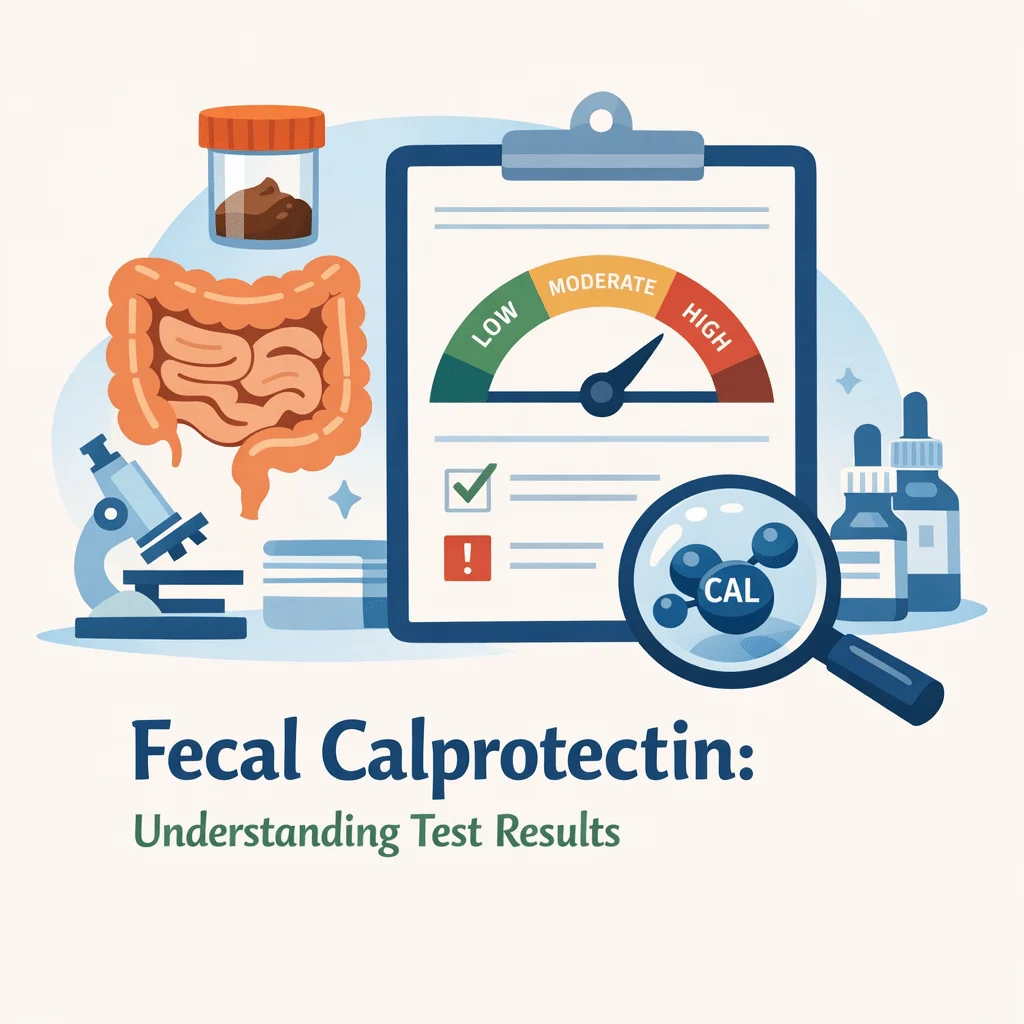
A fecal calprotectin test measures a protein that white blood cells release into the gut, and its level in a stool sample tells your doctor whether the lining of your intestine is inflamed. It is one of the few laboratory tests that can look inside the bowel without a camera. A raised number is not a diagnosis, and it is not a cancer result: it says that inflammation is present somewhere in the digestive tract and that the cause still has to be identified. In this article you will learn what the protein is, how the usual result bands in micrograms per gram are read, why the same sample can give different numbers in two laboratories, what raises the value in people who do not have inflammatory bowel disease, and how the test is used to follow Crohn’s disease and ulcerative colitis over time.
What a fecal calprotectin test measures
Calprotectin is a protein of the S100 family. It sits inside neutrophils, the white blood cells that arrive first wherever tissue is irritated or infected, and it accounts for a large share of the protein those cells carry. When the wall of the intestine becomes inflamed, neutrophils leave the bloodstream and move into the gut lining. Some of them break open, and the calprotectin they were carrying ends up in the bowel contents and leaves the body in stool.
That mechanism is what makes the test useful. The amount measured in stool rises and falls with the number of neutrophils crossing into the gut, so it reads intestinal inflammation directly rather than signaling inflammation somewhere in the body. Concentrations in stool are far higher than in blood, roughly six times higher, which is why stool rather than a blood draw is the sample of choice. Calprotectin also resists digestion, so a sample collected at home can still be measured at the laboratory.
Blood markers behave differently. Our team explains the C-reactive protein inflammation marker, which rises with inflammation anywhere in the body, from a chest infection to arthritis, and therefore cannot tell anyone where the problem sits.
Who is usually offered the test
A fecal calprotectin test is most often ordered in primary care for an adult under 45 or 50 with diarrhea, cramping abdominal pain or a change in bowel habit that has lasted several weeks without alarm features. It is also used repeatedly in people who already have a confirmed diagnosis of Crohn’s disease or ulcerative colitis, to follow how the disease is behaving between appointments.
Reading your fecal calprotectin test result, band by band
Results are reported as a concentration in micrograms of calprotectin per gram of stool, written µg/g. The bands below reflect thresholds published in the studies listed at the end of this article. They are a guide to how clinicians reason, not a rule that applies to every laboratory.
| Result | What it usually means | What typically happens next |
|---|---|---|
| Under about 50 µg/g | Significant bowel inflammation is unlikely. In the health technology assessment used to set this threshold, a result below it made inflammatory bowel disease improbable in a patient with typical symptoms. | Symptoms are usually explored as a functional gut disorder such as irritable bowel syndrome. Endoscopy is not arranged on the strength of this figure alone. |
| About 50 to 150 µg/g | The gray zone. Most people whose result lands here do not turn out to have inflammatory bowel disease; medication, age or a passing infection can be enough to lift the number. | A repeat test a few weeks later, together with a review of current medicines. Referral is not automatic. |
| About 150 to 250 µg/g | Inflammation is likely. In people already diagnosed with inflammatory bowel disease, values under roughly 250 µg/g have corresponded with disease that is quiet. | Specialist assessment. With new symptoms, endoscopy is often arranged; in known disease, the figure is read against previous results. |
| Above about 250 µg/g | Strongly raised. In series of newly diagnosed inflammatory bowel disease, average values sat several hundred µg/g, against a few tens of µg/g in irritable bowel syndrome. | Referral to gastroenterology and, in most cases, endoscopy with biopsies to establish the cause. |
No number in that table is universal. Laboratories choose their own reporting cut-off, often 50 µg/g but sometimes 100 or 120, and that choice depends on the method they run. Some report a plain number, others a word such as normal, moderately raised or markedly raised. Age matters too: healthy infants and young children have naturally higher values, and reference ranges vary by age. Read your result against the range printed on your own report, not against a figure found online.
What a borderline result should prompt
A value in the gray zone is the most common source of anxiety, and it is rarely the emergency people fear. The usual response is to repeat the test after a few weeks, ideally at the same laboratory, and to stop or review any anti-inflammatory painkiller in the meantime. A second normal result is reassuring. A second raised result, or a number that keeps climbing, is what prompts a referral. Panic is not a step in that sequence.
Telling inflammatory bowel disease from irritable bowel syndrome
Diarrhea, cramping, bloating and urgency feel much the same whether the cause is inflammatory bowel disease or irritable bowel syndrome, and symptoms alone separate the two poorly. The difference is physical: in inflammatory bowel disease the gut wall is genuinely inflamed and ulcerated, while in irritable bowel syndrome the bowel looks normal even though it works abnormally. Because calprotectin only appears in quantity when neutrophils invade the gut lining, it stays low in irritable bowel syndrome and rises in inflammatory bowel disease.
The gap between the two groups is wide. In one hospital series, people with newly confirmed inflammatory bowel disease had a median value of roughly 446 µg/g, while people with irritable bowel syndrome sat near 39 µg/g. In primary care, a negative test allows a family doctor to set inflammatory bowel disease aside with reasonable confidence, whereas a positive test needs more caution because several other conditions raise the figure. That asymmetry is the practical value of the test: it is better at ruling disease out than at ruling it in, and it spares a meaningful number of people an unnecessary colonoscopy.
Another article covers the diagnosis and day-to-day management of irritable bowel syndrome, and a separate guide reviews the causes, symptoms and treatments of Crohn’s disease. Our library also describes the normal and abnormal changes in stool consistency, which is the observation that usually brings people to the test in the first place.
What raises calprotectin when you do not have inflammatory bowel disease
An elevated result means neutrophils are entering the bowel. It does not say why. Several very ordinary explanations sit behind mildly raised values.
- Non-steroidal anti-inflammatory drugs and aspirin. These irritate the gut lining directly and are among the most consistent causes of a modestly raised figure.
- Proton pump inhibitors, the acid-suppressing drugs taken for reflux. In one large study, current use of these drugs, of anti-inflammatory painkillers or of aspirin was each independently linked with a result above 50 µg/g.
- Older age. Values drift upward with age even in people whose colonoscopy is entirely normal. In the same study, more than a third of patients with a normal colonoscopy nonetheless had a value above 50 µg/g.
- Gastrointestinal infection. Bacterial gastroenteritis, Clostridioides difficile and some parasitic infections all recruit neutrophils to the bowel and lift the number, sometimes considerably.
- Recent bleeding in the digestive tract, which introduces white blood cells into the bowel contents.
- Bowel tumors and polyps, celiac disease, microscopic colitis and diverticulitis, which the Cleveland Clinic lists among the non-inflammatory-bowel-disease causes.
That last item is the one that frightens people, so it deserves a plain statement: a raised calprotectin is not a cancer test and does not screen for cancer. Colorectal tumors can raise it, but so can a week of ibuprofen. Readers who want that subject in full will find a dedicated review of colorectal cancer.
Where infection is suspected, other stool tests answer the question more directly. A separate guide describes the bacterial stool culture test, another explains how to read the C. diff toxin test, and a third sets out the ova and parasites stool test. If blood has been visible, our team covers the causes of rectal bleeding. Greasy, pale, floating stools point elsewhere again, and another guide details the causes of fatty stool.
Why two laboratories can report different numbers on the same sample
This surprises people, and it is one of the most important things to understand about the test. There is no internationally agreed reference material for calprotectin, so manufacturers calibrate their kits independently. A 2026 analysis presented to the gastroenterology community found wide variation in results depending on the method used, and concluded that part of the notorious gray zone is explained by the assay rather than by the patient.
The consequence is concrete. Work comparing three common laboratory methods found that each performed best at a different cut-off: around 120 µg/g for one, 50 µg/g for another and 100 µg/g for a third. The same specimen can therefore be called normal by one laboratory and borderline by another, with no error on either side. An international expert group has recommended standardizing how the test is performed and, in the meantime, always following a given patient with the same method.
Practical advice follows from that. If your doctor is tracking your values over time, keep going back to the same laboratory. Compare a new result with your own previous results, not with a friend’s. And treat a single number as one data point rather than a verdict, particularly since repeat measurements in the same person naturally vary.
How the sample is collected and handled
Collection is simple. You are given a small container, usually with a spoon or spatula built into the lid. A single random stool sample is enough; unlike parasite testing, there is no need to collect on three separate days. Many laboratories prefer the first stool of the morning, because that is the most reproducible moment of the day. You only need a small amount, typically a spoonful or less.
Collect the stool before it touches the toilet water, using a clean container or a sheet of plastic wrap stretched across the bowl. Avoid mixing in urine or toilet paper. Then get the sample to the laboratory promptly, and refrigerate it if there will be a delay: measured values fall by roughly a tenth within a day at room temperature, and samples should not be left out for more than 24 hours.
Using the test to follow Crohn’s disease and ulcerative colitis
Once inflammatory bowel disease is confirmed, a fecal calprotectin test changes job. It stops being a triage tool and becomes a way of watching the disease without repeated endoscopy.
In remission, values are typically low, and a rise often appears before symptoms return, which gives clinicians a window to adjust treatment early. This underpins what specialists call a treat-to-target approach: rather than aiming only for the patient to feel better, treatment is adjusted until objective signs of inflammation settle as well, with calprotectin serving as the low-burden measure between colonoscopies.
After surgery for Crohn’s disease, the marker has a particular role. Disease often returns at the join between the two ends of bowel, silently at first. A large monitoring study found that a value above about 100 µg/g flagged recurrence reliably enough that roughly half of the planned check-up colonoscopies could have been avoided. A 2025 meta-analysis pooling the available evidence confirmed that calprotectin outperforms C-reactive protein for this purpose, while noting that it detects most, not all, recurrences, so endoscopy retains a role. A 2026 study went one step further and used the marker to decide when to escalate treatment after surgery.
Research in people newly diagnosed and not yet treated also suggests the marker carries prognostic information, helping identify who is likely to follow a more aggressive course. That work is promising rather than settled, and it is not yet part of routine care.
Fecal calprotectin compared with fecal lactoferrin
Lactoferrin is another protein carried by neutrophils, and it appears in stool for the same reason calprotectin does. The two tests answer the same question and perform broadly similarly, which is why a laboratory usually offers one or the other rather than both. Calprotectin has become the more widely used of the pair in Europe and North America, with far more published data behind its thresholds and a longer track record in monitoring inflammatory bowel disease. Lactoferrin remains a reasonable alternative where it is the locally available assay. Our team also explains what a positive fecal lactoferrin result means.
Latest scientific advances
Research on this marker has been busy, and four threads matter to patients.
Home testing is arriving. A 2025 overview of recent developments in inflammatory bowel disease describes kits that let patients measure calprotectin at home, sometimes reading the result with a smartphone, and send the figure to their care team. What this means for you: in the coming years, people with established Crohn’s disease or ulcerative colitis may be able to track flares from home instead of waiting for a laboratory appointment. The technology is real but still being evaluated, and results are not yet interchangeable with laboratory values.
Combining markers looks better than using one alone. A 2024 study in people newly diagnosed and not yet treated found that pairing calprotectin with a second neutrophil protein, myeloperoxidase, improved the accuracy of the assessment and helped predict who would go on to have a more difficult disease course. What this means for you: future stool panels may report two or three numbers rather than one, giving a fuller picture. This is early work in a research setting, not standard practice.
Monitoring after Crohn’s surgery has firmer footing. A 2025 pooled analysis of non-invasive tests for post-operative recurrence confirmed that calprotectin picks up around three out of four recurrences, comfortably ahead of blood inflammation markers. What this means for you: if you have had bowel surgery, a normal stool result is genuinely reassuring, but it does not replace the scheduled endoscopy, because roughly a quarter of recurrences slip past it.
Standardization is the open problem. Work presented in 2026 confirmed that different laboratory methods return different numbers on the same specimen, and an international consensus effort is pushing manufacturers toward a shared calibration. What this means for you: until that lands, your own trend at one laboratory is more informative than any single value, and comparing numbers between laboratories is not meaningful.
Glossary
| Term | Definition |
|---|---|
| Calprotectin | A protein stored inside neutrophils. When those cells enter an inflamed bowel wall and break open, the protein passes into stool, where it can be measured. |
| Neutrophil | The most common type of white blood cell and the first to reach inflamed or infected tissue. |
| µg/g (micrograms per gram) | The unit used to report the result: how many millionths of a gram of calprotectin are present in each gram of stool. |
| Inflammatory bowel disease (IBD) | A group of chronic conditions, mainly Crohn’s disease and ulcerative colitis, in which the digestive tract becomes genuinely inflamed and ulcerated. |
| Irritable bowel syndrome (IBS) | A common disorder of how the bowel functions. It causes real symptoms but leaves no inflammation or damage visible in the gut wall. |
| Colonoscopy | An examination in which a flexible camera is passed through the large bowel, allowing the lining to be seen and small tissue samples to be taken. |
| Assay | The specific laboratory method used to measure a substance. Different assays for calprotectin can return different numbers from the same sample. |
| Remission | A period in which a chronic disease is quiet, with few or no symptoms and little measurable inflammation. |
| Treat-to-target | A strategy in which treatment is adjusted until an objective marker of inflammation improves, not only until the patient feels better. |
| Proton pump inhibitor | A class of medicine that reduces stomach acid, prescribed for reflux and ulcers. Names usually end in -prazole. |
Frequently asked questions
What is a normal calprotectin level?
Most adult laboratories treat a result under about 50 µg/g as normal, and some use 100 or 120 µg/g depending on the method they run. Healthy infants and young children have naturally higher values, so pediatric reports use their own ranges. The reliable answer is the range printed beside your result on your own laboratory report, because it matches the assay that produced the number.
Does a high fecal calprotectin mean cancer?
No. The test detects inflammation in the bowel, and cancer is only one of many things that can produce it. Anti-inflammatory painkillers, acid-suppressing drugs, a recent stomach bug, celiac disease and inflammatory bowel disease are all far more common explanations for a raised figure. A high result is a reason to investigate, not a reason to assume the worst.
How much stool is needed for a calprotectin test?
Very little. Laboratories generally ask for around a spoonful, or roughly one to five grams, collected in the container provided. The kit usually has a small spoon or spatula attached to the lid. One sample from a single bowel movement is enough, and there is no need to collect on several different days.
Does a calprotectin sample need to be refrigerated?
If it cannot reach the laboratory the same day, yes. Calprotectin is a robust protein, but measured values fall by roughly a tenth within 24 hours at room temperature, and samples are not meant to sit out longer than that. Keeping the sealed container in a refrigerator, away from food, preserves the result until you can drop it off.
How long do fecal calprotectin test results take?
Turnaround usually runs from two to seven days, depending on whether the laboratory batches samples and whether it processes them on site. Your doctor receives the number with the laboratory’s own reference range beside it. If your result matters for an urgent decision, the ordering clinician can usually tell you what to expect locally.
Can a raised calprotectin level come back down?
Often, yes, and that is exactly why repeat testing exists. When the cause is a temporary one, such as a course of anti-inflammatory painkillers or a gut infection, values usually settle once the cause passes. When inflammatory bowel disease is behind the rise, effective treatment brings the figure down, and that fall is one of the ways doctors check that a treatment is working.
Sources
- MedlinePlus, National Library of Medicine — Calprotectin Stool Test — medlineplus.gov
- Cleveland Clinic — Fecal Calprotectin Test: What It Is and Understanding Results — my.clevelandclinic.org
- National Institute of Diabetes and Digestive and Kidney Diseases — Diagnosis of Crohn’s Disease — niddk.nih.gov
- Kapel N. et al. — Fecal Calprotectin for the Diagnosis and Management of Inflammatory Bowel Diseases — Clinical and Translational Gastroenterology, 2023 — consensus.app
- Ayling R.M., Kok K. — Fecal Calprotectin — Advances in Clinical Chemistry, 2018 — consensus.app
- Waugh N. et al. — Faecal calprotectin testing for differentiating amongst inflammatory and non-inflammatory bowel diseases: systematic review and economic evaluation — Health Technology Assessment, 2013 — consensus.app
- Chowdhury M.M.R. et al. — Faecal Calprotectin Level in Inflammatory Bowel Disease and Irritable Bowel Syndrome — Mymensingh Medical Journal, 2024 — consensus.app
- Freeman K. et al. — Faecal calprotectin to detect inflammatory bowel disease in primary care — BMJ Open, 2021 — consensus.app
- Dhaliwal A. et al. — Utility of faecal calprotectin in inflammatory bowel disease — Frontline Gastroenterology, 2014 — consensus.app
- Lundgren D. et al. — Proton pump inhibitor use is associated with elevated faecal calprotectin levels — Scandinavian Journal of Gastroenterology, 2019 — consensus.app
- Sandberg-Janzon A. et al. — Faecal calprotectin and drug prescriptions in functional bowel disorder — Scandinavian Journal of Gastroenterology, 2025 — consensus.app
- Khan N. et al. — Is a calprotectin a calprotectin: variation in calprotectin results by methodology — Gastroenterology, 2026 — consensus.app
- Padoan A. et al. — Improving IBD diagnosis and monitoring by understanding preanalytical, analytical and biological faecal calprotectin variability — Clinical Chemistry and Laboratory Medicine, 2018 — consensus.app
- D’Amico F. et al. — International consensus on methodological issues in standardization of fecal calprotectin measurement in inflammatory bowel diseases — United European Gastroenterology Journal, 2021 — consensus.app
- Wright E.K. et al. — Measurement of Fecal Calprotectin Improves Monitoring and Detection of Recurrence of Crohn’s Disease After Surgery — Gastroenterology, 2015 — consensus.app
- Gutiérrez-Ríos A. et al. — Fecal calprotectin monitoring after treatment escalation for endoscopic postoperative recurrence in Crohn’s disease — Gastroenterología y Hepatología, 2026 — consensus.app
- Diagnostic Accuracy of Noninvasive Biomarkers and Imaging for Evaluating Postoperative Recurrence in Crohn’s Disease: A Systematic Review and Meta-analysis — Clinical Gastroenterology and Hepatology, 2025, doi 10.1016/j.cgh.2025.03.030 — PubMed
- Faecal biomarkers for diagnosis and prediction of disease course in treatment-naïve patients with inflammatory bowel disease — Alimentary Pharmacology and Therapeutics, 2024, doi 10.1111/apt.18154 — PubMed
- Epidemiology, pathogenesis, diagnosis, and treatment of inflammatory bowel disease: insights from the past two years — Chinese Medical Journal, 2025, doi 10.1097/CM9.0000000000003542 — PubMed
Further reading
- Celiac disease and gluten intolerance, explained
- The erythrocyte sedimentation rate as an inflammation marker
- Anemia: symptoms, causes, types and how it is diagnosed
- The iron studies panel: ferritin, serum iron, TIBC and transferrin saturation
- The colon cancer blood test and what its FDA approval changes
Understand your lab results with AI DiagMe
A stool report full of numbers and units is hard to read on your own, especially when the figure sits in a gray zone. AI DiagMe turns a fecal calprotectin test result, along with C-reactive protein, a complete blood count or an iron panel, into plain language, showing what each value means and how it compares with the reference range on your report. It is built to help you understand your results and prepare your questions. It does not diagnose, and it does not replace your doctor.
Get your results interpreted in minutes