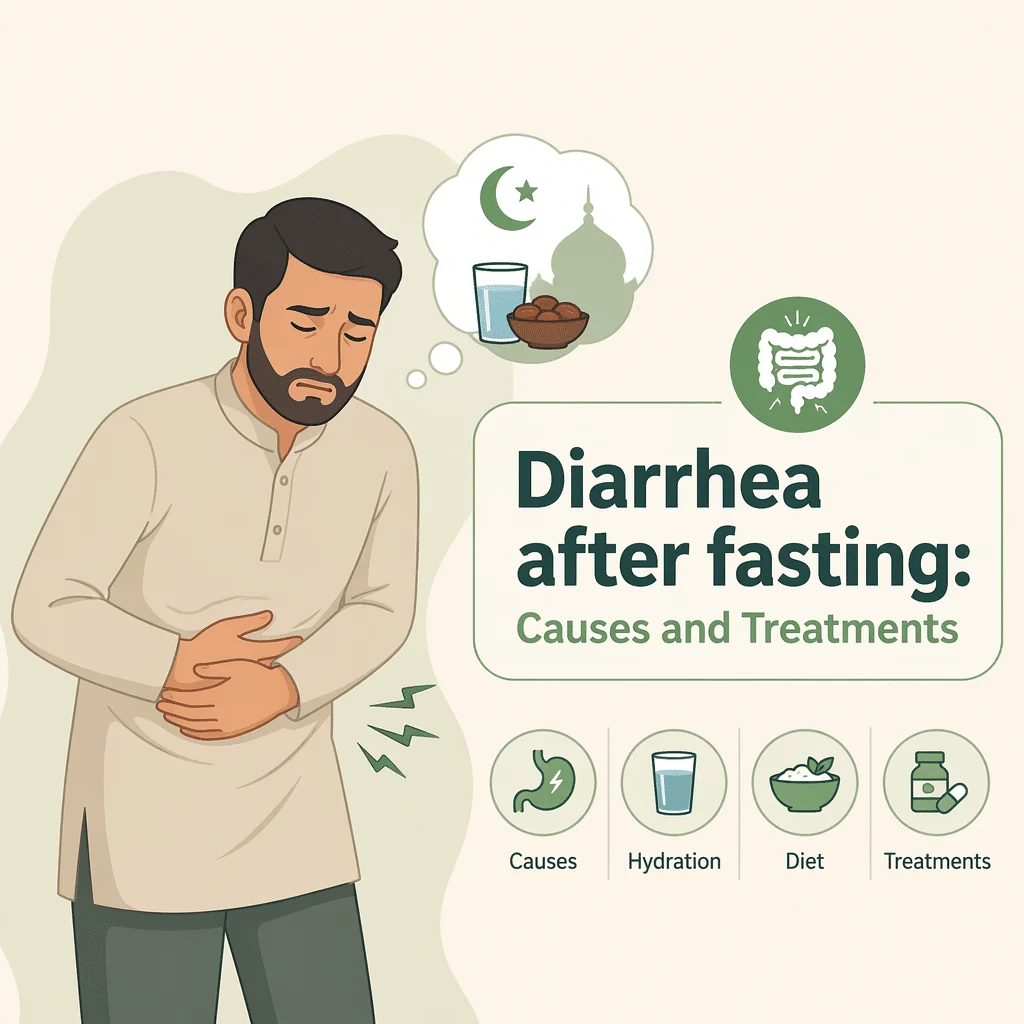
Diarrhea after fasting means loose or watery stools that begin soon after you start eating again, and it is a common experience whether you fast for religious reasons, follow an eating pattern that includes fasting hours, or go without food before a medical procedure. Most of the time it reflects ordinary digestive physiology reacting to the sudden arrival of food, not disease.
In this article you’ll learn what happens inside the gut while you fast and when you eat again, why the first meal so often sends you straight to the bathroom, which foods and drinks make it more likely, when the pattern is really an existing condition being revealed, and which warning signs mean you should contact a doctor.
What happens in your gut during a fast and when eating resumes
The digestive tract never fully switches off. When no food is arriving, the small intestine runs a slow housekeeping wave that sweeps leftover debris toward the colon. Digestive secretions drop, the gallbladder holds on to bile rather than releasing it, and the contractions that move contents along become less frequent.
Eating reverses all of this at once. The stomach stretches, hormones signal the pancreas and gallbladder to release enzymes and bile, and the tract shifts from idling to working. The longer the gap without food, the sharper that switch feels.
Two things then compete. The intestine has to absorb water, fat and sugar, while contractions push the contents along faster than usual. If transit outpaces absorption, water stays in the bowel and the result is a loose stool. That mismatch, rather than anything harmful in the food, explains most episodes.
The gastrocolic reflex and why the first meal hits hard
The gastrocolic reflex is the automatic signal that travels from a filling stomach to the colon, telling it to make room. Everyone has it. It is why many people need the bathroom shortly after breakfast, and why a large meal after a long gap can produce an urgent bowel movement well before that food could possibly have been digested.
The size and richness of the meal drives the strength of the reflex. A big plate eaten quickly stretches the stomach more, and a stronger stretch produces a stronger colonic response.
This is the single commonest reason for diarrhea after fasting: eating a lot, quickly, when the gut has been quiet. The colon’s main job is to reclaim water from what passes through it, so when contents move faster there is less time for that to happen.
What you eat when you break the fast
The composition of the first meal matters as much as its size. Three categories account for most food-related episodes.
Fat and the bile surge
Bile accumulates in the gallbladder during a fast, and the first fatty meal triggers a large, sudden release of it into the small intestine. Bile acids that are not reabsorbed further down reach the colon, where they draw water into the stool and stimulate contractions. Fried food, pastries, creamy sauces and rich meat dishes deliver a big fat load in one go.
Greasy, pale stools that float and are difficult to flush suggest fat is not being absorbed properly. That pattern is described in our guide to fatty stool.
Sugars, fructose and sugar alcohols
Concentrated sugar pulls water into the intestine by osmosis, meaning the gut dilutes it to match the body’s own fluid concentration. Fruit juices, syrupy desserts and large quantities of dried fruit deliver a lot of sugar at once.
Fructose, the sugar in fruit, honey and many soft drinks, is absorbed slowly and incompletely even in healthy people. Sugar alcohols such as sorbitol, mannitol and xylitol, found in sugar-free sweets, chewing gum and some liquid medicines, are absorbed poorly by design. The National Institute of Diabetes and Digestive and Kidney Diseases lists both as recognized causes of diarrhea. Whatever is not absorbed travels on to the colon, where bacteria ferment it into gas and acids, producing bloating, cramping and loose stools.
Caffeine on an empty stomach
Coffee and strong tea stimulate colonic activity directly, independently of their caffeine content, and on a gut that has been quiet for hours that stimulus lands harder. Caffeine also has a mild diuretic effect, which matters more when fluid intake is already low.
Dehydration and electrolyte changes
Many fasting patterns restrict fluids as well as food, and even those that do not often lead to drinking less, because eating and drinking usually happen together. The kidneys respond by conserving sodium and water.
Diarrhea then makes things worse, because stool losses carry both water and salts out of the body. Dizziness on standing, a dry mouth, very dark urine or unusual weakness suggest fluid depletion rather than a gut problem alone.
If symptoms are recurrent or severe, a doctor may order an electrolyte panel to see what has been lost. Blood tests can measure sodium levels and potassium levels, and where dehydration is a concern the same sample often includes a kidney function panel.
When a fast unmasks a condition that was already there
A fast does not usually create a digestive disorder. It changes what and how you eat, and that change can reveal something that was always present but previously blended into a mixed diet. The fast is the spotlight rather than the cause.
Milk taken with a full meal is handled differently from a large glass of milk on an empty stomach. Several conditions declare themselves this way.
Lactose intolerance
Lactase, the enzyme that breaks down milk sugar, declines with age in most of the world’s population. Someone who tolerates milk in tea all day may react clearly to a large dairy-based dish eaten alone. NIDDK describes lactose intolerance as producing bloating, gas, abdominal pain and diarrhea within a few hours of a lactose-containing food.
Celiac disease
Celiac disease is an immune reaction to gluten that damages the lining of the small intestine. It can appear at any age and is frequently missed for years. If bread-based meals reliably provoke symptoms alongside fatigue or unexplained anemia, it is worth discussing. Our article explains how doctors investigate gluten intolerance and celiac disease.
Irritable bowel syndrome and bile acid diarrhea
An unusually strong gastrocolic reflex, urgency after meals and alternating stool patterns can suggest irritable bowel syndrome, in which the gut and the nerves supplying it are more reactive than average.
Bile acid diarrhea is a separate and under-recognized cause. Bile acids that should be reabsorbed in the last part of the small intestine spill into the colon instead, producing urgent, watery, often yellow stools. It is more common after gallbladder removal and in Crohn’s disease. Because refeeding triggers a large bile release, this pattern can become obvious when a fast ends.
Infection and inflammatory bowel disease
An infection picked up before or during the fast will produce diarrhea regardless of what you eat, and often comes with fever or vomiting. Inflammatory bowel disease causes ongoing inflammation of the bowel wall. Doctors may order a fecal calprotectin test to distinguish inflammation from a functional cause, and may also request a complete blood count.
| Pattern you notice | What it usually points to | Reasonable next step |
|---|---|---|
| One loose stool after a large or rich meal, then normal | The gastrocolic reflex responding to volume and fat | No action needed; note what and how much you ate |
| Loose stools every time you break a fast, whatever you eat | Motility and bile timing, sometimes an underlying sensitivity | Keep a symptom and food record, and raise it with your doctor |
| Symptoms tied to one food group, such as dairy or wheat | An intolerance or celiac disease that the fast has revealed | Ask your doctor before cutting foods out, as testing needs them present |
| Urgent, watery, yellow stools, often after gallbladder surgery | Possible bile acid diarrhea | Ask for a medical assessment; specific tests exist |
| Diarrhea with pain, blood, fever or weight loss | Infection, inflammatory bowel disease or another cause needing review | Contact a doctor promptly, do not wait for it to settle |
| Symptoms after prolonged or severe food restriction | Possible refeeding syndrome, a medical emergency | Seek medical care before eating more; see the box below |
Refeeding syndrome: when starting to eat again needs medical supervision
Refeeding syndrome is a serious and potentially fatal complication of starting to eat again after prolonged or severe food restriction. It is not a digestive upset. It is a medical emergency.
When the body has been without adequate nutrition, its stores of phosphate, potassium and magnesium are depleted even if blood levels look normal. Reintroducing food raises blood glucose, insulin rises in response, and insulin drives phosphate and potassium rapidly into cells. Blood levels can then fall far enough to cause heart rhythm disturbances, breathing difficulty, seizures, confusion and cardiac arrest. Thiamine, a B vitamin used to process glucose, can also run out, with neurological consequences.
See a doctor before resuming normal eating, rather than following a web page, if any of these apply: you have gone without adequate food for a prolonged period; you have a very low body weight or have lost weight unintentionally; you have been vomiting repeatedly or misusing laxatives; you have a history of an eating disorder; you drink alcohol heavily; or you have a condition that impairs nutrient absorption.
Managed refeeding means blood tests before and during the reintroduction of food, correction of low electrolytes, thiamine and vitamin supplementation, and food reintroduced under supervision. Anyone in this situation should contact their doctor or attend an emergency department rather than self-manage.
Because phosphate, potassium and magnesium sit at the center of this problem, clinical teams monitor them closely, measuring phosphorus levels and magnesium levels repeatedly during the first days of eating again.
For most people breaking an ordinary daily fast, this risk does not apply. It applies to prolonged or severe restriction.
What generally helps after a fast
These are general principles, not a treatment plan, and they do not replace advice tailored to you.
Slowing down usually helps most. Eating the first meal gradually, and stopping before you feel very full, reduces the stomach stretch that drives the gastrocolic reflex. Splitting a meal into a smaller first portion followed by more later spreads the load.
Gentler food choices tend to be better tolerated. Meals lower in fat and in concentrated sugar place less demand on bile release and on absorption. Very spicy dishes, fruit juice, sugar-free sweets and strong coffee are worth noticing if symptoms recur.
Fluids matter throughout, not only once symptoms appear. If diarrhea has already happened, replacing fluid and salts becomes the priority, and rehydration solutions exist for that purpose; ask a pharmacist or doctor which product suits you rather than guessing. Avoid taking anti-diarrheal medicines without advice, because they are not appropriate for every cause.
A short record of what you ate, how quickly, and what followed is often more revealing than any single change, and gives a doctor something concrete to work with. Understanding normal and abnormal stool consistency makes that record more useful.
Red flags and when to see a doctor
Contact a doctor promptly, or seek urgent care, if diarrhea comes with any of the following:
- blood in the stool, or stools that are black and tarry
- severe or worsening abdominal pain
- fever
- persistent vomiting, or an inability to keep fluids down
- signs of dehydration such as dizziness, very dark urine, or passing no urine
- diarrhea lasting more than a few days, or that keeps returning
- unintentional weight loss
- symptoms in an infant, a young child, an older adult, someone who is pregnant, or anyone with a weakened immune system
Separately, and without alarm: if food, eating or fasting has started to feel distressing, or harder to control than you would like, that is worth raising with your doctor. It is a common thing to discuss, and a qualified professional can help.
AI DiagMe does not diagnose or rule out any condition; only a clinician who can examine you can do that.
Latest scientific advances in understanding fasting and digestion
The findings below are reported as they stand, without any suggestion that fasting is or is not advisable for you.
Digestive symptoms during Ramadan are usually mild, and existing gut conditions predict them best
A 2026 cross-sectional study — a survey capturing a group at a single point in time — of 696 university students in Palestine measured gastrointestinal symptoms during Ramadan using a standard questionnaire. Average symptom scores were mild. The strongest predictor was not the fasting itself but having a pre-existing chronic gut condition. Specific habits, including bread and sweet consumption at the evening meal and eating shortly before sleep, were also linked to symptoms.
What this means for you: if your gut reacts badly when you break a fast, an underlying condition is a more likely explanation than the fasting hours. A cross-sectional study shows associations but cannot prove cause, and self-reported symptoms are imprecise.
Digestive complaints appear in fasting trials, though overall side effect rates resemble comparison groups
A 2024 systematic review and meta-analysis — a study that pools results from many trials into one overall picture — combined 15 randomized controlled trials involving 1,365 adults. Rates of side effects such as fatigue and headache, and the proportion of people who dropped out, were not meaningfully different between intermittent fasting and comparison groups. Dizziness was numerically more frequent in one subgroup, without reaching statistical significance.
What this means for you: under supervised conditions, fasting patterns did not generate more reported adverse effects than the alternatives. The trials were short and enrolled a specific population, so they say little about people with existing digestive disease.
Consensus guidance emphasizes assessing refeeding risk in everyone
In 2025 the Australasian Society of Parenteral and Enteral Nutrition published consensus statements on refeeding syndrome. The group concluded that true refeeding syndrome is rare, but that every patient starting nutrition should be assessed for the risk of developing it. They recommend thiamine and multivitamin supplementation plus regular electrolyte monitoring for anyone at risk, with low electrolyte levels corrected according to local protocols.
What this means for you: the clinical answer to refeeding risk is monitoring and correction, not delaying food indefinitely, and it belongs in a medical setting. Consensus statements reflect expert agreement where trial evidence is thin, so the advice may change.
The gut microbiome shifts during fasting, but the meaning of those shifts is still unclear
A 2026 review synthesized human studies on Ramadan fasting and the gut microbiome — the community of bacteria living in the digestive tract. Studies report changes in microbial richness and in the balance of species during the fasting month. Findings were not consistent, and the authors describe the proposed mechanisms, including effects on bile acid handling, as hypothesis-generating rather than established.
What this means for you: the bacteria in your gut do appear to shift when eating patterns change, which is one plausible contributor to altered bowel habit. The studies were mostly small and observational, results conflicted, and much else changes during a fasting month at the same time.
Glossary of key terms
| Term | Definition |
|---|---|
| Gastrocolic reflex | The automatic signal from a filling stomach that prompts the colon to move its contents along, often creating an urge to open the bowels after a meal. |
| Refeeding | The process of eating again after a period of little or no food intake. |
| Refeeding syndrome | Dangerous shifts in phosphate, potassium and magnesium that can follow the reintroduction of food after prolonged or severe restriction. A medical emergency. |
| Bile acids | Substances made by the liver, stored in the gallbladder and released into the intestine to help digest fat. |
| Bile acid diarrhea | Watery diarrhea caused by bile acids reaching the colon instead of being reabsorbed in the small intestine. |
| Motility | The coordinated muscular movement that pushes food and fluid through the digestive tract. |
| Osmosis | The movement of water toward a more concentrated solution, which is how unabsorbed sugar draws fluid into the bowel. |
| Sugar alcohols | Sweeteners such as sorbitol, mannitol and xylitol, used in sugar-free products and absorbed poorly by the gut. |
| Electrolytes | Salts dissolved in body fluids, including sodium, potassium, magnesium and phosphate, that keep nerves, muscles and the heart working. |
| Gut microbiome | The community of bacteria and other microbes living in the digestive tract. |
Frequently asked questions
Is it normal to have diarrhea after fasting?
A single loose stool after the first substantial meal is common and rarely a cause for concern. The gut has been running slowly, then receives a large volume of food and a surge of bile all at once, and the colon responds by moving things along quickly. What is not routine is diarrhea that keeps happening whatever you eat, diarrhea that comes with pain, blood or fever, or diarrhea that follows a prolonged period of very low food intake. Those situations deserve a medical opinion rather than reassurance from a web page.
How long does diarrhea after fasting usually last?
When the cause is simply a large meal after a gap, symptoms typically settle within a day, often after one or two loose stools. If loose stools persist beyond a few days, keep returning each time you eat, or are accompanied by vomiting, fever or signs of dehydration, that pattern no longer fits a straightforward reflex response and should be assessed. Persistent diarrhea also carries a real risk of fluid and salt depletion, which is the main reason not to simply wait it out.
What should I eat when I break a fast?
There is no universal formula, and this article deliberately avoids prescribing one. As general principles, most people tolerate a smaller first portion better than a large one, eaten slowly rather than quickly. Meals lower in fat and in concentrated sugar tend to sit more comfortably, because they place less demand on bile release and on absorption. Fluids taken steadily rather than in one large volume are usually easier on the gut. If you have a medical condition, take regular medicines, or have been restricting food for a prolonged period, ask your doctor or a registered dietitian for advice specific to you rather than following general guidance.
Why are my stools yellow after fasting?
Yellow, loose and urgent stools often reflect rapid transit: bile normally darkens stool as it is processed on the way through, so when contents move quickly the yellow-green color of bile persists. Fat that has not been absorbed can also lighten the color and make stools greasy or hard to flush. A single yellow stool after a rich meal is usually unremarkable. A repeated pattern, particularly after gallbladder surgery, may point toward bile acid diarrhea or a problem with fat absorption and is worth raising with a doctor.
I had diarrhea after not eating for a day or two. What does that mean?
The same mechanisms apply whether the gap in eating was planned or not. A longer gap generally means a slower gut, a fuller gallbladder and a stronger response to the first meal. If you did not eat because you were unwell, an infection may be the underlying cause of both the loss of appetite and the diarrhea. If you did not eat because food has been difficult for you, or because intake has been low for a while, speak to a doctor before returning to normal eating, because that situation carries a different and more serious risk.
Do probiotics help with diarrhea after fasting?
Evidence for probiotics in diarrhea is mixed and depends heavily on the specific strain, the dose and the underlying cause. There is no good evidence that they prevent the ordinary reflex response to a large meal after a fast. Some people find them helpful and most tolerate them well, but they are not a substitute for identifying why the diarrhea is happening. If symptoms are frequent, discuss them with your doctor or a pharmacist before spending money on supplements.
Sources
- National Institute of Diabetes and Digestive and Kidney Diseases. Symptoms & Causes of Diarrhea
- National Institute of Diabetes and Digestive and Kidney Diseases. Symptoms & Causes of Lactose Intolerance
- MedlinePlus, National Library of Medicine. Diarrhea
- Persaud-Sharma D, Saha S, Trippensee AW. Refeeding Syndrome. StatPearls, NCBI Bookshelf, National Library of Medicine
- Al-Amouri F, Abu Salah D, Al-Mohor S, et al. Gastrointestinal symptoms and eating patterns during Ramadan fasting among university students in Palestine: a cross-sectional study. BMC Public Health, 2026
- Zhong F, Zhu T, Jin X, et al. Adverse events profile associated with intermittent fasting in adults with overweight or obesity: a systematic review and meta-analysis of randomized controlled trials. Nutrition Journal, 2024
- Matthews-Rensch K, Blackwood K, Lawlis D, et al. The Australasian Society of Parenteral and Enteral Nutrition: Consensus statements on refeeding syndrome. Nutrition & Dietetics, 2025
- Shahbazi S, Aminzadeh S, Taati Moghadam M, et al. Ramadan intermittent fasting and the gut microbiome: modulation of diversity and implications for metabolic health. Frontiers in Nutrition, 2026
Further reading
- Stool culture test
- Crohn’s disease
- Low albumin
- Dehydration and blood pressure
- Fasting before a blood test
Understand your lab results with AI DiagMe
If your doctor has investigated recurrent diarrhea, your results may include an electrolyte panel, magnesium and phosphate levels, celiac screening or a complete blood count. Those numbers are easy to misread on your own. AI DiagMe explains what each marker measures and what a result outside the reference range can mean, in plain language. It helps you understand your report and prepare better questions; it does not diagnose and does not replace your doctor.
Get your results interpreted in minutes