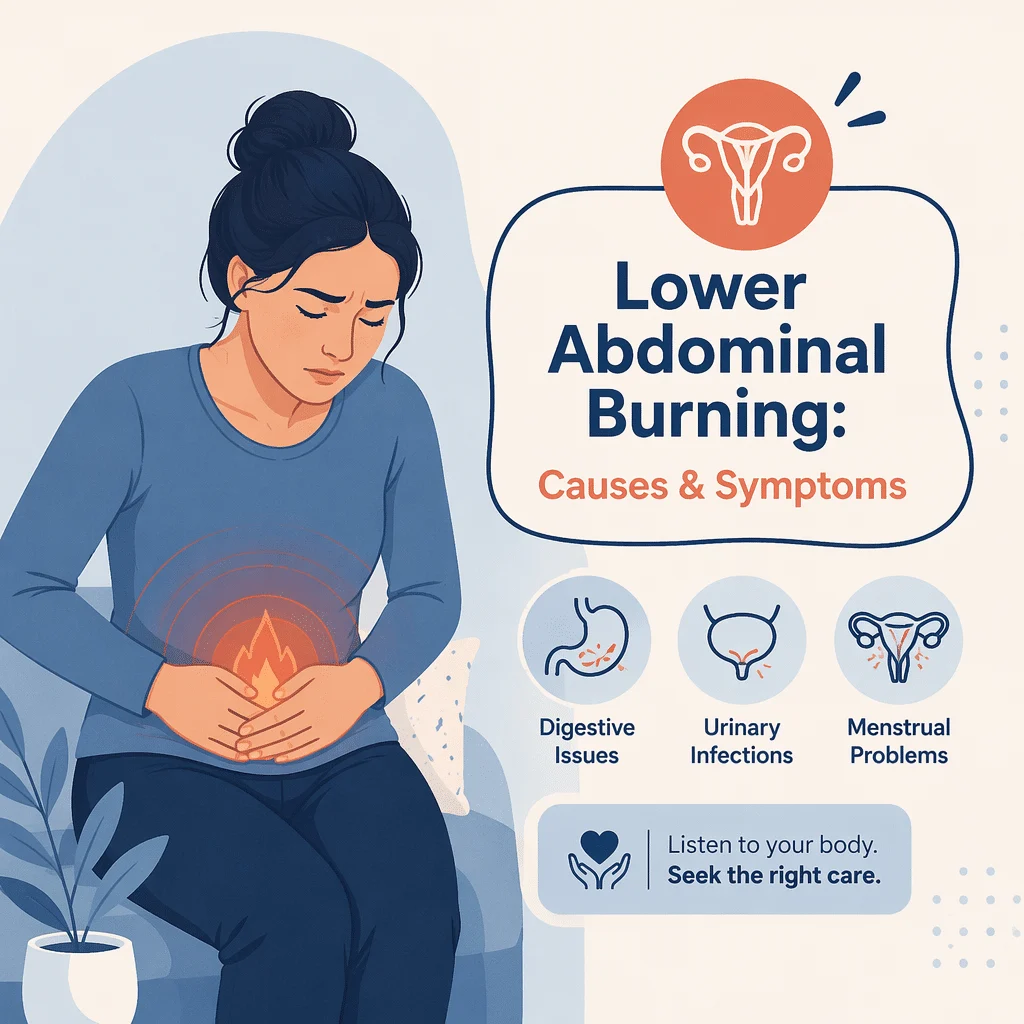
A burning sensation in lower abdomen can feel like heat, stinging, rawness or a hot ache below the belly button. It may come from the bladder, the bowel, the reproductive organs, the abdominal wall or the nerves running across it.
In this article you’ll learn what burning usually signals, why the exact spot narrows things down far less than people expect, which conditions cause it most often, which ones are genuine emergencies, and what a clinician does to tell them apart.
Read the box immediately below before anything else. Several causes of lower abdominal pain are time-critical, and neither an article nor a home test can rule them out.
Red flags: when lower abdominal pain is an emergency
⚠️ Ectopic pregnancy. Lower abdominal pain in anyone who could be pregnant is a medical emergency until proven otherwise, especially with a missed or unusual period, vaginal bleeding, shoulder-tip pain, dizziness or fainting. A negative home pregnancy test does not exclude it when the symptoms fit. Seek emergency care the same day.
⚠️ Appendicitis. Pain starting around the navel and shifting to the lower right side, worsening over hours, with nausea, fever, or pain on moving or coughing, needs urgent assessment.
⚠️ Ovarian torsion. Sudden, severe, one-sided pelvic pain, often with vomiting, is an emergency. The ovary can lose its blood supply within hours.
⚠️ Testicular torsion. In males, sudden severe pain in a testicle or groin can be felt in the lower abdomen. It is time-critical and needs emergency care immediately.
Also seek urgent care for: fever with abdominal pain; being unable to pass urine at all; blood in the urine or stool; black tarry stools; an abdomen that feels rigid or board-like; pain far out of proportion to what can be seen or felt; persistent vomiting; or pain with fainting or collapse.
In their early hours these conditions overlap heavily with harmless ones. That is precisely why they cannot be sorted out at home.
What burning in the lower abdomen usually means
Burning tends to be reported when the lining of a hollow organ is inflamed, when urine or acid irritates a sensitive surface, or when a nerve is involved. That covers a lot of ground.
The bladder is a common source because its lining is richly supplied with sensory nerves. The bowel more often produces cramping, though a distended or inflamed segment can burn too. Nerves entering the abdominal wall can produce a burning band across a strip of skin rather than deep inside.
Internal organs also share nerve pathways with the skin over a wide area. This is why appendicitis often starts as vague pain near the navel before settling on the right, and why a stone in the ureter can be felt in the groin or testicle. Location is a hint, not a verdict.
Timing and companion symptoms matter more than the word you choose. Burning only when you pass urine points somewhere quite different from burning that eases after a bowel movement, or that arrives mid-cycle and lasts a day.
Urinary causes of burning in the lower abdomen
Bladder infection and cystitis
A urinary tract infection affecting the bladder is one of the most frequent causes of burning low in the abdomen. The National Institute of Diabetes and Digestive and Kidney Diseases lists burning during urination, frequent urges, and pain or discomfort in the lower abdomen as the core symptoms. Urine may look cloudy or smell strong.
Fever, back or flank pain, shivering and feeling generally unwell suggest the infection has reached a kidney, which is a different and more serious situation.
A urine sample is usually the first step. A dipstick looks for white cells and nitrites, with the fuller picture in a urinalysis report. Any blood in the urine needs a clinician’s interpretation.
Interstitial cystitis and bladder pain syndrome
Some people have persistent bladder pain, pressure and frequency without any infection ever being found. This is interstitial cystitis, also called bladder pain syndrome. The burning is chronic rather than sudden, often worsens as the bladder fills, and may ease briefly after passing urine. Repeated negative urine cultures alongside ongoing symptoms are a common thread, and diagnosis is one of careful exclusion rather than a single test.
Kidney stones moving into the lower ureter
A stone travelling from the kidney toward the bladder produces severe waves of pain starting in the flank and moving into the lower abdomen and groin. Near the bladder it can mimic an infection exactly: burning on urination, urgency and frequency, often with nausea, vomiting and blood in the urine. Kidney stones should be assessed rather than ridden out at home.
Digestive causes
Bowel conditions rarely cause burning on urination, which is a helpful early separator.
Irritable bowel syndrome and constipation
Irritable bowel syndrome produces cramping or burning linked to bowel habit: pain that eases after opening the bowels, or changes as stool becomes looser or harder. Constipation alone can stretch the left colon enough to cause a persistent low ache.
Gastroenteritis and diverticulitis
Gastroenteritis brings cramping, diarrhea, nausea and sometimes fever over a few days. Diverticulitis is different: inflammation of small pouches in the colon wall, classically causing left lower quadrant pain with fever and a change in bowel habit. The NIDDK notes this pain is usually severe. It needs assessment rather than watching.
Inflammatory bowel disease and celiac disease
Crohn’s disease and ulcerative colitis cause inflammation producing lower abdominal pain, urgency, diarrhea, blood in the stool, weight loss and fatigue. Doctors often measure fecal calprotectin, a stool marker that helps separate bowel inflammation from irritable bowel syndrome. Celiac disease can also cause bloating and altered bowels, and is investigated with blood tests before any change to diet, because removing gluten first makes those tests unreliable.
Gynecological causes
The reproductive organs sit directly behind and beside the bladder, so pain from them is often felt as low abdominal or pelvic burning.
Ovulation pain
Mittelschmerz is one-sided lower abdominal pain around the middle of the cycle, when an egg is released. It lasts hours to a day or two and settles on its own. The problem is that a first episode looks very much like the start of something serious, which is why sudden severe one-sided pain still deserves assessment.
Ovarian cysts
An ovarian cyst may cause a dull ache, pressure or bloating on one side, and a cyst that ruptures can cause abrupt sharp pain. A large cyst also raises the risk of ovarian torsion.
Endometriosis
Endometriosis is tissue similar to the uterine lining growing outside the uterus. It causes pelvic pain that is often worse around periods, painful sex, and bladder or bowel symptoms that get mistaken for cystitis or irritable bowel syndrome for years. Diagnosis is frequently delayed, and a normal examination or scan does not exclude it.
Pelvic inflammatory disease
Pelvic inflammatory disease is infection of the upper reproductive organs, most often after a sexually transmitted infection. The US Office on Women’s Health lists lower abdominal pain as the most common symptom, alongside fever, unusual discharge, painful sex, pain on urinating and irregular bleeding. It can also be mild or silent, and untreated it raises the future risk of ectopic pregnancy and infertility.
Hernia, abdominal wall and nerve causes
An inguinal hernia is tissue bulging through a weak spot in the groin. It often shows as a lump that appears on standing, coughing or straining and disappears on lying down, with dragging or burning discomfort. A hernia that becomes hard, tender and will not push back, especially with vomiting, may be trapped and needs emergency care.
Abdominal wall pain is easy to miss. Pain from the wall itself stays in a small, precisely pointed spot and often becomes more tender when the abdominal muscles are tensed, whereas pain from inside usually becomes less tender. This is the principle behind Carnett’s test. Lifting, coughing and recent surgical scars are common triggers.
Nerve-related burning is another pattern. Irritation of nerves such as the ilioinguinal can create a burning band across the lower abdomen or groin, sometimes with altered skin sensation. Shingles produces a burning strip of pain on one side of the body that may precede the rash by days.
The time-critical causes and why they cannot be excluded at home
Four conditions dominate the urgent end of this symptom, and none can be reliably identified or dismissed without clinical assessment.
Ectopic pregnancy is a pregnancy implanting outside the uterine cavity, usually in a fallopian tube, and it is the leading cause of maternal death in early pregnancy. Its early symptoms are pelvic pain and light vaginal bleeding, which are also the symptoms of many harmless things. MedlinePlus advises seeking care immediately for abdominal pain, shoulder pain, vaginal bleeding or feeling dizzy or faint in early pregnancy, and states plainly that it cannot be diagnosed without blood tests and an ultrasound. Home urine tests can be falsely negative very early or when hormone levels are low, so a negative result does not close the question.
Appendicitis classically begins with vague central pain that migrates to the right lower quadrant over hours. The NIDDK notes the pain typically worsens with movement, deep breaths, coughing or sneezing, and that some people, especially children, have none of the typical symptoms. There is no home test.
Ovarian torsion happens when an ovary twists on its ligaments and cuts off its own blood supply, presenting as sudden severe one-sided pelvic pain, often with vomiting. Delay risks losing the ovary.
Testicular torsion is the male equivalent and even more time-sensitive. The pain is sudden and severe in the testicle or scrotum and frequently radiates to the lower abdomen or groin, so it can be mistaken for a stomach problem. Any male with sudden severe testicular or groin pain needs emergency assessment straight away.
The pattern in all four is the same: the early picture is unremarkable, the window for a good outcome is short, and the deciding information comes from an examination, a blood or urine test and a scan rather than from symptoms.
| Pattern you notice | What it usually points toward | What to do |
|---|---|---|
| Burning when passing urine, with urgency and frequency | Bladder infection, or a stone sitting near the bladder | See a clinician within a day or two; sooner with fever, flank pain or blood in urine |
| Pain in the lower left side with fever and a change in bowel habit | Diverticulitis is the classic explanation | Same-day medical assessment |
| Sudden severe one-sided pelvic or testicular pain, often with vomiting | Possible ovarian or testicular torsion | Emergency care immediately |
| Any lower abdominal pain in someone who could be pregnant | Ectopic pregnancy must be excluded first | Emergency care the same day, even if a home test was negative |
| Cramping or burning that eases after opening the bowels | More typical of irritable bowel syndrome or constipation | Routine appointment; urgent if there is bleeding, weight loss or fever |
| Central pain shifting to the lower right over hours, worse on coughing | Suggestive of appendicitis | Urgent assessment, do not wait overnight |
What a clinician actually does
The history covers where the pain started and where it is now, how fast it built up, what makes it better or worse, urinary and bowel symptoms, menstrual and sexual history, and previous surgery. Sequence matters: pain that came before vomiting is read differently from vomiting that came first.
The examination checks tenderness in each quadrant, guarding and rebound, the groin for a hernia and, where relevant, the scrotum.
Tests answer specific questions rather than cast a wide net. A urine dipstick screens for infection and blood. A pregnancy test is done for anyone who could be pregnant, and this is not optional. Blood tests may include a complete blood count, C-reactive protein and kidney function. Imaging is usually ultrasound first, especially for pelvic and testicular problems, with a CT scan when the picture points toward the bowel. In early pregnancy, ultrasound is paired with quantitative hCG blood levels, sometimes repeated after 48 hours.
When to seek urgent care
Go to an emergency department now if you have sudden severe one-sided pelvic or testicular pain, lower abdominal pain and any possibility of pregnancy, a rigid abdomen, fainting, persistent vomiting, an inability to pass urine, black tarry stools, or pain that is escalating rapidly.
Arrange a same-day or next-day appointment for burning on urination with fever or back pain, left-sided pain with fever, a new tender lump in the groin, or pain steadily worsening over more than a day.
Book a routine appointment for burning or cramping present for weeks without red flags, for cyclical pelvic pain, or for symptoms that keep returning. Persistent pelvic pain that has been dismissed before is still worth pursuing, because delayed diagnosis is well documented in endometriosis.
Latest scientific advances in diagnosing lower abdominal pain
Research since 2023 has focused less on new treatments and more on how quickly and reliably these conditions can be identified. According to PubMed, the following findings help explain why clinicians investigate the way they do.
A 2024 review of ectopic pregnancy in Nature Reviews Disease Primers by Chong and colleagues confirmed that non-invasive diagnosis still rests on transvaginal ultrasound combined with serum beta-hCG, the pregnancy hormone measured in blood. What this means for you: an ectopic pregnancy is identified by combining an internal scan with a blood test, not by symptoms and not by a home urine test. DOI: 10.1038/s41572-024-00579-x
A 2024 emergency medicine review by Jeffers, Koyfman and Long in the American Journal of Emergency Medicine reported that many patients with confirmed ectopic pregnancy have no identifiable risk factor, and that ultrasound is required regardless of the hCG level. What this means for you: having none of the classic risk factors does not make you safe, and one hormone reading is not enough to close the case. DOI: 10.1016/j.ajem.2024.09.005
A 2024 systematic review by Tomlinson and colleagues in Clinical Microbiology and Infection assessed rapid point-of-care tests for urinary tract infection and found insufficient evidence to support their routine use. What this means for you: fast bladder-infection tests are not yet a substitute for a clinician’s assessment and laboratory culture. DOI: 10.1016/j.cmi.2023.10.005
A 2025 review of endometriosis in JAMA by As-Sanie and colleagues reported that diagnosis is typically delayed by five to twelve years, with most patients seeing three or more clinicians first, and that a normal examination and normal imaging do not exclude it. What this means for you: if pelvic pain keeps returning, a reassuring scan is not the end of the investigation. DOI: 10.1001/jama.2025.2975
A 2023 systematic review by Issaiy and colleagues in the World Journal of Emergency Surgery examined machine learning models supporting the diagnosis of acute appendicitis and found they often matched or beat traditional clinical scoring systems, while noting that most studies carried a risk of bias. What this means for you: such tools may help emergency teams decide faster who needs a scan, but they are aids for clinicians, not a replacement for being seen. DOI: 10.1186/s13017-023-00527-2
Glossary of key terms
| Term | Definition |
|---|---|
| Ectopic pregnancy | A pregnancy that implants outside the uterine cavity, most often in a fallopian tube. A medical emergency. |
| hCG | Human chorionic gonadotropin, the pregnancy hormone. Detected by urine tests and measured precisely in blood. |
| Cystitis | Inflammation of the bladder, most commonly from a bacterial infection. |
| Interstitial cystitis | Long-term bladder pain, pressure and urinary frequency without an infection being found. Also called bladder pain syndrome. |
| Ureter | The narrow tube carrying urine from a kidney down to the bladder. A stone stuck here causes severe pain. |
| Diverticulitis | Inflammation or infection of small pouches in the wall of the colon, classically causing left lower abdominal pain with fever. |
| Mittelschmerz | One-sided lower abdominal pain occurring around ovulation, in the middle of the menstrual cycle. |
| Ovarian torsion | Twisting of an ovary on its supporting ligaments, cutting off its blood supply. An emergency. |
| Carnett’s test | An examination maneuver that helps distinguish pain arising from the abdominal wall from pain arising inside the abdomen. |
| Fecal calprotectin | A stool test marker of inflammation in the intestine, used to help separate inflammatory bowel disease from irritable bowel syndrome. |
Frequently asked questions
When is lower abdominal pain an emergency?
Treat it as an emergency if the pain is sudden and severe on one side, if you could be pregnant, if your abdomen feels rigid, if you faint or feel close to fainting, if you cannot pass urine at all, if you are vomiting persistently, or if you pass black tarry stools or visible blood. Fever combined with abdominal pain also warrants same-day assessment. Pain that escalates over hours rather than settling is another warning sign. These features do not tell you what is wrong, but they do tell you that the question needs answering in person and quickly rather than being watched at home.
Can a burning sensation in the lower abdomen be a sign of pregnancy?
Mild stretching or cramping sensations are commonly reported in early pregnancy, but burning low in the abdomen is not a reliable pregnancy sign in either direction. The important point runs the other way: if you could be pregnant and you have lower abdominal pain, an ectopic pregnancy has to be ruled out before anything else is considered. That requires a blood test and an ultrasound. A negative home urine test does not settle it, because hormone levels can be too low to detect very early or in an abnormally implanted pregnancy. Seek assessment the same day.
How do I know if my burning is a UTI or something else?
You often cannot know from symptoms alone, which is the honest answer. Burning specifically while passing urine, together with urgency and frequency, makes a bladder infection more likely, but a stone sitting near the bladder can produce an identical pattern, and pelvic inflammatory disease can too. A urine test is what separates them, and a culture identifies whether bacteria are actually present. If the burning comes with fever, back or flank pain, shivering, blood in the urine, or you are pregnant, do not wait to find out. Get assessed.
Why does my lower abdomen burn but only sometimes?
Intermittent burning usually has a trigger worth noticing. Pain that flares mid-cycle and lasts a day or so suggests ovulation. Pain tied to periods suggests a gynecological cause such as endometriosis. Pain that eases after opening the bowels points toward the bowel. Pain only on urination points to the urinary tract. Pain that appears after lifting or exercising and can be pinpointed with one finger suggests the abdominal wall. Keeping a simple note of when it happens and what else is going on gives a clinician far more to work with than the sensation alone.
Is it dangerous to wait and see if lower abdominal burning goes away?
It depends entirely on the company it keeps. Mild burning with no fever, no bleeding, no vomiting and no possibility of pregnancy can reasonably be reviewed by a clinician within a day or two. But several serious causes lose their treatment window in hours, and their early appearance can be underwhelming. If any of the red flags above apply, waiting is the risk rather than the safe option. When you are unsure whether something counts as a red flag, that uncertainty is itself a reason to be assessed.
Can men get burning in the lower abdomen from something urgent?
Yes. Bladder infections, kidney stones, appendicitis, diverticulitis, hernias and abdominal wall problems all occur in men. Prostate inflammation can cause pelvic burning and painful urination. The one that most often gets missed is testicular torsion, because the pain can be felt in the lower abdomen or groin rather than obviously in the scrotum, and because embarrassment delays presentation. Sudden severe testicular, scrotal or groin pain in a male of any age is an emergency and should be assessed immediately.
Sources
- National Institute of Diabetes and Digestive and Kidney Diseases — Bladder Infection (Urinary Tract Infection) in Adults
- National Institute of Diabetes and Digestive and Kidney Diseases — Symptoms and Causes of Appendicitis
- National Institute of Diabetes and Digestive and Kidney Diseases — Diverticular Disease
- MedlinePlus, US National Library of Medicine — Ectopic Pregnancy
- US Office on Women’s Health — Pelvic Inflammatory Disease
- Chong KY, de Waard L, Oza M, van Wely M, Jurkovic D, Memtsa M, Woolner A, Mol BW. Ectopic pregnancy. Nature Reviews Disease Primers. 2024;10(1):94
- Jeffers K, Koyfman A, Long B. Updates in emergency medicine: Ectopic pregnancy. American Journal of Emergency Medicine. 2024;85:90-97
- Tomlinson E, Jones HE, James R, Cooper C, Stokes C, Begum S, Watson J, Hay AD, Ward M, Thom H, Whiting P. Clinical effectiveness of point of care tests for diagnosing urinary tract infection: a systematic review. Clinical Microbiology and Infection. 2024;30(2):197-205
- As-Sanie S, Mackenzie SC, Morrison L, Schrepf A, Zondervan KT, Horne AW, Missmer SA. Endometriosis: A Review. JAMA. 2025;334(1):64-78
- Issaiy M, Zarei D, Saghazadeh A. Artificial Intelligence and Acute Appendicitis: A Systematic Review of Diagnostic and Prognostic Models. World Journal of Emergency Surgery. 2023;18(1):59
Further reading
- Pregnancy test guide: accuracy and interpretation
- CRP: the C-reactive protein inflammation marker
- Blood tests during pregnancy
- Crohn’s disease: understanding, treating and living with it
- Distended bladder: symptoms, causes and treatments
Understand your lab results with AI DiagMe
If a doctor investigates lower abdominal pain, you may leave with a urine test, inflammatory markers, a complete blood count or a pregnancy blood test, and often very little explanation of what the numbers mean.
AI DiagMe helps you understand those results in plain language once you have them. It does not diagnose you, it does not triage your symptoms, and it is not for emergencies. If you have any of the red flags described above, seek medical care now.
Get your results interpreted in minutes