






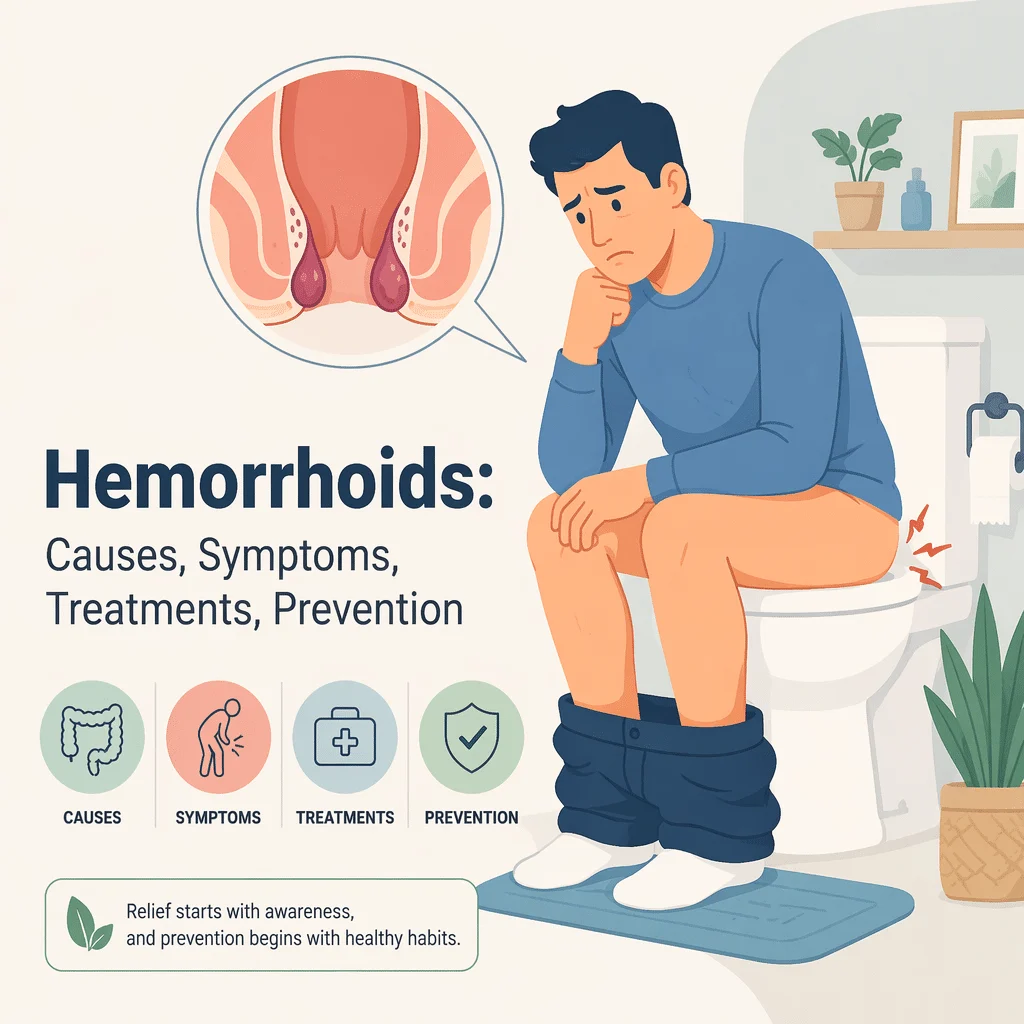
Haemorrhoids are swollen blood vessels in and around the anus and lower rectum, and they are one of the most common reasons adults notice bleeding, itching, or discomfort during a bowel movement. They are also one of the most under-discussed conditions, because the area feels private and even a little embarrassing. That silence is unfortunate, because haemorrhoids are extremely common, usually harmless, and very treatable once you understand what is happening. In this article you’ll learn what haemorrhoids are, why they develop, how to tell internal from external ones, which treatments actually help, and how to know when bleeding deserves a closer look rather than a guess. Along the way, we explain the lab tests that can matter when symptoms do not settle.
What Are Haemorrhoids?
Everyone has haemorrhoidal tissue. These are normal cushions of blood vessels, connective tissue, and small muscle fibres that sit in the anal canal and help control continence. Problems begin when these cushions become swollen, stretched, or slip out of place. When people say they “have haemorrhoids,” they mean this swollen, symptomatic version of otherwise normal anatomy.
Doctors sort haemorrhoids by where they form relative to the dentate line, an invisible border inside the anal canal that separates tissue with many pain nerves from tissue with very few. That single detail explains why some haemorrhoids hurt and others do not, and it guides which treatment is likely to work.
Internal Haemorrhoids
Internal haemorrhoids develop above the dentate line, inside the rectum, where there are few pain-sensing nerves. As a result, they often cause painless bleeding rather than pain. Their most common sign is bright-red blood on the toilet paper, coating the stool, or dripping into the bowl. Larger internal haemorrhoids can bulge out of the anus, a change called prolapse.
External Haemorrhoids
External haemorrhoids form below the dentate line, under the sensitive skin around the anal opening. Because this skin is rich in nerves, external haemorrhoids are more likely to itch, swell, and hurt. If a blood clot forms inside one, it becomes a thrombosed haemorrhoid, which can cause sudden, sharp pain and a firm purple lump. Many people have mixed haemorrhoids, meaning internal and external tissue are both involved at once.
| Feature | Internal haemorrhoids | External haemorrhoids |
|---|---|---|
| Location | Above the dentate line, inside the rectum | Below the dentate line, under the skin around the anus |
| Typical symptoms | Painless bright-red bleeding; prolapse (tissue bulging out) | Itching, swelling, a tender lump; pain if a clot forms |
| Pain | Usually painless (few nerve endings) | Often painful (skin has many nerve endings) |
| How it is examined | Anoscopy or during a colon exam | Visible on outside inspection |
Internal haemorrhoids are also described by grade, which reflects how much they prolapse. Grading matters because it often decides whether simple home care is enough or whether an office procedure will help.
| Grade | What it means |
|---|---|
| Grade I | Bulge slightly but do not prolapse; may bleed |
| Grade II | Prolapse when straining but slide back on their own |
| Grade III | Prolapse and must be pushed back in by hand |
| Grade IV | Stay prolapsed and cannot be pushed back |
What Causes Haemorrhoids? Common Causes and Risk Factors
Haemorrhoids form when pressure inside the anal cushions rises repeatedly, stretching the vessels and the tissue that holds them in place. Most causes trace back to that one idea: anything that increases pressure in the pelvic and anal area, day after day, makes haemorrhoids more likely.
Everyday Habits and Pressure
Straining on the toilet is the classic trigger, especially when it is driven by constipation or hard stools. Sitting for long stretches, including long stays on the toilet with a phone, keeps blood pooled in the area. A low-fibre diet, not drinking enough water, and heavy lifting all raise the same kind of pressure. Chronic diarrhoea can irritate the tissue just as much as constipation.
Life Stages and Health Conditions
Pregnancy is a well-known cause, because the growing uterus presses on pelvic veins and hormones relax vessel walls; many cases appear in the third trimester or after delivery. Ageing weakens the supporting tissue, so haemorrhoids become more common with each decade. Obesity and a family tendency towards weak vein walls add to the risk. By around age 50, close to half of adults have dealt with haemorrhoids at some point, according to the American College of Gastroenterology.
Symptoms and Signs of Haemorrhoids
The symptoms of haemorrhoids depend heavily on whether they are internal, external, or mixed. Recognising the pattern helps you judge how urgent the situation is and which relief measures make sense.
Bleeding, Itching, and Discomfort
Painless, bright-red bleeding is the hallmark of internal haemorrhoids. External haemorrhoids more often bring itching, a feeling of fullness, swelling, and soreness that worsens when you sit. Some people notice mucus, skin irritation, or a soft lump they can feel near the opening. Symptoms frequently flare for a few days and then quiet down, which is why many flare-ups never reach a doctor.
Thrombosed Haemorrhoids
When a clot forms in an external haemorrhoid, the pain can arrive quickly and feel intense. A thrombosed haemorrhoid usually shows up as a hard, bluish lump that is tender to the touch. The pain often peaks within the first two or three days and then eases as the body reabsorbs the clot. Severe or worsening pain is a reason to be seen promptly, since early treatment can bring faster relief.
Diagnosis: Why Not All Rectal Bleeding Is Haemorrhoids
A haemorrhoid diagnosis usually starts with a conversation about your symptoms and a physical examination. The most important idea in this whole article is simple: bleeding from the bottom is a symptom, not a diagnosis. Haemorrhoids are the most common cause, but anal fissures, inflammation, polyps, and, less often, cancer can look similar at first. Because several conditions share the same sign, it is worth taking a moment to read our detailed guide to rectal bleeding.
How Doctors Examine Haemorrhoids
Clinicians confirm haemorrhoids by looking at the area and, for internal ones, by using a short lighted scope called an anoscope. A gloved finger examination, known as a digital rectal examination, checks for lumps and tenderness. If the bleeding pattern is unusual, or you have other risk factors, your clinician may recommend a colonoscopy, which can detect an early colorectal cancer long before it causes serious trouble.
Reading the Clues in Your Symptoms
The colour and timing of bleeding offer clues. Bright-red blood that coats the stool or drips into the bowl points towards the anal area, whilst darker, tarry stool suggests bleeding higher in the digestive tract; our guide explains what causes black specks in stool. If inflammation is a concern, a stool test can measure faecal calprotectin, which helps separate an irritable bowel pattern from inflammatory bowel disease.
When to See a Doctor
Most haemorrhoid flare-ups are safe to manage at home. Still, some signs mean you should book an appointment rather than wait, mainly to rule out other causes of bleeding. See a clinician if you notice any of the following:
- Bleeding that lasts more than a week, keeps coming back, or is heavy
- Black, tarry, or maroon stools, which can signal bleeding higher up
- A change in your normal bowel habits, stool calibre, or new constipation and diarrhoea
- Rectal bleeding for the first time, especially if you are over 45
- A personal or family history of colorectal cancer, polyps, or inflammatory bowel disease
- Bleeding with unexplained weight loss, fatigue, dizziness, or paleness
- Severe anal pain, or a hard lump that is rapidly getting worse
Ongoing or heavy bleeding can slowly add up. Over months, small repeated losses can quietly produce iron-deficiency anaemia. When bleeding is significant, your doctor may order a complete blood count test to see whether your red cells are affected, and blood work done afterward frequently reveals low ferritin, the protein that reflects your iron stores. To see the fuller picture, your clinician may also request an iron studies panel.
Treatment: From Home Care to Procedures
Treatment for haemorrhoids follows a ladder. Almost everyone starts at the bottom rung with simple measures, and only a minority need procedures or surgery. The goal is to relieve symptoms and, just as importantly, to remove the pressure that caused the problem in the first place.
Home and Lifestyle Care
First-line care is the same care that prevents haemorrhoids: more fibre, more water, and no straining. A warm sitz bath, sitting in a few inches of plain warm water for ten to fifteen minutes, eases spasm and soreness. Over-the-counter creams, witch hazel pads, and short courses of medicated ointments can calm itching and swelling, though they treat symptoms rather than the cause. Gentle cleaning and avoiding long toilet sits also help the tissue recover.
Office Procedures
When internal haemorrhoids keep bleeding or prolapsing despite good home care, quick office procedures often solve the problem without surgery. Rubber band ligation is the most common: the clinician places a tiny band at the base of an internal haemorrhoid, cutting off its blood supply so it shrinks and falls away within days. Other options include sclerotherapy, where a solution is injected to collapse the vessel, and heat- or laser-based techniques. These are done in minutes, usually without anaesthesia.
Surgery for Advanced Cases
A small share of haemorrhoids, usually large, prolapsing, grade III or IV cases, need surgery. Haemorrhoidectomy removes the tissue and offers the most durable results, especially for mixed disease. Newer approaches aim to reduce blood flow to the haemorrhoids or lift prolapsed tissue with fewer days of recovery. A colorectal surgeon can match the method to your anatomy, your symptoms, and your overall health.
Preventing Haemorrhoids
Prevention is largely about protecting your bowel habits. Aim for 25 to 35 grams of fibre a day from vegetables, fruit, legumes, and whole grains, and increase it gradually to avoid wind. Drink enough water so stools stay soft. Answer the urge to go promptly instead of holding it, and keep toilet visits short. Regular movement, from walking to structured exercise, keeps the digestive system active and lowers pressure in the pelvic veins.
Because straining is the common thread, managing constipation is prevention that pays off. A quick reference like the Bristol chart can help you track your stool consistency and catch trouble early. If constipation is stubborn, a fibre supplement or a stool softener, chosen with your pharmacist or doctor, can break the cycle before haemorrhoids return.
Latest Scientific Advances
Haemorrhoid research over the past three years has focused less on dramatic new cures and more on getting the basics right: accurate diagnosis, matching treatment to the individual, and knowing when bleeding needs deeper evaluation. Here is what recent work adds, in plain terms.
A 2025 review in JAMA underlined just how common the problem is, estimating that haemorrhoidal disease affects roughly 10 million people in the United States, and reaffirmed the internal, external, and mixed classification that steers treatment. What this means for you: your haemorrhoid type and symptoms, not a single default remedy, should guide the plan you and your clinician choose.
Two recent surgical reviews reinforced a “least invasive first” approach. A 2025 review concluded that good care starts by fixing modifiable risk factors, such as straining and low fibre, before moving to procedures, while a 2023 review highlighted that even specialists correctly identify benign anorectal problems only about seven times in ten. What this means for you: lifestyle steps genuinely come first and often work, and a proper examination matters more than self-diagnosis, because look-alike conditions are easy to confuse.
Prevention science has firmed up too. In 2024, the American Society of Colon and Rectal Surgeons issued updated guidance on managing chronic constipation, the main driver of straining. What this means for you: treating constipation with fibre, fluids, and steady bowel habits is not just folk advice; it is backed by current specialist guidance, and it protects against repeat flare-ups.
Finally, researchers keep sounding the same careful note about bleeding. A 2023 study found that rectal bleeding is among the most common first symptoms of colorectal cancer in adults under 50, a group whose case numbers have been rising. What this means for you: do not assume that being young rules out a serious cause, and treat new or persistent bleeding as a reason to be checked, even when haemorrhoids are the likely answer.
Glossary
| Term | Definition |
|---|---|
| Anal canal | The short final section of the digestive tract that ends at the anus, where haemorrhoidal cushions sit. |
| Dentate line | The border inside the anal canal that separates pain-sensitive skin from less sensitive rectal lining. |
| Prolapse | When an internal haemorrhoid bulges out through the anal opening. |
| Thrombosed haemorrhoid | An external haemorrhoid with a blood clot inside it, often causing sudden pain and a firm lump. |
| Anoscopy | A quick examination using a short lighted tube to view internal haemorrhoids and the lower rectum. |
| Digital rectal examination | A gloved-finger examination that checks the anal canal for lumps, tenderness, and other changes. |
| Sitz bath | Sitting in a few inches of warm water to soothe anal soreness and swelling. |
| Rubber band ligation | An outpatient procedure that ties off an internal haemorrhoid with a small band so it shrinks and falls off. |
| Ferritin | A blood protein that reflects how much iron your body has in storage. |
| Full blood count | A common blood test (full blood count, FBC) that measures red cells, white cells, and platelets, and can flag anaemia. |
Frequently Asked Questions
What do haemorrhoids look like?
It depends on the type. External haemorrhoids can look like soft or firm bumps around the anal opening, sometimes bluish if a clot has formed. Internal haemorrhoids usually cannot be seen from the outside unless they prolapse, in which case they appear as moist pink tissue bulging from the anus. Many people never see their haemorrhoids at all and only notice bright-red blood on the toilet paper or a feeling of fullness. If a lump is hard, rapidly growing, or bleeding heavily, have it examined rather than trying to identify it yourself.
How do you get rid of haemorrhoids at home?
Most flare-ups improve within a week or two with simple steps: eat more fibre, drink more water, and avoid straining or long toilet sits. Warm sitz baths several times a day ease soreness, and over-the-counter creams or witch hazel pads can calm itching and swelling. Cold packs help a painful external lump. These measures relieve symptoms and give irritated tissue time to heal, but they work best when you also fix the underlying cause, which is usually constipation and straining.
Do sitz baths really help haemorrhoids?
Yes, for comfort. A sitz bath, sitting in a few inches of plain warm water for ten to fifteen minutes, relaxes the anal muscles, improves blood flow, and soothes itching and pain. It is one of the most recommended home measures and is especially helpful after a bowel movement or for a tender external haemorrhoid. A sitz bath will not shrink a large or prolapsing internal haemorrhoid, but it makes the day-to-day discomfort far more manageable while other measures take effect.
Does eating more fibre help with haemorrhoids?
Fibre is one of the most effective tools available. By softening and bulking the stool, fibre reduces the straining that drives haemorrhoids, which eases both bleeding and discomfort over time. Aim for 25 to 35 grams a day from food, and add it gradually with plenty of water to avoid bloating. If diet alone is not enough, a fibre supplement can help. This is prevention and treatment at the same time, which is why clinicians almost always start here.
When is haemorrhoid bleeding serious?
Occasional bright-red spotting from a known haemorrhoid is usually not an emergency. Bleeding becomes a concern when it is heavy, lasts more than a week, keeps returning, or comes with dark or tarry stools, a change in bowel habits, weight loss, or fatigue. First-time bleeding after age 45 should always be evaluated. These features do not mean you have something serious, but they are the situations where a doctor should confirm the cause instead of assuming haemorrhoids.
Can haemorrhoids go away on their own, and do they come back?
Mild haemorrhoids often settle on their own within days once straining stops, and many people have occasional flare-ups that resolve without treatment. However, haemorrhoids can return whenever the pressure that caused them returns, so lasting relief depends on steady habits: fibre, fluids, activity, and not straining. Larger or higher-grade haemorrhoids are less likely to disappear completely and may need an office procedure, but even then, good bowel habits reduce the chance of recurrence.
Sources
- National Institute of Diabetes and Digestive and Kidney Diseases (NIDDK). Hemorrhoids. niddk.nih.gov
- MedlinePlus, U.S. National Library of Medicine. Hemorrhoids. medlineplus.gov
- Mayo Clinic. Hemorrhoids — Symptoms and causes. mayoclinic.org
- American College of Gastroenterology. Hemorrhoids and Fissures. gi.org
- Ashburn JH. Hemorrhoidal Disease: A Review. JAMA, 2025. doi.org/10.1001/jama.2025.13083
- Egawa F, Gologorsky RC. Hemorrhoids. Surgical Clinics of North America, 2025. doi.org/10.1016/j.suc.2025.08.003
- Akinmoladun O, Oh W. Management of Hemorrhoids and Anal Fissures. Surgical Clinics of North America, 2023. doi.org/10.1016/j.suc.2023.11.001
- Alavi K, Thorsen AJ, Fang SH, Burgess PL, et al. The ASCRS Clinical Practice Guidelines for the Evaluation and Management of Chronic Constipation. Diseases of the Colon & Rectum, 2024. doi.org/10.1097/DCR.0000000000003430
- Skalitzky MK, Zhou PP, Goffredo P, Guyton K, et al. Characteristics and symptomatology of colorectal cancer in the young. Surgery, 2023. doi.org/10.1016/j.surg.2023.01.018
Further Reading
- Read our complete guide to rectal bleeding.
- Learn the symptoms, tests, and treatments behind colorectal cancer.
- See how to read a complete blood count.
- Understand the signs and diagnosis of anaemia.
- Explore the causes and treatment of low ferritin.
Understand your lab results with AI DiagMe
When rectal bleeding is heavy, repeated, or comes with fatigue, a simple blood count can check whether you are losing enough blood to affect your iron levels, and iron studies can show whether your stores are running low. AI DiagMe helps you make sense of results like a full blood count, ferritin, or an iron studies panel in clear, plain language, so you can have a more informed conversation with your doctor. It is built to help you understand your results; it does not diagnose haemorrhoids and does not replace a medical examination.
Get your results interpreted in minutes