




High cholesterol means there is too much cholesterol — a waxy, fat-like substance your body needs in the right amount — circulating in your blood, most often as a raised level of LDL, the so-called bad cholesterol. It rarely makes you feel unwell, which is exactly why a simple blood test called a lipid panel is the only reliable way to detect it. Left unchecked, high cholesterol quietly feeds fatty deposits in the walls of your arteries and raises your long-term risk of heart attack and stroke. The reassuring part is that it is one of the most treatable risk factors in all of medicine. In this article you will learn what the numbers on your lipid panel actually mean, what pushes cholesterol up, which targets matter for your personal level of risk, and how proven lifestyle steps and modern medicines can bring it back down.
What is high cholesterol?
Cholesterol is not a villain. Your body uses it to build cell walls, make hormones such as oestrogen and testosterone, and produce vitamin D. Because cholesterol does not dissolve in blood, it travels wrapped in tiny particles called lipoproteins. Two of them matter most day to day: low-density lipoprotein (LDL), which delivers cholesterol to your tissues, and high-density lipoprotein (HDL), which carries surplus cholesterol back to the liver for disposal.
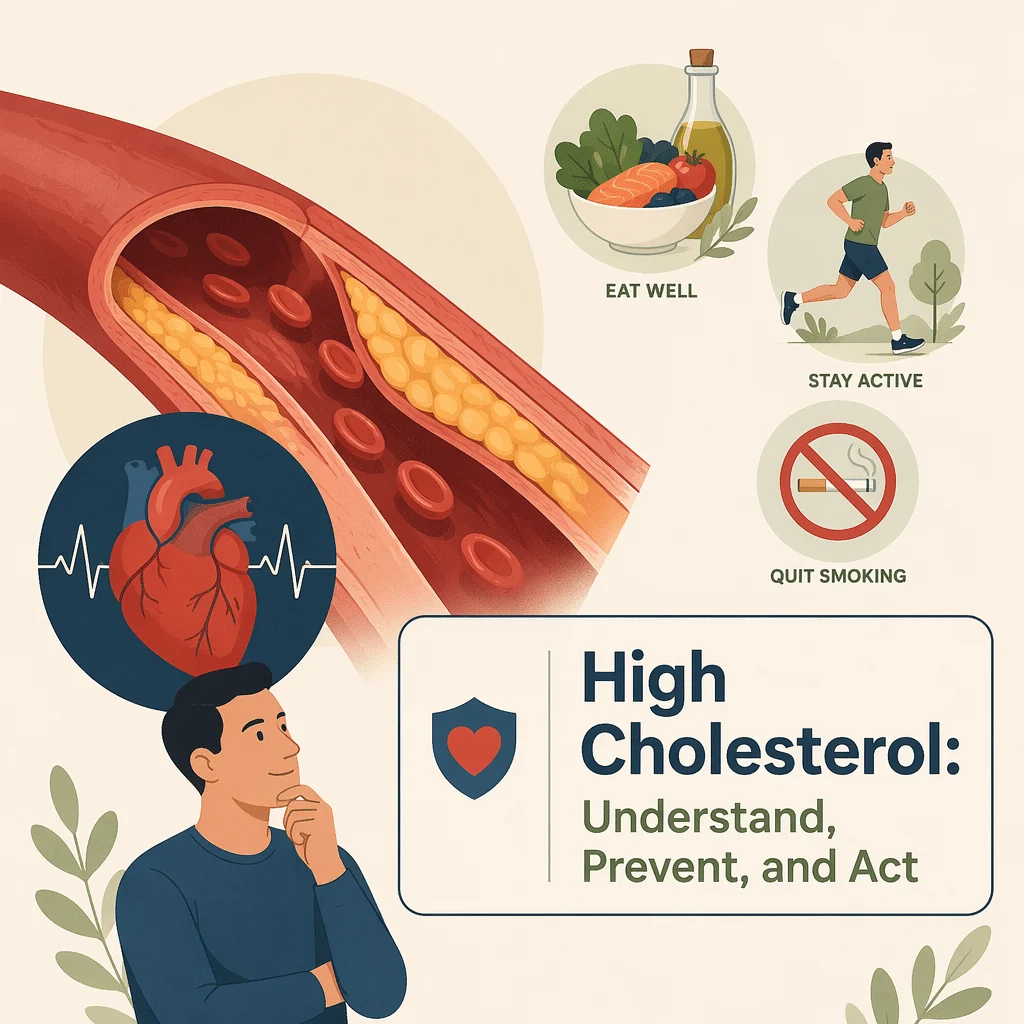
High cholesterol is really a problem of balance. When there is too much LDL, or too little HDL to clear the excess, cholesterol starts to lodge in the lining of your arteries. Over years this builds into plaque, a mix of cholesterol, fat, and inflammatory cells that stiffens and narrows blood vessels. Because this happens silently, many people first learn they have high cholesterol only from a routine result. If you want to see how the headline figure is reported, read our overview of the total cholesterol test, and to understand the particle that drives most of the risk, see our dedicated LDL cholesterol guide.
What causes high cholesterol?
Cholesterol levels reflect a mix of how you live and the genes you inherited. In most people several factors add up rather than a single cause acting alone.
Lifestyle and modifiable causes
- Diets heavy in saturated fat (fatty cuts of meat, butter, full-fat dairy) and trans fats (many fried and packaged foods), which push LDL up.
- A mostly inactive routine, which tends to lower protective HDL and raise triglycerides.
- Carrying excess weight, especially around the waist.
- Smoking, which damages artery walls and lowers HDL.
- Heavy alcohol intake, which can raise both cholesterol and triglycerides.
Genetics, age, and medical causes
Some causes are outside your control. An inherited condition called familial hypercholesterolaemia leaves the body unable to clear LDL efficiently and can cause very high cholesterol from a young age. Levels also tend to rise with age, and for women they often climb after the menopause. Certain conditions — type 2 diabetes, an underactive thyroid, and kidney or liver disease — can raise cholesterol too, as can some medicines. Because blood sugar and lipids are closely linked, it is worth reading our guide to diabetes if that applies to you. Knowing which of your causes are fixed and which are changeable helps you and your clinician focus effort where it pays off.
Because it runs in families, screening now starts far earlier: see why familial hypercholesterolaemia is checked in childhood.
Symptoms and how high cholesterol harms your arteries
Does high cholesterol cause symptoms?
For the vast majority of people, high cholesterol produces no symptoms at all. You cannot feel your LDL level, and you will not notice it climbing. In the uncommon cases where cholesterol is extremely high — often from a genetic cause — it can leave visible clues, such as yellowish cholesterol deposits under the skin (xanthomas), around the eyelids (xanthelasma), or a pale ring at the edge of the cornea. When symptoms like chest pain finally appear, they usually signal that artery narrowing is already advanced. This is why testing, not waiting for warning signs, is the sensible approach.
From plaque to heart attack and stroke
The real danger of high cholesterol is what it does to your arteries over time, a process called atherosclerosis. As plaque grows, arteries narrow and lose flexibility, so less blood reaches the heart, brain, and limbs. A plaque can also rupture, triggering a clot that suddenly blocks flow. In a coronary artery that causes a heart attack; in an artery supplying the brain it causes a stroke, and to learn the warning signs, see our guide to stroke. High cholesterol rarely acts alone, which is why doctors weigh your whole risk picture rather than one number; if raised blood pressure is part of yours, review our guide to high blood pressure.
How to read a lipid panel: your cholesterol numbers explained
A lipid panel is the blood test that measures the fats in your blood. Many labs no longer require fasting for a routine panel, though your clinician may ask you to fast (typically 9 to 12 hours) in certain situations. The table below translates the standard results into plain language, with the general desirable ranges used for many adults. Treat these as orientation, not a verdict — your personal targets depend on your overall risk, as the next section explains. For a fuller walkthrough, explore our complete guide to the lipid panel.
| Marker | What it measures, in plain language | General desirable range for many adults |
|---|---|---|
| Total cholesterol | All the cholesterol carried in your blood added together | Around 150 mg/dL; above 200 mg/dL is often considered high |
| LDL (bad) cholesterol | The particle that deposits cholesterol in artery walls | Around 100 mg/dL or lower; lower is better if your risk is high |
| HDL (good) cholesterol | The particle that clears cholesterol out of your arteries | At least 40 mg/dL for men and 50 mg/dL for women; higher is protective |
| Triglycerides | A fat used for energy; high levels often track with weight and blood sugar | Below 150 mg/dL |
| Non-HDL cholesterol | Total cholesterol minus HDL, capturing every harmful particle at once | Roughly 30 mg/dL above your LDL goal |
| ApoB (apolipoprotein B) | A direct count of the artery-clogging particles, sometimes more accurate than LDL | Interpreted against your risk; a specialised add-on test |
| Lipoprotein(a), or Lp(a) | A largely inherited particle that adds independent cardiovascular risk | Below about 50 mg/dL (or 125 nmol/L) |
Units and reference ranges vary slightly between laboratories, so always read your numbers against the range printed on your own report.
Beyond the basics: non-HDL, ApoB, and Lp(a)
Three figures deserve special attention because they refine the classic LDL number. Non-HDL cholesterol is simply your total minus HDL; it sweeps up every harmful particle in one value and is easy to calculate from a standard panel. ApoB counts those harmful particles directly, which can matter when triglycerides are high or diabetes is present. Lp(a) is a particle you inherit and can barely change through lifestyle, yet it adds real risk on top of LDL. To go deeper, compare our primer on the ApoB blood test and review our article on lipoprotein(a) as a cardiovascular risk marker; to see how the pieces fit together, read our explainer on the cholesterol ratio.
What your target numbers depend on
There is no single healthy LDL for everyone. The lower your overall cardiovascular risk, the more relaxed your target; the higher your risk, the harder you and your clinician aim. The 2026 dyslipidaemia guideline from the American College of Cardiology and the American Heart Association frames LDL goals roughly like this:
When a heart scan has also been done, the calcium result feeds into the same decision, and our guide to what a coronary calcium score actually means explains how to read it.
- Borderline or intermediate risk: an LDL below about 100 mg/dL.
- High risk: an LDL below about 70 mg/dL.
- Very high risk, such as after a heart attack or stroke: an LDL below about 55 mg/dL.
That same guidance recommends measuring Lp(a) at least once in adult life, and using ApoB to judge any leftover risk in people with diabetes, high triglycerides, or existing heart disease. You can read the American Heart Association newsroom release that announced this update. To put your own figure in context, check our guide to normal LDL cholesterol levels, and to understand the good number alongside it, read our explainer on HDL cholesterol.
How to lower high cholesterol
Treatment almost always pairs everyday habits with medicine when needed. The goal is not a perfect number on paper but a lower lifetime risk of heart attack and stroke.
Lifestyle first
- Eat more soluble fibre (oats, beans, fruit) and healthy unsaturated fats (olive oil, nuts, oily fish), whilst cutting saturated and trans fats.
- Aim for at least 150 minutes of moderate activity a week, such as brisk walking.
- Lose excess weight; even a modest drop improves LDL, HDL, and triglycerides together.
- Stop smoking, which lifts protective HDL and helps your arteries heal.
- Keep alcohol within moderate limits.
Triglycerides in particular respond quickly to changes in weight, sugar, and alcohol; to dig into that, read our guide to the triglycerides blood test.
Medications when lifestyle is not enough
When habits alone cannot reach your target, several well-studied drugs can help, and they are often combined:
- Statins are the first-choice medicine. They slow the liver’s cholesterol production and can cut LDL substantially, with decades of evidence that they lower heart attacks and strokes.
- Ezetimibe blocks cholesterol absorption in the gut and adds extra LDL lowering, often on top of a statin.
- Bempedoic acid is an option for people who cannot tolerate enough statin.
- PCSK9 inhibitors are injectable antibodies (evolocumab, alirocumab) that push LDL very low for people at high risk or with familial hypercholesterolaemia.
- Inclisiran is a newer injection that silences the PCSK9 gene and is given only a couple of times a year after the starting doses.
Every medicine has trade-offs, so the right choice depends on your numbers, your risk, and how you tolerate treatment. That decision belongs with your clinician.
When to get tested and when to see a doctor
Because high cholesterol is silent, screening on a schedule is how most people find it. General guidance suggests a first check in childhood (around ages 9 to 11, and again at 17 to 21), then every 4 to 6 years in adulthood, and more often if you have risk factors such as diabetes, high blood pressure, a strong family history, or you already take cholesterol medicine.
Book an appointment sooner rather than later if any of the following apply:
- A parent or sibling developed heart disease early, or has very high cholesterol or high Lp(a).
- You have diabetes, high blood pressure, chronic kidney disease, or you smoke.
- Your last panel was borderline or high and you have not rechecked it.
- You notice cholesterol deposits in the skin or around the eyes.
- You have chest pain, breathlessness on exertion, or stroke warning signs — treat these as urgent and seek emergency care.
Latest scientific advances
Cholesterol care is moving quickly, and the recent research is encouraging. Here is what stands out, in plain terms, along with what it may mean for you.
Combination treatment can be as good as a stronger pill. A 2024 individual-patient meta-analysis — a study that pools the raw data from many trials — found that a moderate statin plus ezetimibe lowered cholesterol and protected the heart about as well as a high-intensity statin alone, often with fewer side effects. What this means for you: if a strong statin dose is hard to tolerate, a gentler combination may reach the same goal.
PCSK9 inhibitors clearly prevent events. A large randomised trial of evolocumab showed that adding this injectable antibody to a statin cut the rate of heart attacks and strokes, without raising the risk of new diabetes. What this means for you: for people at high risk who need more than a statin, driving LDL very low pays off in fewer cardiovascular events.
Twice-a-year injections are now a reality. Phase 3 trials of inclisiran, a small interfering RNA that switches down the PCSK9 gene, showed it roughly halved LDL with just two maintenance doses a year, and a four-year extension study confirmed the effect held up over time. What this means for you: fewer doses can make long-term treatment easier to stick with.
A cholesterol-lowering pill in the same family is coming. In a 2025 trial, an oral PCSK9 inhibitor taken once daily lowered LDL meaningfully — an early but promising step towards a needle-free option. What this means for you: future treatment may be simpler still, though this approach is still being tested.
Lipoprotein(a) is getting the attention it deserves. Recent reviews and a 2024 participant-level meta-analysis confirm that Lp(a) raises cardiovascular risk on its own, separate from LDL, and that this risk is mostly inherited. What this means for you: a one-time Lp(a) test can uncover a hidden, family-linked risk that a standard panel would miss — useful information even though targeted Lp(a) drugs are still in trials.
Glossary
| Term | Definition |
|---|---|
| LDL cholesterol | Low-density lipoprotein, the bad cholesterol that deposits in artery walls. |
| HDL cholesterol | High-density lipoprotein, the good cholesterol that carries excess cholesterol back to the liver. |
| Triglycerides | A type of fat in the blood used for energy; high levels add to cardiovascular risk. |
| Non-HDL cholesterol | Total cholesterol minus HDL, a single figure for all the harmful particles. |
| ApoB (apolipoprotein B) | A protein found on harmful particles; a direct count of them. |
| Lipoprotein(a) | An inherited particle, written Lp(a), that adds independent cardiovascular risk. |
| Atherosclerosis | The gradual buildup of plaque that narrows and stiffens arteries. |
| Lipid panel | The blood test that measures cholesterol and triglycerides. |
| Statin | A first-line medicine that lowers LDL by reducing cholesterol made in the liver. |
| PCSK9 inhibitor | A medicine that helps the liver clear more LDL, given by injection or, in newer forms, differently. |
Frequently asked questions
What causes high cholesterol in the first place?
Usually a combination of factors. Diets rich in saturated and trans fats, limited physical activity, excess weight, smoking, and heavy alcohol all push cholesterol up. Genetics play a large role too: some people inherit a tendency to high LDL, and an inherited condition called familial hypercholesterolaemia can cause very high levels early in life. Age, the menopause, and conditions such as diabetes or an underactive thyroid can also contribute.
What counts as a high LDL cholesterol level?
For many adults an LDL around 100 mg/dL or below is desirable, and above roughly 160 mg/dL is clearly high. But the target is personal: someone who has had a heart attack may be advised to reach an LDL below 55 mg/dL, while a low-risk person has more leeway. Read your result against your own risk and your clinician’s advice rather than a single universal cutoff.
Can I lower high cholesterol with diet alone?
Diet and lifestyle can meaningfully lower cholesterol, and for people at lower risk they are often the first and main step. Soluble fibre, unsaturated fats, weight loss, and regular exercise all help. However, if your LDL is very high or your overall risk is elevated, lifestyle may not be enough on its own, and medicine such as a statin can add substantial protection. The two work best together.
Do I need to fast before a cholesterol test?
Often no. Many laboratories now accept a non-fasting lipid panel for routine screening, because total cholesterol, HDL, and LDL change little with a recent meal. Your clinician may still ask you to fast for 9 to 12 hours when triglycerides are the main concern or when tracking a specific problem. Follow the instructions you are given for your particular test.
Is high cholesterol something you can cure?
It is better thought of as managed than cured. Habits and, when needed, medication can bring cholesterol into a healthy range and keep it there, which lowers your risk substantially. But if you stop the measures that are working, levels usually drift back up, so treatment is generally a long-term commitment rather than a one-time fix.
Should I get my lipoprotein(a) checked?
Measuring Lp(a) at least once in adulthood is increasingly recommended, especially if heart disease runs in your family or your risk is otherwise unclear. Because Lp(a) is mostly inherited and stable, a single test usually tells you what you need to know. A high result does not mean disaster; it is a signal to manage your other risk factors more carefully.
Sources
- National Heart, Lung, and Blood Institute (NHLBI) — Blood Cholesterol, 2024 — https://www.nhlbi.nih.gov/health/blood-cholesterol
- Centers for Disease Control and Prevention (CDC) — About Cholesterol, 2024 — https://www.cdc.gov/cholesterol/about/index.html
- Mayo Clinic — High cholesterol: Symptoms and causes, 2025 — https://www.mayoclinic.org/diseases-conditions/high-blood-cholesterol/symptoms-causes/syc-20350800
- American Heart Association — ACC/AHA issue updated guideline for managing lipids and cholesterol, 2026 — https://newsroom.heart.org/news/accaha-issue-updated-guideline-for-managing-lipids-cholesterol
- Lee YJ, et al. — Alternative LDL Cholesterol-Lowering Strategy vs High-Intensity Statins in Atherosclerotic Cardiovascular Disease: A Systematic Review and Individual Patient Data Meta-Analysis — JAMA Cardiology, 2024 — https://doi.org/10.1001/jamacardio.2024.3911
- Sabatine MS, et al. — Cardiovascular safety and efficacy of the PCSK9 inhibitor evolocumab (FOURIER prespecified analysis) — The Lancet Diabetes & Endocrinology, 2017 — https://doi.org/10.1016/S2213-8587(17)30313-3
- Ray KK, et al. — Two Phase 3 Trials of Inclisiran in Patients with Elevated LDL Cholesterol — New England Journal of Medicine, 2020 — https://doi.org/10.1056/NEJMoa1912387
- Ray KK, et al. — Long-term efficacy and safety of inclisiran (ORION-3) — The Lancet Diabetes & Endocrinology, 2022 — https://doi.org/10.1016/S2213-8587(22)00353-9
- Koren MJ, et al. — An Oral PCSK9 Inhibitor for Treatment of Hypercholesterolemia: The PURSUIT Randomised Trial — Journal of the American College of Cardiology, 2025 — https://doi.org/10.1016/j.jacc.2025.03.499
- Nordestgaard BG, et al. — Lipoprotein(a) and cardiovascular disease — The Lancet, 2024 — https://doi.org/10.1016/S0140-6736(24)01308-4
- Bhatia HS, et al. — Independence of Lipoprotein(a) and LDL Cholesterol-Mediated Cardiovascular Risk: A Participant-Level Meta-Analysis — Circulation, 2024 — https://doi.org/10.1161/CIRCULATIONAHA.124.069556
Further reading
- Advanced lipid panel and ApoB: assessing heart risk
- CRP: the C-reactive protein inflammation marker
- How LDL cholesterol is calculated
- Lipoprotein(a) screening: what to know
- Heart failure: understanding and treating it
Understand your lab results with AI DiagMe
Get your results interpreted in minutes
High cholesterol is diagnosed and tracked through your lipid panel, yet the numbers rarely explain themselves. AI DiagMe reads your results in plain language, showing what your total cholesterol, LDL, HDL, triglycerides, and even non-HDL or ApoB values mean together and how they relate to your risk. It helps you understand your report and prepare better questions for your appointment. AI DiagMe does not diagnose disease or replace your doctor — it turns raw figures into clarity so your next conversation about your heart health starts from a place of understanding.