






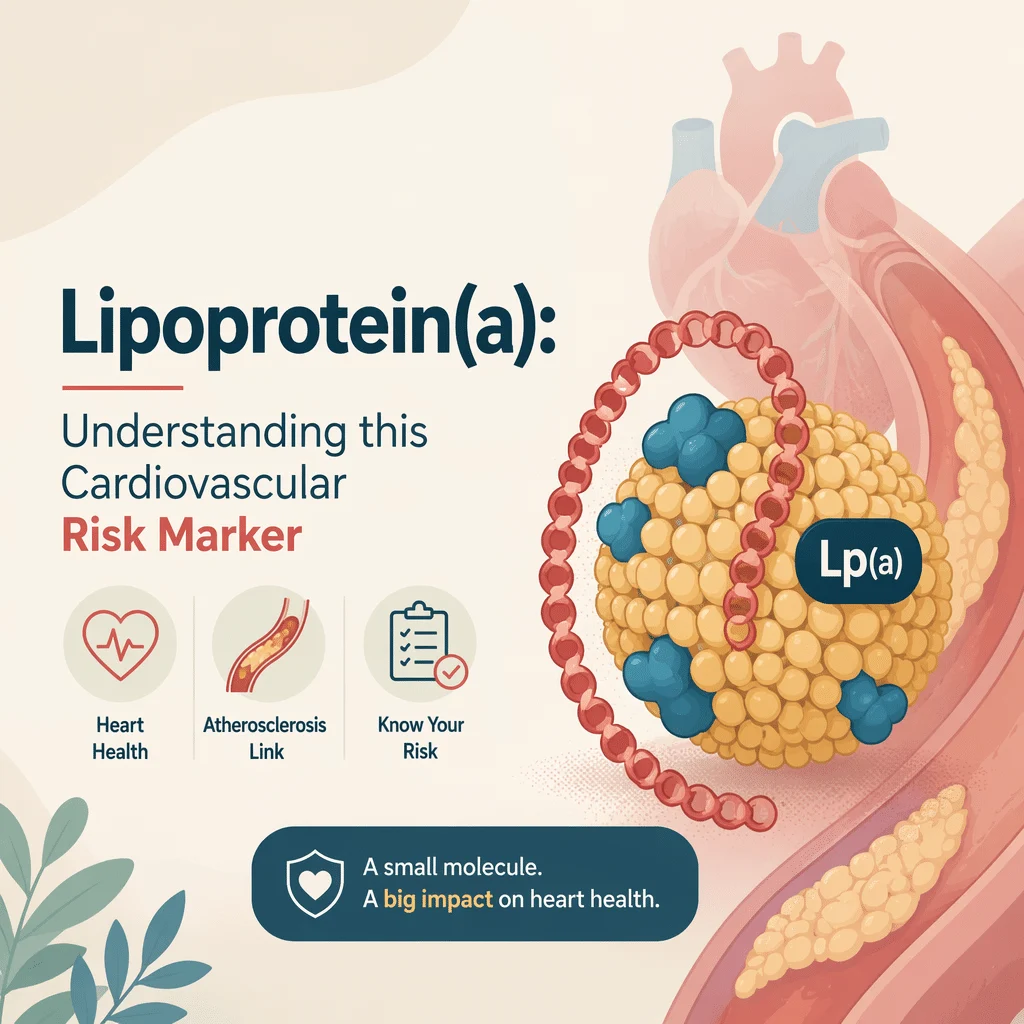
If your lab report shows a line for lipoprotein a, you may be wondering why this marker matters when your regular cholesterol numbers already look fine. Lipoprotein(a), often shortened to Lp(a), is a largely inherited particle that raises cardiovascular risk independently of LDL cholesterol, blood pressure, or lifestyle. In this article, you’ll learn what it is, why doctors order this test, how to read your result, what a high level means for your heart and blood vessels, and what current research says about new treatments in development.
Above a certain level the advice changes: read what the 175 nmol/L Lp(a) threshold actually predicts.
What is lipoprotein(a)?
Lipoprotein(a) is a particle that carries cholesterol through your bloodstream. It belongs to the same family as LDL cholesterol (the “bad” cholesterol) and HDL cholesterol (the “good” cholesterol), but its structure sets it apart. Your liver builds it by attaching a unique protein, called apolipoprotein(a), to a standard LDL particle.
This added protein changes how the particle behaves. It sticks more easily to small injuries in blood vessel walls, and it can interfere with the body’s ability to break down blood clots. Together, these two properties place this marker at the centre of both plaque formation and clotting risk, making it worth understanding even when your other lipid numbers are normal.
Why lipoprotein(a) is different from LDL and HDL
Genetics, not diet, sets your level of this particle. Twin and family studies show that inherited factors account for more than 80% of the variation in concentration between people, according to a 2024 review in The Lancet. Because the value is fixed early in life and stays fairly stable afterwards, testing it once is usually enough for most adults, unlike LDL cholesterol, which shifts with diet, weight, and medication.
This genetic stability also explains why a single elevated result carries lasting significance. A high reading discovered at age 30 will likely still be high at age 60, so the information is relevant for decades of prevention planning rather than a single snapshot in time.
Why doctors order a lipoprotein(a) test
Historically, clinicians reserved this test for people who already showed signs of high cardiovascular risk: a family history of early heart attack or stroke, high LDL cholesterol despite treatment, or a cardiac event without the usual risk factors. That selective approach is changing. A companion article explains the 2026 update to US screening guidelines, which now favours measuring lipoprotein(a) at least once in every adult, since roughly one in five people carries an elevated level, often without knowing it.
A doctor may also order the test if you have unexplained early coronary artery disease, aortic valve narrowing, or a close relative with a known high result. Because the trait is inherited, a high reading in one family member is a signal to discuss testing with siblings, parents, and children.
What happens during the test
A technician draws a small blood sample from a vein in your arm, and the whole process typically takes only a few minutes. Unlike a standard cholesterol panel, this test usually does not require fasting beforehand, since food intake has little effect on the result. Ask your lab whether fasting is needed if the sample is being drawn alongside triglycerides or other lipid values that do change after eating.
How to read and interpret your Lp(a) results
On a lab report, you will find lipoprotein(a) listed in the lipid section, reported in one of two units: milligrams per decilitre (mg/dL) or nanomoles per litre (nmol/L). These two units measure different things and do not convert using a simple multiplier, so it matters which one your laboratory used. Always check the unit printed next to your number before comparing it to any reference chart, including the one below.
The table summarises the risk categories most laboratories and clinical guidelines currently use.
| Level | In mg/dL | In nmol/L | General interpretation |
|---|---|---|---|
| Desirable | Below 30 | Below 75 | Lower related risk |
| Intermediate | 30 to 50 | 75 to 125 | Focus on optimising other risk factors |
| High | Above 50 | Above 125 | Raised independent cardiovascular risk |
A single number never tells the whole story on its own. A healthcare professional reads your result alongside your age, sex, blood pressure, smoking history, diabetes status, and the rest of your lipid panel before drawing conclusions about your personal risk.
How lipoprotein(a) affects your cardiovascular risk
An elevated lipoprotein(a) level contributes to disease through two connected mechanisms. First, like other LDL-family particles, it can deposit cholesterol inside artery walls, contributing to atherosclerosis, the gradual build-up of fatty plaque that narrows and stiffens blood vessels. Second, its unique protein structure promotes clot formation on top of existing plaque, which is part of why researchers consider it a causal factor rather than a passive bystander.
A large 2024 review published in The Lancet, drawing on decades of genetic and population research, concluded that lipoprotein(a) is causally linked to atherosclerotic cardiovascular disease and aortic valve narrowing, with roughly one in five people carrying a level high enough to raise concern. That conclusion rests on Mendelian randomisation studies, a genetic research method that mimics a randomised trial by using naturally occurring gene variants, which strengthens confidence that the association reflects a real biological effect rather than a coincidence.
Coronary artery disease and heart attack
An excess of lipoprotein(a) speeds the deposit of fats along artery walls, contributing to early coronary artery disease. When a plaque ruptures and a clot forms on top of it, the result can be a myocardial infarction, the medical term for a heart attack. Because the clot-promoting effect adds to the plaque-forming effect, people with high levels can face elevated risk even when their LDL cholesterol looks well controlled.
Aortic valve stenosis
Lipoprotein(a) particles can also collect on the aortic valve, the structure that controls blood flow leaving the heart. Over years, this buildup can stiffen and narrow the valve, a condition called aortic valve stenosis. Symptoms often develop slowly and may include shortness of breath during activity or chest discomfort; echocardiography, an ultrasound of the heart, remains the standard way to diagnose this narrowing.
Ischaemic stroke
The mechanism behind stroke risk mirrors that of coronary disease. When this buildup contributes to plaque forming in the arteries supplying the brain, a blockage in one of those vessels can cause an ischaemic stroke. If a family member had a stroke at an unusually young age, discussing this test with a doctor is a reasonable step, since a shared inherited level could partly explain that pattern.
Lipoprotein(a) alongside your other lipid results
This marker rarely joins a routine lipid panel, which usually reports total cholesterol, LDL, HDL, and triglycerides. Because it is not part of that standard set, your doctor has to order it specifically, which is one reason many people never learn their level unless they ask. Reviewing your LDL cholesterol targets and your triglyceride range alongside this result gives a more complete picture, since these markers act through overlapping but distinct pathways.
Having a low HDL cholesterol level does not raise lipoprotein(a) on its own, but the two commonly appear together in someone with an unfavourable overall lipid profile, so clinicians weigh them jointly rather than in isolation. Some people also receive an apolipoprotein A1 test, which measures a separate, protective protein carried on HDL; a low result there combined with a high reading here can point towards a more unfavourable overall balance between protective and harmful particles.
For a more detailed particle count, some clinicians order an ApoB blood test, since every one of these particles, along with LDL and VLDL, carries exactly one ApoB molecule, making ApoB a useful proxy for the total number of potentially harmful particles in circulation. Doctors often include this marker on an advanced lipid panel for people whose standard results do not fully explain their apparent risk, and clinicians sometimes calculate a cholesterol ratio to add further context when the full lipid picture is being reviewed.
When to see a doctor
Discuss lipoprotein(a) testing with your doctor if any of the following apply to you:
- You have a personal or family history of heart attack, stroke, or aortic valve disease occurring before age 55 in men or 65 in women.
- Your LDL cholesterol remains high despite taking cholesterol-lowering medication as prescribed.
- You experienced a cardiovascular event without the usual risk factors, such as high blood pressure, diabetes, or smoking.
- A close relative has already tested positive for a high level.
- You carry a diagnosis of familial hypercholesterolaemia, an inherited condition linked to a higher chance of also carrying an elevated result.
Seek urgent medical attention rather than waiting for any blood test if you experience chest pain or pressure, sudden shortness of breath, or warning signs of a stroke such as facial drooping, arm weakness, or difficulty speaking. A high result is a long-term risk marker, not an emergency signal on its own, so these symptoms always warrant immediate attention regardless of your lab history.
Managing a high lipoprotein(a) level
Because no medicine currently on the market lowers lipoprotein(a) as its primary purpose, management today focuses on reducing every other risk factor you can influence. This approach does not change the number itself, but it lowers the overall cardiovascular burden that a high result is adding to.
Useful lifestyle steps include:
- Eating a Mediterranean-style diet rich in oily fish, nuts, colourful vegetables, and fruit, whilst limiting ultra-processed and sugary foods.
- Getting at least 150 minutes of moderate physical activity weekly, which supports overall vascular health.
- Stopping smoking, since tobacco use sharply amplifies the danger already posed by an elevated result.
- Prioritising 7 to 8 hours of sleep nightly and managing chronic stress, both of which influence general inflammation levels.
- Working with a doctor to control blood pressure, blood sugar, and LDL cholesterol as closely as your individual targets allow.
Your doctor may also discuss cascade screening, the practice of testing first-degree relatives once one family member’s high result is confirmed, since this can catch inherited risk in others before any symptoms appear.
Statins and other current medications
Statins remain the cornerstone of cardiovascular prevention because they lower LDL cholesterol substantially and reduce heart attack risk, but they have little to no effect on lipoprotein(a), and some data suggest they may modestly raise it in certain people. This does not diminish the overall benefit of statin therapy; it simply means the portion of your risk attributable to this trait persists even while your LDL cholesterol is well controlled. PCSK9 inhibitors, a newer class of injectable cholesterol medicine, can lower it by a modest amount as a secondary effect, though that is not their primary approved use.
Recent scientific advances
Research on lipoprotein(a) has moved quickly over the past few years, both in understanding the risks involved and in developing medicines aimed directly at lowering elevated levels. The findings below come from peer-reviewed literature and the public clinical trials registry; none represent an approved treatment yet, and each is presented with that caveat in mind.
A 2024 review in The Lancet examined decades of genetic and population data and concluded that this marker is a causal, independent contributor to atherosclerotic cardiovascular disease and aortic valve narrowing, affecting about one in five people worldwide, with the highest typical concentrations seen in people of African ancestry and the lowest in people of East Asian ancestry. For you, this mainly means that if you have not been tested, a single measurement sometime in adulthood is a reasonable, low-burden way to learn whether this inherited factor applies to you, regardless of your ethnic background.
A 2024 study in JAMA Cardiology, drawing on the UK Biobank and two large randomised drug trials, found that a higher lipoprotein(a) level predicted cardiovascular events regardless of a person’s high-sensitivity C-reactive protein (hs-CRP) level, a blood marker of low-grade inflammation. In simple terms, the risk did not depend on whether inflammation markers were also high or low; it acted as its own separate pathway in both groups studied. Practically speaking, having normal inflammation markers on a check-up does not rule out risk from an elevated result here, so the two tests answer different questions rather than substituting for one another.
A 30-year cohort study of over 27,900 initially healthy women, published in the New England Journal of Medicine in 2024, measured lipoprotein(a) alongside LDL cholesterol and hs-CRP at the start of the study and then tracked cardiovascular events for three decades. Women in the highest fifth of results had a meaningfully greater long-term chance of a major cardiovascular event compared with those in the lowest fifth, an association that held up even after accounting for other established risk factors. This kind of decades-long tracking supports testing earlier in life rather than waiting until midlife risk assessment, since the influence appears to build over a very long horizon.
A 2024 participant-level meta-analysis in Circulation, combining data from more than 27,600 people across six statin trials, found that a high lipoprotein(a) reading, above roughly 50 mg/dL or about 125 nmol/L, carried added cardiovascular risk at every level of achieved LDL cholesterol, including amongst people who reached very low LDL numbers on statin therapy. For someone on treatment, this means reaching your LDL cholesterol goal is genuinely protective, but it may not fully cancel out this additional risk, which is part of why doctors describe it as a “residual risk” that current standard treatment does not fully address.
Turning to treatments in development, several experimental medicines designed specifically to lower lipoprotein(a) are now in late-stage testing through the public clinical trials registry ClinicalTrials.gov. Pelacarsen, an antisense oligonucleotide (a lab-made strand of genetic material that blocks the liver from producing as much of the associated protein), is being tested in a large Phase 3 outcomes trial in people with established cardiovascular disease and an elevated baseline level; that trial has enrolled more than 8,300 participants and is expected to report results around mid-2026. Olpasiran and lepodisiran, two other investigational drugs that use a related gene-silencing technique called small interfering RNA, are each being tested in their own large Phase 3 outcome trials, including one with over 17,000 participants, to see whether lowering the particle directly translates into fewer heart attacks and strokes. None of these medicines are approved or available in routine care today, and it remains unproven whether lowering the number itself reduces cardiovascular events, since that is precisely the question these ongoing trials are designed to answer. If your result is high now, the realistic and effective path is still managing every other modifiable risk factor whilst this research matures.
Understand your lab results with AI DiagMe
Lipoprotein(a) is only one piece of a larger cardiovascular picture, and it reads best alongside your LDL cholesterol, HDL cholesterol, triglycerides, and sometimes ApoB or high-sensitivity CRP. Sorting through several unfamiliar values and two different measurement units can be genuinely confusing on your own. AI DiagMe helps you understand what your lab results mean in plain language, so you can prepare more informed questions for your doctor; it is designed to support understanding, not to diagnose you or replace a clinician’s judgement.
Get your results interpreted in minutes
Glossary
| Term | Definition |
|---|---|
| Lipoprotein(a), or Lp(a) | A largely inherited, LDL-like particle in the blood that raises cardiovascular risk independently of standard cholesterol numbers. |
| Apolipoprotein(a) | The extra protein attached to an LDL particle that gives lipoprotein(a) its distinct, clot-promoting structure. |
| Atherosclerosis | The gradual buildup of fatty plaque inside artery walls, which narrows vessels and raises the risk of heart attack and stroke. |
| Aortic valve stenosis | Narrowing and stiffening of the heart’s aortic valve, a condition that lipoprotein(a) can contribute to over time. |
| Myocardial infarction | The medical term for a heart attack, when part of the heart muscle is damaged by a sudden loss of blood flow. |
| Mendelian randomization | A genetic research method that uses naturally inherited gene variants to test whether a marker likely causes disease, similar in logic to a randomised trial. |
| High-sensitivity C-reactive protein (hs-CRP) | A blood marker of low-grade inflammation, sometimes measured alongside lipoprotein(a) to refine cardiovascular risk assessment. |
| Antisense oligonucleotide | A lab-made strand of genetic material designed to reduce the liver’s production of a specific protein, used in several experimental lipoprotein(a)-lowering drugs. |
| Small interfering RNA (siRNA) | A gene-silencing technology, related to antisense oligonucleotides, used in some investigational medicines being tested to lower lipoprotein(a). |
| Cascade screening | The practice of testing first-degree relatives of someone with a confirmed high lipoprotein(a) or other inherited condition. |
Frequently asked questions
Can lipoprotein(a) levels change over time, or are they fixed for life?
Genetics accounts for the large majority of your concentration, typically more than 80%, which makes this marker remarkably stable across adulthood. Minor fluctuations can occur with conditions like kidney disease, pregnancy, or the menopause, but your baseline generally stays consistent. This stability is exactly why most clinical guidelines consider one lifetime measurement sufficient for most adults, rather than repeated annual testing.
Is there a medication that treats high lipoprotein(a) directly?
Not yet. No drug currently holds approval with lowering this particle as its primary purpose, so today’s management relies on controlling every other modifiable risk factor instead. Several investigational medicines, including antisense oligonucleotides and siRNA-based drugs, are in late-stage clinical trials and have shown large reductions in this marker, but it is still being studied whether lowering the number itself prevents heart attacks and strokes.
Does taking a statin affect my lipoprotein(a) level?
Statins are highly effective at lowering LDL cholesterol and reducing overall cardiovascular risk, but they generally have little to no effect on this particular value, and some research suggests a small increase is possible in certain people. This does not reduce the value of statin therapy for most patients; it simply means that any risk specifically tied to this trait can persist even whilst a statin is working well on LDL cholesterol.
Should my children be tested if my lipoprotein(a) is high?
Because this trait is inherited, a child of someone with a high level has roughly a 50% chance of also carrying an elevated result. Most current guidance suggests holding off on routine testing in early childhood, reserving it instead for adolescence, young adulthood, or sooner if there is a strong family history of early cardiovascular disease. This timing allows for healthy lifestyle habits to take root without creating unnecessary worry in a young child.
What does a high lipoprotein(a) after a heart attack usually mean?
Finding an elevated result in someone who had a cardiovascular event without the usual risk factors, such as high LDL cholesterol, diabetes, or smoking, often points towards a largely genetic explanation for that event. This discovery typically prompts closer, more proactive follow-up and a conversation about testing first-degree relatives, since the same inherited pattern could affect parents, siblings, or children.
Is a high lipoprotein(a) a reason to avoid hormonal birth control?
Oestrogen-containing contraceptives carry a small, independent increase in clotting risk, so a very high result is a relevant factor to raise with a doctor or gynaecologist when choosing a contraceptive method. This conversation often leads to considering progestogen-only or non-hormonal options, though the final decision depends on your full personal and family health history rather than this one result alone.
Further reading
- Cardiac markers panel: troponin, BNP, and CK explained
- Troponin: understanding this cardiac marker
- BNP: a key cardiac health marker
- Normal blood test ranges: a reference chart explained
- How to read your blood test results
Sources
- MedlinePlus (U.S. National Library of Medicine) — Lipoprotein (a) Blood Test, reviewed 2025 — https://medlineplus.gov/lab-tests/lipoprotein-a-blood-test/
- Cleveland Clinic — Lipoprotein (a): Levels and Testing, reviewed 2023 — https://my.clevelandclinic.org/health/articles/25226-lipoprotein-a
- National Lipid Association — 2026 ACC/AHA/Multisociety Dyslipidaemia Guideline Released, 2026 — https://www.lipid.org/nla/2026-accahamultisociety-dyslipidemia-guideline-released
- Nordestgaard BG, Langsted A — Lipoprotein(a) and cardiovascular disease — The Lancet, 2024 — https://doi.org/10.1016/S0140-6736(24)01308-4
- Small AM, et al. — Lipoprotein(a), C-Reactive Protein, and Cardiovascular Risk in Primary and Secondary Prevention Populations — JAMA Cardiology, 2024 — https://doi.org/10.1001/jamacardio.2023.5605
- Ridker PM, et al. — Inflammation, Cholesterol, Lipoprotein(a), and 30-Year Cardiovascular Outcomes in Women — New England Journal of Medicine, 2024 — https://doi.org/10.1056/NEJMoa2405182
- Bhatia HS, et al. — Independence of Lipoprotein(a) and Low-Density Lipoprotein Cholesterol-Mediated Cardiovascular Risk: A Participant-Level Meta-Analysis — Circulation, 2024 — https://doi.org/10.1161/CIRCULATIONAHA.124.069556
- ClinicalTrials.gov (Novartis Pharmaceuticals) — Lp(a)HORIZON: Trial Assessing the Impact of Lipoprotein(a) Lowering With Pelacarsen on Major Cardiovascular Events, NCT04023552 — https://clinicaltrials.gov/study/NCT04023552
- ClinicalTrials.gov (Eli Lilly and Company) — ACCLAIM-Lp(a): Study of Lepodisiran on the Reduction of Major Adverse Cardiovascular Events in Adults With Elevated Lipoprotein(a), NCT06292013 — https://clinicaltrials.gov/study/NCT06292013