








































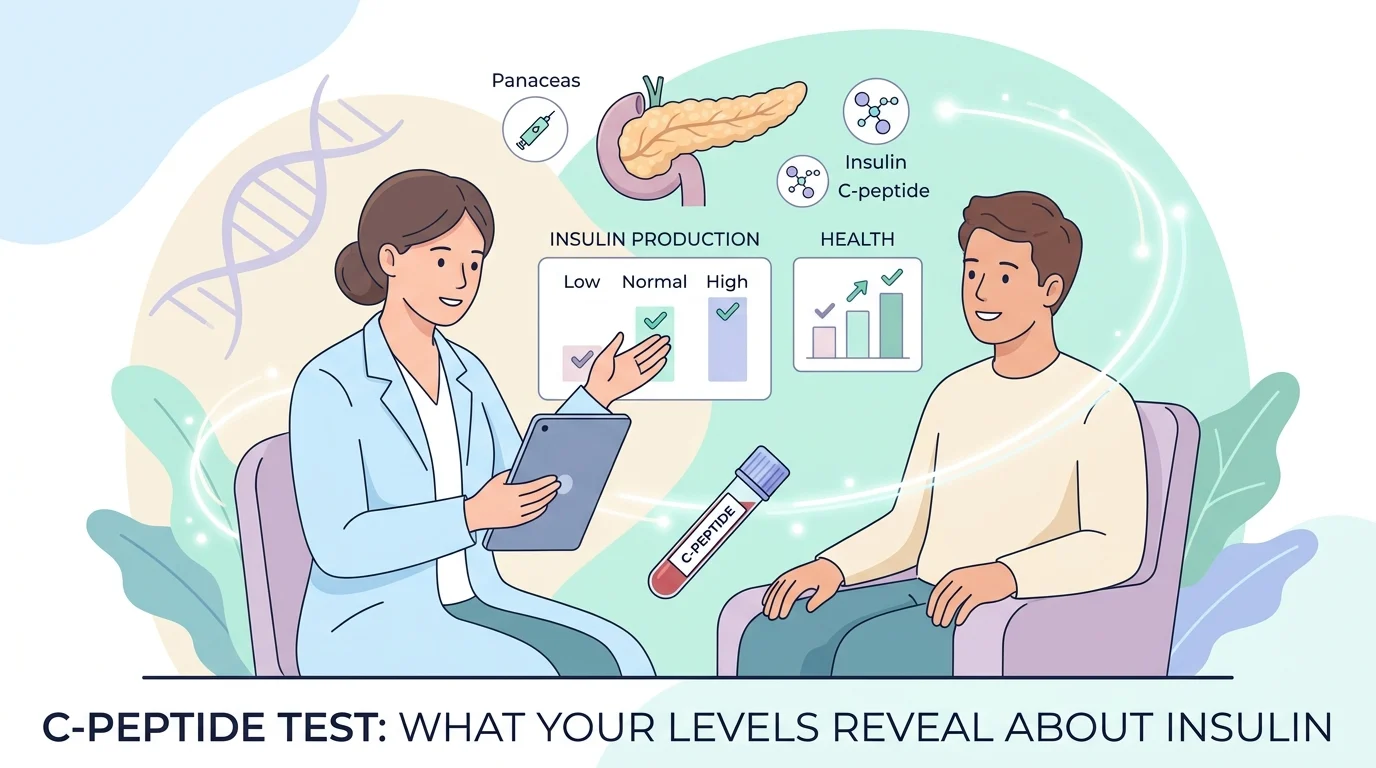
A C-peptide test measures how much insulin your own pancreas is making, something a regular blood sugar reading cannot tell you. If your doctor ordered this test, or you spotted “C-peptide” on a lab report, you are probably wondering what the number means and whether you should worry. The short answer: C-peptide is released in step with insulin, so it works as a stand-in for your body’s natural insulin output. This article explains what a C-peptide test measures, what a normal level looks like, and what high or low results can mean. You will also learn how the test is done, how to read your result alongside your blood sugar, and when a number is worth a conversation with your doctor.
What a C-peptide test measures
C-peptide, short for “connecting peptide,” is a small protein fragment your pancreas makes every time it produces insulin. Inside the insulin-making beta cells, the body first builds a single molecule called proinsulin. An enzyme then snips proinsulin into two pieces: active insulin and C-peptide. Because they come from the same parent molecule, your pancreas releases them in roughly equal amounts.
Insulin is the hormone that moves glucose (blood sugar) out of your bloodstream and into your cells for energy. C-peptide has no major job of its own once it is released, but that is exactly why it is so useful. The amount of C-peptide in your blood mirrors how much insulin your beta cells are producing on their own. Researchers have used it as a reliable window into beta-cell function for decades, and modern assays can now detect even very small amounts.
C-peptide is not part of a standard checkup or a routine panel like the comprehensive metabolic panel. It is a targeted test, ordered when a doctor specifically needs to know about your insulin production.
C-peptide vs. insulin: why doctors often measure C-peptide
You might wonder why a lab would measure C-peptide instead of insulin directly. There are two practical reasons.
First, C-peptide stays in the bloodstream longer and at a steadier level than insulin, so it gives a more stable picture of insulin production. Second, and most importantly, the insulin used to treat diabetes does not contain C-peptide. If someone takes insulin by injection or pump, an insulin test cannot separate the body’s own insulin from the medication, but a C-peptide test still reflects only what the pancreas is making. For anyone on insulin therapy, that distinction is the whole point of the test.
Why your doctor orders a C-peptide test
A C-peptide test is not the test used to first diagnose diabetes. That job belongs to blood sugar measurements such as fasting glucose and the HbA1c. See our guides on the diabetes blood test and the HbA1c normal range for those. Instead, doctors reach for C-peptide in more specific situations:
- Telling diabetes types apart. When it is unclear whether someone has type 1 or type 2 diabetes, C-peptide helps. Very low levels point toward type 1, where the immune system has destroyed the beta cells. Normal or high levels fit type 2, where the body still makes insulin but uses it poorly.
- Finding the cause of low blood sugar. Unexplained hypoglycemia can come from an insulin-producing tumor, certain diabetes pills, or too much injected insulin. C-peptide, read next to insulin, helps separate these.
- Checking remaining insulin reserve. In established diabetes, C-peptide shows how much insulin a person can still make, which may guide whether insulin treatment is needed.
- Monitoring treatment. Levels are tracked after a pancreas or islet cell transplant, and to follow an insulinoma after surgery.
When adult diabetes does not fit the usual pattern
Not every case of diabetes is clearly type 1 or type 2. Some adults are first labeled with type 2 diabetes but respond poorly to the usual pills, because they actually have a slower-developing form of autoimmune diabetes sometimes called LADA (latent autoimmune diabetes in adults). Here, C-peptide can be revealing. A level that starts in the normal range and then falls over months or years suggests the beta cells are gradually failing, which points away from typical type 2. Measured alongside diabetes antibody tests, C-peptide helps a doctor judge whether insulin is likely to be needed sooner rather than later.
C-peptide normal range and units
There is no single normal C-peptide number that applies to everyone. Reference ranges differ between laboratories and depend on whether you fasted, so the only range that truly matters is the one printed on your own report. As a rough guide, many U.S. labs list a fasting C-peptide of roughly 0.5 to 2.0 nanograms per milliliter (ng/mL) as typical, though some report up to about 2.7 ng/mL.
Results may also appear in nanomoles per liter (nmol/L). To move between the two, multiply the ng/mL value by about 0.33.
| Measure | Common units | Typical fasting reference range |
|---|---|---|
| C-peptide in blood | ng/mL | about 0.5 to 2.0 |
| C-peptide in blood | nmol/L | about 0.2 to 0.7 |
One point is easy to miss: a C-peptide value means very little on its own. It has to be read alongside your blood glucose at the moment the sample was taken. A low C-peptide is expected and normal if your blood sugar was also low, because the pancreas is simply resting. The same low value is a concern if your blood sugar was high, since the pancreas should have been working hard. For that reason, labs often draw a glucose level at the same time.
What high C-peptide levels can mean
A high C-peptide level usually means your body is producing a lot of insulin. The most common reason is type 2 diabetes and the insulin resistance that comes with it: the pancreas pumps out extra insulin to overcome cells that no longer respond well. Excess body weight drives the same pattern.
Other causes include:
- Insulinoma, a usually benign tumor of the pancreas that makes insulin nonstop
- Sulfonylureas, a class of diabetes pills that push the pancreas to release more insulin
- Cushing syndrome, where high cortisol raises blood sugar and insulin
- Reduced kidney function, because the kidneys clear C-peptide from the blood; when they slow down, levels can rise even if insulin production is normal
What the high number means depends on your blood sugar. High C-peptide with high blood sugar fits insulin resistance and type 2 diabetes. High C-peptide with low blood sugar is a warning sign for an insulinoma or a reaction to sulfonylurea pills, and it deserves prompt evaluation. Even before diabetes is diagnosed, the early stage of insulin resistance can show up as a higher-than-average C-peptide, as the pancreas quietly compensates for years.
What low C-peptide levels can mean
A low C-peptide level points to a pancreas that is making little or no insulin. In type 1 diabetes, the immune system has destroyed most beta cells, so both insulin and C-peptide run very low. Long-standing type 2 diabetes can eventually reach a similar point if the beta cells wear out. In someone already living with diabetes, a C-peptide that keeps drifting lower over time signals a pancreas running out of reserve, which often means insulin treatment will become necessary.
Low levels can also appear when:
- A person takes insulin by injection or pump, since insulin from outside the body lowers the pancreas’s own output
- The body has gone a long time without food, so insulin production naturally drops
- There is a severe infection, advanced liver disease, or Addison disease
Reading the result with glucose and insulin sharpens the picture. Low C-peptide alongside high blood sugar and ketones in the urine is typical of type 1 diabetes, where the body has no insulin and starts burning fat for fuel. When blood sugar climbs high enough, sugar also spills into the urine, a finding called glucosuria. Low C-peptide with a high insulin level and low blood sugar suggests the insulin is coming from outside the body rather than the pancreas.
How the C-peptide test is done and how to prepare
Getting a C-peptide test is straightforward. A technician draws blood from a vein in your arm, the same as any routine blood test. In some cases, especially in children, a 24-hour urine collection is used instead.
Whether you need to fast depends on why the test was ordered. Many doctors ask for an overnight fast of at least 8 hours so the result is not skewed by a recent meal, while others want a random or after-meal sample to see how the pancreas responds to food. Our guide on fasting before a blood test explains the general rules. In certain cases a stimulated test is used: you receive glucagon or a mixed-meal drink, and C-peptide is measured afterward to gauge the pancreas’s maximum effort.
Two practical notes. High-dose biotin supplements, often sold for hair, skin, and nails, can interfere with some C-peptide assays, so ask your provider whether to pause them beforehand. And results usually come back within a few days, although timing varies by lab; see how long blood test results take for typical turnaround.
How to read your C-peptide result
Because C-peptide only makes sense next to your blood sugar, the table below shows the patterns doctors look for. Use it to follow the conversation, not to label yourself.
| C-peptide | Blood sugar | What it often suggests |
|---|---|---|
| Low | High | Type 1 diabetes, with little or no insulin made |
| Normal or high | High | Type 2 diabetes or insulin resistance |
| High | Low | Insulinoma or a sulfonylurea effect |
| Low | Low, with high insulin | Insulin taken from outside the body |
| Low | Low, after fasting | Normal response to not eating |
This is a simplified map. A real interpretation also weighs your symptoms, how long you have had diabetes, diabetes antibody tests, your kidney function, and any medications you take. As a rough research benchmark, a fasting C-peptide below about 0.2 nmol/L is strongly linked to type 1 diabetes, while a value at or above roughly 0.3 nmol/L favors type 2; even so, major guidelines reserve C-peptide for unclear or unusual cases rather than everyday diagnosis. Two people with the same number can have very different situations, which is why the result belongs in a doctor’s hands.
To make the comparison fairer, some clinicians look at the C-peptide-to-glucose ratio rather than C-peptide alone. The logic is simple: insulin output should rise when blood sugar is high, so weighing the two together can flag a pancreas that is underperforming for the sugar level it faces. You do not need to calculate anything yourself; it is just one more way your doctor puts a single number in context. For the bigger picture on lab reports, see how to read blood test results.
When to talk to your doctor
You will not order a C-peptide test yourself; a clinician requests it and interprets it in context. Still, knowing when the test becomes relevant helps you have a useful conversation.
Bring it up with your doctor if you have:
- Classic signs of high blood sugar, such as constant thirst, frequent urination, unexplained weight loss, or persistent fatigue
- Repeated episodes of low blood sugar, with shakiness, sweating, hunger, or confusion that ease after eating
- A diabetes diagnosis that is hard to classify, or that responds unexpectedly to treatment
Seek urgent care for severe symptoms: confusion, fainting, or a very low blood sugar that does not recover, and for signs of diabetic ketoacidosis such as nausea, deep rapid breathing, and a fruity breath odor. These need attention now, not a routine lab order.
Whatever your result, remember that a single out-of-range C-peptide is a clue, not a verdict. It tells your doctor how your pancreas is working so the two of you can decide what comes next.
Glossary
| Term | Definition |
|---|---|
| Addison disease | A condition in which the adrenal glands make too little of certain hormones, which can lower blood sugar. |
| Beta cells | The cells in the pancreas that make and release insulin and C-peptide. |
| C-peptide | A protein fragment released in equal amounts with insulin; used to measure the body’s own insulin production. |
| Equimolar | Released in equal amounts; insulin and C-peptide leave the pancreas in equimolar quantities. |
| Glucagon stimulation test | A test that uses the hormone glucagon to prompt the pancreas, so C-peptide can be measured at its peak. |
| Hypoglycemia | Low blood sugar, which can cause shakiness, sweating, hunger, or confusion. |
| Insulin | The hormone that moves glucose from the blood into cells for energy. |
| Insulinoma | A usually noncancerous tumor of the pancreas that makes too much insulin. |
| Proinsulin | The single molecule the pancreas makes first, later split into insulin and C-peptide. |
| Sulfonylureas | A class of diabetes pills that push the pancreas to release more insulin. |
Frequently asked questions
Can C-peptide levels increase naturally?
It depends on the cause. In type 2 diabetes, the issue is often too much insulin rather than too little, and losing excess weight, moving more, and improving blood sugar can ease insulin resistance over time. In type 1 diabetes, the beta cells that make insulin have largely been destroyed and do not grow back, so a very low C-peptide usually stays low. There is no supplement proven to raise C-peptide. The most useful step is to work with your doctor on the underlying condition rather than chasing the number itself.
Is a C-peptide test the same as a blood sugar or A1c test?
No. They measure different things. A blood glucose test shows your sugar level at a single moment, and the HbA1c reflects your average blood sugar over about three months. A C-peptide test measures how much insulin your pancreas is producing. Glucose and A1c are used to screen for and diagnose diabetes, while C-peptide is used mainly to understand the type of diabetes or to investigate unusual insulin problems. They often work together: your C-peptide makes the most sense when read next to the glucose drawn at the same time.
What tube color is used for a C-peptide test?
Most labs collect C-peptide in a serum tube, often a gold-top or red-top tube, and the sample is usually separated and chilled soon after the draw. The exact tube and handling depend on the laboratory and on whether blood or urine is being tested. This is something your lab manages, not something you need to arrange. If you are curious or are having blood drawn at a specific lab, the phlebotomist can confirm the details on the day of your test.
Can children have a C-peptide test?
Yes. The test is used in children when doctors need to understand insulin production, for example when classifying new-onset diabetes. Because frequent blood draws can be hard for young children, a 24-hour urine C-peptide collection is sometimes used instead of a blood sample. Published reference ranges for children are broadly similar to those for adults, but results are always interpreted by the child’s clinician alongside blood sugar, symptoms, and other tests rather than read in isolation.
Does kidney disease affect C-peptide results?
It can. The kidneys are responsible for clearing C-peptide from the blood, so when kidney function declines, C-peptide can build up and read higher than expected even if the pancreas is working normally. For this reason, C-peptide is considered unreliable for classifying diabetes in people with advanced kidney disease. If you have reduced kidney function, your doctor will keep this in mind and may rely on other tests to get an accurate picture.
Is an abnormal C-peptide result dangerous?
Not on its own. An out-of-range C-peptide is a clue about how much insulin your body is making, not a diagnosis or an emergency by itself. What matters is the cause behind it and how it fits with your blood sugar and symptoms. A high or low value prompts your doctor to look further, sometimes with insulin levels, antibody tests, or imaging. The result becomes meaningful only in that fuller context, which is why interpretation belongs with a healthcare professional.
Sources
- C-Peptide Test — Cleveland Clinic
- C-Peptide Test — MedlinePlus, U.S. National Library of Medicine (NIH)
- A Practical Review of C-Peptide Testing in Diabetes — Leighton, Sainsbury & Jones, Diabetes Therapy (2017), via NIH PMC
Further reading
- Diabetes Blood Test: Glucose, HbA1c & Insulin
- HbA1c Normal Range: Meaning and Target Levels
- Glucose Levels: Causes, Symptoms, Treatments
- Diabetes: Causes, Symptoms, and Treatments
- Read Blood Test Results: A Simple Guide
Understand your lab results with AI DiagMe
A C-peptide result rarely stands alone. It makes the most sense next to your other numbers, such as your blood sugar (glucose), your three-month average (HbA1c), and your insulin level. AI DiagMe reads your lab report and explains what each value means in plain language, so you can walk into your appointment already understanding the big picture. It is built to help you understand your results, not to replace your doctor or provide a diagnosis.
➡️ Get your results interpreted in minutes