

































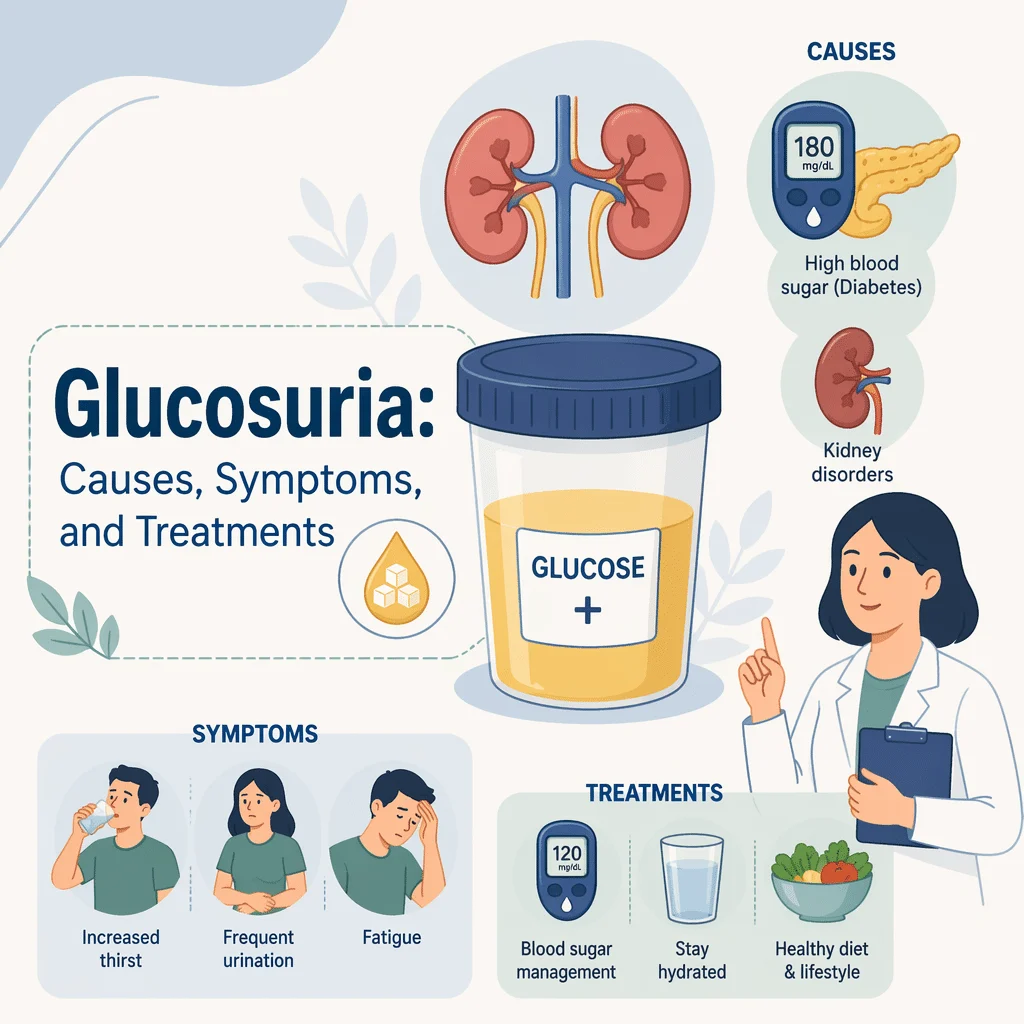
Glucosuria means glucose — sugar — is present in the urine, and it is one of the most misread findings on a routine urinalysis report. Most people who see it assume it points straight to diabetes. Sometimes it does. Often it does not, and increasingly it is the expected result of a medicine working exactly as designed. You may also see the word glycosuria, the commoner American spelling of the same finding.
In this article you’ll learn how the kidney handles glucose and what the renal threshold really is; why a urine glucose result is not a test for diabetes; why the “-flozin” medicines deliberately produce glucosuria; the harmless inherited condition that mimics it; what pregnancy changes; and what makes the pad give a wrong answer.
What glucose in urine means, and the renal threshold
Your kidneys filter roughly 180 grams of glucose out of the blood every day, and essentially all of it is pulled straight back in again, in the first stretch of tubing after the filter, by transport proteins — chiefly one called SGLT2, which does most of the work.
Those transporters have a ceiling. Once blood glucose climbs past a certain point they are saturated, the leftover glucose stays in the fluid heading for the bladder, and the pad on the test strip turns positive. That tipping point is the renal threshold, conventionally around 180 mg/dL, or about 10 mmol/L.
The consequence is the key to everything else. Glucosuria usually means blood glucose has been high at some point — not that the kidney is faulty. The kidney did exactly what it was built to do; it simply ran out of capacity.
What the pad on the strip is actually reporting
The glucose pad is a colour-change reaction, read as negative, trace, or a rising scale up to around 1000 mg/dL. It is semi-quantitative: it says roughly how much glucose was in that sample, not how much is in your blood now. How dilute the sample was shifts it too, which is what specific gravity describes.
Why urine glucose is not a test for diabetes
This is the correction that matters most, and it falls out of the threshold.
The pad only turns positive once blood glucose has climbed above the renal threshold. Prediabetes and early type 2 diabetes sit well below that line for most of the day, so someone can have genuinely abnormal blood glucose and a perfectly clean strip, over and over. As a screening test it misses precisely the people it would be most useful to find.
Second, urine is a pooled sample. It reports what happened across the hours the bladder was filling, not the moment the cup was handed over, so a rise after a meal can surface long after the blood level settled.
Third, the threshold is not the same in everyone. It drifts upward with age and with long-standing kidney disease, and downward in pregnancy, with fever and with exercise. Two people with identical blood glucose can produce opposite urine results.
Diagnosis and monitoring use blood: fasting glucose, an oral glucose tolerance test, and HbA1c, the average over roughly three months. Those numbers and their cut-offs belong in the guide to blood glucose levels. The National Institute of Diabetes and Digestive and Kidney Diseases is unambiguous that diabetes, prediabetes and gestational diabetes are diagnosed with blood tests, not urine ones.
The reverse is equally true, and worth saying plainly: a negative glucose pad does not rule diabetes out.
Why an older relative may remember testing their urine
For decades, urine testing was the only practical way to follow diabetes at home, and people diagnosed in the 1960s or 1970s often remember dipping strips several times a day. Home blood glucose meters and continuous monitors replaced it. The US National Library of Medicine now describes urine glucose as a test used to monitor diabetes in the past, with blood tests used instead. It is obsolete for that job, so if a relative still swears by it, that is history speaking.
Medicines that cause glucosuria on purpose
This is the most important recent change in how a positive glucose pad should be read.
SGLT2 inhibitors — the medicines whose names end in “-flozin”, such as dapagliflozin, empagliflozin and canagliflozin — block the very transporter that reclaims glucose from the filtrate. They are prescribed in type 2 diabetes, heart failure and chronic kidney disease, and they lower blood glucose precisely by sending it into the urine.
So if you take one, you will have glucosuria. At a completely normal blood glucose. Every time. That is the medicine working as intended, not a problem, and it is never a reason to stop or skip a dose — any change to these medicines is a decision for the prescriber, not for a test strip.
Two practical consequences follow.
The first is that urine glucose testing becomes meaningless in anyone taking one. The pad reads positive regardless of how well blood sugar is controlled, so it cannot judge anything. Say that you take a “-flozin” medicine when you hand in a sample, so the result is not misread as new or worsening diabetes.
The second is that sugar in urine feeds organisms. Genital thrush — a yeast infection — is noticeably more common on these medicines in both women and men, and urinary infections are reported too, though less consistently. Both are treatable, usually easily, and neither is a reason to walk away from a drug with real heart and kidney benefits. Itching, soreness or discharge is worth mentioning early. If the report also flags leukocyte esterase, that is a separate pad with a separate meaning.
One further point matters, and it is why the box further down is worth reading. In someone taking an SGLT2 inhibitor who becomes acutely unwell, ketones can rise to dangerous levels even when blood glucose looks normal, which is why ketones in urine, rather than glucose, are the marker that counts in that situation.
When the kidney’s threshold is simply set low
There is a version of glucosuria in which nothing is wrong at all.
Familial renal glucosuria is an inherited condition in which the SGLT2 transporter works less efficiently, because of a change in the gene that codes for it. The threshold is set low, so glucose spills into the urine at entirely normal blood glucose levels. It is the same mechanism the “-flozin” drugs create artificially, except that these people were born with it.
What matters is mostly what it does not do. It causes no symptoms, needs no treatment, does not damage the kidney and does not progress to diabetes. Blood glucose and HbA1c are normal, and stay normal.
It is also badly under-explained. People are sometimes investigated on and off for years, told repeatedly that they have sugar in their urine, without anyone naming the benign condition behind it. If your urine is persistently positive while every blood test comes back normal, this is the possibility to raise by name with your doctor.
Glucosuria in pregnancy
Pregnancy lowers the renal threshold. Blood flow through the kidney increases, more glucose is filtered, and the tubules cannot always keep pace — so glucose can appear in the urine at blood levels that would produce nothing outside pregnancy. It is common, frequently meaningless, and on its own it does not mean gestational diabetes.
Both halves of that sentence carry weight. Because gestational diabetes genuinely matters for mother and baby, a positive result is not brushed aside either. It usually prompts a proper blood test — a glucose challenge or an oral glucose tolerance test at the right point in pregnancy — rather than being ignored or treated as a diagnosis. The urine finding is a prompt to look properly, not an answer.
If you are not yet certain whether you are pregnant, a pregnancy test answers a different question from a urinalysis, and a period that is a few days late has plenty of other explanations.
The less common kidney causes
When glucose turns up alongside other things that should have been reabsorbed, the picture changes. Fanconi syndrome and related proximal tubular disorders affect the whole reabsorbing segment rather than the glucose transporter alone, so the urine carries glucose together with protein, phosphate, amino acids, bicarbonate and uric acid. That combination is the signal, not the glucose alone. These disorders can be inherited or acquired, and they are investigated rather than watched.
Other causes are far less exotic. A handful of medicines outside the SGLT2 class shift how the tubule handles glucose. And acute stress or severe illness — a major injury, burns, a heart attack, a stroke — pushes stress hormones up and blood glucose with them, so glucosuria can appear briefly in someone who does not have diabetes and never will.
Where a tubular problem is suspected, the work-up looks beyond the strip: urine creatinine to correct for how concentrated the sample was, and blood chemistry including BUN and creatinine to show how the kidney filters overall.
What makes the glucose pad give a wrong answer
Three interferences are worth knowing, and the first runs the opposite way from what most people expect.
High-dose vitamin C causes false negatives. Ascorbic acid blocks the reaction on the glucose pad, so a genuinely positive sample can read clean. Supplements, effervescent tablets and some drinks contain more than enough to matter. This hides real findings rather than inventing false ones, which is why it is worth mentioning before you give a sample.
A sample left standing loses glucose. Bacteria and cells in the container consume it, so a specimen that sat around or travelled slowly can under-report. Fresh samples read truest, which is one reason collection technique has its own section in the urinalysis interpretation guide.
Some older test methods reacted to other sugars. Historical copper-reduction tests responded to any reducing sugar — galactose, lactose, fructose — rather than to glucose specifically, which is why glycosuria is technically the broader word. Modern enzymatic pads are glucose-specific, but the distinction still shows up in old records.
What happens next
What a positive glucose pad means depends almost entirely on context, which is usually easy to establish.
| Situation | What it usually means | What to do |
|---|---|---|
| Glucose in urine with a high blood glucose | Blood glucose passed the renal threshold; fits undiagnosed or uncontrolled diabetes | Blood testing confirms or excludes it; the urine result diagnoses nothing |
| Glucose in urine while taking an SGLT2 inhibitor (“-flozin”) | The medicine doing its job; expected at any blood glucose | Nothing, other than making sure the lab and your clinician know you take it. Do not stop the medicine |
| Glucose in urine with entirely normal blood glucose and HbA1c | Possibly familial renal glucosuria, a benign inherited low threshold | Ask about it by name; if confirmed, no treatment is needed |
| Glucose in urine in pregnancy | Common, because the threshold falls in pregnancy; not a diagnosis | Expect a blood-based glucose test rather than dismissal or alarm |
| Glucose alongside protein, phosphate and amino acids | Points to a proximal tubular disorder such as Fanconi syndrome, not to blood sugar | Needs proper investigation of kidney tubular function |
Red flags: when to seek help urgently
- Heavy thirst, passing large volumes of urine and unexplained weight loss — arrange same-day assessment, especially in a child or a young adult.
- Vomiting, deep or rapid breathing, abdominal pain or drowsiness — possible ketoacidosis, which is an emergency. In someone taking an SGLT2 inhibitor this can happen even when the blood glucose reading looks normal.
- Fever together with pain, swelling or redness of the genitals or the area between the genitals and the anus, spreading quickly — a rare but serious infection associated with these medicines. Seek emergency care.
- Glucose found in the urine during pregnancy — contact your maternity team for proper blood testing rather than waiting for the next routine visit.
Away from those situations, glucosuria is a conversation for the next appointment rather than an emergency. Bring your full medicine list, including anything bought over the counter. If glucose has been high for a long time, the questions that follow are about nerves and circulation — persistent numbness in a big toe is one symptom that prompts a check — and about what else the urinalysis showed, including any blood in the urine.
Latest scientific advances in urine glucose testing
Research since 2023 has confirmed what the mechanism predicts, and sharpened two things: how poorly urine glucose screens, and how much one kidney differs from another.
Urine glucose missed every case of gestational diabetes in a screening study
A 2025 study of nearly a thousand women attending antenatal clinics in Tanzania compared two recommended screening approaches against the oral glucose tolerance test. What was found: the glycosuria test identified none of the women who turned out to have gestational diabetes, and only a small minority of those with diabetes in pregnancy. What this means for you: a clean urine strip in pregnancy is not reassurance, and a positive one is not a diagnosis.
A positive urine glucose early in pregnancy still flags higher risk
A 2026 retrospective cohort from China examined first-trimester markers in older first-time mothers. What was found: glucose in the urine between 10 and 13 weeks was independently associated with later gestational diabetes, and was the strongest routine marker examined, although the overall prediction model performed only moderately. What this means for you: an early positive result is a reason for your team to look more carefully, not a reason to panic, and it does not replace the standard test later on.
Genital yeast infections are a real, and manageable, effect of these medicines
A 2025 systematic review and meta-analysis pooled 98 randomised trials involving more than 90,000 people with type 2 diabetes, alongside adverse-event reports submitted to the US regulator. What was found: SGLT2 inhibitors clearly increase genital fungal infections, while the link with urinary tract infections was inconsistent between studies. What this means for you: thrush is a recognised and treatable side effect worth reporting early — a known trade-off against substantial heart and kidney benefits.
The renal threshold varies enormously between people
A 2023 study characterised a cohort of patients with familial renal glucosuria, sequencing the responsible gene and measuring each person’s renal threshold directly. What was found: the threshold ranged from very low to close to normal, tracking how severely the variant disabled the transporter. What this means for you: the renal threshold is a convention rather than a fixed number, and spilling glucose earlier than someone else says nothing about your blood sugar control.
Low-threshold gene variants are commoner than the textbooks suggest
A 2024 US analysis linked genetic data to health records across two large biobanks, then gave an SGLT2 inhibitor to carriers and non-carriers of the relevant variants in a small trial. What was found: around one person in fifty carried a rare variant in the gene behind renal glucosuria, and carriers appeared to respond somewhat differently, though the trial was too small to be conclusive. What this means for you: benign low-threshold glucosuria is not vanishingly rare, and it is reasonable to ask about.
Frequently asked questions
Does sugar in urine mean diabetes?
Not necessarily. It means glucose passed the level your kidney can reabsorb during the period that sample was collecting, which happens with undiagnosed or poorly controlled diabetes — but also on an SGLT2 inhibitor, in pregnancy, with a benign inherited low threshold, during severe illness, or with a tubular kidney disorder. The urine result raises the question. Only a blood test answers it. And because the pad stays negative until blood glucose is well above normal, it also cannot rule diabetes out.
Why do I have glucose in my urine when my blood sugar is normal?
Two explanations cover most cases. The first is that you take an SGLT2 inhibitor, one of the “-flozin” medicines used in type 2 diabetes, heart failure and chronic kidney disease. Those drugs work by making the kidney release glucose, so a positive result is expected and desirable. The second is familial renal glucosuria, an inherited condition in which the kidney’s threshold is simply set low. It causes no symptoms, needs no treatment and does not turn into diabetes. Pregnancy is a third common reason.
Can I test my urine for diabetes at home?
No, and it is not recommended. Urine strips only turn positive above the renal threshold, so they miss prediabetes and early diabetes entirely, and a negative result gives false reassurance. They also report a pooled window of time rather than the present moment, and the threshold varies from person to person. Diabetes is diagnosed and monitored with blood tests arranged by a clinician. If you are worried, ask for one rather than buying strips.
What is a normal amount of glucose in urine?
Essentially none. A small amount of glucose escapes reabsorption in everyone, but it sits below what a standard strip can detect, so a normal result reads negative. Laboratories usually quote roughly 0 to 15 mg/dL, or 0 to 0.8 mmol/L. Anything the pad picks up is worth explaining, though as this article describes, the explanation is often entirely benign. Ranges vary slightly between laboratories, so read the range printed on your own report.
What does a urine glucose reading of 1000 mean?
The number is milligrams per decilitre in that sample, so 1000 mg/dL sits at or near the top of most strip scales. It says a large amount of glucose was present, which points to blood glucose having been well above the renal threshold — or, very commonly now, to an SGLT2 inhibitor doing its job. It does not correspond to any particular blood glucose value, and it is not a severity score. The next step is a blood test and a look at your medicine list.
My urine glucose was negative. Does that rule out diabetes?
No. This is the most consequential misunderstanding about the test. Because the pad stays negative until blood glucose exceeds the renal threshold, someone can have prediabetes, or diabetes that has not yet been diagnosed, and produce clean urine strips indefinitely. A negative result tells you the blood level was below threshold while that urine collected, and nothing more. If you have symptoms or risk factors, ask about fasting glucose or HbA1c.
Glossary of key terms
| Term | Definition |
|---|---|
| Glucosuria | Glucose present in the urine, detected on a test strip or measured in the laboratory. |
| Glycosuria | The commoner US spelling, used interchangeably in practice; strictly it covers any sugar in urine, not only glucose. |
| Renal threshold | The blood glucose level above which the kidney can no longer reabsorb everything it filters, conventionally around 180 mg/dL. |
| Proximal tubule | The first stretch of kidney tubing after the filter, where almost all filtered glucose is reclaimed. |
| SGLT2 | The transport protein in the proximal tubule responsible for most glucose reabsorption. |
| SGLT2 inhibitor | A class of medicine ending in “-flozin” that blocks that transporter, deliberately causing glucose to appear in urine. |
| Familial renal glucosuria | A benign inherited condition in which the threshold is set low, producing glucosuria with normal blood glucose. |
| Fanconi syndrome | A disorder of the whole proximal tubule, leaking glucose together with protein, phosphate and amino acids. |
| HbA1c | A blood test reflecting average glucose over roughly three months, used to diagnose and monitor diabetes. |
| Reagent strip | The plastic dipstick carrying chemical pads that change colour, one of which reads glucose. |
Sources
- National Institute of Diabetes and Digestive and Kidney Diseases — Diabetes Tests & Diagnosis
- MedlinePlus, US National Library of Medicine — Glucose urine test
- US Food and Drug Administration — FDA warns about rare occurrences of a serious infection of the genital area with SGLT2 inhibitors for diabetes
- Liman MNP, Jialal I. Physiology, Glycosuria. StatPearls, NCBI Bookshelf, National Library of Medicine
- Kikula AI, Ramaiya K, Sirili N, et al. Hyperglycemia in pregnancy: a sensitivity analysis study of two recommended screening tests in Tanzania. PLOS Global Public Health, 2025
- Zhao KS, Bi JC, Bei N, et al. Neutrophil count and urinary glucose as early predictors of gestational diabetes mellitus in nulliparous women of advanced maternal age. Frontiers in Endocrinology, 2026
- Yoosuf BT, Kt MF, D P S, et al. Risk of genitourinary tract infections with SGLT-2 inhibitors in type 2 diabetes mellitus. Endocrine, 2025
- Xu L, Zhao R, Zhao Y, et al. Genetic and clinical characterization of familial renal glucosuria. Clinical Kidney Journal, 2023
- Allaire P, Fox J, Kitchner T, et al. Familial renal glucosuria and potential pharmacogenetic impact on sodium-glucose cotransporter-2 inhibitors. Kidney360, 2024
Study summaries in this article draw on literature indexed in PubMed.
Further reading
- Urinalysis results: interpretation guide
- Glucose levels: causes, symptoms and treatments
- Urine creatinine levels: guide and interpretation
- Kidney stones: causes, symptoms and treatments
- Cholesterol ratio explained: meaning and risks
Understand your lab results with AI DiagMe
A urinalysis puts urine glucose on the page next to a handful of other markers, usually without the context that decides what any of them mean — and that context often lives in a separate blood glucose or HbA1c result. AI DiagMe reads your report back to you in plain language and shows how the pieces fit together. It helps you understand your results and prepare for your appointment. It does not diagnose, and it does not replace your doctor.
Get your results interpreted in minutes