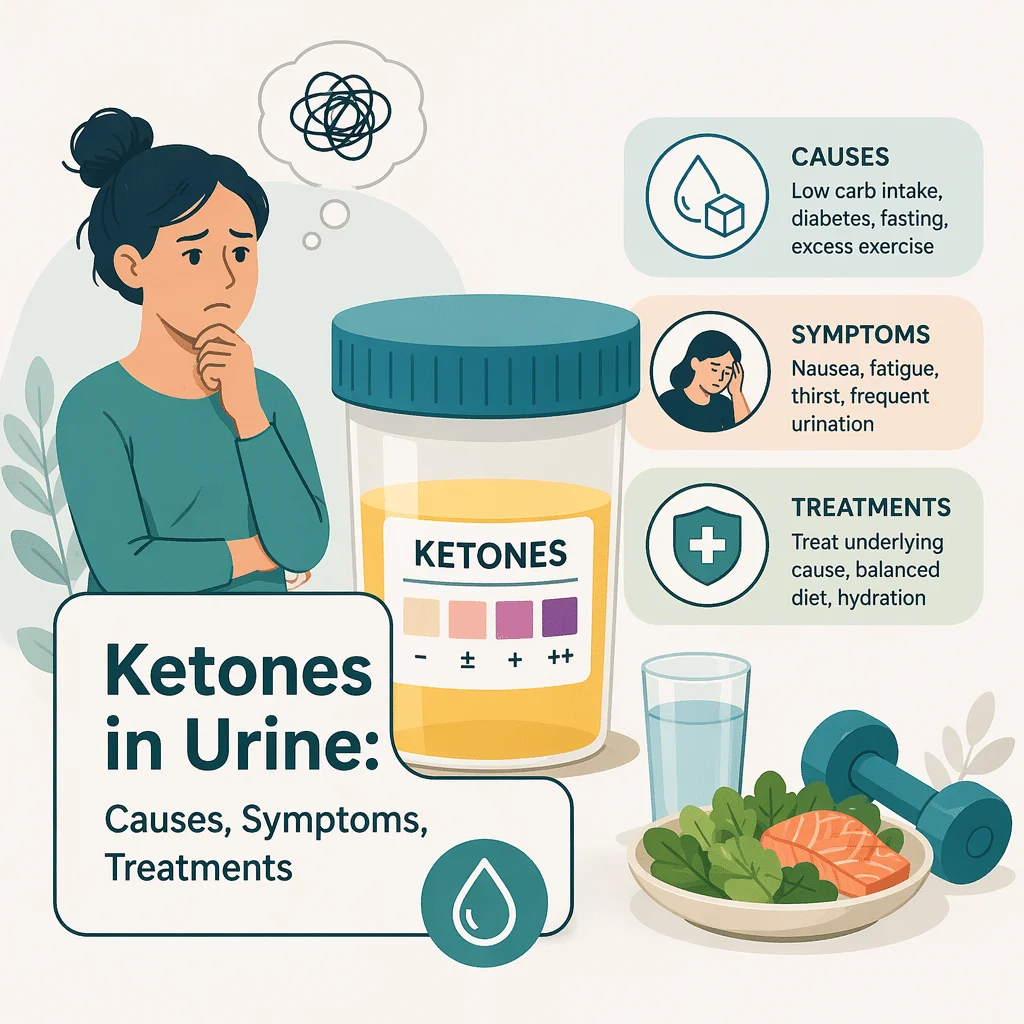
Ketones in urine mean one thing: your body has been burning fat for fuel instead of glucose. Sometimes that is completely ordinary — after an overnight fast, on a low-carbohydrate diet, or during a stomach bug that has stopped you eating. Sometimes it is the first visible sign of a life-threatening emergency called ketoacidosis. The job of this page is to make that difference unmistakable.
In this article you’ll learn what ketones are, the everyday reasons the ketone pad turns positive, the combination of signs that means you should call 911, why ketoacidosis can develop while your blood sugar looks perfectly normal, and the one substance the urine strip cannot measure. The ketone pad is only one square on the dipstick; our guide to reading urinalysis results covers the full pad-by-pad picture and sample collection. If you feel unwell as you read this, start with the emergency box below.
When ketones in urine are an emergency
Call 911 or go to the emergency department now
Get emergency help if ketones appear with any of the following:
- Vomiting, or being unable to keep fluids down
- Deep, fast or labored breathing, or breathlessness
- Breath that smells sweet or fruity, like nail polish remover
- Abdominal pain
- Drowsiness, confusion, or difficulty staying awake
Also seek urgent medical assessment for:
- Ketones together with a high blood glucose reading in anyone who has diabetes
- Feeling unwell while taking an SGLT2 inhibitor (a medicine ending in “-flozin”) even if the glucose reading is normal
- Ketones in a child who is not drinking, or who is drowsy or vomiting
- Persistent vomiting in pregnancy
Do not wait to see whether the strip improves. Ketoacidosis can worsen over hours.
Most positive ketone results are not emergencies. What turns a chemistry finding into a red flag is the company it keeps: symptoms, and the situation the person is in. A trace in someone who skipped breakfast and feels well is a different event from a moderate result in someone who has been vomiting all night.
If you have diabetes, follow the sick-day plan your own team has given you, and contact them when ketones appear. Do not adjust or skip any medicine on the strength of a strip reading and a web page.
What ketones are and why they appear in urine
Your body prefers glucose as fuel. When glucose is unavailable, or is in the blood but cannot get into cells because there is not enough insulin, the liver breaks down fat instead. That process, lipolysis, produces three ketone bodies: acetoacetate, beta-hydroxybutyrate and acetone.
Ketones circulate in the blood and are filtered into the urine. A positive ketone pad is therefore a record that fat has been fueling you recently. It says nothing on its own about whether that was healthy adaptation or metabolic crisis.
Two practical points follow. Urine ketones lag behind blood ketones, so a strip can stay positive after the problem has settled, and can read low early in one that is only starting; the timing of the sample matters. And how concentrated the urine is affects the color on the pad, which is one reason the specific gravity pad sits beside it.
The everyday reasons the ketone pad turns positive
The commonest explanations are benign and expected:
- An overnight fast, a skipped meal, or a first-morning sample after a long gap without food
- A low-carbohydrate or ketogenic diet, or intermittent fasting
- Prolonged or intense exercise, especially without eating first
- Pregnancy, particularly with morning sickness and reduced intake
- Any illness that suppresses appetite or causes vomiting or diarrhea
None of these is inherently dangerous in a well person who is eating and drinking normally again within a day or so. Because low intake and fluid loss travel together, dehydration often sits behind a positive result, and it nudges other markers too — see how it shows up in blood pressure and in BUN and creatinine.
Alcohol, severe vomiting and illness
Heavy alcohol use with poor food intake can produce alcoholic ketoacidosis, in which ketones rise sharply while blood glucose is often normal or low. Severe or repeated vomiting does something similar: it removes intake and fluid at once, and ketone production accelerates. If you cannot keep water down, that needs assessment rather than watchful waiting — our page on vomiting bile explains when that sign matters.
Diabetic ketoacidosis: the emergency the strip is really screening for
In a person with diabetes, ketones plus a high blood glucose reading is the classic warning combination. Without enough insulin, glucose piles up in the blood but cannot enter cells, so the liver keeps making ketones. Ketones are acids, and as they accumulate the blood turns acidic. That is diabetic ketoacidosis, or DKA.
DKA often starts quietly, with thirst and passing a lot of urine, then declares itself with nausea and vomiting, abdominal pain, fast deep breathing, a fruity smell on the breath, extreme tiredness and eventually confusion. It is most common in type 1 diabetes but happens in type 2 too, and is sometimes the first sign of diabetes at all.
Hospital treatment involves intravenous fluids, electrolyte correction, insulin under medical supervision, and treating whatever set the episode off. None of that can be replicated at home, and no article should tell you how to adjust insulin. What you can do is recognize the pattern, test when your team has told you to, and go in early. For the blood-side numbers, see our guide to blood glucose levels and HbA1c.
Ketoacidosis with normal blood glucose: the SGLT2 inhibitor blind spot
This is the part almost no consumer article carries, and the one most likely to change an outcome.
SGLT2 inhibitors — the medicines whose names end in “-flozin”, such as empagliflozin, dapagliflozin and canagliflozin — are prescribed for type 2 diabetes, heart failure and chronic kidney disease. They work by making the kidneys pass glucose into the urine, which is why people taking them routinely have sugar in their urine; our page on glucose in urine explains that mechanism.
The consequence for ketones is this. Because the drug removes glucose continuously, blood sugar stays normal or only mildly raised even when the body has switched to burning fat and is producing acid. Someone can therefore develop full ketoacidosis with a glucose reading that looks reassuring. Clinicians call this euglycemic diabetic ketoacidosis, and it is regularly missed or diagnosed late for exactly that reason. The US Food and Drug Administration has required ketoacidosis warnings on this drug class, noting that glucose at presentation may be lower than doctors expect.
The triggers are predictable: acute illness or infection, surgery or a procedure, fasting (including before an operation or scan), dehydration, and a sudden sharp drop in carbohydrate intake. Cases have also been reported in people prescribed these medicines for heart failure who do not have diabetes at all.
The practical message is short. If you take an SGLT2 inhibitor and feel unwell — nausea, vomiting, abdominal pain, unusual tiredness, breathlessness — “my sugar is fine” is not reassurance. Ketones should be checked, ideally in blood, and you should contact your prescriber or seek urgent care. Never stop an SGLT2 inhibitor on your own; that is a prescriber’s decision. Your team may pause it around illness, fasting or planned surgery, and current guidance is to hold these drugs for several days before an operation.
What the urine strip cannot see: acetoacetate and beta-hydroxybutyrate
Here is a technical detail with very practical consequences. The urine ketone pad uses a nitroprusside reaction that detects acetoacetate, and weakly acetone. It does not detect beta-hydroxybutyrate at all — and beta-hydroxybutyrate is the dominant ketone during ketoacidosis. Two things follow, and both regularly confuse people.
Early in ketoacidosis, when beta-hydroxybutyrate is high and acetoacetate has not yet built up, the strip can under-read. A modest-looking result does not rule out a serious problem in someone who has symptoms.
During recovery the opposite happens. As treatment takes effect, beta-hydroxybutyrate is converted back into acetoacetate — the very ketone the strip measures. So the urine test can appear to get worse while the person is actually getting better. A darkening pad is not evidence that treatment is failing.
This is why blood ketone meters, which measure beta-hydroxybutyrate on a fingerprick sample, are preferred wherever available, and why they are recommended for people with type 1 diabetes and anyone taking an SGLT2 inhibitor. If you monitor ketones at home, ask your team whether a blood meter suits you.
Ketogenic diets and ketoacidosis are not the same thing
If you follow a ketogenic diet and your urine strip is positive, that is the expected result — the diet is designed to produce it. Nutritional ketosis and ketoacidosis differ in magnitude, not merely in name: the ketone concentrations reached on a well-managed low-carbohydrate diet are a small fraction of those in ketoacidosis, and acid-base balance is maintained. A positive strip on keto, in someone who feels well, is not an early stage of DKA.
Three caveats are worth stating plainly, and none is an argument for or against the diet itself. First, symptoms override the strip: nausea, vomiting, abdominal pain, breathlessness or confusion are not part of nutritional ketosis and need medical assessment whatever the dietary explanation.
Second, severe ketoacidosis has been reported in people without diabetes on very strict low-carbohydrate regimens combined with other metabolic stress; one case involved a breastfeeding mother, since lactation adds a large extra fuel demand.
Third, and most importantly: if you have diabetes and take insulin or an SGLT2 inhibitor, discuss any low-carbohydrate or fasting plan with your prescriber first. The combination raises ketoacidosis risk, and the medicine plan may need reviewing by the person who wrote it.
Ketones in pregnancy and in children
Pregnancy changes the metabolic rules. Insulin resistance rises and fat breakdown accelerates, so starvation ketosis develops after a much shorter gap without food, especially in the third trimester. A trace of ketones on a routine prenatal sample after an overnight fast is common and usually unremarkable.
Persistent ketones with vomiting are a different matter. They can indicate hyperemesis gravidarum with dehydration, needing assessment and often intravenous fluids rather than reassurance. Anyone pregnant who cannot keep fluids down and has ketones should be reviewed the same day. If you are still working out whether pregnancy explains your symptoms, our page on a period five days late covers the next steps.
In children, ketones appear readily. Small glycogen stores mean a child who has been vomiting, has a fever or refuses food overnight can produce a strongly positive strip. Usually this is illness-related ketosis that settles once the child drinks and eats, but children deteriorate faster than adults. A child with ketones who is not drinking, is drowsy, is breathing fast or keeps vomiting needs to be seen urgently, and new type 1 diabetes can present directly as DKA.
Reading your result: what each situation usually means
Urine ketone results are reported as negative, trace, small, moderate or large. The grade matters far less than the context. The table below maps the common scenarios.
| Situation | What it usually means | What to do |
|---|---|---|
| Trace ketones after an overnight fast or skipped meal, feeling well | Normal physiological ketosis; the body used fat overnight | Nothing urgent. Eat and drink normally; mention it at your next appointment if it recurs |
| Ketones on a ketogenic diet, feeling well | Expected effect of the diet, far below ketoacidosis levels | No action needed. Speak to your prescriber if you take insulin or an SGLT2 inhibitor |
| Ketones with a high blood glucose reading in someone with diabetes | Possible diabetic ketoacidosis | Medical emergency. Follow your team’s sick-day plan and contact them now; call 911 if vomiting, breathless or drowsy |
| Ketones with a normal glucose reading while unwell on an SGLT2 inhibitor | Possible euglycemic ketoacidosis; the normal glucose is misleading | Urgent assessment the same day. Say which medicine you take. Do not stop it yourself |
| Ketones with vomiting in pregnancy | Dehydration and starvation ketosis, possibly hyperemesis | Contact maternity services the same day if you cannot keep fluids down |
| Ketones in a child who is drowsy, breathing fast or not drinking | Significant illness, dehydration or new type 1 diabetes | Seek urgent medical care immediately |
If the result came from a laboratory urinalysis, read the rest of the report too. A positive leukocyte esterase pad points toward infection, protein in the urine raises kidney questions, and blood in the urine is followed up on its own track. Expect follow-up testing rather than a verdict from the strip alone: a blood ketone measurement, blood glucose, kidney function and electrolytes, and blood gases if ketoacidosis is suspected.
Latest scientific advances in ketone testing
Recent research has concentrated on the two problems this article is built around: ketoacidosis that hides behind a normal glucose reading, and the limits of the urine strip itself.
A 2023 review in BMJ Open Diabetes Research and Care examined euglycemic diabetic ketoacidosis in the era of SGLT2 inhibitors. Cases are becoming more frequent as the drugs are prescribed more widely, and the central difficulty is diagnostic: the hallmark high blood sugar that prompts doctors to think of ketoacidosis is absent. What this means for you is that the burden of raising the possibility often falls on the patient. Saying “I take a flozin medicine” when you arrive unwell is useful.
A 2023 review of ketone measurement in the Journal of Diabetes Science and Technology set out why the urine pad behaves as it does. Beta-hydroxybutyrate predominates in blood during ketoacidosis, acetoacetate predominates in urine, and as ketoacidosis resolves beta-hydroxybutyrate is oxidized into acetoacetate. Because of this lag, the authors note, a urine ketone test can be rising even as ketoacidosis resolves. What this means for you is that a worsening strip during treatment is not evidence of failure, and a blood beta-hydroxybutyrate measurement gives a far more current picture.
A 2024 narrative review in the Journal of General Internal Medicine looked at euglycemic ketoacidosis in people taking SGLT2 inhibitors who do not have diabetes, mostly prescribed them for heart failure. In nearly all reported cases the common thread was reduced food intake: acute illness, fasting, or surgery. What this means for you is that risk is tied to situations, not only diagnoses: if you take one of these medicines and stop eating for any reason, be alert.
A 2024 clinical guideline from a large US academic medical center, in the Journal of Cardiothoracic and Vascular Anesthesia, addressed managing patients on SGLT2 inhibitors around surgery. It reports that the Food and Drug Administration updated its recommendation so these medicines are held for several days before a planned operation. What this means for you is practical: tell every surgeon, anesthetist and dentist that you take this medicine, well before the date.
Finally, a 2024 case report in the European Journal of Case Reports in Internal Medicine described life-threatening starvation ketoacidosis in a breastfeeding woman without diabetes on a strict ketogenic diet. The authors argue the risk in the early postpartum period deserves more discussion. What this means for you is not that the diet is unsafe in general, but that combining strict carbohydrate restriction with high metabolic demand — pregnancy, breastfeeding, acute illness — is worth talking through with a clinician first.
Frequently asked questions
Are ketones in urine dangerous?
It depends entirely on the context. In a person who feels well and has simply not eaten for a while, is exercising hard, or is following a low-carbohydrate diet, ketones are a normal metabolic finding and not dangerous. In a person with diabetes whose blood glucose is high, or in anyone with vomiting, abdominal pain, deep or rapid breathing, fruity-smelling breath, drowsiness or confusion, the same result may signal ketoacidosis, which is a medical emergency. The strip result alone never decides. Symptoms, blood glucose and the medicines you take decide.
Are ketones on a keto diet the same as diabetic ketoacidosis?
No. They are the same chemical family at completely different concentrations. Nutritional ketosis on a ketogenic diet produces ketone levels that are a small fraction of those reached in ketoacidosis, and blood acidity stays within its normal range. A positive urine strip on keto is the expected result, not an early stage of DKA. The exception is symptoms: nausea, vomiting, abdominal pain or breathlessness are not part of nutritional ketosis and need assessment. If you take insulin or an SGLT2 inhibitor, discuss the diet with your prescriber first.
Can I have ketoacidosis with normal blood sugar?
Yes. This is called euglycemic diabetic ketoacidosis, and it is most often linked to SGLT2 inhibitors, the “-flozin” medicines. Because these drugs remove glucose through the kidneys, blood sugar can look normal or only slightly raised while ketones and blood acidity climb. Common triggers are illness, surgery, fasting, dehydration and a sudden drop in carbohydrate intake. If you take one of these medicines and feel unwell, a normal glucose reading is not reassurance. Ketones should be checked and you should seek medical advice.
What is a dangerous level of ketones in urine?
Laboratories usually report ketones as negative, trace, small, moderate or large. Moderate or large results warrant prompt medical contact, especially in anyone with diabetes. But no single level is reliably safe or dangerous on its own, and a low urine result cannot rule out early ketoacidosis, because the strip does not detect beta-hydroxybutyrate. A blood ketone measurement is the more dependable number. Treat symptoms as more informative than the color on the pad, and contact your care team if you are unwell.
Can you have ketones in your urine without diabetes?
Very commonly. Fasting, skipping meals, a low-carbohydrate or ketogenic diet, prolonged exercise, pregnancy with morning sickness, any illness with vomiting or poor appetite, and heavy alcohol use with little food can all produce ketones in someone who has never had diabetes. Children produce them especially readily. Ketoacidosis without diabetes is rare but does happen, in alcoholic ketoacidosis, in severe starvation, and in people taking SGLT2 inhibitors for heart failure. Context and symptoms determine whether the finding needs action.
How do I get rid of ketones in my urine?
That depends on why they are there, and it is not always something to fix yourself. If the cause is a missed meal, a long fast or exercise, ketones clear once you eat and drink normally again. If dehydration or vomiting is driving them, fluids help, but if you cannot keep fluids down you need medical help rather than home measures. If you have diabetes, do not change insulin, food or any other medicine to chase a strip result. Follow the sick-day plan your team has given you and contact them.
Glossary
| Term | Definition |
|---|---|
| Ketones (ketone bodies) | Molecules the liver makes from fat when glucose is unavailable or cannot be used. The three are acetoacetate, beta-hydroxybutyrate and acetone |
| Acetoacetate | The ketone that the urine dipstick pad actually detects, and the one that predominates in urine |
| Beta-hydroxybutyrate | The dominant ketone in blood during ketoacidosis. Urine strips do not detect it; blood ketone meters measure it |
| Ketosis | A state of raised but controlled ketone production, such as during fasting or a ketogenic diet. Blood acidity stays normal |
| Ketoacidosis | Ketone production high enough to make the blood acidic. A medical emergency requiring hospital treatment |
| Diabetic ketoacidosis (DKA) | Ketoacidosis caused by insufficient insulin, classically alongside a high blood glucose level |
| Euglycemic ketoacidosis | Ketoacidosis occurring while blood glucose is normal or only mildly raised, most often in people taking SGLT2 inhibitors |
| SGLT2 inhibitor | A prescribed medicine ending in “-flozin” that makes the kidneys pass glucose into the urine, used in diabetes, heart failure and kidney disease |
| Lipolysis | The breakdown of stored fat into fatty acids, the raw material the liver turns into ketones |
| Reagent strip (dipstick) | The plastic strip with chemical pads that change color in urine, giving a rapid approximate result |
Sources
- Centers for Disease Control and Prevention. Diabetic Ketoacidosis
- MedlinePlus, US National Library of Medicine. Ketones urine test
- National Institute of Diabetes and Digestive and Kidney Diseases. Managing Diabetes: checking urine for ketones
- Chow E, Clement S, Garg R. Euglycemic diabetic ketoacidosis in the era of SGLT-2 inhibitors. BMJ Open Diabetes Research and Care, 2023
- Huang J, Yeung AM, Bergenstal RM, et al. Update on Measuring Ketones. Journal of Diabetes Science and Technology, 2023
- Garg R, Sood N, Bansal O, Hoskote A. Euglycemic Ketoacidosis Associated with SGLT-2 Inhibitors in Non-diabetic Patients: A Narrative Review. Journal of General Internal Medicine, 2024
- Raiten JM, Morlok A, D’Ambrosia S, Ruggero MA, Flood J. Perioperative Management of Patients Receiving Sodium-Glucose Cotransporter 2 Inhibitors. Journal of Cardiothoracic and Vascular Anesthesia, 2024
- Shaikh A, Williams DM, Stephens JW, Edwards R. Starvation Ketoacidosis on the Acute Medical Take: An Easily Missed Complication of the Keto Diet. European Journal of Case Reports in Internal Medicine, 2024
- Abraham L, Ning X, Whitlatch HB. Starvation Ketoacidosis in Pregnancy: An Unusual Presentation and Brief Literature Review. JCEM Case Reports, 2024
Further reading
- Urinalysis results: how to read every pad on the strip
- Magnesium deficiency: symptoms, causes and treatments
- Nighttime nausea: causes, symptoms and treatments
- Diarrhea after fasting: causes and treatments
- Numb big toe: causes, symptoms and treatments
Understand your lab results with AI DiagMe
A urinalysis rarely arrives alone. Ketones, glucose and bicarbonate only make sense read together with the rest of the panel, and most reports land in your inbox with no explanation attached. AI DiagMe turns those numbers into plain language so you walk into your appointment already knowing what to ask. It helps you understand your results; it does not diagnose, it is not for emergencies, and it does not replace your doctor.
Get your results interpreted in minutes