肝癌症状是搜索量最高的健康话题之一,也是最容易引起误解的话题之一,因为这种疾病在早期阶段异常"沉默"。肝脏内部没有痛觉神经,功能储备量大,肿瘤可以在很长一段时间内悄悄生长,不引起任何不适。正因如此,当您想了解"需要注意哪些信号"时,更诚实的回答应该从另一个问题开始:您是否属于应该定期筛查、而非等待症状出现的高风险人群?美国国家癌症研究所预计,2026年美国将新增约42,340例肝脏及肝内胆管癌病例,所有分期的五年相对生存率为21.9%,而预后与发现时间的早晚密切相关。本文将为您详细介绍肝癌的真实症状、症状出现的时机、哪些人群属于高风险,以及面对这些信息应该怎么做。.
为什么肝癌症状出现得如此晚
肝脏的三个特点解释了这一延迟现象。首先,肝脏拥有巨大的功能储备,即使相当大一部分受到影响,血液检查或日常功能也可能不会出现明显变化。其次,肝脏内部组织没有感觉神经,因此肿瘤在器官内生长时不会引起疼痛,直到它撑开外层包膜或压迫邻近结构才会有所感觉。此外,大多数肝癌发生在慢性肝病的基础上,因此最终出现的疲劳、食欲不振和腹部不适,往往会被归因于患者已知的肝硬化或肝炎等基础疾病。.
肝细胞癌约占原发性肝癌的90%。肝内胆管癌占其余大部分,约为10%至20%,而肝血管肉瘤极为罕见,约占1%。原发性肝癌是指起源于肝脏本身的癌症,与从其他部位转移至肝脏的癌症是两种不同的疾病,尽管两者在日常交流中都可能被称为"肝癌",但不可混为一谈。.
肝癌早期症状
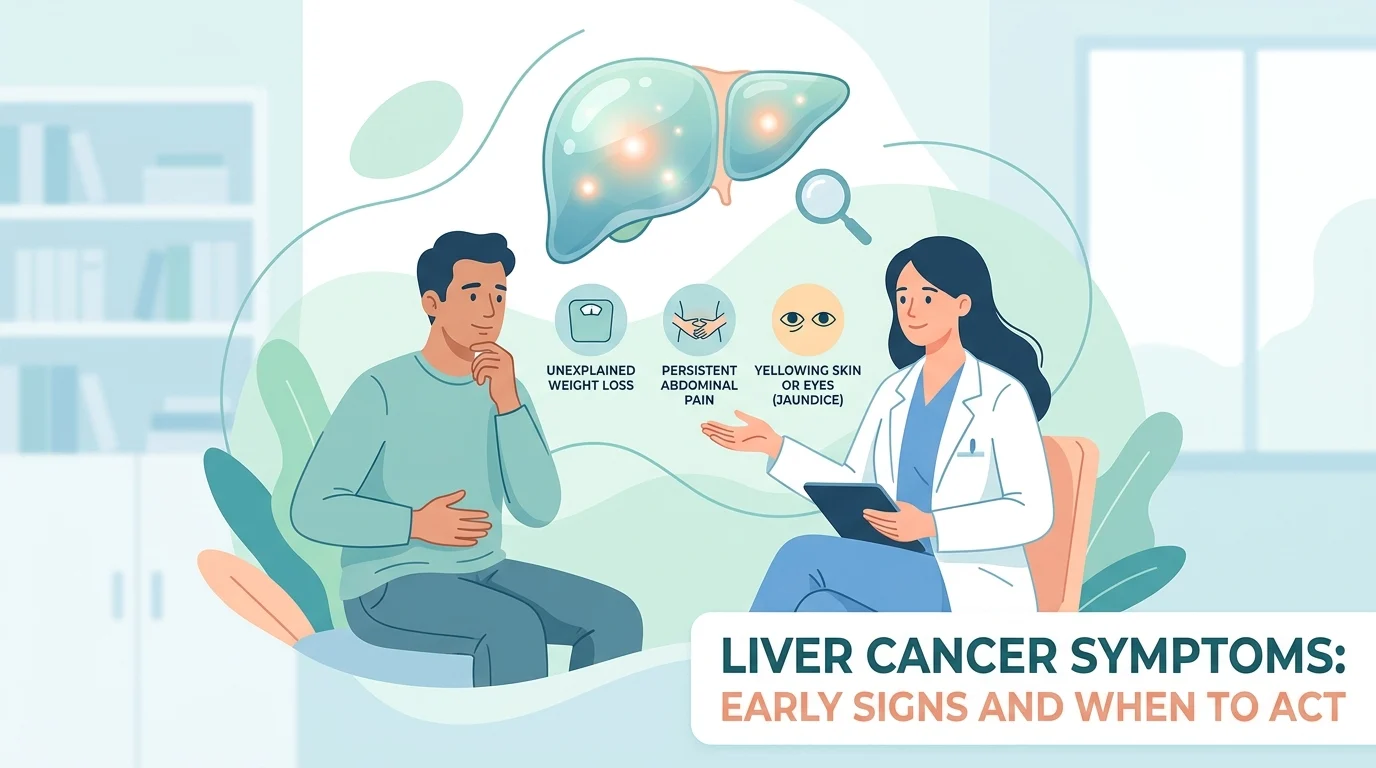
大多数早期肝癌完全没有任何症状。一旦出现某些不适,通常也比较模糊,容易被归因于其他原因。下表列出了最常见的症状及其各自反映的情况。.
| 症状 | 它反映了什么 | 典型时间 |
|---|---|---|
| 体重无故下降 | 肿瘤引起的全身代谢改变 | 通常是最先被注意到的表现,但缺乏特异性 |
| 食欲减退、进食后很快感到饱胀 | 肿瘤压迫胃部,或疾病本身的影响 | 早期至中期 |
| 右侧上腹部疼痛 | 肝脏周围包膜受到牵拉 | 需要肿瘤已长到一定大小 |
| 全身乏力与疲劳 | 肝功能下降、贫血或肿瘤本身所致 | 症状逐渐出现,常被归因于其他原因 |
| 恶心与呕吐 | 邻近器官受到压迫移位 | 中间结果 |
| 右侧肋骨下方可触及的硬块 | 肝脏肿大或可触及的肿块 | 出现较晚,从不是可靠的早期征兆 |
上述每一项症状都有更为常见的其他解释。非刻意的体重下降和疲劳是医学上特异性最低的症状之一。赋予它们意义的是背景:同样的症状,出现在已知有肝硬化或慢性乙型肝炎患者身上,与出现在肝脏健康的人身上,意义截然不同。.
较晚期及进展期症状
随着病情进展,症状变得更具特征性,因为它们反映的是肝功能衰竭,而非肿瘤本身。.
- 黄疸,即皮肤和眼白发黄
- 尿液颜色加深,粪便呈浅色、灰色或白垩色
- 腹腔积液(腹水)引起的腹部膨隆
- 无皮疹的皮肤瘙痒,由胆汁代谢产物蓄积所致
- 容易出现瘀伤或出血,因为肝脏负责合成凝血因子
- 无明显感染原因的发热
- 意识模糊或嗜睡,这是晚期征兆,称为肝性脑病
第4期及终末期症状
晚期疾病将上述症状与癌症扩散部位的症状相叠加,最常见的转移部位为肺、骨骼和腹膜。骨痛、呼吸困难、双腿明显水肿以及严重的肌肉和体重消耗变得突出。根据SEER数据,21%的病例在确诊时已发生远处转移,五年相对生存率仅为3.6%,而病灶仍局限于肝脏的患者五年相对生存率为37.4%。这一差距是在症状出现之前就进行早期筛查的最有力依据。.
女性肝癌的症状有何不同?
症状本身是相同的。区别在于哪些人更容易患病:肝癌在男性中的确诊率明显高于女性,男性性别是经大型循证综合研究证实的既定危险因素。确诊时的中位年龄为68岁。目前并不存在女性特有的症状模式,相关搜索所暗示的差异通常反映的是发病率的不同,而非临床表现的差异。.
肝癌的病因及高危人群
肝癌几乎总是在慢性肝损伤的背景下发展。2025年发表的一项综合综述汇集了175项荟萃分析,确定了101个候选危险因素,发现慢性乙型肝炎与风险增加约12.5倍相关,慢性丙型肝炎与风险增加约11.2倍相关,而抗病毒治疗和病毒学应答可降低上述风险。.
- 慢性乙型肝炎或丙型肝炎感染,是全球最主要的两大病因
- 任何原因引起的肝硬化,包括酒精相关性肝病
- 代谢功能障碍相关脂肪性肝病、肥胖及2型糖尿病
- 大量饮酒和吸烟
- 遗传性血色病及其他遗传性肝脏疾病
- 黄曲霉毒素暴露,来源于某些地区储存的谷物和坚果受霉菌污染
- 男性及高龄
同一综述还报告了与较低风险相关的因素,包括饮用咖啡、健康饮食,以及若干常用药物的相关信号。这些均为来自观察性数据的人群层面关联,并非行动指南:其中任何内容都不构成在未与医生沟通的情况下自行开始或停止用药的理由。.
为何症状并非可靠的筛查工具,而定期监测才是正确选择
这是最关键的一点。由于早期肝癌往往没有症状,相关指南并不依赖症状来发现它。指南建议对高风险人群进行定期监测,通常是每六个月进行一次腹部超声检查,对于肝硬化患者或高风险慢性乙型肝炎患者,可同时检测甲胎蛋白(AFP)血液指标。定期监测与更早期的病变发现、更多的根治性治疗机会以及更低的肝癌死亡率密切相关。如果您属于上述高风险人群,最重要的一步是确认自己已纳入监测计划,而不是去记忆一份症状清单。.
血液检查能查出什么,查不出什么
标准肝功能检查检测的是肝细胞受损时释放的酶,而非是否存在肿瘤,我们的 肝功能检查指南 explains how those markers are read as a pattern. The individual values each carry their own meaning: for the enzyme most often flagged first, open our ALT blood test guide, and for its usual companion, check our AST blood test guide. Jaundice is explained in our total bilirubin guide, and the protein that falls as liver function declines is covered in our low albumin guide.
Alpha-fetoprotein is the blood marker used in surveillance, and it is widely misunderstood. A raised level most often reflects a benign liver condition rather than cancer, and a normal level does not rule cancer out, because a substantial share of liver cancers never produce it; read our AFP blood test guide before drawing conclusions from a single value. Because hepatitis status determines whether surveillance applies at all, testing for it matters: see our hepatitis B surface antigen guide and our hepatitis blood test guide.
何时应该去看医生
Contact a clinician promptly, rather than waiting, in any of these situations.
- Yellowing of the skin or eyes, at any age and with any other symptom
- Pale or chalky stools together with dark urine
- New abdominal swelling, or clothes becoming tight around the waist over weeks
- Unintentional weight loss of more than about 5 percent of body weight within six months
- Persistent upper right abdominal pain lasting more than two weeks
- A hard lump felt below the right rib cage
- Any new or worsening symptom in someone with known cirrhosis, hepatitis B, or hepatitis C
Confusion, drowsiness, vomiting blood, or black tarry stools in someone with liver disease are emergencies and need immediate care rather than an appointment.
Survival rates in context
Liver cancer survival statistics are sobering, and they are also frequently misapplied. The 21.9 percent five-year relative survival covers every stage and every type together, and it describes people diagnosed in past years and treated with the methods available then. Stage changes the picture substantially: 37.4 percent at five years for localized disease, 13.4 percent for regional spread, and 3.6 percent for distant disease. Underlying liver function also shapes the outlook independently of the tumor, because treatment options depend on how much healthy liver remains. No statistic predicts an individual outcome, and the figures cannot account for a specific person’s treatment plan or response.
最新科学进展
Research over the past three years has concentrated on the problem this article opened with: finding liver cancer before symptoms appear. The findings below come from peer-reviewed studies and guidelines, and none of them changes what any individual should do without a clinician’s input.
The limits of current surveillance are now well documented. A 2024 review of surveillance strategies concluded that ultrasound alone has suboptimal sensitivity for early-stage disease, particularly in people with obesity and in non-viral liver disease, and that adding alpha-fetoprotein improves detection but still misses more than a third of early-stage cancers. That acknowledged gap is what the rest of this work is trying to close.
Blood-based biomarker panels are the most advanced response. The best-studied is the GALAD score, which combines sex, age, alpha-fetoprotein, AFP-L3, and des-gamma-carboxy prothrombin into a single value. A phase 3 validation study published in 2024 followed 1,558 patients with cirrhosis across seven centers for a median of 2.2 years, during which 109 developed liver cancer. Measured in blood drawn up to 12 months before diagnosis, GALAD achieved an area under the curve of 0.78 against 0.66 for alpha-fetoprotein alone, and at matched specificity of 82 percent its sensitivity was 62 percent against 41 percent. In plain terms, the panel found meaningfully more cancers a year earlier than the single marker, while still missing a substantial share. A 2025 systematic review of 44 studies and 33,100 patients pooled the three commercially available panels and found early-stage sensitivities of 70.1 to 74.1 percent with specificities of 83.3 to 87.2 percent, with no significant difference between them and high statistical heterogeneity across studies.
The decisive evidence is not yet in. A phase 4 randomized trial began enrolling in 2024 across 15 United States sites, comparing semi-annual ultrasound with or without alpha-fetoprotein against semi-annual GALAD in 5,500 patients with cirrhosis or chronic hepatitis B, with reduction in late-stage cancer as the primary endpoint measured at five and a half years. A separate real-world implementation study of a related panel is running in the United Kingdom through 2030. A search of ClinicalTrials.gov in September 2026 returns 42 recruiting studies in liver cancer screening and surveillance. Until those trials report, ultrasound with or without alpha-fetoprotein remains the recommended standard, and a biomarker panel is an adjunct discussed with a specialist rather than a replacement.
Guidelines have moved in parallel. The European Association for the Study of the Liver published updated clinical practice guidelines on managing hepatocellular carcinoma in 2024, introducing personalized surveillance based on individual risk assessment, standardized imaging criteria, and clearer transitions between surgical, locoregional, and systemic therapies. On the treatment side, a network meta-analysis of 25 studies and 4,548 patients with early-stage disease found surgical resection associated with better disease-free survival at one and three years than radiofrequency or microwave ablation, though the comparison varied by region and the studies were mostly observational. Which option suits a given patient depends on tumor size and number, liver function, and overall health, and remains a multidisciplinary decision.
词汇表
| 学期 | 意义 |
|---|---|
| Hepatocellular carcinoma | The most common primary liver cancer, about 90 percent of cases. |
| 肝硬化 | Permanent scarring of the liver, the main setting in which liver cancer arises. |
| 监测筛查 | Planned repeat testing in people at high risk, to find cancer before symptoms. |
| Alpha-fetoprotein | A protein used as a blood marker in liver cancer surveillance. |
| GALAD score | A panel combining sex, age and three blood markers into one detection score. |
| Ascites | Fluid collecting in the abdomen, causing swelling. |
| 黄疸 | Yellowing of skin and eyes from a build-up of bilirubin. |
| Ablation | Destroying a small tumor with heat, cold, or alcohol through a needle. |
| Relative survival | Survival compared with people of the same age without the cancer. |
常见问题解答
What is the first sign of liver cancer?
There often is none. When something is noticed first, it is usually unintentional weight loss, loss of appetite, or vague discomfort in the upper right abdomen, all of which have far more common causes. Jaundice and abdominal swelling are later signs, not first ones. This is precisely why people at high risk are offered scheduled scans rather than being told to watch for symptoms.
Can liver cancer show up in a routine blood test?
Not reliably. A liver panel can be entirely normal in someone with liver cancer, and it can be abnormal for dozens of reasons that have nothing to do with cancer. Alpha-fetoprotein is more specific but still misses a large share of cases and rises in benign liver conditions. Imaging, usually ultrasound followed by a CT or MRI scan, is what identifies a tumor.
Where do you feel liver cancer pain?
Typically in the upper right part of the abdomen, just below the ribs, sometimes radiating to the right shoulder blade. The pain comes from stretching of the capsule around the liver rather than from the liver tissue itself, which has no pain nerves, so it appears only once a tumor has reached a certain size.
How quickly does liver cancer progress?
It varies widely. Some hepatocellular carcinomas double in size over several months, others much faster, and progression also depends on the state of the underlying liver. The six-month interval used in surveillance programs reflects this typical pace rather than an arbitrary schedule.
Can liver cancer be cured?
Yes, when it is found early. Surgical removal, liver transplant, and ablation can be curative for small tumors in a liver that still functions well, and five-year relative survival for localized disease is 37.4 percent. Once the cancer has spread beyond the liver, treatment aims to control the disease and maintain quality of life rather than to cure.
Who should be screened for liver cancer?
Guidelines recommend surveillance for adults with cirrhosis from any cause and for selected people with chronic hepatitis B, usually an ultrasound every six months with or without an alpha-fetoprotein test. If you have either condition, ask your clinician directly whether you are enrolled, because participation rates remain low even among people who qualify.
来源
- Cancer Stat Facts: Liver and Intrahepatic Bile Duct Cancer — SEER Program, National Cancer Institute
- Liver Cancer Treatment (PDQ) Patient Version — National Cancer Institute, National Institutes of Health
- Liver Cancer — MedlinePlus, National Library of Medicine
- Liver Cancer, Symptoms and Causes — Mayo Clinic
- Liver Cancer: Symptoms, Signs, Causes and Treatment — Cleveland Clinic
- EASL Clinical Practice Guidelines on the management of hepatocellular carcinoma — Journal of Hepatology, 2024 (indexed in PubMed)
- Wang J. et al. Risk factors for hepatocellular carcinoma: an umbrella review of systematic review and meta-analysis — Annals of Medicine, 2025 (indexed in PubMed)
- Min Y. et al. Ablative Treatments and Surgery for Early-Stage Hepatocellular Carcinoma: A Network Meta-Analysis — Journal of Surgical Research, 2024 (indexed in PubMed)
- Singal A.G. et al. Advancing Surveillance Strategies for Hepatocellular Carcinoma: A New Era of Efficacy and Precision — Journal of Clinical and Experimental Hepatology, 2024
- Marsh T.L. et al. A Phase 3 Biomarker Validation of GALAD for the Detection of Hepatocellular Carcinoma in Cirrhosis — Gastroenterology, 2024
- Jarrah M. et al. Performance of GALAD, GAAD, and ASAP for Early HCC Detection in Chronic Liver Disease: A Systematic Review and Meta-Analysis — Liver Cancer, 2025
- Singal A. et al. National Liver Cancer Screening Trial (TRACER) study protocol — Hepatology Communications, 2024
- National Liver Cancer Screening Trial, TRACER (NCT06084234) — ClinicalTrials.gov
- Real-world GAAD Algorithm Implementation and Validation to Improve Surveillance and Early Detection of Hepatocellular Carcinoma (NCT05971108) — ClinicalTrials.gov
其他文章
- AFP血液检测:如何读懂您的结果
- 肝功能检查(LFT):如何解读您的肝功能检查结果
- SGPT血液检测:正常范围、偏高水平及原因
- AST血液检测:您的肝酶水平意味着什么
- 总胆红素水平:正常范围、原因与注意事项
- 低白蛋白血症:病因、症状和风险
- HBsAg阳性:结果意味着什么及后续步骤
- 肝炎血液检测:您的结果意味着什么
Liver results are much easier to act on when each enzyme, protein, and marker is explained next to the others rather than read alone. 利用 AI DiagMe 了解您的实验室结果,它逐行解读您的报告,以通俗易懂的语言解释每项数值,解读内容经医生委员会审核。