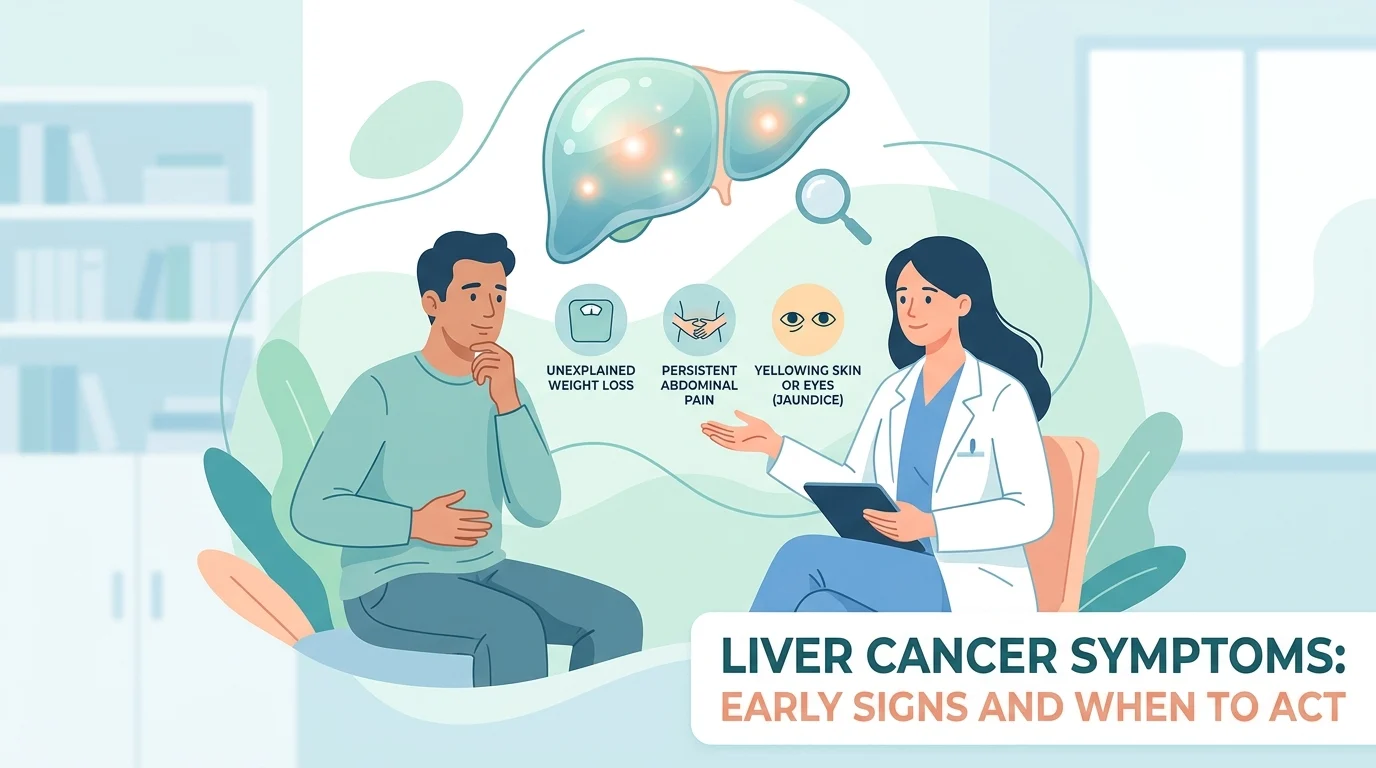
Liver cancer symptoms are one of the most searched health topics, and also one of the most misleading, because the disease is unusually quiet in its early stages. The liver has no pain fibers inside it, it holds a large functional reserve, and a tumor can grow for a long time before anything is felt. That is why the honest answer to the question of what to look out for begins with a different question: whether you are in a group that should be screened rather than waiting for a sign. The National Cancer Institute expects about 42,340 new liver and intrahepatic bile duct cancers in the United States in 2026, and the five-year relative survival across all stages is 21.9 percent, with the outlook strongly tied to how early the disease was found. This guide explains what the symptoms actually are, when they appear, who is at risk, and what to do with that information.
Why liver cancer symptoms appear so late
Three features of the liver explain the delay. It has enormous spare capacity, so a substantial part of it can be affected before blood tests or daily function change. Its internal tissue has no sensory nerves, so a tumor growing within the organ causes no pain until it stretches the capsule around it or presses on a neighboring structure. And most liver cancer develops on top of chronic liver disease, so the fatigue, poor appetite, and abdominal discomfort that eventually appear are often attributed to the underlying cirrhosis or hepatitis that the person already knows about.
Hepatocellular carcinoma accounts for roughly 90 percent of primary liver cancers. Intrahepatic bile duct cancer makes up most of the remainder, at around 10 to 20 percent of cases, and hepatic angiosarcoma is very rare at about 1 percent. Primary liver cancer, which starts in the liver, is a different disease from cancer that spreads to the liver from elsewhere, and the two are not interchangeable even though both may be described as liver cancer in conversation.
Early liver cancer symptoms
Most early liver cancers produce no symptoms at all. When something is noticed, it is usually vague and easy to attribute to something else. The table below sets out the signs most often reported and what each one reflects.
| สัญญาณ | สิ่งที่สะท้อนให้เห็น | ช่วงเวลาที่แนะนำ |
|---|---|---|
| Losing weight without trying | A general metabolic effect of the tumor | Often the first thing noticed, but non-specific |
| Loss of appetite, feeling full quickly | Pressure on the stomach, or the illness itself | Early to intermediate |
| Upper abdominal pain on the right side | Stretching of the capsule surrounding the liver | Requires the tumor to have reached some size |
| General weakness and fatigue | Reduced liver function, anemia, or the tumor | Gradual, often blamed on other causes |
| Nausea and vomiting | Displacement of nearby organs | ไม่ชัดเจน |
| A hard lump below the right rib cage | An enlarged liver or a palpable tumor | Later, and never a reliable early sign |
Every item on that list has far more common explanations. Unintentional weight loss and fatigue are among the least specific symptoms in medicine. What gives them weight is context: the same symptom means something different in a person with known cirrhosis or chronic hepatitis B than in someone with a healthy liver.
Later and advanced symptoms
As the disease progresses, the signs become more distinctive because they reflect failing liver function rather than the tumor itself.
- Jaundice, meaning yellowing of the skin and the whites of the eyes
- Dark urine, and pale, grey, or chalky-white stools
- Abdominal swelling from ascites, which is fluid collecting in the abdomen
- Itchy skin without a rash, caused by bile products accumulating
- Easy bruising or bleeding, since the liver makes clotting factors
- Fever without an obvious infection
- Confusion or drowsiness, a late sign known as hepatic encephalopathy
Stage 4 and end-stage symptoms
Advanced disease combines the above with symptoms from wherever the cancer has spread, most often the lungs, the bones, or the lining of the abdomen. Bone pain, breathlessness, marked swelling of the legs, and severe loss of muscle and weight become prominent. According to SEER data, 21 percent of cases are already distant at diagnosis, with a five-year relative survival of 3.6 percent, against 37.4 percent for disease still localized to the liver. That gap is the single strongest argument for detection before symptoms appear.
Are liver cancer symptoms different in women?
The symptoms themselves are the same. The difference is in who develops the disease: liver cancer is diagnosed substantially more often in men, and male sex is an established risk factor confirmed in large evidence syntheses. The median age at diagnosis is 68. There is no distinct female symptom pattern, and the searches implying one generally reflect this difference in incidence rather than in presentation.
What causes liver cancer and who is at risk
Liver cancer almost always develops against a background of chronic liver injury. An umbrella review published in 2025, pooling 175 meta-analyses and identifying 101 candidate risk factors, found chronic hepatitis B associated with roughly a 12.5-fold increase in risk and chronic hepatitis C with roughly an 11.2-fold increase, with those risks reduced by antiviral treatment and virological response.
- Chronic hepatitis B or hepatitis C infection, the two dominant causes worldwide
- Cirrhosis from any cause, including alcohol-related liver disease
- Metabolic dysfunction-associated fatty liver disease, obesity, and type 2 diabetes
- Heavy alcohol use and smoking
- Hereditary hemochromatosis and other inherited liver conditions
- Aflatoxin exposure, from mold contamination of stored grains and nuts in some regions
- Male sex and older age
The same review also reported factors associated with lower risk, including coffee consumption and a healthy diet, and signals for several common medications. Those are population-level associations from observational data, not instructions: nothing on that list is a reason to start or stop a medication without discussing it with your physician.
Why symptoms are the wrong tool, and surveillance is the right one
This is the part that matters most. Because early liver cancer is silent, guidelines do not rely on symptoms to find it. They recommend regular surveillance for people at high risk, typically an abdominal ultrasound every six months, with or without an alpha-fetoprotein blood test, in anyone with cirrhosis or high-risk chronic hepatitis B. Surveillance is associated with more early-stage detection, more curative treatment, and lower liver-cancer mortality. If you belong to one of those groups, the single most useful action is confirming that you are actually enrolled in a surveillance program, not memorizing a symptom list.
การตรวจเลือดบอกอะไรได้และบอกอะไรไม่ได้
A standard liver panel measures enzymes released when liver cells are injured, not whether a tumor is present, and our คู่มือการตรวจการทำงานของตับ explains how those markers are read as a pattern. The individual values each carry their own meaning: for the enzyme most often flagged first, open our ALT blood test guide, and for its usual companion, check our AST blood test guide. Jaundice is explained in our total bilirubin guide, and the protein that falls as liver function declines is covered in our low albumin guide.
Alpha-fetoprotein is the blood marker used in surveillance, and it is widely misunderstood. A raised level most often reflects a benign liver condition rather than cancer, and a normal level does not rule cancer out, because a substantial share of liver cancers never produce it; read our AFP blood test guide before drawing conclusions from a single value. Because hepatitis status determines whether surveillance applies at all, testing for it matters: see our hepatitis B surface antigen guide and our hepatitis blood test guide.
เมื่อใดควรพบแพทย์
Contact a clinician promptly, rather than waiting, in any of these situations.
- Yellowing of the skin or eyes, at any age and with any other symptom
- Pale or chalky stools together with dark urine
- New abdominal swelling, or clothes becoming tight around the waist over weeks
- Unintentional weight loss of more than about 5 percent of body weight within six months
- Persistent upper right abdominal pain lasting more than two weeks
- A hard lump felt below the right rib cage
- Any new or worsening symptom in someone with known cirrhosis, hepatitis B, or hepatitis C
Confusion, drowsiness, vomiting blood, or black tarry stools in someone with liver disease are emergencies and need immediate care rather than an appointment.
Survival rates in context
Liver cancer survival statistics are sobering, and they are also frequently misapplied. The 21.9 percent five-year relative survival covers every stage and every type together, and it describes people diagnosed in past years and treated with the methods available then. Stage changes the picture substantially: 37.4 percent at five years for localized disease, 13.4 percent for regional spread, and 3.6 percent for distant disease. Underlying liver function also shapes the outlook independently of the tumor, because treatment options depend on how much healthy liver remains. No statistic predicts an individual outcome, and the figures cannot account for a specific person’s treatment plan or response.
ความก้าวหน้าทางวิทยาศาสตร์ล่าสุด
Research over the past three years has concentrated on the problem this article opened with: finding liver cancer before symptoms appear. The findings below come from peer-reviewed studies and guidelines, and none of them changes what any individual should do without a clinician’s input.
The limits of current surveillance are now well documented. A 2024 review of surveillance strategies concluded that ultrasound alone has suboptimal sensitivity for early-stage disease, particularly in people with obesity and in non-viral liver disease, and that adding alpha-fetoprotein improves detection but still misses more than a third of early-stage cancers. That acknowledged gap is what the rest of this work is trying to close.
Blood-based biomarker panels are the most advanced response. The best-studied is the GALAD score, which combines sex, age, alpha-fetoprotein, AFP-L3, and des-gamma-carboxy prothrombin into a single value. A phase 3 validation study published in 2024 followed 1,558 patients with cirrhosis across seven centers for a median of 2.2 years, during which 109 developed liver cancer. Measured in blood drawn up to 12 months before diagnosis, GALAD achieved an area under the curve of 0.78 against 0.66 for alpha-fetoprotein alone, and at matched specificity of 82 percent its sensitivity was 62 percent against 41 percent. In plain terms, the panel found meaningfully more cancers a year earlier than the single marker, while still missing a substantial share. A 2025 systematic review of 44 studies and 33,100 patients pooled the three commercially available panels and found early-stage sensitivities of 70.1 to 74.1 percent with specificities of 83.3 to 87.2 percent, with no significant difference between them and high statistical heterogeneity across studies.
The decisive evidence is not yet in. A phase 4 randomized trial began enrolling in 2024 across 15 United States sites, comparing semi-annual ultrasound with or without alpha-fetoprotein against semi-annual GALAD in 5,500 patients with cirrhosis or chronic hepatitis B, with reduction in late-stage cancer as the primary endpoint measured at five and a half years. A separate real-world implementation study of a related panel is running in the United Kingdom through 2030. A search of ClinicalTrials.gov in September 2026 returns 42 recruiting studies in liver cancer screening and surveillance. Until those trials report, ultrasound with or without alpha-fetoprotein remains the recommended standard, and a biomarker panel is an adjunct discussed with a specialist rather than a replacement.
Guidelines have moved in parallel. The European Association for the Study of the Liver published updated clinical practice guidelines on managing hepatocellular carcinoma in 2024, introducing personalized surveillance based on individual risk assessment, standardized imaging criteria, and clearer transitions between surgical, locoregional, and systemic therapies. On the treatment side, a network meta-analysis of 25 studies and 4,548 patients with early-stage disease found surgical resection associated with better disease-free survival at one and three years than radiofrequency or microwave ablation, though the comparison varied by region and the studies were mostly observational. Which option suits a given patient depends on tumor size and number, liver function, and overall health, and remains a multidisciplinary decision.
อภิธานศัพท์
| คำศัพท์ | ความหมาย |
|---|---|
| Hepatocellular carcinoma | The most common primary liver cancer, about 90 percent of cases. |
| โรคตับแข็ง (Cirrhosis) | Permanent scarring of the liver, the main setting in which liver cancer arises. |
| การเฝ้าระวัง | Planned repeat testing in people at high risk, to find cancer before symptoms. |
| Alpha-fetoprotein | A protein used as a blood marker in liver cancer surveillance. |
| GALAD score | A panel combining sex, age and three blood markers into one detection score. |
| Ascites | Fluid collecting in the abdomen, causing swelling. |
| ดีซ่าน (Jaundice) | Yellowing of skin and eyes from a build-up of bilirubin. |
| Ablation | Destroying a small tumor with heat, cold, or alcohol through a needle. |
| Relative survival | Survival compared with people of the same age without the cancer. |
คำถามที่พบบ่อย
What is the first sign of liver cancer?
There often is none. When something is noticed first, it is usually unintentional weight loss, loss of appetite, or vague discomfort in the upper right abdomen, all of which have far more common causes. Jaundice and abdominal swelling are later signs, not first ones. This is precisely why people at high risk are offered scheduled scans rather than being told to watch for symptoms.
Can liver cancer show up in a routine blood test?
Not reliably. A liver panel can be entirely normal in someone with liver cancer, and it can be abnormal for dozens of reasons that have nothing to do with cancer. Alpha-fetoprotein is more specific but still misses a large share of cases and rises in benign liver conditions. Imaging, usually ultrasound followed by a CT or MRI scan, is what identifies a tumor.
Where do you feel liver cancer pain?
Typically in the upper right part of the abdomen, just below the ribs, sometimes radiating to the right shoulder blade. The pain comes from stretching of the capsule around the liver rather than from the liver tissue itself, which has no pain nerves, so it appears only once a tumor has reached a certain size.
How quickly does liver cancer progress?
It varies widely. Some hepatocellular carcinomas double in size over several months, others much faster, and progression also depends on the state of the underlying liver. The six-month interval used in surveillance programs reflects this typical pace rather than an arbitrary schedule.
Can liver cancer be cured?
Yes, when it is found early. Surgical removal, liver transplant, and ablation can be curative for small tumors in a liver that still functions well, and five-year relative survival for localized disease is 37.4 percent. Once the cancer has spread beyond the liver, treatment aims to control the disease and maintain quality of life rather than to cure.
Who should be screened for liver cancer?
Guidelines recommend surveillance for adults with cirrhosis from any cause and for selected people with chronic hepatitis B, usually an ultrasound every six months with or without an alpha-fetoprotein test. If you have either condition, ask your clinician directly whether you are enrolled, because participation rates remain low even among people who qualify.
แหล่งอ้างอิง
- Cancer Stat Facts: Liver and Intrahepatic Bile Duct Cancer — SEER Program, National Cancer Institute
- Liver Cancer Treatment (PDQ) Patient Version — National Cancer Institute, National Institutes of Health
- Liver Cancer — MedlinePlus, National Library of Medicine
- Liver Cancer, Symptoms and Causes — Mayo Clinic
- Liver Cancer: Symptoms, Signs, Causes and Treatment — Cleveland Clinic
- EASL Clinical Practice Guidelines on the management of hepatocellular carcinoma — Journal of Hepatology, 2024 (indexed in PubMed)
- Wang J. et al. Risk factors for hepatocellular carcinoma: an umbrella review of systematic review and meta-analysis — Annals of Medicine, 2025 (indexed in PubMed)
- Min Y. et al. Ablative Treatments and Surgery for Early-Stage Hepatocellular Carcinoma: A Network Meta-Analysis — Journal of Surgical Research, 2024 (indexed in PubMed)
- Singal A.G. et al. Advancing Surveillance Strategies for Hepatocellular Carcinoma: A New Era of Efficacy and Precision — Journal of Clinical and Experimental Hepatology, 2024
- Marsh T.L. et al. A Phase 3 Biomarker Validation of GALAD for the Detection of Hepatocellular Carcinoma in Cirrhosis — Gastroenterology, 2024
- Jarrah M. et al. Performance of GALAD, GAAD, and ASAP for Early HCC Detection in Chronic Liver Disease: A Systematic Review and Meta-Analysis — Liver Cancer, 2025
- Singal A. et al. National Liver Cancer Screening Trial (TRACER) study protocol — Hepatology Communications, 2024
- National Liver Cancer Screening Trial, TRACER (NCT06084234) — ClinicalTrials.gov
- Real-world GAAD Algorithm Implementation and Validation to Improve Surveillance and Early Detection of Hepatocellular Carcinoma (NCT05971108) — ClinicalTrials.gov
บทความอื่น ๆ
- การตรวจเลือด AFP: วิธีทำความเข้าใจผลของคุณ
- การตรวจการทำงานของตับ (LFTs): วิธีอ่านผลตรวจตับของคุณ
- การตรวจเลือด SGPT: ค่าปกติ ระดับสูง และสาเหตุ
- การตรวจเลือด AST: ค่าเอนไซม์ตับของคุณหมายความว่าอะไร
- ระดับบิลิรูบินรวม: ค่าปกติ สาเหตุ และการดูแล
- อัลบูมินต่ำ: สาเหตุ อาการ และความเสี่ยง
- HBsAg ให้ผลบวก: หมายความว่าอะไร และขั้นตอนต่อไปคืออะไร
- การตรวจเลือดหาไวรัสตับอักเสบ: ผลการตรวจของคุณหมายความว่าอะไร
Liver results are much easier to act on when each enzyme, protein, and marker is explained next to the others rather than read alone. ทำความเข้าใจผลตรวจของคุณด้วย AI DiagMeซึ่งอ่านรายงานผลของคุณทีละบรรทัด และอธิบายค่าแต่ละตัวด้วยภาษาที่เข้าใจง่าย โดยมีคณะแพทย์ร่วมตรวจสอบการแปลผล