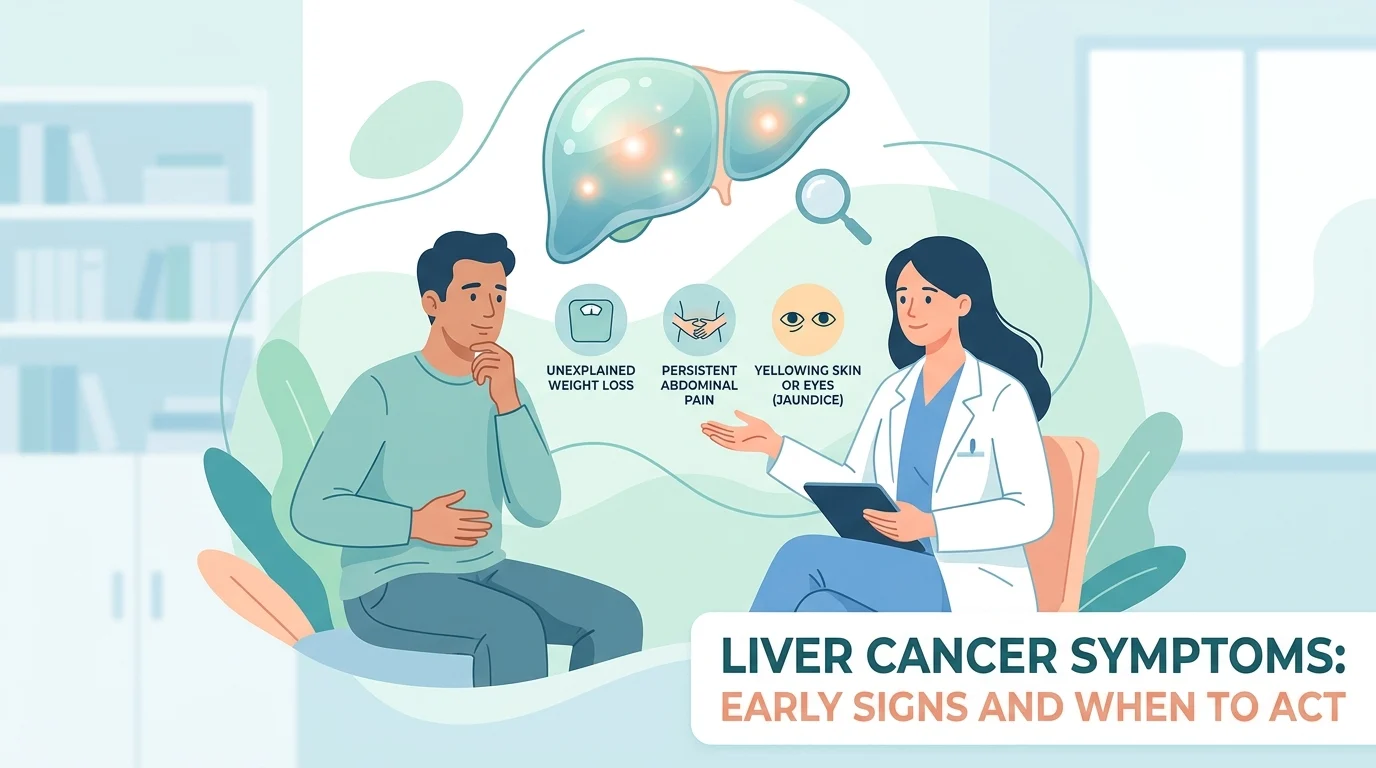
Τα συμπτώματα του καρκίνου του ήπατος είναι ένα από τα πιο συχνά αναζητούμενα θέματα υγείας, αλλά και ένα από τα πιο παραπλανητικά, επειδή η νόσος είναι ασυνήθιστα «σιωπηλή» στα πρώιμα στάδιά της. Το ήπαρ δεν έχει νευρικές ίνες πόνου στο εσωτερικό του, διαθέτει μεγάλο λειτουργικό αποθεματικό και ένας όγκος μπορεί να αναπτύσσεται για μεγάλο χρονικό διάστημα χωρίς να γίνει αντιληπτός. Γι' αυτό, η ειλικρινής απάντηση στο ερώτημα «τι να προσέχω» ξεκινά με ένα διαφορετικό ερώτημα: αν ανήκεις σε μια ομάδα που πρέπει να υποβάλλεται σε τακτικό έλεγχο, αντί να περιμένει κάποιο σύμπτωμα. Το Εθνικό Ινστιτούτο Καρκίνου των ΗΠΑ εκτιμά περίπου 42.340 νέα κρούσματα καρκίνου ήπατος και ενδοηπατικών χοληφόρων πόρων για το 2026, ενώ η πενταετής σχετική επιβίωση σε όλα τα στάδια ανέρχεται στο 21,9%, με την πρόγνωση να εξαρτάται σε μεγάλο βαθμό από το πόσο νωρίς εντοπίστηκε η νόσος. Αυτός ο οδηγός εξηγεί ποια είναι πραγματικά τα συμπτώματα, πότε εμφανίζονται, ποιος διατρέχει κίνδυνο και τι μπορείς να κάνεις με αυτές τις πληροφορίες.
Γιατί τα συμπτώματα του καρκίνου του ήπατος εμφανίζονται τόσο αργά
Τρία χαρακτηριστικά του ήπατος εξηγούν αυτή την καθυστέρηση. Έχει τεράστια εφεδρική λειτουργική ικανότητα, οπότε ένα σημαντικό τμήμα του μπορεί να έχει προσβληθεί πριν αλλάξουν οι εξετάσεις αίματος ή η καθημερινή λειτουργία. Ο εσωτερικός ιστός του δεν έχει αισθητικά νεύρα, οπότε ένας όγκος που αναπτύσσεται μέσα στο όργανο δεν προκαλεί πόνο μέχρι να τεντώσει τον περιβάλλοντα χιτώνα ή να πιέσει κάποια γειτονική δομή. Επιπλέον, ο καρκίνος του ήπατος αναπτύσσεται συνήθως πάνω σε χρόνια ηπατική νόσο, οπότε η κόπωση, η μειωμένη όρεξη και η κοιλιακή δυσφορία που τελικά εμφανίζονται αποδίδονται συχνά στην υποκείμενη κίρρωση ή ηπατίτιδα που το άτομο ήδη γνωρίζει.
Το ηπατοκυτταρικό καρκίνωμα αντιπροσωπεύει περίπου το 90% των πρωτοπαθών καρκίνων του ήπατος. Ο ενδοηπατικός χολαγγειοκαρκίνος αποτελεί το μεγαλύτερο μέρος των υπόλοιπων περιπτώσεων, περίπου 10 έως 20%, ενώ το αγγειοσάρκωμα του ήπατος είναι πολύ σπάνιο, σε ποσοστό περίπου 1%. Ο πρωτοπαθής καρκίνος του ήπατος, που ξεκινά από το ίδιο το ήπαρ, είναι διαφορετική νόσος από τον καρκίνο που μεταστατεύει στο ήπαρ από αλλού, και οι δύο δεν είναι εναλλάξιμοι, ακόμα κι αν και οι δύο αποκαλούνται «καρκίνος του ήπατος» στην καθημερινή ομιλία.
Πρώιμα συμπτώματα καρκίνου του ήπατος
Οι περισσότεροι πρώιμοι καρκίνοι του ήπατος δεν προκαλούν κανένα σύμπτωμα. Όταν παρατηρηθεί κάτι, συνήθως είναι ασαφές και εύκολο να αποδοθεί σε κάτι άλλο. Ο παρακάτω πίνακας παρουσιάζει τα σημεία που αναφέρονται πιο συχνά και τι αντικατοπτρίζει το καθένα.
| Σημείο | Τι αντικατοπτρίζει | Τυπικός χρόνος εμφάνισης |
|---|---|---|
| Απώλεια βάρους χωρίς προφανή αιτία | Γενική μεταβολική επίδραση του όγκου | Συχνά το πρώτο που παρατηρείται, αλλά μη ειδικό |
| Απώλεια όρεξης, αίσθηση κορεσμού γρήγορα | Πίεση στο στομάχι ή η ίδια η νόσος | Πρώιμο έως ενδιάμεσο στάδιο |
| Πόνος στο πάνω δεξί τμήμα της κοιλιάς | Διάταση της κάψας που περιβάλλει το ήπαρ | Απαιτεί ο όγκος να έχει φτάσει σε κάποιο μέγεθος |
| Γενική αδυναμία και κόπωση | Μειωμένη ηπατική λειτουργία, αναιμία ή ο ίδιος ο όγκος | Σταδιακή, συχνά αποδίδεται σε άλλες αιτίες |
| Ναυτία και εμετός | Μετατόπιση γειτονικών οργάνων | Ενδιάμεσο |
| Σκληρός όγκος κάτω από τα δεξιά πλευρά | Διογκωμένο ήπαρ ή ψηλαφητός όγκος | Αργότερα, και ποτέ αξιόπιστο πρώιμο σημείο |
Κάθε στοιχείο αυτής της λίστας έχει πολύ πιο συνηθισμένες εξηγήσεις. Η ακούσια απώλεια βάρους και η κόπωση είναι από τα λιγότερο ειδικά συμπτώματα στην ιατρική. Αυτό που τους δίνει βαρύτητα είναι το πλαίσιο: το ίδιο σύμπτωμα σημαίνει κάτι διαφορετικό σε ένα άτομο με γνωστή κίρρωση ή χρόνια ηπατίτιδα Β από ό,τι σε κάποιον με υγιές ήπαρ.
Μεταγενέστερα και προχωρημένα συμπτώματα
Καθώς η νόσος εξελίσσεται, τα σημεία γίνονται πιο χαρακτηριστικά, καθώς αντικατοπτρίζουν την ηπατική ανεπάρκεια και όχι τον ίδιο τον όγκο.
- Ίκτερος, δηλαδή κιτρίνισμα του δέρματος και του λευκού των ματιών
- Σκούρα ούρα και χλωμά, γκρίζα ή κιμωλιόχρωμα κόπρανα
- Διόγκωση της κοιλιάς από ασκίτη, δηλαδή συσσώρευση υγρού στην κοιλιακή κοιλότητα
- Κνησμός χωρίς εξάνθημα, που προκαλείται από τη συσσώρευση χολικών προϊόντων
- Εύκολοι μώλωπες ή αιμορραγία, καθώς το ήπαρ παράγει παράγοντες πήξης
- Πυρετός χωρίς εμφανή λοίμωξη
- Σύγχυση ή υπνηλία, ένα εκπρόθεσμο σημείο γνωστό ως ηπατική εγκεφαλοπάθεια
Συμπτώματα σταδίου 4 και τελικού σταδίου
Η προχωρημένη νόσος συνδυάζει τα παραπάνω με συμπτώματα από τα σημεία όπου έχει εξαπλωθεί ο καρκίνος, συνηθέστερα τους πνεύμονες, τα οστά ή το περιτόναιο. Ο πόνος στα οστά, η δύσπνοια, η έντονη οίδημα των ποδιών και η σοβαρή απώλεια μυϊκής μάζας και βάρους γίνονται εμφανή. Σύμφωνα με τα δεδομένα SEER, το 21 τοις εκατό των περιπτώσεων έχουν ήδη απομακρυσμένες μεταστάσεις κατά τη διάγνωση, με πενταετή σχετική επιβίωση 3,6 τοις εκατό, έναντι 37,4 τοις εκατό για νόσο που παραμένει εντοπισμένη στο ήπαρ. Αυτή η διαφορά είναι το ισχυρότερο επιχείρημα για έγκαιρη ανίχνευση πριν εμφανιστούν συμπτώματα.
Είναι διαφορετικά τα συμπτώματα του καρκίνου του ήπατος στις γυναίκες;
Τα ίδια τα συμπτώματα είναι τα ίδια. Η διαφορά έγκειται στο ποιος αναπτύσσει τη νόσο: ο καρκίνος του ήπατος διαγιγνώσκεται σημαντικά συχνότερα στους άνδρες, και το ανδρικό φύλο αποτελεί καθιερωμένο παράγοντα κινδύνου που επιβεβαιώνεται σε μεγάλες συνθέσεις αποδεικτικών στοιχείων. Η διάμεση ηλικία κατά τη διάγνωση είναι τα 68 έτη. Δεν υπάρχει ξεχωριστό πρότυπο συμπτωμάτων για τις γυναίκες, και οι αναζητήσεις που το υπονοούν αντικατοπτρίζουν γενικά αυτή τη διαφορά στη συχνότητα εμφάνισης και όχι στην κλινική εικόνα.
Τι προκαλεί τον καρκίνο του ήπατος και ποιος διατρέχει κίνδυνο
Ο καρκίνος του ήπατος αναπτύσσεται σχεδόν πάντα σε φόντο χρόνιας ηπατικής βλάβης. Μια ανασκόπηση ανασκοπήσεων που δημοσιεύθηκε το 2025, συγκεντρώνοντας 175 μετα-αναλύσεις και εντοπίζοντας 101 πιθανούς παράγοντες κινδύνου, διαπίστωσε ότι η χρόνια ηπατίτιδα Β συνδέεται με περίπου 12,5πλάσια αύξηση του κινδύνου και η χρόνια ηπατίτιδα Γ με περίπου 11,2πλάσια αύξηση, με τους κινδύνους αυτούς να μειώνονται με αντιική θεραπεία και ιολογική ανταπόκριση.
- Χρόνια λοίμωξη από ηπατίτιδα Β ή ηπατίτιδα Γ, οι δύο κυρίαρχες αιτίες παγκοσμίως
- Κίρρωση από οποιαδήποτε αιτία, συμπεριλαμβανομένης της αλκοολικής ηπατικής νόσου
- Μεταβολική λιπώδης νόσος του ήπατος, παχυσαρκία και σακχαρώδης διαβήτης τύπου 2
- Υπερβολική κατανάλωση αλκοόλ και κάπνισμα
- Κληρονομική αιμοχρωμάτωση και άλλες κληρονομικές παθήσεις του ήπατος
- Έκθεση σε αφλατοξίνες, από μολυσμένα με μούχλα αποθηκευμένα δημητριακά και ξηρούς καρπούς σε ορισμένες περιοχές
- Ανδρικό φύλο και μεγαλύτερη ηλικία
Η ίδια ανασκόπηση ανέφερε επίσης παράγοντες που συνδέονται με χαμηλότερο κίνδυνο, όπως η κατανάλωση καφέ και η υγιεινή διατροφή, καθώς και ενδείξεις για ορισμένα συνήθη φάρμακα. Πρόκειται για συσχετίσεις σε επίπεδο πληθυσμού από παρατηρησιακά δεδομένα, όχι για οδηγίες: τίποτα από αυτά δεν αποτελεί λόγο να ξεκινήσετε ή να διακόψετε κάποιο φάρμακο χωρίς να το συζητήσετε με τον γιατρό σας.
Γιατί τα συμπτώματα δεν είναι το κατάλληλο εργαλείο και η τακτική παρακολούθηση είναι η σωστή επιλογή
Αυτό είναι το σημείο που έχει τη μεγαλύτερη σημασία. Επειδή ο πρώιμος καρκίνος του ήπατος δεν προκαλεί συμπτώματα, οι κατευθυντήριες οδηγίες δεν βασίζονται στα συμπτώματα για τον εντοπισμό του. Συνιστούν τακτική παρακολούθηση για άτομα υψηλού κινδύνου — συνήθως υπερηχογράφημα άνω κοιλίας κάθε έξι μήνες, με ή χωρίς εξέταση αίματος για αλφα-φετοπρωτεΐνη (AFP), σε όσους έχουν κίρρωση ή χρόνια ηπατίτιδα Β υψηλού κινδύνου. Η τακτική παρακολούθηση συνδέεται με συχνότερη ανίχνευση σε πρώιμο στάδιο, μεγαλύτερες πιθανότητες θεραπείας με ίαση και μειωμένη θνησιμότητα από καρκίνο του ήπατος. Αν ανήκετε σε μία από αυτές τις ομάδες, η πιο χρήσιμη ενέργεια που μπορείτε να κάνετε είναι να επιβεβαιώσετε ότι παρακολουθείστε πράγματι στο πλαίσιο ενός προγράμματος τακτικής παρακολούθησης — όχι να απομνημονεύσετε μια λίστα συμπτωμάτων.
Τι μπορούν και τι δεν μπορούν να δείξουν οι εξετάσεις αίματος
Ένα τυπικό ηπατικό προφίλ μετρά ένζυμα που απελευθερώνονται όταν τραυματίζονται τα ηπατικά κύτταρα, όχι αν υπάρχει όγκος, και το οδηγό εξετάσεων ηπατικής λειτουργίας explains how those markers are read as a pattern. The individual values each carry their own meaning: for the enzyme most often flagged first, open our ALT blood test guide, and for its usual companion, check our AST blood test guide. Jaundice is explained in our total bilirubin guide, and the protein that falls as liver function declines is covered in our low albumin guide.
Alpha-fetoprotein is the blood marker used in surveillance, and it is widely misunderstood. A raised level most often reflects a benign liver condition rather than cancer, and a normal level does not rule cancer out, because a substantial share of liver cancers never produce it; read our AFP blood test guide before drawing conclusions from a single value. Because hepatitis status determines whether surveillance applies at all, testing for it matters: see our hepatitis B surface antigen guide and our hepatitis blood test guide.
Πότε να επισκεφτείτε γιατρό
Contact a clinician promptly, rather than waiting, in any of these situations.
- Yellowing of the skin or eyes, at any age and with any other symptom
- Pale or chalky stools together with dark urine
- New abdominal swelling, or clothes becoming tight around the waist over weeks
- Unintentional weight loss of more than about 5 percent of body weight within six months
- Persistent upper right abdominal pain lasting more than two weeks
- A hard lump felt below the right rib cage
- Any new or worsening symptom in someone with known cirrhosis, hepatitis B, or hepatitis C
Confusion, drowsiness, vomiting blood, or black tarry stools in someone with liver disease are emergencies and need immediate care rather than an appointment.
Survival rates in context
Liver cancer survival statistics are sobering, and they are also frequently misapplied. The 21.9 percent five-year relative survival covers every stage and every type together, and it describes people diagnosed in past years and treated with the methods available then. Stage changes the picture substantially: 37.4 percent at five years for localized disease, 13.4 percent for regional spread, and 3.6 percent for distant disease. Underlying liver function also shapes the outlook independently of the tumor, because treatment options depend on how much healthy liver remains. No statistic predicts an individual outcome, and the figures cannot account for a specific person’s treatment plan or response.
Τελευταίες επιστημονικές εξελίξεις
Research over the past three years has concentrated on the problem this article opened with: finding liver cancer before symptoms appear. The findings below come from peer-reviewed studies and guidelines, and none of them changes what any individual should do without a clinician’s input.
The limits of current surveillance are now well documented. A 2024 review of surveillance strategies concluded that ultrasound alone has suboptimal sensitivity for early-stage disease, particularly in people with obesity and in non-viral liver disease, and that adding alpha-fetoprotein improves detection but still misses more than a third of early-stage cancers. That acknowledged gap is what the rest of this work is trying to close.
Blood-based biomarker panels are the most advanced response. The best-studied is the GALAD score, which combines sex, age, alpha-fetoprotein, AFP-L3, and des-gamma-carboxy prothrombin into a single value. A phase 3 validation study published in 2024 followed 1,558 patients with cirrhosis across seven centers for a median of 2.2 years, during which 109 developed liver cancer. Measured in blood drawn up to 12 months before diagnosis, GALAD achieved an area under the curve of 0.78 against 0.66 for alpha-fetoprotein alone, and at matched specificity of 82 percent its sensitivity was 62 percent against 41 percent. In plain terms, the panel found meaningfully more cancers a year earlier than the single marker, while still missing a substantial share. A 2025 systematic review of 44 studies and 33,100 patients pooled the three commercially available panels and found early-stage sensitivities of 70.1 to 74.1 percent with specificities of 83.3 to 87.2 percent, with no significant difference between them and high statistical heterogeneity across studies.
The decisive evidence is not yet in. A phase 4 randomized trial began enrolling in 2024 across 15 United States sites, comparing semi-annual ultrasound with or without alpha-fetoprotein against semi-annual GALAD in 5,500 patients with cirrhosis or chronic hepatitis B, with reduction in late-stage cancer as the primary endpoint measured at five and a half years. A separate real-world implementation study of a related panel is running in the United Kingdom through 2030. A search of ClinicalTrials.gov in September 2026 returns 42 recruiting studies in liver cancer screening and surveillance. Until those trials report, ultrasound with or without alpha-fetoprotein remains the recommended standard, and a biomarker panel is an adjunct discussed with a specialist rather than a replacement.
Guidelines have moved in parallel. The European Association for the Study of the Liver published updated clinical practice guidelines on managing hepatocellular carcinoma in 2024, introducing personalized surveillance based on individual risk assessment, standardized imaging criteria, and clearer transitions between surgical, locoregional, and systemic therapies. On the treatment side, a network meta-analysis of 25 studies and 4,548 patients with early-stage disease found surgical resection associated with better disease-free survival at one and three years than radiofrequency or microwave ablation, though the comparison varied by region and the studies were mostly observational. Which option suits a given patient depends on tumor size and number, liver function, and overall health, and remains a multidisciplinary decision.
Γλωσσάριο
| Όρος | Σημασία |
|---|---|
| Hepatocellular carcinoma | The most common primary liver cancer, about 90 percent of cases. |
| Κίρρωση | Permanent scarring of the liver, the main setting in which liver cancer arises. |
| Παρακολούθηση | Planned repeat testing in people at high risk, to find cancer before symptoms. |
| Alpha-fetoprotein | A protein used as a blood marker in liver cancer surveillance. |
| GALAD score | A panel combining sex, age and three blood markers into one detection score. |
| Ascites | Fluid collecting in the abdomen, causing swelling. |
| Ίκτερος | Yellowing of skin and eyes from a build-up of bilirubin. |
| Ablation | Destroying a small tumor with heat, cold, or alcohol through a needle. |
| Relative survival | Survival compared with people of the same age without the cancer. |
Συχνές ερωτήσεις
What is the first sign of liver cancer?
There often is none. When something is noticed first, it is usually unintentional weight loss, loss of appetite, or vague discomfort in the upper right abdomen, all of which have far more common causes. Jaundice and abdominal swelling are later signs, not first ones. This is precisely why people at high risk are offered scheduled scans rather than being told to watch for symptoms.
Can liver cancer show up in a routine blood test?
Not reliably. A liver panel can be entirely normal in someone with liver cancer, and it can be abnormal for dozens of reasons that have nothing to do with cancer. Alpha-fetoprotein is more specific but still misses a large share of cases and rises in benign liver conditions. Imaging, usually ultrasound followed by a CT or MRI scan, is what identifies a tumor.
Where do you feel liver cancer pain?
Typically in the upper right part of the abdomen, just below the ribs, sometimes radiating to the right shoulder blade. The pain comes from stretching of the capsule around the liver rather than from the liver tissue itself, which has no pain nerves, so it appears only once a tumor has reached a certain size.
How quickly does liver cancer progress?
It varies widely. Some hepatocellular carcinomas double in size over several months, others much faster, and progression also depends on the state of the underlying liver. The six-month interval used in surveillance programs reflects this typical pace rather than an arbitrary schedule.
Can liver cancer be cured?
Yes, when it is found early. Surgical removal, liver transplant, and ablation can be curative for small tumors in a liver that still functions well, and five-year relative survival for localized disease is 37.4 percent. Once the cancer has spread beyond the liver, treatment aims to control the disease and maintain quality of life rather than to cure.
Who should be screened for liver cancer?
Guidelines recommend surveillance for adults with cirrhosis from any cause and for selected people with chronic hepatitis B, usually an ultrasound every six months with or without an alpha-fetoprotein test. If you have either condition, ask your clinician directly whether you are enrolled, because participation rates remain low even among people who qualify.
Πηγές
- Cancer Stat Facts: Liver and Intrahepatic Bile Duct Cancer — SEER Program, National Cancer Institute
- Liver Cancer Treatment (PDQ) Patient Version — National Cancer Institute, National Institutes of Health
- Liver Cancer — MedlinePlus, National Library of Medicine
- Liver Cancer, Symptoms and Causes — Mayo Clinic
- Liver Cancer: Symptoms, Signs, Causes and Treatment — Cleveland Clinic
- EASL Clinical Practice Guidelines on the management of hepatocellular carcinoma — Journal of Hepatology, 2024 (indexed in PubMed)
- Wang J. et al. Risk factors for hepatocellular carcinoma: an umbrella review of systematic review and meta-analysis — Annals of Medicine, 2025 (indexed in PubMed)
- Min Y. et al. Ablative Treatments and Surgery for Early-Stage Hepatocellular Carcinoma: A Network Meta-Analysis — Journal of Surgical Research, 2024 (indexed in PubMed)
- Singal A.G. et al. Advancing Surveillance Strategies for Hepatocellular Carcinoma: A New Era of Efficacy and Precision — Journal of Clinical and Experimental Hepatology, 2024
- Marsh T.L. et al. A Phase 3 Biomarker Validation of GALAD for the Detection of Hepatocellular Carcinoma in Cirrhosis — Gastroenterology, 2024
- Jarrah M. et al. Performance of GALAD, GAAD, and ASAP for Early HCC Detection in Chronic Liver Disease: A Systematic Review and Meta-Analysis — Liver Cancer, 2025
- Singal A. et al. National Liver Cancer Screening Trial (TRACER) study protocol — Hepatology Communications, 2024
- National Liver Cancer Screening Trial, TRACER (NCT06084234) — ClinicalTrials.gov
- Real-world GAAD Algorithm Implementation and Validation to Improve Surveillance and Early Detection of Hepatocellular Carcinoma (NCT05971108) — ClinicalTrials.gov
Άλλα άρθρα
- Εξέταση αίματος AFP: πώς να κατανοήσετε τα αποτελέσματά σας
- Εξετάσεις λειτουργίας ήπατος (LFTs): πώς να διαβάσετε το ηπατικό σας προφίλ
- Εξέταση SGPT: φυσιολογικές τιμές, υψηλά επίπεδα και αιτίες
- Εξέταση AST αίματος: τι σημαίνουν τα επίπεδα αυτού του ηπατικού ενζύμου
- Επίπεδα ολικής χολερυθρίνης: φυσιολογικές τιμές, αιτίες και φροντίδα
- Χαμηλή Αλβουμίνη: Αιτίες, Συμπτώματα και Κίνδυνοι
- HBsAg θετικό: τι σημαίνει και ποια είναι τα επόμενα βήματα
- Εξέταση αίματος για ηπατίτιδα: τι σημαίνουν τα αποτελέσματά σας
Liver results are much easier to act on when each enzyme, protein, and marker is explained next to the others rather than read alone. Κατανοήστε τα αποτελέσματα των εξετάσεών σας με το AI DiagMe, που διαβάζει την εξέτασή σου γραμμή προς γραμμή και εξηγεί κάθε τιμή με απλά λόγια, με ερμηνεία που έχει ελεγχθεί από επιτροπή ιατρών.