تُعدّ أعراض سرطان الكبد من أكثر الموضوعات الصحية بحثًا على الإنترنت، وفي الوقت ذاته من أكثرها إضلالًا، إذ يتسم هذا المرض بصمت غير معتاد في مراحله الأولى. فالكبد لا يحتوي على ألياف عصبية حسية في داخله، ويمتلك احتياطيًا وظيفيًا كبيرًا، وقد ينمو الورم فيه وقتًا طويلًا قبل أن يشعر المريض بأي شيء. لهذا السبب، فإن الإجابة الصادقة عن سؤال "ما الذي ينبغي الانتباه إليه؟" تبدأ بسؤال مختلف: هل أنت ضمن فئة يجب أن تخضع للفحص الدوري بدلًا من انتظار ظهور أعراض؟ تتوقع المعاهد الوطنية للسرطان في الولايات المتحدة تسجيل نحو 42,340 حالة جديدة من سرطان الكبد والقنوات الصفراوية داخل الكبد عام 2026، فيما تبلغ نسبة البقاء النسبية لخمس سنوات عبر جميع المراحل 21.9 بالمئة، وترتبط هذه النسبة ارتباطًا وثيقًا بمدى مبكّر اكتشاف المرض. يشرح هذا الدليل ما هي الأعراض الفعلية، ومتى تظهر، ومن هم الأكثر عرضة للخطر، وكيف يمكن التعامل مع هذه المعلومات.
لماذا تظهر أعراض سرطان الكبد متأخرة جدًا
ثمة ثلاث خصائص للكبد تفسّر هذا التأخر. فهو يمتلك طاقة احتياطية هائلة، مما يعني أن جزءًا كبيرًا منه قد يتأثر قبل أن تتغير نتائج تحاليل الدم أو تتأثر الوظائف اليومية. كما أن أنسجته الداخلية تخلو من الأعصاب الحسية، فلا يسبب الورم النامي داخله أي ألم حتى يمتد ليشد الغشاء المحيط به أو يضغط على بنية مجاورة. فضلًا عن ذلك، يتطور معظم سرطان الكبد فوق مرض كبدي مزمن، لذا كثيرًا ما يُعزى التعب وفقدان الشهية وعدم الراحة في البطن التي تظهر في نهاية المطاف إلى تليف الكبد أو التهاب الكبد الذي يعاني منه الشخص أصلًا.
يمثّل سرطان الخلايا الكبدية نحو 90 بالمئة من سرطانات الكبد الأولية. ويشكّل سرطان القنوات الصفراوية داخل الكبد معظم الحالات المتبقية، بنسبة تتراوح بين 10 و20 بالمئة من الحالات، في حين يُعدّ الساركوما الوعائية الكبدية نادرة جدًا بنسبة تبلغ نحو 1 بالمئة. وسرطان الكبد الأولي الذي ينشأ في الكبد ذاته يختلف اختلافًا جوهريًا عن السرطان الذي ينتشر إلى الكبد من مكان آخر، ولا يمكن الخلط بينهما حتى وإن وُصف كلاهما بـ"سرطان الكبد" في الحديث العام.
أعراض سرطان الكبد في مراحله الأولى
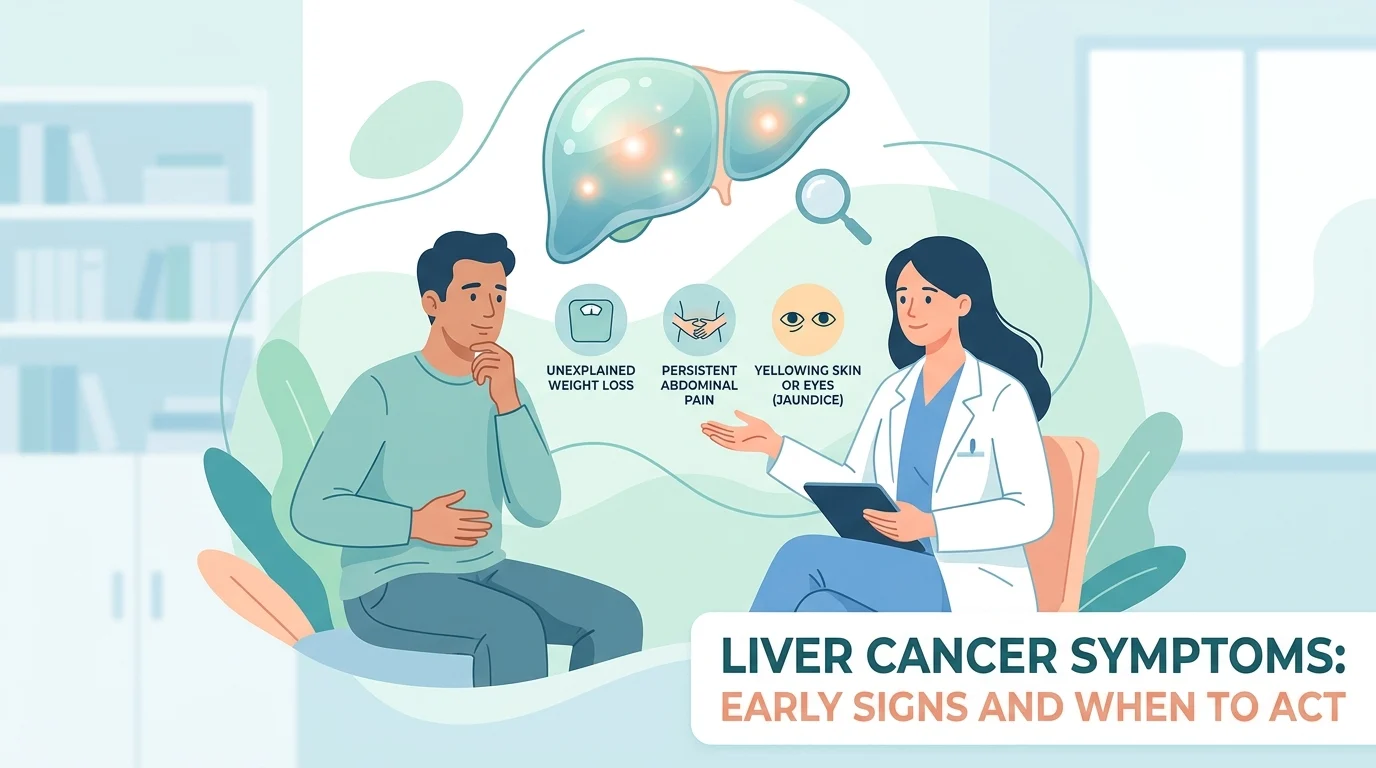
لا تُسبّب معظم سرطانات الكبد المبكرة أي أعراض على الإطلاق. وحين يُلاحَظ شيء ما، فإنه يكون في الغالب غامضًا ويسهل إسناده إلى سبب آخر. يوضح الجدول أدناه العلامات الأكثر شيوعًا في التقارير وما يعكسه كل منها.
| علامة | ما يعكسه | التوقيت النموذجي |
|---|---|---|
| فقدان الوزن دون سبب واضح | تأثير استقلابي عام للورم | غالبًا أول ما يُلاحَظ، لكنه غير محدد |
| فقدان الشهية والشعور بالامتلاء السريع | ضغط على المعدة، أو تأثير المرض نفسه | مبكر إلى متوسط |
| ألم في الجزء العلوي من البطن على الجانب الأيمن | تمدد الكبسولة المحيطة بالكبد | يستلزم أن يكون الورم قد بلغ حجمًا معينًا |
| ضعف عام وإرهاق | ضعف وظائف الكبد أو فقر الدم أو الورم نفسه | تدريجي، وكثيرًا ما يُعزى إلى أسباب أخرى |
| غثيان وقيء | إزاحة الأعضاء المجاورة | نتيجة متوسطة |
| كتلة صلبة أسفل القفص الضلعي الأيمن | تضخم الكبد أو ورم يمكن الإحساس به عند الجس | يظهر في مراحل لاحقة، وليس علامة مبكرة موثوقة أبدًا |
لكل عرض من هذه الأعراض تفسيرات أكثر شيوعًا بكثير. ففقدان الوزن غير المقصود والإرهاق من أقل الأعراض تحديدًا في الطب. ما يمنحها ثقلًا هو السياق: فالعرض ذاته يعني شيئًا مختلفًا لدى شخص مصاب بتليف الكبد أو التهاب الكبد الوبائي B المزمن، مقارنةً بشخص يتمتع بكبد سليم.
الأعراض المتأخرة والمتقدمة
مع تقدم المرض، تصبح العلامات أكثر وضوحًا لأنها تعكس قصورًا في وظائف الكبد لا الورم في حد ذاته.
- اليرقان، أي اصفرار الجلد وبياض العينين
- بول داكن اللون، وبراز شاحب أو رمادي أو أبيض طباشيري
- انتفاخ البطن بسبب الاستسقاء، وهو تجمع السوائل في تجويف البطن
- حكة في الجلد دون طفح جلدي، ناجمة عن تراكم منتجات الصفراء
- سهولة الإصابة بالكدمات أو النزيف، إذ يصنع الكبد عوامل التخثر
- حمى دون وجود عدوى واضحة
- ارتباك ذهني أو نعاس، وهو علامة متأخرة تُعرف باعتلال الدماغ الكبدي
أعراض المرحلة الرابعة والمرحلة النهائية
يجمع المرض المتقدم بين الأعراض السابقة وأعراض أخرى تتعلق بالأماكن التي انتشر إليها السرطان، وأكثرها شيوعًا الرئتان والعظام وبطانة البطن. ويصبح ألم العظام وضيق التنفس والتورم الشديد في الساقين والفقدان الحاد للعضلات والوزن أعراضًا بارزة. واستنادًا إلى بيانات SEER، فإن 21 بالمئة من الحالات تكون قد انتشرت بالفعل عند التشخيص، مع نسبة بقاء نسبية لخمس سنوات تبلغ 3.6 بالمئة، مقارنةً بـ 37.4 بالمئة للمرض المحصور في الكبد. هذا الفارق هو الحجة الأقوى على الإطلاق للكشف المبكر قبل ظهور الأعراض.
هل تختلف أعراض سرطان الكبد لدى النساء؟
الأعراض في حد ذاتها متشابهة. الفارق يكمن في من يصاب بالمرض: إذ يُشخَّص سرطان الكبد لدى الرجال بنسبة أعلى بكثير، وذكورة الجنس عامل خطر ثابت أكدته تحليلات الأدلة الكبرى. متوسط العمر عند التشخيص هو 68 عامًا. ولا يوجد نمط أعراض خاص بالنساء، والبحث الذي يوحي بذلك يعكس في الغالب هذا الفارق في معدلات الإصابة لا في طريقة ظهور المرض.
ما أسباب سرطان الكبد ومن هم الأكثر عرضة للإصابة به
يتطور سرطان الكبد في الغالب على خلفية إصابة مزمنة بالكبد. كشف استعراض شامل نُشر عام 2025، جمع 175 تحليلاً تلوياً وحدّد 101 عامل خطر محتمل، أن التهاب الكبد الفيروسي المزمن من النوع B يرتبط بزيادة في الخطر تبلغ نحو 12.5 ضعفاً، فيما يرتبط التهاب الكبد الفيروسي المزمن من النوع C بزيادة تبلغ نحو 11.2 ضعفاً، مع انخفاض هذه المخاطر بالعلاج المضاد للفيروسات والاستجابة الفيروسية.
- الإصابة المزمنة بالتهاب الكبد الفيروسي B أو C، وهما السببان الرئيسيان على مستوى العالم
- تليّف الكبد الناجم عن أي سبب، بما في ذلك أمراض الكبد المرتبطة بالكحول
- مرض الكبد الدهني المرتبط بالخلل الأيضي، والسمنة، والسكري من النوع الثاني
- الإفراط في تناول الكحول والتدخين
- داء ترسّب الأصبغة الدموية الوراثي وغيره من أمراض الكبد الوراثية
- التعرض للأفلاتوكسين الناتج عن تلوث الحبوب والمكسرات المخزّنة بالعفن في بعض المناطق
- الجنس الذكوري وكبر السن
أشار الاستعراض ذاته أيضاً إلى عوامل مرتبطة بانخفاض الخطر، من بينها تناول القهوة واتباع نظام غذائي صحي، فضلاً عن إشارات تتعلق ببعض الأدوية الشائعة. وهذه ارتباطات على مستوى السكان مستمدة من بيانات رصدية، وليست توجيهات: لا شيء في تلك القائمة يُبرر البدء بتناول دواء أو التوقف عنه دون مناقشة ذلك مع طبيبك.
لماذا الأعراض ليست الأداة المناسبة، والمراقبة الدورية هي الخيار الصحيح
هذا هو الجانب الأهم على الإطلاق. نظراً لأن سرطان الكبد في مراحله المبكرة لا يُسبب أي أعراض، لا تعتمد الإرشادات الطبية على الأعراض للكشف عنه، بل توصي بالمراقبة الدورية للأشخاص المعرّضين لخطر مرتفع، وتشمل عادةً إجراء تصوير بالموجات فوق الصوتية للبطن كل ستة أشهر، مع فحص دم لقياس مستوى بروتين ألفا فيتوبروتين أو دونه، لكل من يعاني من تليّف الكبد أو التهاب الكبد الفيروسي المزمن B ذي الخطورة العالية. وقد ثبت أن المراقبة الدورية ترتبط باكتشاف أكبر للحالات في مراحلها المبكرة، وبمعدلات أعلى للعلاج الشافي، وبانخفاض الوفيات الناجمة عن سرطان الكبد. إن كنت تنتمي إلى إحدى هذه الفئات، فإن أهم خطوة يمكنك اتخاذها هي التأكد من انتسابك فعلياً إلى برنامج مراقبة دورية، لا حفظ قائمة بالأعراض.
ما تكشفه فحوصات الدم وما لا تكشفه
يقيس فحص وظائف الكبد المعياري الإنزيمات التي تُطلقها خلايا الكبد عند تضررها، لا ما إذا كان ورم موجوداً، و دليل فحوصات وظائف الكبد explains how those markers are read as a pattern. The individual values each carry their own meaning: for the enzyme most often flagged first, open our ALT blood test guide, and for its usual companion, check our AST blood test guide. Jaundice is explained in our total bilirubin guide, and the protein that falls as liver function declines is covered in our low albumin guide.
Alpha-fetoprotein is the blood marker used in surveillance, and it is widely misunderstood. A raised level most often reflects a benign liver condition rather than cancer, and a normal level does not rule cancer out, because a substantial share of liver cancers never produce it; read our AFP blood test guide before drawing conclusions from a single value. Because hepatitis status determines whether surveillance applies at all, testing for it matters: see our hepatitis B surface antigen guide and our hepatitis blood test guide.
متى يجب زيارة الطبيب
Contact a clinician promptly, rather than waiting, in any of these situations.
- Yellowing of the skin or eyes, at any age and with any other symptom
- Pale or chalky stools together with dark urine
- New abdominal swelling, or clothes becoming tight around the waist over weeks
- Unintentional weight loss of more than about 5 percent of body weight within six months
- Persistent upper right abdominal pain lasting more than two weeks
- A hard lump felt below the right rib cage
- Any new or worsening symptom in someone with known cirrhosis, hepatitis B, or hepatitis C
Confusion, drowsiness, vomiting blood, or black tarry stools in someone with liver disease are emergencies and need immediate care rather than an appointment.
Survival rates in context
Liver cancer survival statistics are sobering, and they are also frequently misapplied. The 21.9 percent five-year relative survival covers every stage and every type together, and it describes people diagnosed in past years and treated with the methods available then. Stage changes the picture substantially: 37.4 percent at five years for localized disease, 13.4 percent for regional spread, and 3.6 percent for distant disease. Underlying liver function also shapes the outlook independently of the tumor, because treatment options depend on how much healthy liver remains. No statistic predicts an individual outcome, and the figures cannot account for a specific person’s treatment plan or response.
أحدث التطورات العلمية
Research over the past three years has concentrated on the problem this article opened with: finding liver cancer before symptoms appear. The findings below come from peer-reviewed studies and guidelines, and none of them changes what any individual should do without a clinician’s input.
The limits of current surveillance are now well documented. A 2024 review of surveillance strategies concluded that ultrasound alone has suboptimal sensitivity for early-stage disease, particularly in people with obesity and in non-viral liver disease, and that adding alpha-fetoprotein improves detection but still misses more than a third of early-stage cancers. That acknowledged gap is what the rest of this work is trying to close.
Blood-based biomarker panels are the most advanced response. The best-studied is the GALAD score, which combines sex, age, alpha-fetoprotein, AFP-L3, and des-gamma-carboxy prothrombin into a single value. A phase 3 validation study published in 2024 followed 1,558 patients with cirrhosis across seven centers for a median of 2.2 years, during which 109 developed liver cancer. Measured in blood drawn up to 12 months before diagnosis, GALAD achieved an area under the curve of 0.78 against 0.66 for alpha-fetoprotein alone, and at matched specificity of 82 percent its sensitivity was 62 percent against 41 percent. In plain terms, the panel found meaningfully more cancers a year earlier than the single marker, while still missing a substantial share. A 2025 systematic review of 44 studies and 33,100 patients pooled the three commercially available panels and found early-stage sensitivities of 70.1 to 74.1 percent with specificities of 83.3 to 87.2 percent, with no significant difference between them and high statistical heterogeneity across studies.
The decisive evidence is not yet in. A phase 4 randomized trial began enrolling in 2024 across 15 United States sites, comparing semi-annual ultrasound with or without alpha-fetoprotein against semi-annual GALAD in 5,500 patients with cirrhosis or chronic hepatitis B, with reduction in late-stage cancer as the primary endpoint measured at five and a half years. A separate real-world implementation study of a related panel is running in the United Kingdom through 2030. A search of ClinicalTrials.gov in September 2026 returns 42 recruiting studies in liver cancer screening and surveillance. Until those trials report, ultrasound with or without alpha-fetoprotein remains the recommended standard, and a biomarker panel is an adjunct discussed with a specialist rather than a replacement.
Guidelines have moved in parallel. The European Association for the Study of the Liver published updated clinical practice guidelines on managing hepatocellular carcinoma in 2024, introducing personalized surveillance based on individual risk assessment, standardized imaging criteria, and clearer transitions between surgical, locoregional, and systemic therapies. On the treatment side, a network meta-analysis of 25 studies and 4,548 patients with early-stage disease found surgical resection associated with better disease-free survival at one and three years than radiofrequency or microwave ablation, though the comparison varied by region and the studies were mostly observational. Which option suits a given patient depends on tumor size and number, liver function, and overall health, and remains a multidisciplinary decision.
مسرد المصطلحات
| شرط | معنى |
|---|---|
| Hepatocellular carcinoma | The most common primary liver cancer, about 90 percent of cases. |
| تليّف الكبد | Permanent scarring of the liver, the main setting in which liver cancer arises. |
| المراقبة الدورية | Planned repeat testing in people at high risk, to find cancer before symptoms. |
| Alpha-fetoprotein | A protein used as a blood marker in liver cancer surveillance. |
| GALAD score | A panel combining sex, age and three blood markers into one detection score. |
| Ascites | Fluid collecting in the abdomen, causing swelling. |
| اليرقان | Yellowing of skin and eyes from a build-up of bilirubin. |
| Ablation | Destroying a small tumor with heat, cold, or alcohol through a needle. |
| Relative survival | Survival compared with people of the same age without the cancer. |
الأسئلة الشائعة
What is the first sign of liver cancer?
There often is none. When something is noticed first, it is usually unintentional weight loss, loss of appetite, or vague discomfort in the upper right abdomen, all of which have far more common causes. Jaundice and abdominal swelling are later signs, not first ones. This is precisely why people at high risk are offered scheduled scans rather than being told to watch for symptoms.
Can liver cancer show up in a routine blood test?
Not reliably. A liver panel can be entirely normal in someone with liver cancer, and it can be abnormal for dozens of reasons that have nothing to do with cancer. Alpha-fetoprotein is more specific but still misses a large share of cases and rises in benign liver conditions. Imaging, usually ultrasound followed by a CT or MRI scan, is what identifies a tumor.
Where do you feel liver cancer pain?
Typically in the upper right part of the abdomen, just below the ribs, sometimes radiating to the right shoulder blade. The pain comes from stretching of the capsule around the liver rather than from the liver tissue itself, which has no pain nerves, so it appears only once a tumor has reached a certain size.
How quickly does liver cancer progress?
It varies widely. Some hepatocellular carcinomas double in size over several months, others much faster, and progression also depends on the state of the underlying liver. The six-month interval used in surveillance programs reflects this typical pace rather than an arbitrary schedule.
Can liver cancer be cured?
Yes, when it is found early. Surgical removal, liver transplant, and ablation can be curative for small tumors in a liver that still functions well, and five-year relative survival for localized disease is 37.4 percent. Once the cancer has spread beyond the liver, treatment aims to control the disease and maintain quality of life rather than to cure.
Who should be screened for liver cancer?
Guidelines recommend surveillance for adults with cirrhosis from any cause and for selected people with chronic hepatitis B, usually an ultrasound every six months with or without an alpha-fetoprotein test. If you have either condition, ask your clinician directly whether you are enrolled, because participation rates remain low even among people who qualify.
مصادر
- Cancer Stat Facts: Liver and Intrahepatic Bile Duct Cancer — SEER Program, National Cancer Institute
- Liver Cancer Treatment (PDQ) Patient Version — National Cancer Institute, National Institutes of Health
- Liver Cancer — MedlinePlus, National Library of Medicine
- Liver Cancer, Symptoms and Causes — Mayo Clinic
- Liver Cancer: Symptoms, Signs, Causes and Treatment — Cleveland Clinic
- EASL Clinical Practice Guidelines on the management of hepatocellular carcinoma — Journal of Hepatology, 2024 (indexed in PubMed)
- Wang J. et al. Risk factors for hepatocellular carcinoma: an umbrella review of systematic review and meta-analysis — Annals of Medicine, 2025 (indexed in PubMed)
- Min Y. et al. Ablative Treatments and Surgery for Early-Stage Hepatocellular Carcinoma: A Network Meta-Analysis — Journal of Surgical Research, 2024 (indexed in PubMed)
- Singal A.G. et al. Advancing Surveillance Strategies for Hepatocellular Carcinoma: A New Era of Efficacy and Precision — Journal of Clinical and Experimental Hepatology, 2024
- Marsh T.L. et al. A Phase 3 Biomarker Validation of GALAD for the Detection of Hepatocellular Carcinoma in Cirrhosis — Gastroenterology, 2024
- Jarrah M. et al. Performance of GALAD, GAAD, and ASAP for Early HCC Detection in Chronic Liver Disease: A Systematic Review and Meta-Analysis — Liver Cancer, 2025
- Singal A. et al. National Liver Cancer Screening Trial (TRACER) study protocol — Hepatology Communications, 2024
- National Liver Cancer Screening Trial, TRACER (NCT06084234) — ClinicalTrials.gov
- Real-world GAAD Algorithm Implementation and Validation to Improve Surveillance and Early Detection of Hepatocellular Carcinoma (NCT05971108) — ClinicalTrials.gov
مقالات أخرى
- فحص AFP في الدم: كيف تفهم نتائجك
- اختبارات وظائف الكبد (LFTs): كيفية قراءة نتائج اختبارات وظائف الكبد
- فحص SGPT في الدم: النطاق الطبيعي والمستويات المرتفعة وأسبابها
- تحليل AST في الدم: ماذا تعني مستويات إنزيم الكبد لديك
- مستويات البيليروبين الكلي: القيم الطبيعية والأسباب وطرق الرعاية
- انخفاض مستوى الألبومين: الأسباب والأعراض والمخاطر
- HBsAg إيجابي: ماذا يعني وما الخطوات التالية
- فحص الدم للكشف عن التهاب الكبد: ماذا تعني نتائجك
Liver results are much easier to act on when each enzyme, protein, and marker is explained next to the others rather than read alone. افهم نتائج مختبرك باستخدام AI DiagMe، الذي يقرأ تقريرك سطرًا بسطر ويشرح كل قيمة بلغة واضحة، مع مراجعة التفسير من قِبَل لجنة من الأطباء.