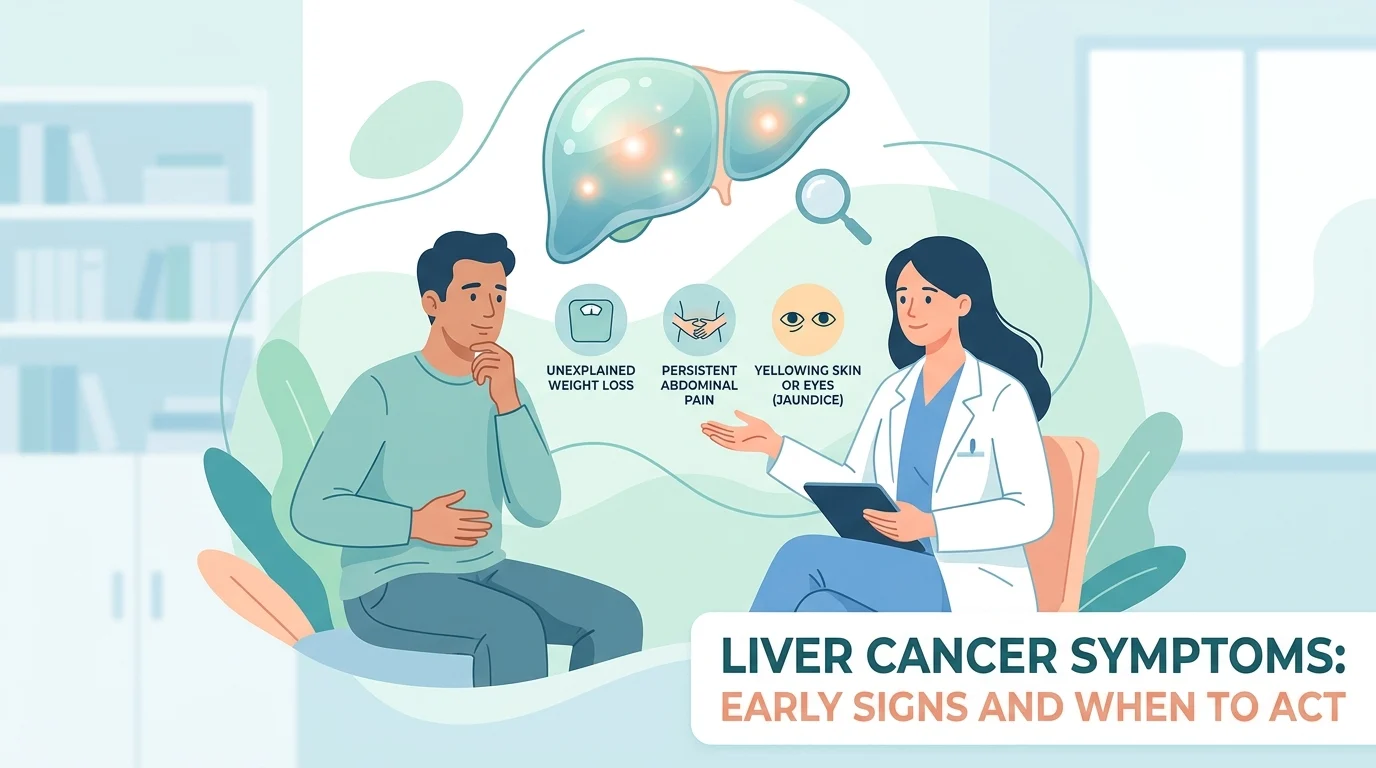
I sintomi del cancro al fegato sono tra gli argomenti di salute più cercati in rete, ma anche tra i più fuorvianti, perché questa malattia è insolitamente silenziosa nelle fasi iniziali. Il fegato non ha fibre del dolore al suo interno, dispone di una grande riserva funzionale e un tumore può crescere a lungo prima che si avverta qualcosa. Ecco perché la risposta onesta alla domanda su cosa tenere d'occhio parte da un'altra domanda: se appartieni a un gruppo che dovrebbe sottoporsi a screening, invece di aspettare un segnale. Il National Cancer Institute stima circa 42.340 nuovi casi di cancro al fegato e alle vie biliari intraepatiche negli Stati Uniti nel 2026, con una sopravvivenza relativa a cinque anni del 21,9% su tutti gli stadi, un dato strettamente legato a quanto precocemente viene individuata la malattia. Questa guida spiega quali sono davvero i sintomi, quando compaiono, chi è a rischio e cosa fare con queste informazioni.
Perché i sintomi del cancro al fegato compaiono così tardi
Tre caratteristiche del fegato spiegano questo ritardo. Ha un'enorme capacità di riserva, quindi una parte consistente può essere compromessa prima che gli esami del sangue o le funzioni quotidiane cambino. Il tessuto interno non ha nervi sensitivi, quindi un tumore che cresce all'interno dell'organo non provoca dolore finché non distende la capsula che lo avvolge o non preme su una struttura vicina. Inoltre, la maggior parte dei tumori epatici si sviluppa su una base di malattia epatica cronica, per cui la stanchezza, la scarsa appetenza e il fastidio addominale che alla fine compaiono vengono spesso attribuiti alla cirrosi o all'epatite già nota alla persona.
Il carcinoma epatocellulare rappresenta circa il 90% dei tumori primitivi del fegato. Il colangiocarcinoma intraepatico costituisce la maggior parte dei casi rimanenti, con una quota intorno al 10-20%, mentre l'angiosarcoma epatico è molto raro, con circa l'1% dei casi. Il tumore primitivo del fegato, che origina nel fegato stesso, è una malattia diversa dal cancro che si diffonde al fegato da un'altra sede: le due condizioni non sono intercambiabili, anche se nel linguaggio comune entrambe vengono chiamate "cancro al fegato".
Sintomi del cancro al fegato nelle fasi iniziali
La maggior parte dei tumori epatici in fase iniziale non produce alcun sintomo. Quando si nota qualcosa, di solito è vago e facile da attribuire ad altro. La tabella seguente riporta i segni più frequentemente riferiti e cosa indica ciascuno di essi.
| Segnale | Ciò che riflette | Tempistica tipica |
|---|---|---|
| Perdita di peso senza una causa apparente | Effetto metabolico generale del tumore | Spesso la prima cosa che si nota, ma non specifica |
| Perdita di appetito, senso di sazietà precoce | Pressione sullo stomaco, o la malattia stessa | Fase iniziale o intermedia |
| Dolore addominale in alto a destra | Distensione della capsula che circonda il fegato | Richiede che il tumore abbia raggiunto una certa dimensione |
| Stanchezza e debolezza generale | Ridotta funzionalità epatica, anemia o il tumore stesso | Graduale, spesso attribuita ad altre cause |
| Nausea e vomito | Spostamento degli organi vicini | Intermedio |
| Un nodulo duro sotto le costole destre | Un fegato ingrossato o un tumore palpabile | Tardivo, e mai un segnale precoce affidabile |
Ogni elemento di quell'elenco ha spiegazioni molto più comuni. La perdita di peso involontaria e la stanchezza sono tra i sintomi meno specifici in medicina. Ciò che dà loro rilevanza è il contesto: lo stesso sintomo ha un significato diverso in una persona con cirrosi nota o epatite B cronica rispetto a qualcuno con un fegato sano.
Sintomi tardivi e avanzati
Con il progredire della malattia, i segni diventano più caratteristici perché riflettono il deterioramento della funzionalità epatica piuttosto che il tumore in sé.
- Ittero, ovvero ingiallimento della pelle e del bianco degli occhi
- Urine scure e feci pallide, grigie o bianco-gessose
- Gonfiore addominale da ascite, cioè accumulo di liquido nell'addome
- Prurito cutaneo senza eruzioni, causato dall'accumulo di prodotti biliari
- Facilità a formare lividi o sanguinamenti, poiché il fegato produce i fattori della coagulazione
- Febbre senza un'infezione evidente
- Confusione o sonnolenza, un segno tardivo noto come encefalopatia epatica
Sintomi allo stadio 4 e in fase terminale
La malattia avanzata combina quanto sopra con i sintomi provenienti dai siti in cui il cancro si è diffuso, più spesso i polmoni, le ossa o il rivestimento dell'addome. Dolore osseo, difficoltà respiratorie, marcato gonfiore delle gambe e grave perdita di massa muscolare e di peso diventano predominanti. Secondo i dati SEER, il 21% dei casi è già in fase metastatica al momento della diagnosi, con una sopravvivenza relativa a cinque anni del 3,6%, rispetto al 37,4% per la malattia ancora localizzata al fegato. Questo divario è l'argomento più forte a favore della diagnosi precoce prima che compaiano i sintomi.
I sintomi del cancro al fegato sono diversi nelle donne?
I sintomi in sé sono gli stessi. La differenza riguarda chi sviluppa la malattia: il cancro al fegato viene diagnosticato molto più spesso negli uomini, e il sesso maschile è un fattore di rischio consolidato, confermato da ampie sintesi delle evidenze scientifiche. L'età mediana alla diagnosi è 68 anni. Non esiste un quadro sintomatologico specifico per le donne, e le ricerche che lo suggeriscono riflettono generalmente questa differenza nell'incidenza, non nella presentazione clinica.
Cause del cancro al fegato e fattori di rischio
Il cancro al fegato si sviluppa quasi sempre su uno sfondo di danno epatico cronico. Una revisione ombrello pubblicata nel 2025, che ha raccolto 175 meta-analisi e identificato 101 potenziali fattori di rischio, ha rilevato che l'epatite B cronica è associata a un aumento del rischio di circa 12,5 volte e l'epatite C cronica di circa 11,2 volte, con rischi ridotti dal trattamento antivirale e dalla risposta virologica.
- Infezione cronica da epatite B o epatite C, le due cause principali a livello mondiale
- Cirrosi di qualsiasi origine, inclusa la malattia epatica correlata all'alcol
- Steatosi epatica associata a disfunzione metabolica, obesità e diabete di tipo 2
- Consumo eccessivo di alcol e fumo
- Emocromatosi ereditaria e altre malattie epatiche di origine genetica
- Esposizione alle aflatossine, dovuta alla contaminazione da muffe di cereali e frutta secca conservati in alcune regioni
- Sesso maschile ed età avanzata
La stessa revisione ha riportato anche fattori associati a un rischio più basso, tra cui il consumo di caffè e un'alimentazione sana, oltre a segnali relativi ad alcuni farmaci comuni. Si tratta di associazioni a livello di popolazione ricavate da dati osservazionali, non di indicazioni pratiche: nulla in quell'elenco è un motivo per iniziare o interrompere un farmaco senza prima parlarne con il tuo medico.
Perché i sintomi non sono lo strumento giusto, e la sorveglianza è quello corretto
Questo è l'aspetto più importante. Poiché il cancro al fegato in stadio iniziale è silenzioso, le linee guida non si basano sui sintomi per individuarlo. Raccomandano una sorveglianza regolare per le persone ad alto rischio: in genere un'ecografia addominale ogni sei mesi, con o senza il dosaggio dell'alfa-fetoproteina nel sangue, per chiunque abbia cirrosi o epatite B cronica ad alto rischio. La sorveglianza è associata a una maggiore diagnosi in stadio precoce, a più possibilità di trattamento curativo e a una minore mortalità per cancro al fegato. Se appartieni a uno di questi gruppi, la cosa più utile che puoi fare è verificare di essere effettivamente inserito in un programma di sorveglianza, non imparare a memoria un elenco di sintomi.
Cosa possono e non possono mostrare gli esami del sangue
Un esame standard del fegato misura gli enzimi rilasciati quando le cellule epatiche sono danneggiate, non se è presente un tumore, e il nostro guida agli esami della funzionalità epatica explains how those markers are read as a pattern. The individual values each carry their own meaning: for the enzyme most often flagged first, open our ALT blood test guide, and for its usual companion, check our AST blood test guide. Jaundice is explained in our total bilirubin guide, and the protein that falls as liver function declines is covered in our low albumin guide.
Alpha-fetoprotein is the blood marker used in surveillance, and it is widely misunderstood. A raised level most often reflects a benign liver condition rather than cancer, and a normal level does not rule cancer out, because a substantial share of liver cancers never produce it; read our AFP blood test guide before drawing conclusions from a single value. Because hepatitis status determines whether surveillance applies at all, testing for it matters: see our hepatitis B surface antigen guide and our hepatitis blood test guide.
Quando consultare un medico
Contact a clinician promptly, rather than waiting, in any of these situations.
- Yellowing of the skin or eyes, at any age and with any other symptom
- Pale or chalky stools together with dark urine
- New abdominal swelling, or clothes becoming tight around the waist over weeks
- Unintentional weight loss of more than about 5 percent of body weight within six months
- Persistent upper right abdominal pain lasting more than two weeks
- A hard lump felt below the right rib cage
- Any new or worsening symptom in someone with known cirrhosis, hepatitis B, or hepatitis C
Confusion, drowsiness, vomiting blood, or black tarry stools in someone with liver disease are emergencies and need immediate care rather than an appointment.
Survival rates in context
Liver cancer survival statistics are sobering, and they are also frequently misapplied. The 21.9 percent five-year relative survival covers every stage and every type together, and it describes people diagnosed in past years and treated with the methods available then. Stage changes the picture substantially: 37.4 percent at five years for localized disease, 13.4 percent for regional spread, and 3.6 percent for distant disease. Underlying liver function also shapes the outlook independently of the tumor, because treatment options depend on how much healthy liver remains. No statistic predicts an individual outcome, and the figures cannot account for a specific person’s treatment plan or response.
Ultimi progressi scientifici
Research over the past three years has concentrated on the problem this article opened with: finding liver cancer before symptoms appear. The findings below come from peer-reviewed studies and guidelines, and none of them changes what any individual should do without a clinician’s input.
The limits of current surveillance are now well documented. A 2024 review of surveillance strategies concluded that ultrasound alone has suboptimal sensitivity for early-stage disease, particularly in people with obesity and in non-viral liver disease, and that adding alpha-fetoprotein improves detection but still misses more than a third of early-stage cancers. That acknowledged gap is what the rest of this work is trying to close.
Blood-based biomarker panels are the most advanced response. The best-studied is the GALAD score, which combines sex, age, alpha-fetoprotein, AFP-L3, and des-gamma-carboxy prothrombin into a single value. A phase 3 validation study published in 2024 followed 1,558 patients with cirrhosis across seven centers for a median of 2.2 years, during which 109 developed liver cancer. Measured in blood drawn up to 12 months before diagnosis, GALAD achieved an area under the curve of 0.78 against 0.66 for alpha-fetoprotein alone, and at matched specificity of 82 percent its sensitivity was 62 percent against 41 percent. In plain terms, the panel found meaningfully more cancers a year earlier than the single marker, while still missing a substantial share. A 2025 systematic review of 44 studies and 33,100 patients pooled the three commercially available panels and found early-stage sensitivities of 70.1 to 74.1 percent with specificities of 83.3 to 87.2 percent, with no significant difference between them and high statistical heterogeneity across studies.
The decisive evidence is not yet in. A phase 4 randomized trial began enrolling in 2024 across 15 United States sites, comparing semi-annual ultrasound with or without alpha-fetoprotein against semi-annual GALAD in 5,500 patients with cirrhosis or chronic hepatitis B, with reduction in late-stage cancer as the primary endpoint measured at five and a half years. A separate real-world implementation study of a related panel is running in the United Kingdom through 2030. A search of ClinicalTrials.gov in September 2026 returns 42 recruiting studies in liver cancer screening and surveillance. Until those trials report, ultrasound with or without alpha-fetoprotein remains the recommended standard, and a biomarker panel is an adjunct discussed with a specialist rather than a replacement.
Guidelines have moved in parallel. The European Association for the Study of the Liver published updated clinical practice guidelines on managing hepatocellular carcinoma in 2024, introducing personalized surveillance based on individual risk assessment, standardized imaging criteria, and clearer transitions between surgical, locoregional, and systemic therapies. On the treatment side, a network meta-analysis of 25 studies and 4,548 patients with early-stage disease found surgical resection associated with better disease-free survival at one and three years than radiofrequency or microwave ablation, though the comparison varied by region and the studies were mostly observational. Which option suits a given patient depends on tumor size and number, liver function, and overall health, and remains a multidisciplinary decision.
Glossario
| Termine | Senso |
|---|---|
| Hepatocellular carcinoma | The most common primary liver cancer, about 90 percent of cases. |
| Cirrosi | Permanent scarring of the liver, the main setting in which liver cancer arises. |
| Sorveglianza | Planned repeat testing in people at high risk, to find cancer before symptoms. |
| Alpha-fetoprotein | A protein used as a blood marker in liver cancer surveillance. |
| GALAD score | A panel combining sex, age and three blood markers into one detection score. |
| Ascites | Fluid collecting in the abdomen, causing swelling. |
| Ittero | Yellowing of skin and eyes from a build-up of bilirubin. |
| Ablation | Destroying a small tumor with heat, cold, or alcohol through a needle. |
| Relative survival | Survival compared with people of the same age without the cancer. |
Domande frequenti
What is the first sign of liver cancer?
There often is none. When something is noticed first, it is usually unintentional weight loss, loss of appetite, or vague discomfort in the upper right abdomen, all of which have far more common causes. Jaundice and abdominal swelling are later signs, not first ones. This is precisely why people at high risk are offered scheduled scans rather than being told to watch for symptoms.
Can liver cancer show up in a routine blood test?
Not reliably. A liver panel can be entirely normal in someone with liver cancer, and it can be abnormal for dozens of reasons that have nothing to do with cancer. Alpha-fetoprotein is more specific but still misses a large share of cases and rises in benign liver conditions. Imaging, usually ultrasound followed by a CT or MRI scan, is what identifies a tumor.
Where do you feel liver cancer pain?
Typically in the upper right part of the abdomen, just below the ribs, sometimes radiating to the right shoulder blade. The pain comes from stretching of the capsule around the liver rather than from the liver tissue itself, which has no pain nerves, so it appears only once a tumor has reached a certain size.
How quickly does liver cancer progress?
It varies widely. Some hepatocellular carcinomas double in size over several months, others much faster, and progression also depends on the state of the underlying liver. The six-month interval used in surveillance programs reflects this typical pace rather than an arbitrary schedule.
Can liver cancer be cured?
Yes, when it is found early. Surgical removal, liver transplant, and ablation can be curative for small tumors in a liver that still functions well, and five-year relative survival for localized disease is 37.4 percent. Once the cancer has spread beyond the liver, treatment aims to control the disease and maintain quality of life rather than to cure.
Who should be screened for liver cancer?
Guidelines recommend surveillance for adults with cirrhosis from any cause and for selected people with chronic hepatitis B, usually an ultrasound every six months with or without an alpha-fetoprotein test. If you have either condition, ask your clinician directly whether you are enrolled, because participation rates remain low even among people who qualify.
Fonti
- Cancer Stat Facts: Liver and Intrahepatic Bile Duct Cancer — SEER Program, National Cancer Institute
- Liver Cancer Treatment (PDQ) Patient Version — National Cancer Institute, National Institutes of Health
- Liver Cancer — MedlinePlus, National Library of Medicine
- Liver Cancer, Symptoms and Causes — Mayo Clinic
- Liver Cancer: Symptoms, Signs, Causes and Treatment — Cleveland Clinic
- EASL Clinical Practice Guidelines on the management of hepatocellular carcinoma — Journal of Hepatology, 2024 (indexed in PubMed)
- Wang J. et al. Risk factors for hepatocellular carcinoma: an umbrella review of systematic review and meta-analysis — Annals of Medicine, 2025 (indexed in PubMed)
- Min Y. et al. Ablative Treatments and Surgery for Early-Stage Hepatocellular Carcinoma: A Network Meta-Analysis — Journal of Surgical Research, 2024 (indexed in PubMed)
- Singal A.G. et al. Advancing Surveillance Strategies for Hepatocellular Carcinoma: A New Era of Efficacy and Precision — Journal of Clinical and Experimental Hepatology, 2024
- Marsh T.L. et al. A Phase 3 Biomarker Validation of GALAD for the Detection of Hepatocellular Carcinoma in Cirrhosis — Gastroenterology, 2024
- Jarrah M. et al. Performance of GALAD, GAAD, and ASAP for Early HCC Detection in Chronic Liver Disease: A Systematic Review and Meta-Analysis — Liver Cancer, 2025
- Singal A. et al. National Liver Cancer Screening Trial (TRACER) study protocol — Hepatology Communications, 2024
- National Liver Cancer Screening Trial, TRACER (NCT06084234) — ClinicalTrials.gov
- Real-world GAAD Algorithm Implementation and Validation to Improve Surveillance and Early Detection of Hepatocellular Carcinoma (NCT05971108) — ClinicalTrials.gov
Altri articoli
- Esame del sangue AFP: come capire i tuoi risultati
- Test di funzionalità epatica (LFT): come interpretare i risultati del pannello epatico
- Esame del sangue SGPT: valori normali, livelli alti e cause
- AST (transaminasi GOT): valori normali, alti e bassi
- Bilirubina totale alta: valori normali e cause
- Albumina bassa: cause, sintomi e rischi
- HBsAg Positivo: Cosa Significa e Cosa Succede Dopo
- Esame del sangue per l'epatite: cosa significano i tuoi risultati
Liver results are much easier to act on when each enzyme, protein, and marker is explained next to the others rather than read alone. Scopri i tuoi referti con AI DiagMe, che legge il tuo referto riga per riga e spiega ogni valore in modo chiaro e semplice, con un'interpretazione revisionata da un comitato di medici.