


































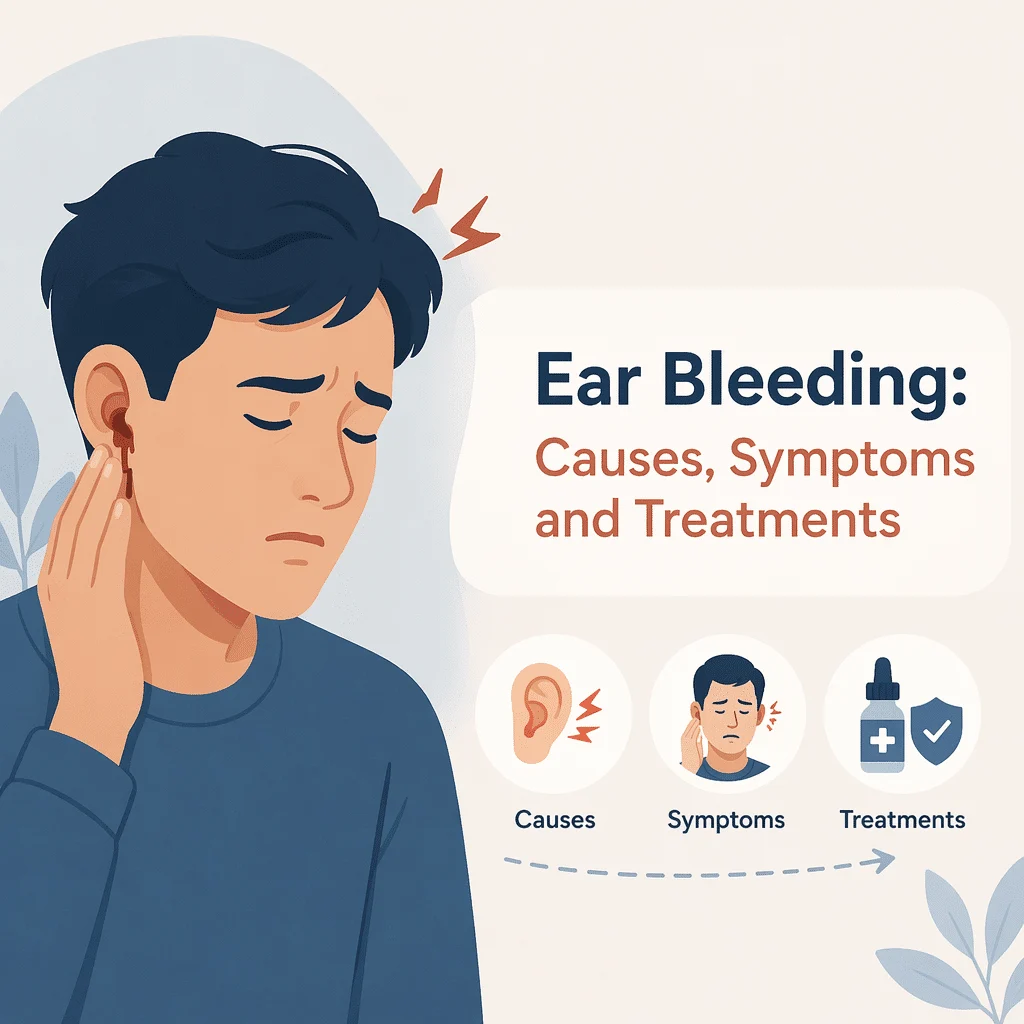
Ear bleeding can look far more serious than it usually is. A smear of blood on a cotton swab, a pink stain on your pillow, or a trickle from the ear canal most often comes from a small scratch in the skin of the canal, or from an eardrum that has torn. But the same symptom can also signal a head injury, a deep infection, or a bleeding problem that needs prompt attention. Telling those apart matters more than treating the blood itself.
In this article you’ll learn where the blood comes from, what the color and consistency of the discharge suggest, which warning signs mean urgent care, what to do and avoid in the first hour, and which tests doctors use to find the cause.
What ear bleeding is, and where the blood comes from
Ear bleeding, called otorrhagia in medical notes, means blood coming from the ear. The term describes what you see, not why it is happening. The ear has three compartments, and each produces a different pattern of bleeding.
The ear canal
The outer canal is a short tunnel lined with thin skin that sits directly on bone in its inner half. That skin tears easily and bleeds readily, which is why a fingernail, cotton swab, earbud, or hearing aid can draw blood with very little force. Canal bleeding is usually bright red, small, stops within minutes, and is the most common explanation for ear bleeding in healthy adults.
The middle ear and the eardrum
Behind the canal sits the eardrum, a membrane about a tenth of a millimeter thick. When it tears, blood escapes from the torn edges and mixes with fluid from the middle ear behind it, producing a thinner, watery discharge, often with a sudden change in hearing, a pop, or a blocked sensation. If blood collects behind an intact eardrum instead of draining, doctors call it hemotympanum, which usually points to a pressure injury or a blow to the head.
Deeper structures
Bleeding from beyond the middle ear is much less common but far more consequential. A fracture through the temporal bone, the dense part of the skull housing the hearing and balance organs, can produce blood in the ear along with hearing loss, dizziness, or facial weakness. Rarely, a tumor or abnormal cluster of blood vessels bleeds without any injury.
What the discharge looks like, and what that tells you
Clinicians pay close attention to the color, thickness, and smell of the discharge, because those details narrow the cause quickly. The table below follows the patterns described by the Mayo Clinic and the National Library of Medicine, and it helps organize what you are seeing before you call a clinician.
| What you see | Often points to | Usual urgency |
|---|---|---|
| Bright red streak on a swab or fingertip, no pain | Superficial scratch to the canal skin | Usually minor; watch for 48 hours |
| Blood mixed into brown or waxy debris | Irritated canal, impacted wax, canal eczema | Routine appointment |
| Blood with yellow or green pus, and a smell | Canal or middle ear infection, possibly a perforated eardrum | Within a day or two |
| Thin blood-tinged fluid after a pop, with sudden muffled hearing | Torn eardrum from pressure, noise, or an object | Promptly |
| Clear or straw-colored fluid with blood after a head injury | Possible skull base fracture with leaking spinal fluid | Emergency care now |
| Steady bleeding that soaks gauze, or from both ears | Significant trauma, or a clotting problem | Emergency care now |
| Persistent blood-stained discharge with deep pain, in diabetes | Aggressive infection spreading toward bone | Same-day assessment |
One distinction deserves emphasis. Clear watery fluid, especially if it keeps dripping and tastes salty running into the throat, can be cerebrospinal fluid, the liquid that cushions the brain. Mixed with blood after a head injury, that is a genuine emergency regardless of how much you see.
Common causes of ear bleeding
Cotton swabs and ear cleaning
Cleaning the ear with a cotton bud is the most frequent reason people notice blood in the ear. The canal is self-cleaning, so swabs mostly push wax deeper while abrading the skin on the way in. A painless smear after cleaning generally means nothing more than a graze. Blood with pain, muffled hearing, or ringing suggests the swab reached the eardrum, only about two and a half centimeters in.
Ear infections
Infection is the leading cause of a perforated eardrum. Pus builds up behind the drum until the pressure ruptures it, which relieves the pain abruptly and releases blood-streaked fluid. An infection of the canal itself, otitis externa, inflames the lining until it bleeds on contact or forms fragile tissue that oozes. Our guide sets out ear infection symptoms and treatments, and a separate article explains dry, crusty ears.
Pressure changes, noise, and a torn eardrum
Flying with a blocked nose, descending in a lift, or diving creates a pressure difference the ear cannot equalize. The result, ear barotrauma, ranges from discomfort to a frank tear with bleeding, and blast waves and gunshots do the same through sound energy alone. According to the StatPearls reference used by clinicians, roughly eight in ten torn eardrums close on their own, and doctors typically watch four to six weeks before considering repair.
Objects in the ear, especially in children
Beads, seeds, small toys, and insects are frequent finds in young children’s ears. Ear bleeding here comes from the object scratching the canal, or from attempts to fish it out. Expanding water beads deserve particular caution, because they swell against the eardrum the longer they stay in, and need specialist removal.
Blood thinners and clotting disorders
Anticoagulants, antiplatelet drugs such as aspirin, a low platelet count, or an inherited clotting disorder all mean a trivial scratch bleeds longer and looks worse. The injury is no more serious, but the bleeding is harder to stop and likelier to recur. If you take a blood thinner and your ear bleeds without obvious cause, mention it first when you call.
Growths and, rarely, cancer
Painless ear bleeding that keeps returning in the same ear, particularly with progressive hearing loss on that side, warrants examination even when it seems trivial. Benign polyps, cholesteatoma, and rarely a tumor can all present this way. Recurrence without explanation is what matters, not the volume of blood.
Red flags: when ear bleeding needs urgent care
This is the question behind most searches about ear bleeding, and it deserves a direct answer. Ear bleeding on its own, in a well person, after an identifiable poke or scratch, is rarely an emergency. What changes the picture is the company it keeps.
Go to an emergency department now
- The bleeding followed a blow to the head, a fall, an accident, or a blast
- Clear watery fluid keeps draining from the ear, with or without blood
- Confusion, repeated vomiting, severe headache, or loss of consciousness
- One side of the face has weakened or droops
- Hearing has dropped suddenly, or the room is spinning violently
- Bleeding is heavy, will not stop, or comes from both ears
- Bruising appears behind the ear or around the eyes after an injury
Arrange same-day or next-day care
- Fever with ear pain and blood-stained or foul-smelling discharge
- Deep ear pain that keeps you awake, especially with diabetes or a weakened immune system
- An object is stuck in the ear, or might be
- You take an anticoagulant and the bleeding has not settled
- The person affected is a baby or young child
- Discharge continues for more than a couple of days
A routine appointment is reasonable
- A single painless smear after cleaning the ear, already stopped
- Mild itching and flaking with occasional spotting
- Recurrent small bleeds with no other symptoms
What to do about ear bleeding, and what not to do
Most people asking how to stop ear bleeding are looking at a small amount of blood and no other symptoms. The aim there is to protect the ear and let it heal, not to intervene.
Sit upright, tilt the affected ear downward so fluid can drain, and place a clean pad of gauze loosely over the opening, changing it when it becomes damp. Keep the ear dry: no swimming, and keep shower water out with a petroleum-jelly-coated cotton ball at the canal entrance only. Take a standard over-the-counter pain reliever if you need one. Note when the bleeding started, what it looks like, and any change in hearing, because that is the history your clinician will ask for.
What not to do matters more. Do not pack anything into the canal or plug the bleeding deep inside. Do not use ear drops, oil, hydrogen peroxide, or an irrigation kit, because some are harmful to the middle ear if the eardrum has a hole in it. Do not try to remove an object yourself. Avoid forceful nose-blowing and flying until you have been checked, and stop cleaning the ear.
How doctors find the cause of ear bleeding
Examination and hearing tests
The core of the assessment is looking. A clinician uses an otoscope, often with a microscope, to gently clear the canal and inspect the eardrum, which distinguishes a canal graze from a perforation in most cases. A tuning fork test, then formal audiometry, establishes whether hearing loss is conductive, meaning sound is blocked mechanically, or sensorineural, meaning the inner ear or nerve is involved. Two related symptoms are covered separately: we explain tinnitus causes and relief, and another article reviews vertigo causes and diagnosis.
Imaging
Imaging answers specific questions. After a head injury, a CT scan of the temporal bones looks for a fracture, for blood in the middle ear, and for a defect that could let spinal fluid leak. When a deep infection spreading to bone or a growth is suspected, CT or MRI defines how far it extends.
Lab tests that help
Ear bleeding is not diagnosed by a blood test, but laboratory results answer questions the examination raises, and they are often handed to patients without explanation.
- White cells raised in a way that fits infection, or platelets and hemoglobin low enough to explain prolonged bleeding, both show up on a complete blood count. Our guide explains the complete blood count.
- Clotting studies, including prothrombin time and INR, matter if you take a blood thinner or bleed unusually easily. We cover the coagulation panel, and a separate article interprets PT and INR results.
- Inflammatory markers such as C-reactive protein and the erythrocyte sedimentation rate gauge how active an infection is and whether it is responding. Our guide explains the CRP blood test.
- A culture of the ear discharge identifies the bacteria or fungus responsible and which treatments will work, which is why clinicians often swab before starting treatment.
- Blood sugar and A1C are checked when a severe canal infection is suspected, because poorly controlled diabetes is the biggest risk factor. We explain A1C targets, and a further article covers diabetes symptoms and treatment.
Treatment and healing: what to expect
Treatment for ear bleeding follows the cause rather than the bleeding itself. A superficial canal graze needs nothing but dry ear precautions and time, and heals within days. An infected canal is usually treated with prescription drops chosen to be safe for that ear, sometimes after cleaning or placing a wick. A middle ear infection that has ruptured the drum is treated with antibiotics when indicated, and the drum is then monitored.
For a torn eardrum, watchful waiting is the standard first approach, with repeat examinations to confirm the hole is closing, and keeping water out is the main thing the patient controls. Surgical repair with a graft is considered when a perforation persists beyond the observation window, is large, sits at the rim, or leaves significant hearing loss. Objects are removed by whoever is best equipped to succeed on the first attempt, usually under a microscope. Temporal bone fractures and bone-invading infections are managed by a team over months rather than days.
Latest scientific advances
Research on the injuries behind ear bleeding has moved steadily in recent years. Here is what the latest studies suggest, in plain language.
Most torn eardrums heal without surgery
A 2023 study of 70 people with a torn eardrum after an injury found nearly nine in ten healed on their own within twelve weeks; tears at the very rim healed far less reliably than tears in the middle. A 2024 systematic review, meaning a study that pools earlier trials, combined six randomized trials in just over 500 similar patients: prescription antibiotic ear drops closed the eardrum somewhat more often, and two to three weeks sooner, than waiting alone, without worsening hearing or raising infection risk.
What this means for you: watchful waiting rests on good evidence, and the position of the tear matters as much as its size. Drops can help, but they are prescription-only, and the wrong preparation can damage an ear with a hole in it. Never put anything into a bleeding ear on your own.
Digging at a stuck object makes it harder to remove
A 2022 review pooling 13 studies and nearly 3,900 children found that ear, nose and throat specialists removed an object successfully about nine times in ten when they attempted it first, but success fell to around two thirds when someone had already tried elsewhere. The reviewers attributed much of that drop to swelling and bleeding in the canal, which blocks the view. A 2025 report on 447 children’s ears found almost all came out safely in a specialist office, though nearly half arrived after a failed attempt elsewhere.
What this means for you: a first attempt by the right person is worth far more than a quick attempt by the nearest one. Leave the object alone and have the ear examined.
Hearing usually improves after a skull base injury
A 2023 study followed 50 patients with a temporal bone fracture, testing their hearing over six months. Most had conductive hearing loss, the type caused by sound being blocked rather than by nerve damage, and hearing improved substantially across the group.
What this means for you: hearing loss straight after a head injury is frightening, but much of it is often temporary. It still needs formal testing and scheduled follow-up, not guesswork at home.
Severe ear infections in older adults with diabetes remain a concern
A 2024 review of 197 patients with a severe, bone-invading ear infection found most were older adults, and roughly four in five had a condition weakening the immune system, most often diabetes. Fungi, not only bacteria, accounted for a substantial share. A separate 2023 review of treatment approaches found the published evidence inconsistent, with care usually given in hospital over a long course.
What this means for you: if you live with diabetes and develop a painful, discharging ear that is not settling, say so early and mention the diabetes. Early diagnosis is where these studies agree.
Glossary of key terms
| Term | Definition |
|---|---|
| Otorrhagia | The medical term for bleeding from the ear. It describes the symptom only, not its cause. |
| Otorrhea | Any discharge from the ear, whether watery, pus-like, or bloody. |
| Tympanic membrane | The eardrum. A thin membrane that separates the ear canal from the middle ear and vibrates in response to sound. |
| Perforation | A hole or tear in the eardrum, caused by infection, pressure, noise, or a direct injury. |
| Hemotympanum | Blood collected in the middle ear behind an eardrum that is still intact, often after a head injury. |
| Otitis externa | Inflammation or infection of the ear canal, sometimes called swimmer’s ear. |
| Otitis media | Infection or inflammation of the middle ear, the air-filled space behind the eardrum. |
| Barotrauma | Injury caused by a difference in air or water pressure that the ear cannot equalize, as during flying or diving. |
| Temporal bone | The dense part of the skull on each side that houses the hearing and balance organs. |
| Cerebrospinal fluid | The clear liquid that surrounds and cushions the brain and spinal cord. Leaking from the ear after injury, it is a warning sign. |
Frequently asked questions
Should I be worried if my ear is bleeding?
Usually the cause is minor, but the answer depends on what comes with it. A single painless streak of blood after cleaning your ear, which stops on its own, rarely signals anything serious. You should treat it as urgent if the bleeding followed a head injury, if clear watery fluid is draining, if hearing has dropped suddenly, if the room is spinning, if one side of your face has weakened, or if the bleeding is heavy or will not stop. Fever with foul-smelling discharge, or deep pain in someone with diabetes, needs same-day assessment. When in doubt, have the ear looked at rather than watched.
What does it mean if there is blood on the cotton swab but no pain?
Painless blood on a swab almost always means the swab scraped the thin skin lining the canal. That skin is fragile and sits close to bone, so it bleeds easily and heals quickly. Stop cleaning the ear, keep it dry for a few days, and let it settle. Two things change the assessment: if the bleeding repeats in the same ear without any obvious cause, or if you notice muffled hearing or ringing afterward, arrange an examination. The concern in those cases is not the graze but what a clinician might find behind it.
How long does a bleeding ear take to heal?
A superficial scratch to the canal usually stops bleeding within minutes and heals in a few days. A torn eardrum takes considerably longer. Most close on their own, and clinicians generally allow four to six weeks of observation before discussing repair, with some tears taking up to about twelve weeks. Healing is slower when the hole is large, sits at the rim of the eardrum, or gets wet. Keeping water out is the most useful thing you can do during that period.
Can an ear infection cause bleeding?
Yes, and it is a common route. In a middle ear infection, pus builds up behind the eardrum until the pressure tears it. The rupture releases blood-streaked fluid and often relieves the pain quite suddenly, which can feel like improvement even though it needs review. An infection of the canal itself inflames the lining until it bleeds when touched, or forms fragile tissue that oozes. Blood mixed with yellow or green discharge, especially with a smell or a fever, should be assessed within a day or two.
What should I not do when my ear is bleeding?
Do not push anything into the canal, including gauze, tissue, or a cotton bud, and do not try to plug the bleeding deep inside. Avoid ear drops, oils, hydrogen peroxide, and irrigation kits unless a clinician has told you which product to use, because several preparations are harmful if the eardrum is torn. Do not try to remove a stuck object yourself. Avoid forceful nose-blowing, swimming, and flying until you have been checked. Cover the outer ear loosely, let it drain, and keep it dry.
Is bleeding from the ear always an emergency in children?
Not always, but children warrant a lower threshold for being seen. Small children put objects in their ears, cannot always describe pain or hearing changes, and are prone to middle ear infections that rupture the drum. If your child’s ear bleeds, have it examined rather than waiting, and resist any attempt to remove a visible object at home, since that reliably makes professional removal harder. Seek emergency care if the bleeding followed a fall or blow to the head, or if your child is drowsy, vomiting, unsteady, or has facial weakness.
Sources
- Mayo Clinic — Ruptured eardrum (perforated tympanic membrane): symptoms and causes, 2024 — mayoclinic.org
- MedlinePlus, National Library of Medicine — Ear discharge, medical encyclopedia, 2024 — medlineplus.gov
- MedlinePlus, National Library of Medicine — Malignant otitis externa, medical encyclopedia, 2024 — medlineplus.gov
- Dolhi N, Weimer AD — Tympanic Membrane Perforation — StatPearls, National Center for Biotechnology Information, 2023 — ncbi.nlm.nih.gov
- Bird S, Wilson E — Ear Barotrauma — StatPearls, National Center for Biotechnology Information, 2023 — ncbi.nlm.nih.gov
- Bishnoi T, Marlapudi SK, Sahu PK — Factors influencing the outcome of spontaneous healing of traumatic tympanic membrane perforation — Indian Journal of Otolaryngology and Head and Neck Surgery, 2023 — doi.org/10.1007/s12070-023-03722-4
- Kutbi AH, Malas M, Al-Talhi AA, Noori F, Amoodi HA — The effect of using ofloxacin ear drops in traumatic tympanic membrane healing: a systematic review and meta-analysis — Ear, Nose and Throat Journal, 2024 — doi.org/10.1177/01455613241264479
- White AC, Shih MC, Nguyen SA, Liu YC — Comparison of care settings for pediatric external auditory canal foreign bodies: a meta-analysis — Annals of Otology, Rhinology and Laryngology, 2022 — doi.org/10.1177/00034894221093584
- Prasad D, Isaacson G — Safety and efficacy of a protocol for in-office pediatric aural foreign body removal — The Laryngoscope, 2025 — doi.org/10.1002/lary.32073
- Deshmukh KA, Fatima U, Siddiqui A, Tegnoor MS — Evaluation and outcomes of hearing loss in temporal bone fractures: a prospective study — Cureus, 2023 — doi.org/10.7759/cureus.46331
- Sideris G, Petsiou DP, Kourklidou M, Papadimitriou N, Vlastarakos PV, Karamagkiolas S, Margaris I, Nikolopoulos T, Delides A — Fungal malignant otitis externa: a systematic review — Cureus, 2024 — doi.org/10.7759/cureus.71345
- Lodhi S, Timms S, Stapleton E — A systematic review of antimicrobial treatment regimens and their outcomes in necrotising otitis externa — The Journal of Laryngology and Otology, 2023 — doi.org/10.1017/S0022215123001664
Further reading
- Tingling in the ear: causes, tests and treatment
- Sinus infection: symptoms, causes and treatment
- Platelet count: normal, low and high ranges
- ESR blood test: normal range and meaning
- Hemoglobin levels: what your blood test means
Understand your lab results with AI DiagMe
When ear bleeding comes with infection, unusual bruising, or a bleeding tendency, your clinician often orders blood work alongside the ear examination. AI DiagMe reads those results back to you in plain language, whether it is a complete blood count, clotting studies such as PT and INR, an inflammatory marker like C-reactive protein, or an A1C that reflects blood sugar control. That understanding helps you ask better questions at your appointment. It does not diagnose your condition and does not replace your doctor.
Get your results interpreted in minutes