





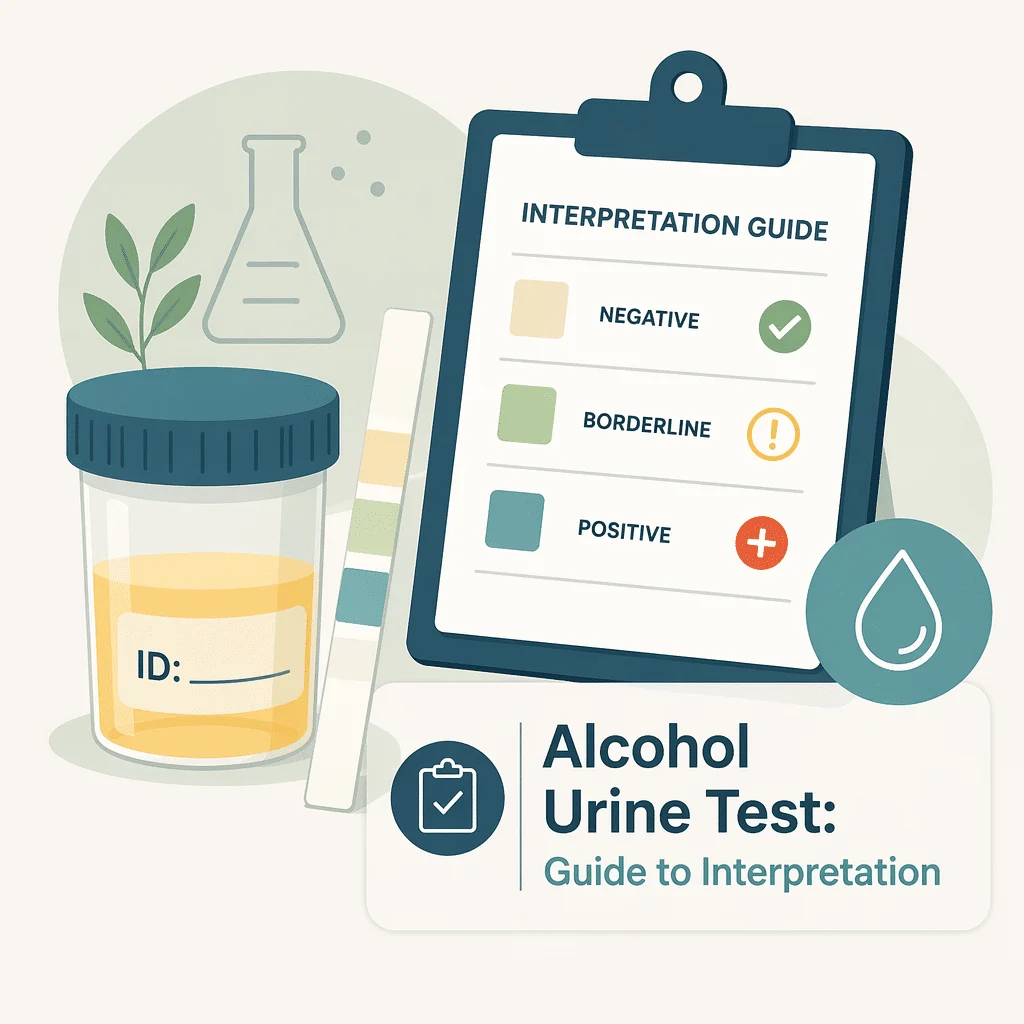
An alcohol urine test looks for either alcohol itself or the byproducts your liver makes after breaking alcohol down. That distinction decides almost everything else about your result: what the lab can see, how far back it can look, and how confidently anyone can say you drank. Clinics, treatment programs, employers and courts all use these tests, and each sets its own threshold for a positive. In this article you’ll learn what the two main versions measure, how long each realistically detects drinking, how cutoffs turn a number into a verdict, and which everyday situations produce misleading results. You’ll also find a side-by-side comparison of urine, breath and blood methods, plus a plain-language summary of recent biomarker research.
What an alcohol urine test actually measures
There is no single alcohol urine test. There are two families of test, and they answer different questions. Knowing which one you took is the first step in reading your report, because the same sample can be negative on one and positive on the other.
Direct ethanol testing
Ethanol is the alcohol in beer, wine and spirits. A direct test measures ethanol that has passed unchanged into the urine, which only happens while alcohol is still circulating in your body. Your liver clears alcohol steadily and continuously, so this signal fades quickly. MedlinePlus notes that blood testing detects alcohol for up to about 12 hours after drinking, and urine ethanol behaves on a broadly similar timescale. A negative direct result therefore tells you very little about last night.
EtG and EtS, the alcohol metabolites
Ethyl glucuronide (EtG) and ethyl sulfate (EtS) are two small molecules your liver produces only when ethanol is present. They are called minor metabolites because your body makes very little of each, but laboratory instruments detect them at extremely low concentrations. Because they linger after the ethanol itself has gone, an alcohol urine test built on EtG or EtS looks further back in time than a direct test. Most modern testing programs use this version, which is why so many reports mention EtG rather than ethanol.
How long alcohol stays detectable in urine
This is the question almost everyone brings to an alcohol urine test, and the honest answer is a range rather than a number. Published reviews of alcohol biomarkers describe how the non-oxidative metabolites widen the detection window well beyond ethanol’s own short life, and reported EtG windows commonly fall between roughly one and three days, stretching further after sustained heavy drinking.
Why a fixed number is misleading
Detection depends on three moving parts: how much you drank, how quickly your body processed and excreted it, and how low the laboratory set its threshold. Change any one of them and the window moves. A single drink at a low threshold and a heavy evening at a high threshold can produce the same result on paper for completely different reasons. Anyone quoting one universal figure is quietly assuming a specific dose and a specific cutoff.
What shifts your personal window
- Total amount consumed, and whether it was spread out or concentrated in a few hours
- Kidney function and urine output, which govern how fast metabolites leave the body
- Hydration at the moment of collection, which changes how concentrated the sample is
- The cutoff your program chose, which can differ from the laboratory next door
- Body composition, age and liver health, which shape how alcohol is processed
Alcohol test types compared
An alcohol urine test is one option among several, and each method trades reach against precision. This table sets out what each one detects, roughly how far back it looks, and what most often confuses the result.
| Test | What it detects | Typical look-back | What commonly confuses it |
|---|---|---|---|
| Urine ethanol (direct) | Alcohol itself, still present in the body | Hours, on a timescale similar to blood | Bacteria or yeast in a poorly stored sample, which can create or consume ethanol |
| Urine EtG and EtS | Two byproducts made only when ethanol has been present | Commonly around one to three days, longer after heavy drinking | Very dilute urine, a low cutoff, and incidental alcohol from household products |
| Breath test | Alcohol in exhaled air, tracking the current blood level | Hours, reflecting the present moment only | Alcohol left in the mouth from a recent drink, mouthwash or medication |
| Blood ethanol | Alcohol concentration at the exact moment of the draw | Up to about 12 hours | Delay between the event in question and the blood draw |
| Blood PEth | A blood cell membrane compound formed only in the presence of ethanol | Up to about four weeks | Drinking pattern, whether whole blood or a dried blood spot was used, and individual variation |
Notice the pattern. Breath and blood ethanol answer “are you affected right now?” An alcohol urine test based on EtG answers “did you drink in the last few days?” PEth answers “have you been drinking for weeks?” Programs match the method to the question they need answered, not because one is universally better. The same screen-then-confirm logic governs most workplace panels, and we published a broader drug screen results guide.
How cutoffs turn a number into a positive or negative
Your alcohol urine test report is fundamentally a number compared against a line. That line is a policy decision made by the laboratory or the program, not a biological boundary, and it is the single most underappreciated element of the whole process.
Screening versus confirmatory testing
Most samples first meet a fast, inexpensive immunoassay screen. Screens are deliberately tuned to miss as few positives as possible, which means they occasionally flag samples that are not truly positive. A flagged sample should then go to a confirmatory method such as liquid or gas chromatography with mass spectrometry, which identifies the exact molecule rather than reacting to a look-alike. The FDA makes this point plainly about home urine screening kits: send the sample to a laboratory before drawing conclusions, and take no serious action on a home result alone.
Why programs use tiered thresholds
Research programs that monitor drinking often run two levels rather than one. A recent randomized trial in adults with alcohol use disorder used a lower urine EtG threshold to call a sample negative and a distinctly higher one to flag heavier recent drinking. That design matters for you: “positive” is not one thing. A result can sit above a strict abstinence threshold while falling well below the level a program treats as evidence of heavy drinking, so it is always reasonable to ask which cutoff was applied to your sample.
What pushes an alcohol urine test the wrong way
Both directions of error are possible, and they have different causes. Understanding them is what separates panic from perspective.
Incidental exposure and false positives
Because EtG can be measured at very low concentrations, alcohol you never intended to consume can register. Realistic sources include some mouthwashes and breath products, hand sanitizer used heavily in an unventilated space, certain cough and cold preparations, kombucha, and foods cooked with wine or spirits. At a low cutoff these can nudge a sample over the line; at a higher cutoff they usually cannot. This is precisely why the threshold matters so much, and why a confirmatory test plus context beats a bare number.
Dilution, delay and false negatives
The opposite error is more common than people expect. Drinking large volumes of water before a collection dilutes the sample and can drop the concentration below the cutoff without changing whether you drank. Laboratories anticipate this and check whether a sample is too watery to interpret, which is why we explain urine specific gravity levels and their meaning and also publish a urine creatinine interpretation guide. A sample judged too dilute is often treated as invalid rather than negative. Timing is the other cause: a collection taken after the window closes will be negative regardless of what happened three days earlier.
A note on the sample itself
Direct ethanol results deserve extra caution. If a specimen sits warm for too long, microorganisms present in the urine can generate ethanol that was never drunk, or consume ethanol that was. Ketones can appear on the same dipstick for entirely unrelated metabolic reasons, and we cover ketones in urine and their causes separately. Chain-of-custody paperwork, refrigeration and prompt transport exist to close these gaps.
Blood markers your clinician may read alongside
An alcohol urine test captures a narrow slice of time. When the clinical question is a pattern over months rather than a single episode, clinicians turn to blood. A 2025 review of markers of excessive alcohol use describes the familiar trio: enlarged red blood cells, an aspartate aminotransferase to alanine aminotransferase ratio above two pointing toward alcohol-related liver injury, and gamma-glutamyl transferase raised in roughly three of every four people drinking heavily for several weeks.
Each of these has its own article here. Alcohol directly stimulates one liver enzyme in particular, and we published a dedicated GGT liver enzyme guide. For the enzyme ratio pattern, see our AST/ALT ratio guide. Sustained drinking also enlarges red blood cells slightly, and we explain high MCV levels and their causes. Your clinician may order a full panel in the same visit, and we explain liver function tests and how to read them.
None of these markers is specific to alcohol on its own. Enzymes rise for many reasons, red cells enlarge in vitamin deficiencies, and a normal panel does not rule out heavy drinking. They are read together, and read against the person in front of the clinician.
How to read your own result, step by step
When your alcohol urine test report arrives, work through it in this order rather than jumping to the verdict.
- Identify the analyte. Does the report name ethanol, or EtG and EtS? This sets the look-back period before anything else.
- Find the cutoff. It is usually printed beside the result in nanograms per milliliter. Without it, the number is uninterpretable.
- Check the method. A screening immunoassay carries less weight than a chromatography-based confirmation of the same sample.
- Look for validity markers. Specific gravity and creatinine tell you whether the sample was concentrated enough to trust.
- Reconstruct the timeline. Note the collection date and time, then count backward across the relevant window.
- List genuine exposures. Mouthwash, sanitizer, cooking wine and cold remedies are worth writing down before any conversation.
A routine urinalysis reports several unrelated markers on the same page, which is a frequent source of confusion, and we published a full urinalysis results interpretation guide. Color, incidentally, tells you about hydration rather than alcohol, and we explain urine color changes and their causes.
When to talk to a clinician
Raise a result with a clinician if you dispute it and no confirmatory test was performed, if the report shows no cutoff or no validity markers, if the result conflicts with a breath or blood test taken the same day, or if a consequential decision rests on a single home test. Speak to a clinician promptly, whatever your test says, if you notice yellowing skin or eyes, persistent vomiting, confusion, or abdominal swelling, or if stopping alcohol brings on shaking, sweating or agitation, since withdrawal can be serious and is treatable.
Latest scientific advances
Alcohol biomarker research has moved quickly since 2023. Here is what the recent literature adds, in plain language, along with what each finding changes for someone holding a test report.
Blood biomarkers now look back much further
A 2025 review in the Journal of Hepatology examined phosphatidylethanol, a compound that forms in blood cell membranes only when ethanol is present, and described a detection window of up to about four weeks. The authors recommend combining it with a person’s own account of their drinking and a short standard questionnaire rather than reading the number alone. What this means for you: if a clinic needs a longer view than a few days, expect a blood test rather than repeated urine collections, and expect to be asked about your drinking as part of interpreting it. The review is a narrative synthesis of existing evidence, so it reflects expert consensus rather than a single new experiment.
Why metabolites replaced ethanol in most programs
A 2023 review tracing the development of the main alcohol biomarkers set out the underlying logic clearly: ethanol leaves the body steadily and quickly, so measuring it captures only a narrow moment, while the metabolites the liver forms afterward widen the window considerably. What this means for you: a negative direct ethanol result is not evidence that you did not drink two days ago, and a positive EtG result alongside a negative breath test is not a contradiction. The two tests are answering different questions.
Different tests genuinely disagree, and that is expected
A 2023 study in women receiving care for HIV and hepatitis C compared urine EtG, breath alcohol readings and what participants reported themselves. The three measures often did not line up. What this means for you: disagreement between methods is a normal consequence of different time windows and different sensitivities, not automatic evidence that someone was untruthful. A cohort study of this kind, meaning a defined group assessed with several measures, shows patterns of agreement rather than proving which measure is correct.
The cutoff, not the biology, often decides the outcome
Researchers assessing biomarker thresholds in pregnant women found that moving the cutoff up or down substantially changed how many people were identified as having consumed alcohol, and that a strict threshold missed some who reported drinking. A 2025 randomized trial in adults with alcohol use disorder likewise used two separate urine EtG levels, one for abstinence and a higher one for heavier drinking. What this means for you: the threshold applied to your sample is a choice, and asking which one was used is a legitimate and useful question. These are findings about test design, and they do not tell you anything about any individual result.
Rapid on-site testing is becoming practical
A large randomized trial published in 2023 in Lancet Global Health used point-of-care urine alcohol biomarker testing at scale in a clinical program in Uganda, showing that immediate on-site results are workable outside specialist laboratories. What this means for you: you may increasingly receive an alcohol urine test result during the visit itself. A rapid positive is still a screening result, and confirmation in a laboratory remains the appropriate next step before anything consequential follows from it.
The direction of travel: several markers, read together
One theme recurs across this literature. No single alcohol biomarker is positioned as a standalone answer. A 2025 review of markers of excessive alcohol use, and the hepatology review above, both describe combining a direct metabolite measurement with blood markers and a clinical conversation. What this means for you: a number on an alcohol urine test is one input among several, meant to open a conversation rather than close one. Much of this work is recent and some remains preliminary, so it will be refined as larger studies report.
Glossary
| Term | Definition |
|---|---|
| Ethanol | The type of alcohol found in beer, wine and spirits. It is what a direct alcohol test measures. |
| Metabolite | A substance your body creates while breaking something else down. Metabolites often stay detectable after the original substance is gone. |
| Ethyl glucuronide (EtG) | A minor alcohol metabolite formed only when ethanol has been present. It is the marker most urine alcohol programs measure. |
| Ethyl sulfate (EtS) | A second alcohol metabolite, often measured alongside EtG so the two results can support each other. |
| Cutoff | The concentration a laboratory or program sets as the line between a negative and a positive result. It is a policy choice, not a biological boundary. |
| Detection window | How far back in time a test can realistically pick up drinking. It varies with the amount consumed and the cutoff used. |
| Immunoassay | A fast, inexpensive screening method that reacts to a class of molecules. It is sensitive but less specific than confirmatory testing. |
| Confirmatory test | A precise laboratory method, usually chromatography combined with mass spectrometry, that identifies the exact molecule behind a screening result. |
| Phosphatidylethanol (PEth) | A blood marker formed in cell membranes only when ethanol is present. It looks back weeks rather than days. |
| Chain of custody | The documented trail following a sample from collection to analysis, designed to keep the result defensible. |
Frequently asked questions
How long can alcohol be detected in urine with an EtG test?
Published reviews of alcohol biomarkers describe EtG windows that commonly fall between roughly one and three days, extending further after sustained heavy drinking. Treat that as a range shaped by three things: how much you drank, how quickly your body cleared it, and how low your program set its cutoff. A light drink with a high threshold may not register the next morning, while a heavy evening measured against a strict threshold can still show up considerably later. No calculator can give you a reliable personal figure, because your cutoff and your own physiology are both part of the equation.
How accurate is a urine test for alcohol?
Modern laboratory confirmation of EtG and EtS is highly reliable at identifying the molecule it targets. The accuracy question usually turns on interpretation rather than chemistry. A screening immunoassay is intentionally sensitive and can flag samples that confirmation does not support. A very dilute sample can read negative even after drinking. And a low cutoff can capture alcohol from products you never thought of as drinks. Accuracy therefore depends on the method used, the cutoff applied, and whether a positive screen was confirmed in a laboratory.
Will drinking a lot of water make an alcohol urine test negative?
Heavy water intake dilutes urine and can lower measured concentrations, sometimes below the cutoff. It does not remove the fact of drinking, and laboratories actively look for it. Samples are checked for specific gravity and creatinine, and a specimen that is too watery to interpret is typically reported as invalid rather than negative, which usually triggers a repeat collection. Deliberate dilution can also carry consequences within a workplace or supervision program. Excessive water loading is additionally unsafe, because it can disturb the sodium balance in your blood.
Will a single sip of alcohol show up on a urine test?
It can, depending entirely on the cutoff. EtG is measurable at very low concentrations, so a strict abstinence threshold may pick up a genuinely small exposure, while a higher threshold generally will not. This is the same mechanism behind incidental positives from mouthwash or hand sanitizer. If you are in a program with a strict cutoff and you have had an unintended exposure, saying so before the result arrives is far more constructive than explaining it afterward.
Are at-home alcohol urine test strips reliable?
Home strips are screening tools, not verdicts. The FDA advises that a positive home urine screening result should be sent to a laboratory for confirmation, because foods, supplements, beverages and medicines can all affect these tests, and that no serious action should be taken on a home result alone. Strips are reasonable for a rough personal check. They are not a substitute for laboratory testing where the outcome carries weight, and they generally do not tell you which cutoff they are using.
What counts as heavy drinking when a test is interpreted?
Clinical thresholds are defined in standard drinks. The NIAAA describes one US standard drink as containing about 14 grams of pure alcohol, roughly a 12-ounce regular beer, a 5-ounce glass of table wine or a 1.5-ounce measure of spirits. The CDC describes heavy drinking as eight or more drinks a week for women and fifteen or more for men, and binge drinking as four or more drinks for women or five or more for men on one occasion. These definitions guide clinical interpretation; individual testing programs set their own laboratory cutoffs separately.
Sources
- MedlinePlus, National Library of Medicine — Blood Alcohol Level, medical test overview, 2024 — medlineplus.gov
- National Institute on Alcohol Abuse and Alcoholism — What Is A Standard Drink? — niaaa.nih.gov
- Centers for Disease Control and Prevention — Alcohol Use and Your Health — cdc.gov
- U.S. Food and Drug Administration — Drugs of Abuse Home Use Test — fda.gov
- Jones AW — Brief history of the alcohol biomarkers CDT, EtG, EtS, 5-HTOL, and PEth — Drug Testing and Analysis, 2023 — doi.org/10.1002/dta.3584
- Torp N, Israelsen M, Thiele M, Rinella ME, Krag A — Phosphatidylethanol in steatotic liver disease — Journal of Hepatology, 2025 — doi.org/10.1016/j.jhep.2025.07.019
- Caputo F, Casabianca A, Lungaro L, et al. — Available markers of excessive alcohol use — Minerva Gastroenterology, 2025 — doi.org/10.23736/S2724-5985.25.03884-7
- Hasken JM, Marais AS, de Vries MM, et al. — Assessing the sensitivity and specificity of phosphatidylethanol (PEth) cutoffs to identify alcohol exposed pregnancies — Current Research in Toxicology, 2023 — doi.org/10.1016/j.crtox.2023.100105
- Brown JL, Capasso A, Revzina N, et al. — Concordance of Ethyl Glucuronide, Blood Alcohol Content, and Self-Reported Alcohol Use — AIDS and Behavior, 2023 — doi.org/10.1007/s10461-023-04120-1
- McDonell MG, Parent S, Jett J, et al. — Testing adaptations to contingency management for alcohol use disorders: a randomized controlled trial — Journal of Consulting and Clinical Psychology, 2025 — doi.org/10.1037/ccp0000960
- Chamie G, Hahn JA, Kekibiina A, et al. — Financial incentives for reduced alcohol use and increased isoniazid adherence during tuberculosis preventive therapy among people with HIV in Uganda — Lancet Global Health, 2023 — doi.org/10.1016/S2214-109X(23)00436-9
Further reading
- How to read your blood test results — how reference ranges and lab report structure work.
- Specific urine chemistry explained — what dipstick and laboratory urine assays measure.
- Normal urine pH levels and their meaning — another routine urinalysis marker in context.
- Abnormal blood test results and what to do next — a calm framework for out-of-range numbers.
- Fatty liver and what blood work can detect — where liver markers help and where they fall short.
Understand your lab results with AI DiagMe
An alcohol urine test rarely arrives alone. It usually sits on a page beside liver enzymes, kidney markers and a routine urinalysis, each with its own reference range and its own caveats. AI DiagMe reads that page with you, explaining in plain language what markers such as gamma-glutamyl transferase, the AST and ALT liver enzymes, red blood cell size and urine creatinine actually indicate in your particular set of results. It is built to help you understand your report and arrive at your appointment with better questions. It does not diagnose you, and it does not replace your doctor.
Get your results interpreted in minutes