



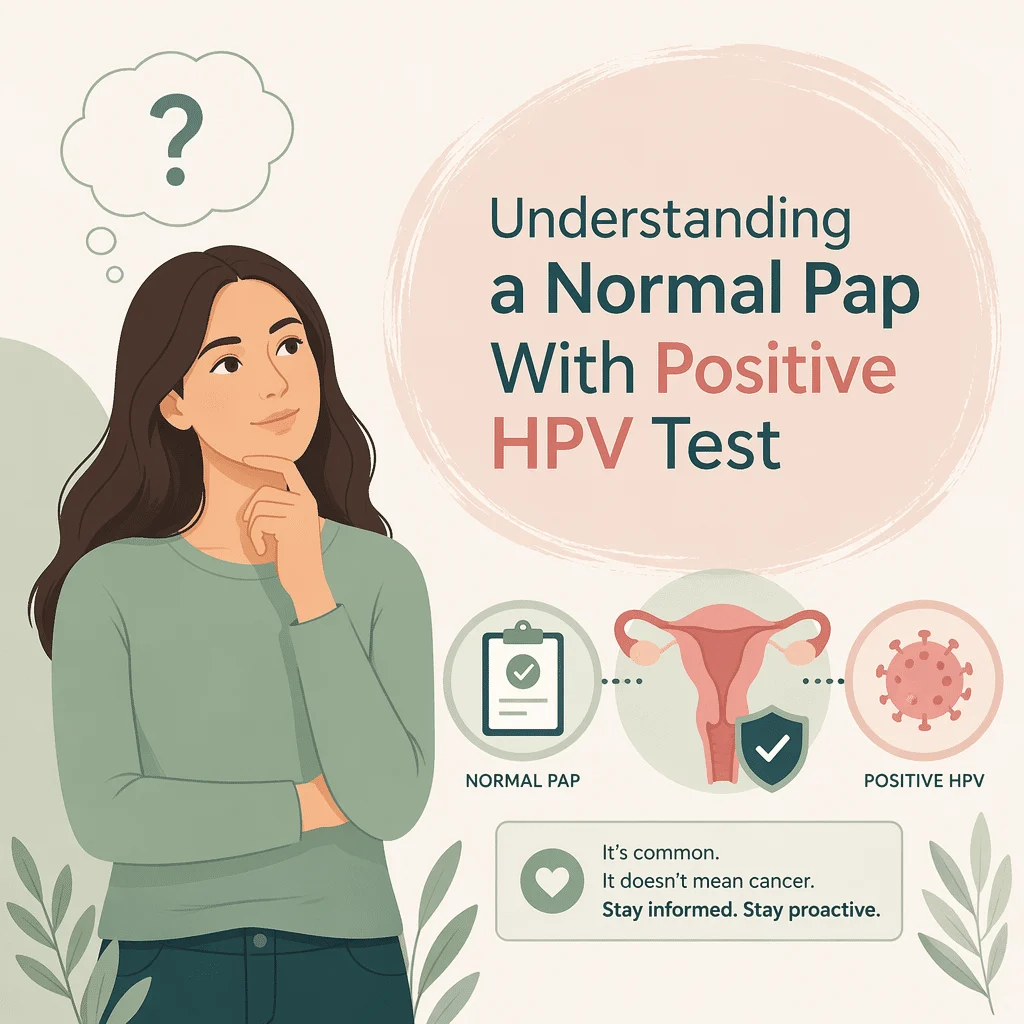
A normal Pap with a positive HPV test is one of the most confusing combinations in cervical screening, and it frightens far more people than it needs to. It means the laboratory found high-risk human papillomavirus in your sample, but the cells taken from your cervix still looked healthy under the microscope. The virus is present; visible cell damage is not. In this article you will learn what each of the two tests measures, why this pairing is so common, why the result says nothing about when or from whom you acquired the virus, how the HPV type on your report changes what happens next, and what follow-up usually involves. One message matters more than any other: keep the follow-up appointment your clinician recommends.
What a normal Pap with a positive HPV test actually means
Two different tests can be run on the same cervical sample, and they answer two different questions. When they disagree in this particular way, it is not a contradiction or a laboratory error. It is a snapshot of an early moment: the virus has arrived, and your cervical cells have not changed in response to it.
What the Pap test looks at
The Pap test, also called a Papanicolaou test or Pap smear, examines cervical cells under a microscope. A trained cytologist looks at the size, shape, and internal structure of those cells. A normal Pap is often reported as NILM, short for negative for intraepithelial lesion or malignancy. That phrase means one thing only: on the day your sample was taken, nobody could see abnormal cells. It is a report on appearance, not on infection. Our library also covers a detailed guide to cervical cancer prevention and treatment.
What the HPV test looks for
The HPV test does not examine cells at all. It searches for the genetic material of high-risk human papillomavirus types, the ones capable of driving cervical cell changes over many years. According to MedlinePlus, the test checks for infection with the types of HPV that can cause cancer of the cervix. It is far more sensitive than a microscope examination, because it detects the cause long before any effect becomes visible. Our team also covers the full picture of human papillomavirus infection.
Why co-testing produces this exact combination
When both tests are run on the same sample, the arrangement is called co-testing. Because the HPV test picks up the virus years before cells begin to change, a positive virus result alongside a clean cell result is exactly what you would expect in most people who currently carry high-risk HPV. It is by far the most common way the two tests disagree, which is why this combination has its own recognized follow-up pathway rather than being treated as an anomaly.
Your result combination at a glance
The table below summarizes how US screening guidelines generally describe the main co-testing combinations. Read it as a map, not as a prescription: your age, your previous results, and your medical history all feed into the plan your clinician makes with you.
| Your result combination | What it usually means | What typically comes next |
|---|---|---|
| HPV negative, Pap normal | No high-risk virus found and no cell changes seen | Routine screening at the usual interval |
| HPV positive for type 16 or 18, Pap normal | The two types linked to most HPV-related cancers are present, but cells still look normal | Colposcopy is more often recommended straight away |
| HPV positive for another high-risk type, Pap normal | Virus present, no visible effect on the cells | Repeat testing after an interval, commonly about a year |
| HPV positive, Pap abnormal | Virus present and early cell changes already visible | Colposcopy, usually with a biopsy |
| HPV negative, Pap abnormal | Cell changes without a high-risk virus, often from a benign cause | Follow-up depends on the type of change reported |
How common HPV is, and why most infections clear on their own
The Centers for Disease Control and Prevention describes HPV as the most common sexually transmitted infection, and states that in most cases, about nine out of ten, HPV goes away on its own within two years without causing health problems. The National Cancer Institute puts it in similar terms: the immune system usually controls HPV infections so that the body clears them within a year or two.
This is why a single positive test is treated as information rather than as a diagnosis. Most people who test positive today will test negative at their next screening, having cleared the virus without ever noticing anything. The concern is not infection itself. It is persistence, meaning an infection with a high-risk type that is still there year after year. The National Cancer Institute notes that research has found it can take 5 to 10 years for HPV-infected cervical cells to develop into precancers, and about 20 years to develop into cancer. That long runway is exactly what makes screening effective, and it is why one positive test is a reason to stay in the follow-up system rather than a reason to panic.
Why the HPV type on your report matters
There are more than a dozen high-risk HPV types, and they do not all carry the same weight. The National Cancer Institute states that two of them, HPV 16 and HPV 18, are responsible for most HPV-related cancers. Many US laboratories now report whether one of those two types is present, a practice called genotyping. Some laboratories report several additional types individually, which is known as extended genotyping.
The practical consequence is real. A positive result for HPV 16 or HPV 18 generally moves a person toward colposcopy sooner, even when the Pap is normal, because the risk attached to those types is higher. A positive result for one of the other high-risk types alongside a normal Pap more often leads to a repeat test after an interval. If your report simply says that high-risk HPV was detected without naming a type, it is entirely reasonable to ask your clinician whether genotyping was performed and what it showed.
What follow-up usually looks like after this result
Management in the United States is risk-based. The recommendation depends on how likely you are to have or to develop a precancer, taking your whole screening history into account, rather than on one test read in isolation. The National Cancer Institute describes the two main paths after a positive screening result as returning for a repeat HPV test or HPV/Pap co-test in one or three years, or having a colposcopy and biopsy. Which path applies to you is a conversation with your clinician, not something to settle from an article.
Repeat testing after an interval
For many people with a normal Pap and a high-risk type other than 16 or 18, the recommendation is simply to come back and be tested again. The logic is straightforward: if your immune system clears the virus in the meantime, the next test is negative and you return to routine screening. If the virus is still there, that persistence is itself the signal that warrants a closer look. The waiting period can feel passive, but it is doing real diagnostic work.
Referral for colposcopy
Colposcopy is recommended when the estimated risk crosses a certain threshold, which can happen because of the HPV type detected, because of previous abnormal results, or because of other factors your clinician weighs. Being referred is not a sign that something bad has been found. It is a sign that a closer look is the more informative next step.
What a colposcopy actually involves
Much of the anxiety around this appointment comes from not knowing what happens. The National Cancer Institute describes the procedure plainly: a speculum is inserted to gently open the vagina and see the cervix, a vinegar solution is applied to the cervix to help show abnormal areas, and a colposcope, an instrument with a bright light and a magnifying lens, is brought close to the vagina. The colposcope stays outside your body. The examination usually includes a biopsy, a small tissue sample, which many people describe as a brief pinch or a cramp. It is done in a clinic or office rather than an operating room. Light spotting afterward is common, and our team describes the causes of a friable cervix, one reason cervical tissue can bleed easily.
What a positive HPV test does not tell you
It does not tell you when you were infected
HPV can sit in the body at levels too low to detect and become detectable again later, which means a test tells you the virus is present now and nothing more. It cannot date the infection. For most people who have ever been sexually active, the possible window covers their entire adult life. A first positive result at age forty may reflect an exposure at twenty.
It is not evidence that a partner was unfaithful
This is the question people are most afraid to ask out loud, so here is the direct answer: a positive HPV test is not proof of recent exposure and is not evidence of infidelity. Long-term monogamous couples test positive. People whose last new partner was fifteen years ago test positive. Because the virus is so widespread and can go undetected for years, the result carries no information about timing, and therefore none about who transmitted it to whom. Partners also do not usually need to be tested, because there is no routine screening test for HPV in men.
It is worth knowing that HPV is not confined to the cervix either. Our library also explains the signs of HPV on the tongue, and our team explains the tests that actually screen for ovarian cancer, since a Pap test does not do that job.
What helps your body clear HPV, and what gets in the way
There is no pill, cream, or supplement proven to clear HPV. What does exist is a set of conditions that make clearance more or less likely, and two of them are worth knowing about.
Smoking is the best-documented obstacle. Tobacco smoke exposes cervical tissue to carcinogens and appears to blunt the local immune response, and stopping is one of the few concrete actions with a plausible effect on your own clearance. The second factor is a weakened immune system, whether from an untreated HIV infection, from an organ transplant, or from medication that deliberately dampens immunity. Our library explains the symptoms of autoimmune disease, which are often managed with such medication, and our team describes the causes of low lymphocyte counts, one of the ways reduced immune capacity shows up in a blood test.
Vaccination protects against types you have not met yet
The HPV vaccine is preventive, not curative. It does not clear an infection you already carry. It can still protect you against the high-risk types you have not yet encountered, which is why vaccination after a positive test is a legitimate conversation to have with your clinician rather than a closed door. Vaccination also does not replace screening: the vaccine does not cover every cancer-causing type, so people who have been vaccinated still follow the screening schedule for their age.
There is no treatment for the virus itself
The Centers for Disease Control and Prevention is explicit on this point: there is no treatment for the virus itself. Treatments exist for what HPV can cause, such as genital warts and cervical precancer. This is the key to understanding why follow-up looks the way it does. Nobody is waiting to treat the virus. They are watching for cell changes, because cell changes are the thing that can be treated, and treating them early is what prevents cervical cancer.
When to contact your clinician
Screening results describe your risk between appointments. They do not override symptoms. Contact your clinician promptly, whatever your last result was, if you notice any of the following:
- Bleeding between periods, or bleeding after menopause
- Bleeding or pain during or after sex
- Pelvic pain that is new, persistent, or unexplained
- Vaginal discharge that changes in amount, color, or smell
- Any symptom that worries you enough to look it up twice
Our library covers the common causes of vaginal burning, and our team also reviews the symptoms of a chlamydia rash, since other infections can produce overlapping complaints.
Latest scientific advances in HPV screening
Cervical screening has changed noticeably in the last three years. Here is what has actually moved, and what it means for someone holding a positive HPV result today.
Samples you collect yourself
A meta-analysis published in 2025 pooled sixteen studies comparing HPV testing on samples collected by patients themselves against samples collected by a clinician, and against the traditional Pap. HPV testing on a self-collected sample performed comparably to clinician-collected testing at finding the cell changes that matter, and did at least as well as clinician-collected cytology. What this means for you: if getting to an appointment is the barrier, self-collection is no longer a second-rate option. In 2026 the American Cancer Society updated its screening guideline to accept self-collected vaginal samples for average-risk people aged 25 to 65, while still preferring clinician-collected samples, and to recommend a shorter three-year interval after a negative self-collected result. Our newsroom covers the new at-home HPV self-collection tests.
Extended genotyping and dual-stain triage
A 2025 review written for cytopathology laboratories describes two tools now cleared by the US Food and Drug Administration for sorting out who among HPV-positive people needs a colposcopy. The first is extended genotyping, which names more individual high-risk types rather than lumping them together. The second is dual stain, a test that looks for two proteins, p16 and Ki-67, appearing together in the same cell. A separate 2025 review explains that this pairing signals a cell that has started down the abnormal path, and that dual stain finds precancers more reliably than cytology while sending fewer people to colposcopy unnecessarily. What this means for you: the goal of both tools is to give a normal Pap with a positive HPV test a more precise answer, so that people at genuinely low risk are reassured and can wait, and people at higher risk are seen sooner. These tools are still being rolled out, so availability depends on which laboratory processes your sample.
What vaccination is doing to screening populations
A 2025 systematic review of fifty-four studies on licensed HPV vaccines found a substantial fall in the prevalence of cancer-causing HPV types, in high-grade cervical lesions, and in cervical cancer itself in countries with high vaccination coverage and routine programs. What this means for you: as fewer people carry the highest-risk types, a positive result in a vaccinated population is statistically less likely to involve HPV 16 or 18. It does not change what you personally should do next, and it does not remove the need for screening, but it is a real reason for optimism about the direction of travel.
Glossary of key terms
| Term | Definition |
|---|---|
| Cervix | The lower, narrow end of the uterus that opens into the vagina. It is the part sampled during cervical screening. |
| Pap test | Short for Papanicolaou test, also called a Pap smear. Cervical cells are examined under a microscope for changes in their appearance. |
| HPV | Human papillomavirus, a very common family of viruses. Some types cause warts, some can cause cancer, and many cause nothing at all. |
| High-risk HPV | The subgroup of HPV types that can drive cervical cell changes over many years. These are the types a cervical HPV test looks for. |
| NILM | Negative for intraepithelial lesion or malignancy. The formal way a laboratory reports a normal Pap result. |
| Co-testing | Running a Pap test and an HPV test on the same sample at the same visit, so that cells and virus are both assessed. |
| Genotyping | Identifying which HPV type is present rather than reporting only that a high-risk type was found. |
| Persistent infection | An HPV infection that is still detectable at a later test instead of being cleared. Persistence, not infection, is what raises risk. |
| Colposcopy | An office examination in which the cervix is viewed through a lighted magnifying instrument after a vinegar solution is applied. |
| Dual stain | A laboratory test that looks for the proteins p16 and Ki-67 together in a cervical cell, used to sort out who needs a closer look. |
Frequently asked questions
Does a normal Pap with a positive HPV test mean I have cancer?
No. A positive HPV test is not a cancer diagnosis, and a normal Pap means no abnormal cells were seen in your sample. The result tells you that a high-risk virus is present, which is the situation most people who carry HPV are in. The National Cancer Institute notes that it can take 5 to 10 years for infected cervical cells to develop into precancers and about 20 years to develop into cancer, and screening exists to catch changes long before that. The action this result calls for is follow-up, not alarm.
Can a urinary tract infection or a yeast infection cause a false positive HPV test?
No. The HPV test looks specifically for the genetic material of high-risk HPV types, so bacteria that cause a urinary tract infection and the yeast that causes thrush do not produce a positive HPV result. What other conditions can occasionally do is affect sample quality, which leads to an unsatisfactory or unclear result and a request to repeat the test rather than to a false positive. If you had symptoms of another infection around the time of your sample, mention it to your clinician. Our team also reviews the symptoms and testing of a urinary tract infection.
Can you test negative for HPV after testing positive?
Yes, and it is the most likely outcome. The Centers for Disease Control and Prevention states that in about nine out of ten cases HPV goes away on its own within two years. A negative result at your next screening usually means your immune system has cleared the infection to an undetectable level. That is why repeat testing after an interval is such a common recommendation: it distinguishes a passing infection from a persistent one, which is the distinction that actually matters.
Does a positive HPV test mean my partner was unfaithful?
No. HPV can remain in the body undetected for years and become detectable again later, so a positive test says nothing about when the infection was acquired. A result today can reflect an exposure from decades ago, including one before your current relationship began. Long-term monogamous couples receive positive results regularly. There is no way to trace a positive HPV test back to a particular partner or a particular time, and it should not be treated as evidence of anything about your relationship.
Can I pass HPV to my partner?
Transmission is possible, but by the time a test comes back positive, a long-term partner has usually already been exposed. There is no routine HPV screening test for men, and no treatment for the virus itself, so testing a partner rarely changes what either of you does. Condoms lower the risk of transmission without eliminating it, since HPV can affect skin the condom does not cover. Vaccination remains worth discussing for partners in the recommended age groups.
Is the HPV vaccine still worth it after a positive test?
It can be, and it is a conversation worth having. The vaccine does not treat or clear an infection you already have, so it will not change your current result. What it can do is protect you against the other high-risk types you have not yet encountered. Whether it is recommended depends mainly on your age and your vaccination history, so ask your clinician rather than assuming the answer either way. Vaccination never replaces screening.
Sources
- National Cancer Institute — HPV and Pap Test Results: Next Steps after an Abnormal Cervical Cancer Screening Test — cancer.gov
- National Cancer Institute — HPV and Cancer — cancer.gov
- Centers for Disease Control and Prevention — About Genital HPV Infection — cdc.gov
- MedlinePlus, National Library of Medicine — Human Papillomavirus (HPV) Test — medlineplus.gov
- Phillips SA, Denoël S, Wentzensen N, Arbyn M — Accuracy of HPV Self-Collection Compared with Clinician-Collected HPV Testing and Cytology: A Meta-analysis — Cancer Epidemiology, Biomarkers and Prevention, 2025 — doi.org/10.1158/1055-9965.EPI-25-0362
- Perkins RB, Wolf AMD, Church TR, et al. — Self-collected vaginal specimens for human papillomavirus testing and guidance on screening exit: An update to the American Cancer Society cervical cancer screening guideline — CA: A Cancer Journal for Clinicians, 2026 — doi.org/10.3322/caac.70041
- Goulart RA, Nayar R, Lorey T, Joste N, Stoler MH — Extended HPV genotyping and dual stain for the triage of primary HPV screen-positive cases: Practical guidance for the cytopathology laboratory — Cancer Cytopathology, 2025 — doi.org/10.1002/cncy.70006
- Harper DM, Paczos T, Ridder R, Huh WK — p16/Ki-67 dual stain triage of individuals positive for HPV to detect cervical precancerous lesions — International Journal of Cancer, 2025 — doi.org/10.1002/ijc.35353
- Harper DM, Navarro-Alonso JA, Bosch FX, et al. — Impact of human papillomavirus vaccines in the reduction of infection, precursor lesions, and cervical cancer: A systematic literature review — Human Vaccines and Immunotherapeutics, 2025 — doi.org/10.1080/21645515.2025.2497608
Further reading
- Menopause symptoms, stages, and treatment
- PCOS symptoms, causes, and diagnostic tests
- Endometriosis: understanding, diagnosing, treating
- Tumor markers explained: what they measure and their limits
- How to read your blood test results
Understand your lab results with AI DiagMe
A screening report full of abbreviations like NILM and hrHPV is hard to read when you are anxious, and the words on the page rarely say what you actually want to know. AI DiagMe turns laboratory results into plain language, whether that is a cervical screening report, a complete blood count, an iron panel, or a hormone panel ordered alongside it. It is built to help you understand your own numbers and arrive at your appointment with better questions. It does not make a diagnosis and it does not replace your doctor.
Get your results interpreted in minutes