High TSH symptoms are, in almost every case, the symptoms of an underactive thyroid rather than symptoms of the hormone itself. TSH stands for thyroid-stimulating hormone, made by the pituitary gland at the base of the brain to tell the thyroid how much hormone to release. When the number climbs above the range printed on your report, it usually means the pituitary is pushing harder because the thyroid is not keeping up. In this article you will learn which complaints genuinely track with a raised result, why a single reading is not a diagnosis, what separates subclinical from overt hypothyroidism, which ordinary things push the number up without any thyroid disease, and which tests come next.
Why high TSH symptoms are really hypothyroid symptoms
The pituitary and the thyroid work like a thermostat and a radiator. The pituitary reads how much thyroid hormone is circulating and, if it senses too little, raises TSH to turn the thyroid up. A raised TSH is therefore not a symptom generator in its own right: it is a signal that the body is compensating for a thyroid running slow. The complaints people feel come from the shortage of thyroid hormone in the tissues, not from the TSH molecule.
That distinction explains something patients find confusing: two people with the same TSH can feel completely different. One whose output has only just begun to slip may feel nothing; another whose output has fallen further may feel a great deal at the same number.
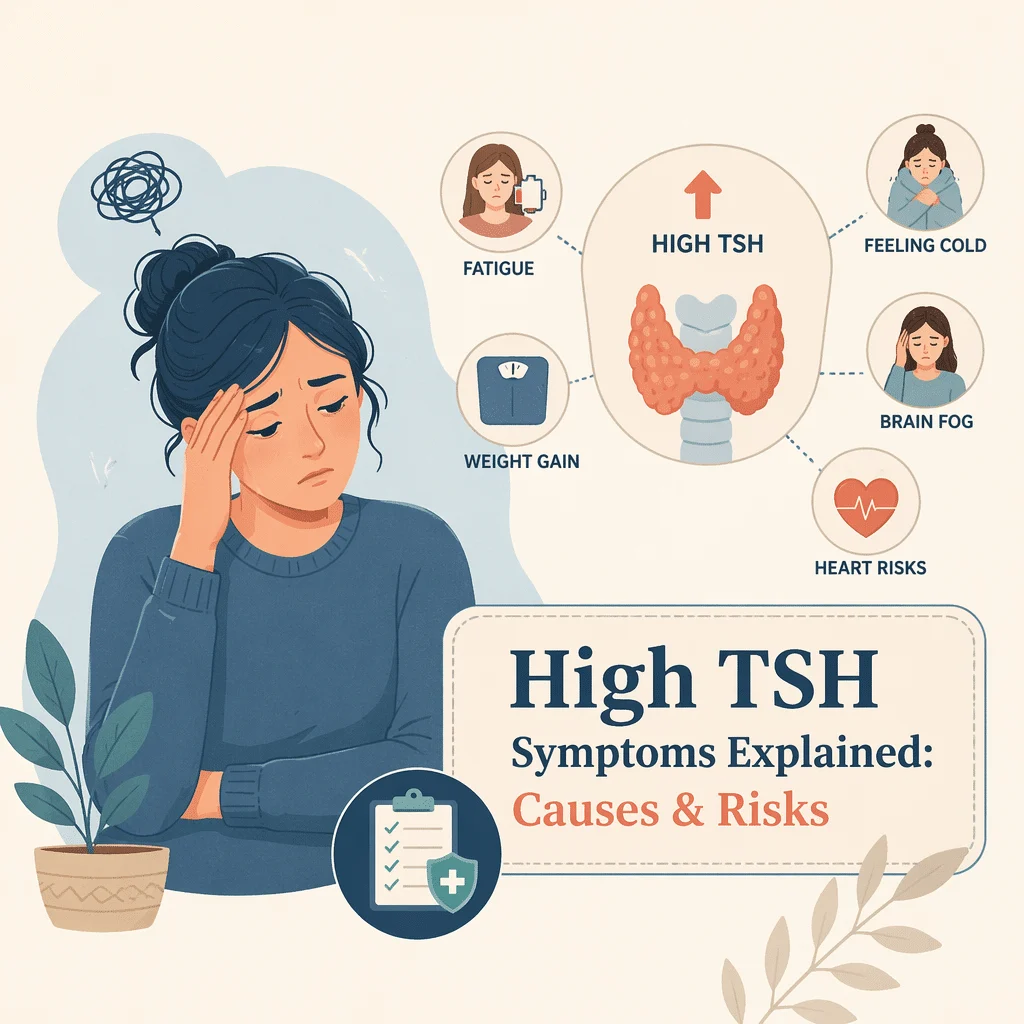
The complaints most often reported when thyroid hormone runs low include persistent tiredness that sleep does not fix, feeling cold when others do not, dry skin, thinning or brittle hair, constipation, muscle aches and weakness, puffiness around the eyes or face, heavier or irregular periods, low mood, and a foggy, slowed-down quality to thinking and memory. Our library describes an underactive thyroid gland in more detail.
Every one of those complaints is non-specific. Our library also covers the symptoms and causes of anemia and the symptoms and stages of menopause, both of which overlap heavily with an underactive thyroid. That is why symptoms alone cannot confirm a thyroid problem, and why a number alone cannot either.
Subclinical or overt: the distinction that changes the answer
Almost everyone who arrives at this page with a flagged TSH falls into one of two groups, and the practical answer is different for each.
Subclinical hypothyroidism: a high TSH with a normal free T4
Here the pituitary has raised its signal, but the thyroid is still keeping the active hormone within range. The Mayo Clinic describes this as TSH being elevated while thyroid hormone levels remain normal, and notes that it often causes no noticeable symptoms. Most people with a mildly flagged TSH sit in this band. It is a laboratory pattern more than an illness, and whether it needs treating is a genuine clinical judgment rather than an automatic yes.
Overt hypothyroidism: a high TSH with a low free T4
Here the compensation has failed and the active hormone has fallen below range. This is established hypothyroidism: symptoms are far more likely and treatment is much less controversial. The gap between these two pictures is the most useful thing to understand about a raised result, which is why free T4 is measured alongside TSH rather than after it.
| TSH result | Free T4 | What the pattern usually points to | Typical next step |
|---|---|---|---|
| Slightly above your lab’s range | Within range | Subclinical hypothyroidism, often with few or no symptoms | Repeat TSH with free T4 after several weeks; consider thyroid antibodies |
| Clearly above the range | Below range | Overt hypothyroidism | Confirmatory testing and a treatment discussion with your doctor |
| High on one test, normal on the repeat | Within range | A transient rise rather than thyroid disease | No treatment; your doctor decides whether to recheck later |
| High after recent illness, a new medicine or a biotin supplement | Variable | A result that may not reflect your true thyroid state | Retest once the interfering factor is gone |
| High during pregnancy | Within or below range | Assessed against pregnancy-specific targets, not the standard range | Prompt review by the clinician managing the pregnancy |
Why one high TSH result should always be repeated
A single raised TSH is a reason to look again, not a diagnosis. TSH is a restless measurement: it rises and falls through the day, shifts with illness, and varies between laboratory analyzers. Many mildly raised results simply return to normal on a repeat test, with nothing treated in between.
This is why clinicians confirm the pattern before acting, usually by rechecking TSH with free T4 after a few weeks rather than a few days. Treating on one reading risks starting a lifelong medicine for a number that was never going to stay up. Our team explains the normal thyroid hormone ranges, and the range printed on your own report is the one that applies, because analyzers differ.
Things that raise TSH without any thyroid disease
Before concluding that the thyroid is failing, it is worth ruling out the ordinary explanations that make the number look worse than the gland is.
Recovery from a non-thyroidal illness
Serious illness disturbs thyroid readings, and the disturbance does not end when the illness does. While recovering from a significant infection, hospital stay or surgery, TSH commonly rebounds above the normal range before settling. Testing in that window can label someone hypothyroid when the thyroid was never the problem, which is why thyroid testing is generally avoided during and shortly after acute illness unless there is a specific reason.
Biotin in hair, skin and nail supplements
This one deserves particular attention, because it causes genuine laboratory errors rather than borderline noise. Many thyroid assays use a biotin-streptavidin binding system, so high-dose biotin taken as a supplement competes with the test chemistry itself. The National Institutes of Health Office of Dietary Supplements states that very high intakes of biotin may interfere with diagnostic assays that use this technology to measure hormones such as thyroid hormone, and describes a small study in healthy adults taking 10 mg a day for a week in which several assays were affected, including falsely decreased TSH.
The direction of the error depends on how the assay is built, so biotin can make TSH look falsely low while distorting free T4 the other way, mimicking an overactive thyroid. A 2025 review in Deutsches Ärzteblatt International confirms that biotin interference in thyroid function tests remains a live problem in routine practice. The practical step is simple: tell the laboratory and your doctor about any biotin-containing supplement and ask how long to pause it before the draw. Hair and nail formulas are the usual culprits, at doses far above what food provides.
Time of day and which analyzer the laboratory uses
TSH follows a daily rhythm, peaking overnight and reaching its lowest point in the afternoon, so a very early morning draw can read higher than an afternoon draw from the same person on the same day. Analyzers from different manufacturers also disagree slightly, which makes comparing results across laboratories unreliable. Repeat testing is best done at a similar time of day and by the same laboratory.
Medicines
Several widely used drugs raise TSH: amiodarone and lithium are the classic examples, and some cancer immunotherapies now do the same. Iodine-containing contrast agents and high-dose iodine supplements can also disturb thyroid function. And if you already take thyroid medicine, a raised TSH may simply mean the dose is too low, or that iron, calcium or certain stomach acid drugs are blocking absorption.
Untreated adrenal insufficiency
This is uncommon but important. When the adrenal glands are not producing enough cortisol, TSH can be mildly elevated, and it often falls once the adrenal problem is treated. Starting thyroid hormone first in untreated adrenal insufficiency can make someone acutely unwell, so this is checked when the picture suggests it. Our team explains the adrenal hormone panel.
Age and pregnancy move the goalposts
Older adults naturally run higher
TSH drifts upward with age in people whose thyroids are perfectly healthy. MedlinePlus states plainly that the level may be higher in people over age 80 even though they have no thyroid problem. Because most laboratories apply one adult range across every age group, a result that is genuinely normal for an eighty-year-old can be flagged abnormal. Age is part of interpreting the number, not a detail to set aside.
Pregnancy uses different thresholds entirely
Pregnancy changes thyroid physiology from the first weeks, and the targets used are lower and stage-specific rather than the standard adult range. The stakes are higher too, because thyroid hormone matters for fetal development. Anyone pregnant or trying to conceive should have an abnormal thyroid result reviewed promptly by the clinician managing the pregnancy, not measured against a general range.
The lab work that usually follows a high TSH
A raised TSH is the beginning of an assessment, not the end of one. The tests that typically follow are few and purposeful.
- A repeat TSH, measured with free T4, after several weeks. This confirms whether the rise is real and sorts subclinical from overt. Our guide covers the free T4 thyroid test.
- Thyroid peroxidase antibodies, usually called TPO antibodies. Their presence points to autoimmune thyroid disease, the most common cause of an underactive thyroid, and makes progression more likely. We also detail the autoimmune antibody panel.
- Free T3 in selected cases. It is not part of the routine first-line workup, and our team explains the free T3 thyroid marker.
- A lipid panel, because an underactive thyroid can raise cholesterol, and the picture may improve when thyroid function is corrected. We cover the lipid panel and cholesterol markers.
- A complete blood count, which helps separate thyroid-related tiredness from anemia, a condition that often accompanies an underactive thyroid. This article explains a complete blood count report.
If you are unsure how to read the figures on your own report, our guide explains how to read your blood test results.
When to see a doctor promptly
Most raised TSH results are not urgent; a small number are. Seek medical advice without delay if you notice any of the following.
- Severe and worsening tiredness with confusion, unusual drowsiness or slowed speech.
- A markedly slow heart rate, feeling persistently cold with a low body temperature, or noticeable swelling of the face, hands or legs.
- A neck lump that is growing, new hoarseness, or difficulty swallowing or breathing.
- Any abnormal thyroid result while pregnant or while trying to conceive.
- Chest pain, breathlessness or a new irregular heartbeat after starting or increasing thyroid medicine.
Latest scientific advances
Research over the last three years has shifted the conversation around mildly raised results, mostly by asking who actually benefits from treatment. Here is what it suggests, in plain terms.
Age-specific ranges reduce overdiagnosis. A 2023 multicenter study in the journal Thyroid recalculated reference ranges by age and sex across more than twenty thousand people having routine health checks. With those tailored ranges, roughly six in ten women labeled as having subclinical hypothyroidism by the standard manufacturer range turned out to be normal for their age and sex, the effect concentrated in those aged sixty and over. What this means for you: if you are older and your TSH is only slightly above the printed range, it is reasonable to ask whether an age-appropriate range changes the interpretation.
A 2025 review in Endocrine Connections reached a similar conclusion for older adults, reporting that TSH levels and the upper limits of the reference interval both tend to rise with age, and that a higher threshold for diagnosing and treating mild cases in older people appears reasonable.
Treating mild cases in older adults has not shown a clear payoff. A 2024 systematic review and meta-analysis in the journal Systematic Reviews, which combines the results of many earlier studies, compared people over sixty-five with subclinical hypothyroidism who were given levothyroxine against those left untreated, and found no meaningful difference in heart outcomes. What this means for you: for an older adult with a mildly raised TSH and few symptoms, careful monitoring rather than immediate medication is a legitimate option, not neglect.
Pregnancy findings are more nuanced. A 2024 systematic review and meta-analysis in Thyroid pooled randomized trials of levothyroxine for subclinical hypothyroidism. Treatment started before conception did not improve fertility or reduce miscarriage, and during pregnancy a benefit on preterm birth appeared only where TSH was above 4.0 mU/L, not between 2.5 and 4.0 mU/L. What this means for you: pregnancy is exactly the situation to be guided by your clinician rather than a general threshold, because where your number sits changes the answer.
Stopping treatment is being studied. A small pilot trial published in Endocrine in 2025 withdrew levothyroxine from adults already taking a low dose for subclinical hypothyroidism, comparing it against a dummy tablet over six months. Stopping proved feasible and well tolerated, with no clear difference in symptoms or tiredness. This was a preliminary study designed to show a larger trial is possible, so it is not yet a reason to change anything. What this means for you: if you were started on thyroid medicine years ago for a borderline number, it is fair to ask your doctor whether it is still needed, but never stop on your own.
Glossary of key terms
| Term | Definition |
|---|---|
| TSH (thyroid-stimulating hormone) | The hormone the pituitary releases to tell the thyroid how much hormone to make. A high value usually means the pituitary is pushing a thyroid that is underperforming. |
| Free T4 (free thyroxine) | The main thyroid hormone circulating in its unbound, usable form. It shows whether the thyroid is keeping up. |
| Free T3 (free triiodothyronine) | The more active thyroid hormone, mostly converted from T4 inside the tissues. Not part of the routine first-line workup. |
| Subclinical hypothyroidism | A raised TSH with a free T4 still inside the reference range. Symptoms are often mild or absent. |
| Overt hypothyroidism | A raised TSH with a free T4 below the reference range. This is established underactive thyroid disease. |
| TPO antibodies | Thyroid peroxidase antibodies. Their presence indicates that the immune system is targeting the thyroid, the usual cause of an underactive gland. |
| Levothyroxine | A synthetic form of thyroxine taken as a daily tablet to replace hormone the thyroid is not producing. |
| Reference range | The band of values a laboratory considers normal for its own analyzer. Ranges differ, so the one on your report is the one that applies. |
| Non-thyroidal illness | Changes in thyroid blood tests caused by an unrelated illness rather than thyroid disease. TSH often rebounds above range during recovery. |
Frequently asked questions
What is considered a dangerously high TSH level?
There is no single number that makes a result dangerous, and treating one figure as a danger line is misleading. What matters far more is whether free T4 has fallen, how quickly the change happened, and how you feel. A very high TSH with a clearly low free T4 in someone who is drowsy, confused, cold or swollen is the picture that needs urgent attention, and that combination is rare. A high TSH with a normal free T4 and no symptoms is common and is not an emergency. Bring the actual report to your doctor rather than comparing your number against figures found online, because ranges differ between laboratories.
Can a high TSH cause weight gain?
An underactive thyroid can cause modest weight gain, but the amount is usually smaller than people expect, and much of it is retained fluid rather than fat. Weight that has climbed substantially is rarely explained by thyroid function alone. Correcting an underactive thyroid tends to reverse the fluid component and restore energy, which can indirectly help, but thyroid medicine is not a weight-loss treatment and should never be taken or increased for that purpose. Taking more than your body needs carries real risks to the heart and bones.
Does a high TSH always mean I need medication?
No. For established hypothyroidism, where free T4 has fallen, replacement is standard. For a mildly raised TSH with a normal free T4, the decision is individual. The Mayo Clinic notes that for a mild rise in TSH thyroid hormone medicine may not be useful, while a higher level that is still in the subclinical range may improve some symptoms. Your age, your symptoms, whether TPO antibodies are present, and whether you are pregnant or planning to be all feed into that discussion.
How long does it take for symptoms to improve after starting treatment?
Blood levels shift within a few weeks, but how you feel usually lags behind. Most people notice a gradual change over roughly six to eight weeks, and TSH is normally rechecked around that point because it takes that long to reflect a new dose. Full benefit can take several months, and dose adjustments are common early on. If nothing has improved once your TSH has been in range for a few months, that is a signal to look again at other explanations for the symptoms rather than to keep raising the dose.
Do I need to fast, or change the timing of my blood draw?
Fasting is not required for a TSH test. Timing does matter a little, because TSH is highest overnight and lowest in the afternoon, so try to have repeat tests taken at a similar time of day and at the same laboratory. If you already take levothyroxine, the usual advice is to have blood drawn before that morning’s dose. Mention any biotin-containing supplement, and ask whether to pause it beforehand.
Can diet or lifestyle changes bring a high TSH down on their own?
If the thyroid is genuinely underactive, diet will not restore it, and no food or supplement replaces thyroid hormone. Where lifestyle does help is around the edges: adequate but not excessive iodine, treating a documented deficiency such as low iron or vitamin B12, sleeping properly, and separating thyroid medicine from iron and calcium supplements so it is absorbed. Be cautious with kelp and high-dose iodine products, which can worsen thyroid function rather than help it.
Sources
- MedlinePlus, National Library of Medicine — TSH (Thyroid-stimulating hormone) Test — medlineplus.gov
- National Institute of Diabetes and Digestive and Kidney Diseases — Hypothyroidism (Underactive Thyroid) — niddk.nih.gov
- Mayo Clinic — Hypothyroidism (underactive thyroid): Diagnosis and treatment — mayoclinic.org
- U.S. Preventive Services Task Force — Thyroid Dysfunction: Screening — uspreventiveservicestaskforce.org
- National Institutes of Health, Office of Dietary Supplements — Biotin: Health Professional Fact Sheet — ods.od.nih.gov
- Yamada S, et al. — The Impact of Age- and Sex-Specific Reference Ranges for Serum Thyrotropin and Free Thyroxine on the Diagnosis of Subclinical Thyroid Dysfunction: A Multicenter Study from Japan — Thyroid, 2023 — PubMed
- Zhai X, et al. — Thyrotropin reference interval in older adults — Endocrine Connections, 2025 — PubMed
- Holley M, et al. — Cardiovascular and bone health outcomes in older people with subclinical hypothyroidism treated with levothyroxine: a systematic review and meta-analysis — Systematic Reviews, 2024 — PubMed
- Sankoda A, et al. — Effects of Levothyroxine Treatment on Fertility and Pregnancy Outcomes in Subclinical Hypothyroidism: A Systematic Review and Meta-Analysis of Randomized Controlled Trials — Thyroid, 2024 — PubMed
- Rußwurm M, et al. — Biotin Interference in Thyroid Function Tests — Deutsches Ärzteblatt International, 2025 — PubMed
- Maraka S, et al. — Discontinuation of levothyroxine therapy in patients with subclinical hypothyroidism: a pilot randomized clinical trial — Endocrine, 2025 — PubMed
Further reading
- Hair Loss Blood Test: What the GLP-1 Headlines Reveal
- Low Ferritin: Causes, Symptoms, and Treatment
- Depression: Symptoms, Causes, and Treatments
- Comprehensive Metabolic Panel (CMP): How to Read Your Results
- How Long Do Blood Test Results Take
Understand your lab results with AI DiagMe
A raised TSH rarely tells its whole story alone. It makes sense next to free T4, thyroid antibodies, your cholesterol figures and a blood count, and next to the range your own laboratory prints. AI DiagMe reads those results together and explains, in plain language, what each value means and which ones deserve a conversation with your doctor. It helps you understand your report, it does not diagnose, and it does not replace your physician.
Get your results interpreted in minutes