









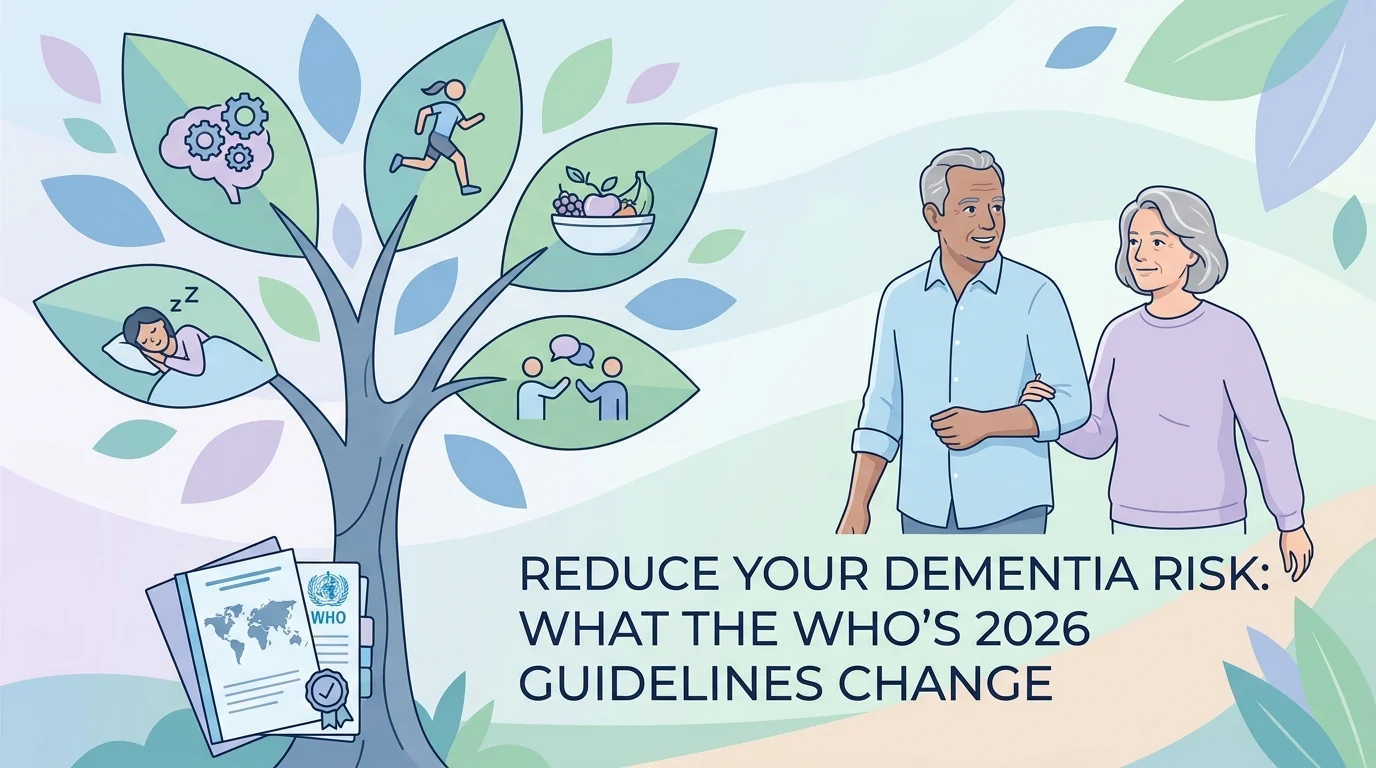
El 15 de julio de 2026, la Organización Mundial de la Salud publicó la segunda edición de sus directrices para reducir el riesgo de deterioro cognitivo y demencia, y el titular es alentador: puedes reducir tu riesgo de demencia, porque hasta el 45 % de los casos en todo el mundo podrían retrasarse o prevenirse. Gran parte de ese potencial reside en factores de salud cotidianos que puedes ver directamente en una analítica: tu colesterol, tu glucosa en sangre y tu tensión arterial. En este artículo descubrirás qué han cambiado las nuevas directrices de la OMS, qué análisis de sangre controlan los factores de riesgo sobre los que puedes actuar y por qué las directrices recomiendan hacerse pruebas antes de recurrir a suplementos.
Qué dicen realmente las nuevas directrices de la OMS sobre la demencia
La segunda edición actualiza las recomendaciones que la OMS publicó por primera vez en 2019 e incorpora años de nueva evidencia. Mantiene la idea central de que la demencia no es simplemente una cuestión de edad o de genética, y subraya que controlar las enfermedades comunes a lo largo de toda la vida puede reducir el riesgo. Por primera vez, incluye factores medioambientales —entre ellos, reducir la exposición a la contaminación del aire— y apuesta por planes de prevención personalizados y multifactoriales en lugar de soluciones únicas. El dato tan citado del «hasta el 45 %» significa que casi la mitad de los casos de demencia están relacionados con factores que, en principio, pueden modificarse. Si el tema te resulta nuevo, conviene que primero conozcas los distintos tipos de demencia.
Los factores de riesgo de demencia que puedes detectar con una analítica
Varios de los factores de riesgo que destaca la OMS son aspectos que una analítica de rutina o una simple medición de la tensión arterial pueden revelar mucho antes de que aparezca cualquier problema de memoria. Mantenerlos en un rango saludable protege el corazón y, según una evidencia científica cada vez mayor, también el cerebro. La tabla siguiente muestra los principales y cómo se comprueban.
| Factor de riesgo | Cómo se comprueba | Por qué importa para tu cerebro |
|---|---|---|
| Hipertensión | Una medición de la tensión arterial (los dos valores) | La tensión arterial elevada en la mediana edad es uno de los factores de riesgo modificables más importantes |
| Glucemia alta o diabetes | Glucosa en ayunas y HbA1c | Una glucemia elevada de forma prolongada se asocia a un mayor riesgo de demencia |
| Colesterol LDL elevado | Un perfil lipídico (LDL, HDL, triglicéridos) | El LDL en la mediana edad se asocia moderadamente con la demencia muchos años después |
| Vitamina B12 o vitamina D bajas | Un panel vitamínico y nutricional | Corregir una deficiencia real favorece la salud nerviosa y cerebral |
| Inflamación crónica | Marcadores como la PCR | La inflamación crónica puede contribuir al deterioro cognitivo |
Son análisis habituales que quizá ya tengas en tu historial. Para profundizar en los valores, consulta nuestra guía del perfil lipídico, comprueba tu ratio de colesterol, entiende tus niveles de glucosa, revisa nuestra tabla de conversión de HbA1c y lee nuestra guía sobre la tensión arterial alta. Si la glucemia es tu principal preocupación, también puedes consultar nuestra guía sobre la diabetes.
Suplementos: por qué la OMS recomienda hacerse primero una analítica
Uno de los mensajes más claros de las nuevas directrices es lo que no hay que hacer. La OMS no recomienda tomar suplementos de vitamina B, vitamina E, multivitamínicos ni omega-3 solo para prevenir la demencia, a menos que un análisis de sangre demuestre que realmente tienes una carencia. En pocas palabras, un suplemento solo ayuda si de verdad tienes niveles bajos; de lo contrario, solo supone un gasto, no una protección. Por eso tiene sentido comprobar tus niveles primero: un simple análisis de sangre puede revelar si tu vitamina B12 o tu vitamina D están bajas antes de que compres pastillas que quizás no sirvan para nada. Para saber qué incluye una revisión nutricional, consulta nuestro panel de vitaminas y nutrientes, conoce los signos de niveles bajos de vitamina B12 e interpreta tu análisis de vitamina D en sangre.
Lo que añade la investigación más reciente
Las directrices de la OMS se apoyan en un amplio conjunto de estudios recientes. Algunos hallazgos ayudan a entender por qué los valores analíticos mencionados importan, aunque conviene recordar que la mayor parte de esta evidencia muestra asociaciones, no relaciones de causa y efecto probadas.
Una revisión de 2024 publicada en The Lancet Healthy Longevity analizó decenas de estudios y concluyó que un puñado de factores comunes —entre ellos la hipertensión arterial, la pérdida de audición, el sedentarismo y la obesidad— explican una gran parte de los casos de demencia; en conjunto, un grupo de factores de riesgo cotidianos se asoció con aproximadamente la mitad de los casos. Lo que esto significa para ti: ningún cambio por sí solo es una solución mágica, pero combinar varios hábitos saludables sí marca una diferencia real.
Un análisis de 2025 sobre registros hospitalarios encontró que las personas con LDL (el colesterol «malo») bajo —por debajo de 70 mg/dL— tenían alrededor de un 25 % menos de casos de demencia que quienes tenían el LDL alto, por encima de 130 mg/dL, con un pequeño beneficio adicional en las personas que tomaban estatinas. Lo que esto significa para ti: el valor de LDL que ya aparece en un análisis de lípidos estándar puede ser importante tanto para tu cerebro como para tu corazón. Esto no es motivo para cambiar ningún medicamento por tu cuenta —eso es algo que debes hablar con tu médico.
Una revisión independiente de 2024 mostró que el ictus, la demencia y la depresión en la vejez comparten los mismos factores de riesgo modificables: tensión arterial, glucemia, colesterol y salud renal, entre otros. Lo que esto significa para ti: una rutina saludable para el corazón, controlada con unos pocos análisis de sangre habituales, reporta beneficios en varios frentes a la vez. Para los lectores interesados en herramientas diagnósticas más recientes, también explicamos el análisis de sangre p-tau217.
Cuándo consultar a un médico
La prevención funciona mejor cuando conoces tu punto de partida. Vale la pena pedir una revisión si nunca te han medido la tensión arterial, el azúcar en sangre o el colesterol siendo adulto, si hay antecedentes de demencia en tu familia y quieres tener una referencia inicial, o si tú o quienes te rodean notáis cambios en la memoria. Un médico puede pedir las pruebas adecuadas y, algo igual de importante, interpretarlas en contexto. Una advertencia de la OMS y de los expertos de la Conferencia Internacional de la Asociación de Alzheimer de 2026: las pruebas de biomarcadores en sangre para el alzhéimer no están pensadas para el cribado de la población general y no sustituyen a una evaluación médica completa.
Glosario
| Término | Definición |
|---|---|
| Demencia | Término general para referirse al deterioro duradero de la memoria y el pensamiento que interfiere con la vida cotidiana. |
| Factor de riesgo modificable | Un factor de riesgo que puedes cambiar, como la tensión arterial, a diferencia de la edad o los genes. |
| colesterol LDL | El colesterol “malo”; unos niveles elevados pueden acumularse en el interior de los vasos sanguíneos. |
| HbA1c | Un análisis de sangre que muestra tu nivel medio de azúcar en sangre durante aproximadamente tres meses. |
| Perfil lipídico | Un análisis de sangre que mide el colesterol y los triglicéridos. |
| Homocisteína | Un aminoácido presente en la sangre; unos niveles elevados se han relacionado con problemas vasculares y cerebrales. |
| Deterioro cognitivo | Un empeoramiento gradual de la memoria, la atención o la velocidad de pensamiento. |
| Fracción atribuible poblacional | La proporción de casos en una población que podrían evitarse si se eliminara un factor de riesgo. |
Preguntas frecuentes
¿Puedes reducir de verdad el riesgo de demencia?
No puedes garantizar que nunca vayas a desarrollar demencia, pero la OMS estima que hasta el 45 % de los casos en todo el mundo están relacionados con factores que puedes influir. Hábitos como mantenerse activo, proteger la audición, no fumar y controlar la tensión arterial, el azúcar en sangre y el colesterol son buenos para el corazón y también pueden beneficiar al cerebro.
¿Qué análisis de sangre importan para el riesgo de demencia?
Los análisis más útiles en el día a día son un perfil lipídico para el colesterol, una glucosa en ayunas y la HbA1c para el azúcar en sangre, y una medición de la tensión arterial. Se puede añadir un panel de vitaminas y nutrientes si tienes síntomas o tu médico sospecha alguna carencia. Estas pruebas no diagnostican la demencia; sirven para controlar los factores de riesgo sobre los que puedes actuar.
¿El colesterol alto aumenta el riesgo de demencia?
Algunos estudios sugieren que un colesterol LDL elevado en la mediana edad se asocia de forma moderada con un mayor riesgo de demencia años después, y que un LDL más bajo se relaciona con menos casos. La evidencia muestra una asociación más que una prueba definitiva, pero controlar el colesterol ya se recomienda por su beneficio para la salud cardiovascular.
¿Debo tomar suplementos para prevenir la demencia?
La OMS desaconseja tomar suplementos de vitamina B, vitamina E, multivitamínicos u omega-3 únicamente para prevenir la demencia, salvo que un análisis muestre una deficiencia. Lo más sensato es comprobar primero tus niveles y suplementarte solo si realmente tienes un déficit.
¿La diabetes causa demencia?
La diabetes y los niveles elevados de azúcar en sangre mantenidos a lo largo del tiempo son factores de riesgo reconocidos de deterioro cognitivo y demencia. Mantener el azúcar en sangre en un rango saludable mediante la alimentación, la actividad física y, cuando sea necesario, la medicación puede ayudar a reducir ese riesgo, aunque no es una garantía.
¿A qué edad debería empezar?
La OMS recomienda un enfoque a lo largo de toda la vida. La mediana edad —los 40 y los 50— es una etapa especialmente importante para controlar la tensión arterial, el colesterol y el azúcar en sangre, pero rara vez es demasiado pronto o demasiado tarde para adoptar cambios que favorezcan la salud cerebral.
Fuentes
- Organización Mundial de la Salud. Reducción del riesgo de deterioro cognitivo y demencia: directrices de la OMS, segunda edición, 2026. who.int
- Instituto Nacional sobre el Envejecimiento (NIH). Prevención de la enfermedad de Alzheimer: ¿qué sabemos? nia.nih.gov
- Alzheimers.gov (NIA/NIH). ¿Puedo prevenir la demencia? alzheimers.gov
- Stephan BCM, et al. Fracciones atribuibles poblacionales de factores de riesgo modificables para la demencia: revisión sistemática y metaanálisis. The Lancet Healthy Longevity, 2024. doi.org
- Factores de riesgo modificables para el ictus, la demencia y la depresión en la vejez: revisión sistemática y análisis ponderado por AVAD. Journal of Neurology, Neurosurgery & Psychiatry, 2024. doi.org
- Lee M, et al. Niveles de colesterol LDL y riesgo de demencia incidente. Journal of Neurology, Neurosurgery & Psychiatry, 2025. consensus.app
Lecturas adicionales
- Colesterol alto: comprender, prevenir y actuar
- El panel lipídico avanzado
- El análisis de sangre para el Alzheimer en atención primaria
- Entender el colesterol HDL bajo
- ¿Realmente necesitas una analítica completa?
Comprenda los resultados de su laboratorio con AI DiagMe.
Tu tensión arterial, el azúcar en sangre y el colesterol se encuentran entre los pocos factores de riesgo de demencia que puedes medir y sobre los que puedes actuar, pero una página llena de números es difícil de leer por tu cuenta. AI DiagMe convierte un perfil lipídico, una HbA1c o un panel de vitaminas en explicaciones claras y en lenguaje sencillo, para que puedas ver en qué punto estás y qué comentar con tu médico. Te ayuda a entender tus resultados; no diagnostica demencia ni sustituye el consejo médico.
Obtén la interpretación de tus resultados en minutos.