




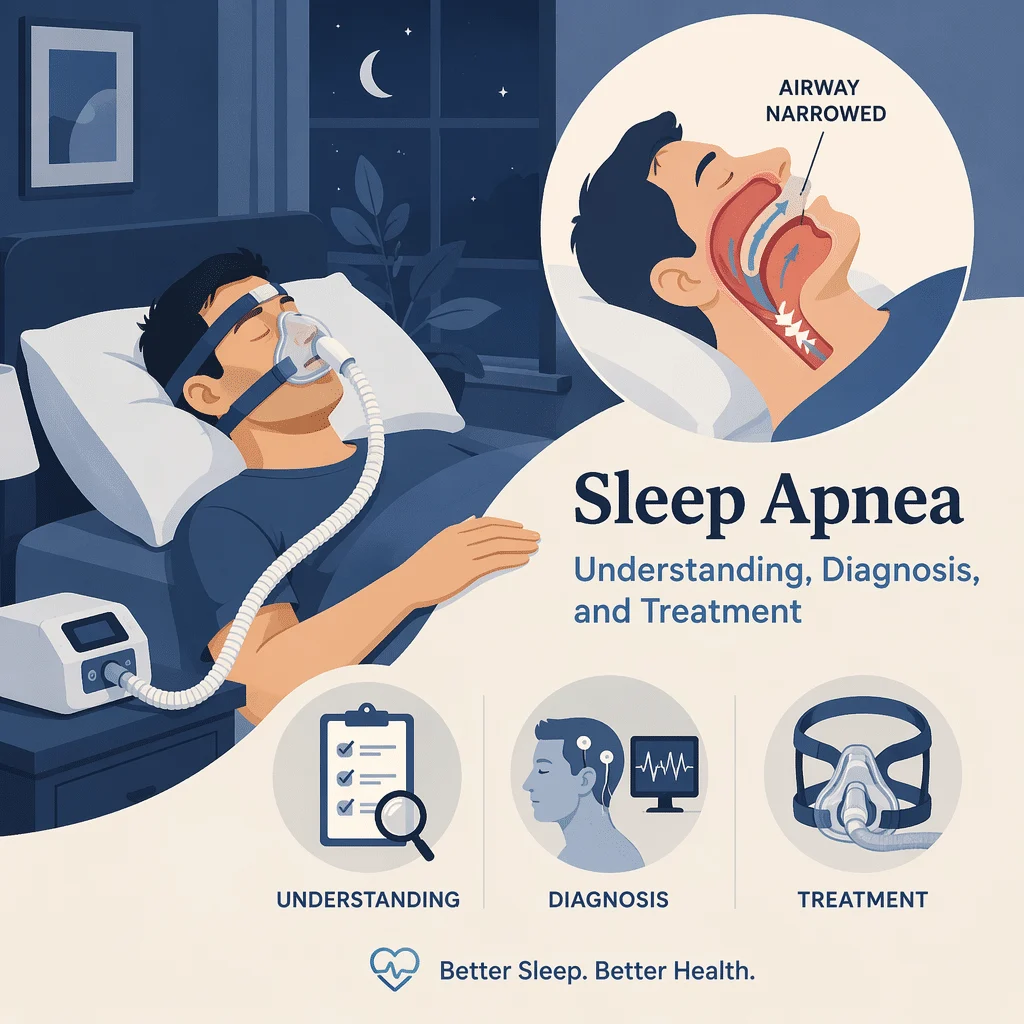
Sleep apnea is a common but often undiagnosed condition in which your breathing repeatedly stops and starts whilst you sleep. Each pause can last several seconds, briefly lowering the oxygen in your blood and pulling you out of deep, restorative sleep — sometimes dozens or hundreds of times a night without you ever waking fully. Left untreated, it is linked to daytime exhaustion, high blood pressure, heart disease, and type 2 diabetes. The reassuring part is that it is very treatable once it is recognised. In this article you’ll learn what sleep apnea is, how to spot the warning signs, how doctors diagnose it with sleep studies, and which treatments — from CPAP to a newly approved medication — actually help. You’ll also see which lab tests are worth checking, because the condition rarely travels alone.
What is sleep apnea?
Sleep apnea is a sleep-related breathing disorder marked by repeated interruptions in breathing during the night. An “apnea” is a pause of at least ten seconds; a “hypopnea” is a partial reduction in airflow. Both briefly starve the body of oxygen and force the brain to nudge you towards wakefulness to restart normal breathing. Because these events are so brief, most people have no memory of them — which is exactly why the condition so often goes unnoticed for years.
Obstructive versus central sleep apnea
There are two main types. Obstructive sleep apnea (OSA) is by far the most common. It happens when the soft tissues at the back of the throat relax and collapse during sleep, physically blocking the airway even though the body keeps trying to breathe. Central sleep apnea is less common and works differently: the airway stays open, but the brain temporarily fails to send the signal to breathe. Some people have a mix of both, sometimes called complex sleep apnea. This guide focuses mainly on obstructive sleep apnea, the form most closely tied to snoring, excess weight, and daytime fatigue.
Why the pauses matter
A single pause is harmless. The problem is repetition. When breathing stalls many times an hour, night after night, oxygen levels dip and rebound over and over, the nervous system stays on alert, and blood pressure and heart rate swing repeatedly. Over months and years this pattern places real strain on the heart and blood vessels and disrupts the body’s metabolism, which is why it is considered more than just a nuisance snore.
Sleep apnea symptoms and warning signs
The symptoms of sleep apnoea show up both at night and during the day. Often it is a bed partner who first notices the nighttime signs, while the person affected mainly feels the daytime consequences.
Nighttime signs
- Loud, chronic snoring, often interrupted by silent pauses
- Choking, gasping, or snorting that ends a pause in breathing
- Witnessed episodes of stopped breathing
- Frequent awakenings or restless, fragmented sleep
- Waking to urinate several times a night
- Night sweats and a dry mouth on waking
Daytime signs
- Excessive daytime sleepiness, even after a full night in bed
- Morning headaches
- Trouble concentrating, memory lapses, or brain fog
- Irritability, low mood, or reduced motivation
- Falling asleep at inappropriate times, such as at a desk or at the wheel
Not everyone snores, and not everyone with the condition feels sleepy, so the absence of one symptom does not rule the condition out. If several of these signs sound familiar — especially loud snoring plus daytime fatigue — it is worth raising with a clinician. Seek prompt medical advice if you notice witnessed breathing pauses, wake gasping for air, or feel dangerously drowsy whilst driving.
What causes sleep apnoea, and who is at risk?
Obstructive sleep apnoea develops when the upper airway is prone to collapsing during sleep. Several factors raise that risk, and many people have more than one.
Physical and anatomical factors
- Excess weight and a larger neck circumference, which add soft tissue around the airway
- A naturally narrow throat, large tonsils or adenoids, or a small or set-back jaw
- Nasal congestion or a deviated septum
- Being male, and being older, although risk in women rises after the menopause
- A family history of sleep apnoea
Lifestyle and health-related factors
Alcohol and sedatives relax the throat muscles and worsen airway collapse, especially in the evening. Smoking inflames and narrows the airway. Certain medical conditions also raise the risk or mimic the picture — including an underactive thyroid and heart failure. An underactive thyroid, for example, can cause weight gain, tissue swelling, and fatigue that overlap with, and can aggravate, the disorder. That overlap is one reason doctors sometimes look beyond the sleep study itself; you can read our article on hypothyroidism to see how it is tested and treated.
How is sleep apnea diagnosed?
Sleep apnoea is diagnosed with a sleep study, not with a symptom checklist alone. The process usually starts with a clinical assessment — your history, your symptoms, and often a short questionnaire — followed by an objective overnight test that counts your breathing events.
In-lab polysomnography
Polysomnography (PSG) is the comprehensive, in-laboratory sleep study and remains the reference standard. You spend a night in a sleep centre whilst sensors record brain waves, eye movements, airflow, breathing effort, blood oxygen, heart rhythm, and leg movements. Because it captures so much, PSG can distinguish obstructive from central events and detect other sleep disorders at the same time.
Home sleep apnoea testing
A home sleep apnoea test (HSAT) lets suitable adults be tested in their own bed with a smaller device that mainly records airflow, breathing effort, and oxygen. It is more convenient and less expensive, and for otherwise-healthy adults with a high likelihood of moderate-to-severe obstructive sleep apnoea it is a validated first step. Its main limitation is that it can underestimate the severity of the problem, so a normal home test in someone with ongoing symptoms is often followed by a full in-lab study.
| Feature | In-lab polysomnography | Home sleep apnoea test |
|---|---|---|
| Where it happens | Overnight in a sleep lab, supervised | In your own bed, unsupervised |
| What it records | Brain waves, breathing, oxygen, heart rate, leg movements, sleep stages | Mainly airflow, breathing effort, and oxygen |
| Best suited to | Complex cases, suspected central apnoea, or a normal home test with lasting symptoms | Otherwise-healthy adults likely to have moderate-to-severe OSA |
| Main trade-off | Most complete picture, but less convenient | Convenient and lower cost, but can underestimate severity |
The apnoea-hypopnoea index (AHI)
Both tests produce a key number: the apnoea-hypopnoea index, or AHI, which is the average count of apnoeas and hypopnoeas per hour of sleep. The AHI is how doctors grade severity in adults and track whether treatment is working.
| AHI (events per hour) | Severity in adults |
|---|---|
| Fewer than 5 | Normal — no sleep apnoea |
| 5 to 14 | Mild sleep apnoea |
| 15 to 29 | Moderate sleep apnoea |
| 30 or more | Severe sleep apnoea |
These thresholds apply to adults; children are graded on a stricter scale. Your clinician reads the AHI alongside your oxygen levels and symptoms rather than treating it as a single pass-or-fail score.
Sleep apnoea treatment options
Treatment for sleep apnea is chosen to match the severity, the cause, and what a person can stick with. Most people improve substantially, and many combine two approaches.
CPAP therapy
Continuous positive airway pressure (CPAP) is the first-line treatment for moderate-to-severe obstructive sleep apnoea. A quiet bedside machine delivers a steady stream of air through a mask, acting like a pneumatic splint that keeps the airway open. CPAP is highly effective when it is used consistently, and modern masks and machines are far more comfortable than older models. The main challenge is adherence, so working with a sleep team to fine-tune the mask and pressure is time well spent.
Oral appliances
For mild-to-moderate cases, or for people who cannot tolerate CPAP, a custom mandibular advancement device can help. Fitted by a dentist trained in sleep medicine, this mouthpiece gently holds the lower jaw forward to keep the airway from collapsing. It is more portable than CPAP, though generally less powerful for severe disease.
Weight management and lifestyle changes
Because excess weight is the leading driver of obstructive sleep apnoea, losing even a modest amount of weight can lower the AHI, and substantial weight loss occasionally resolves mild cases. Other helpful steps include avoiding alcohol and sedatives near bedtime, stopping smoking, treating nasal congestion, and — for people whose apnoea is worse when lying on their back — sleeping on their side.
A newly approved medication option
Until recently there was no approved drug for sleep apnea itself. That changed when the U.S. Food and Drug Administration approved tirzepatide — a weekly injection sold as Zepbound — as the first medication for moderate-to-severe obstructive sleep apnea in adults with obesity, used together with a reduced-calorie diet and more activity. Tirzepatide mimics two natural gut hormones that curb appetite (GIP and GLP-1), and by driving weight loss it reduces the breathing events. You can read the FDA’s announcement of the first approved medication for obstructive sleep apnea for the official details.
Surgery and other options
When other treatments fail or an anatomical blockage is clear, surgical options may be considered — from removing enlarged tonsils to procedures that reposition tissue. An implanted device that stimulates the nerve controlling the tongue (hypoglossal nerve stimulation) is another option for selected people with moderate-to-severe OSA who cannot use CPAP.
The lab tests that go hand in hand with sleep apnea
Here is a crucial point: no blood test can diagnose sleep apnoea. Only a sleep study can do that. What blood tests do is uncover the conditions that so often accompany it — and sometimes worsen it — so they can be treated alongside it. Because untreated apnoea and metabolic disease feed each other, screening the two together often makes sense.
- Blood sugar. Sleep apnoea is strongly linked to insulin resistance and type 2 diabetes. A fasting glucose test and an HbA1c give a picture of long-term blood sugar control; you can read our guide to reading an HbA1c result and our explainer on fasting blood glucose levels.
- Cholesterol and triglycerides. Sleep apnoea often travels with abnormal blood fats that raise cardiovascular risk; to see how these are measured, read our overview of the lipid panel.
- Thyroid function. An underactive thyroid can mimic or aggravate sleep apnea, so a TSH test is often checked; see our guide to the TSH thyroid test.
- Testosterone. Poor sleep and obesity can lower testosterone in men, adding to fatigue and low libido; see our guide to low testosterone in men.
Interpreting these results is where many people feel lost. Understanding what an out-of-range value actually means — and which numbers to bring to your doctor — turns a confusing lab report into a clear next step. These conditions matter because, over time, sleep apnoea contributes to problems such as high blood pressure, type 2 diabetes, and heart failure; you can explore our guide to high blood pressure, read our overview of type 2 diabetes, and read our article on heart failure to understand those links.
Latest scientific advances in sleep apnea
Research on sleep apnea has moved quickly in the past few years. Here is what the most relevant recent studies found, in plain language.
A weight-loss medicine that treats the apnoea itself. In a large 2024 clinical trial, the injectable medicine tirzepatide sharply reduced the number of nighttime breathing pauses — often by around half — in adults who had moderate-to-severe obstructive sleep apnoea together with obesity. Some participants improved so much that their apnoea fell into a milder category. Researchers stress that it works by driving weight loss rather than acting as a stand-alone cure. What this means for you: if excess weight is fuelling your sleep apnoea, treating the weight can directly ease the breathing problem.
CPAP protects the heart mainly when it is worn. When researchers pooled many studies (a meta-analysis — a study that combines the results of earlier trials), they found that CPAP lowered the risk of repeat heart problems mostly in people who used it consistently for several hours each night; occasional use showed little benefit. What this means for you: the payoff comes from steady, nightly use, not simply owning the machine.
Sleep apnea is not one-size-fits-all. A 2023 review explained that the way the condition strains the heart and blood vessels varies from person to person, which helps explain why some people gain more from treatment than others. What this means for you: your risk and your best treatment are individual, so it is worth discussing your specific results with your doctor rather than comparing yourself to others.
Home tests keep getting better. Newer home sleep tests are becoming more accurate as devices add better sensors and smarter analysis, although they can still underestimate milder disease compared with an in-lab study. What this means for you: a home test is a convenient first step, but a normal result paired with ongoing symptoms may still warrant a full laboratory study.
Glossary
| Term | Definition |
|---|---|
| Obstructive sleep apnea (OSA) | The most common form of sleep apnea, caused by the throat tissues collapsing and blocking the airway during sleep. |
| Central sleep apnoea | A less common form in which the airway stays open but the brain briefly stops sending the signal to breathe. |
| Apnoea | A pause in breathing lasting at least ten seconds during sleep. |
| Hypopnoea | A partial reduction in airflow during sleep, less complete than an apnoea but still disruptive. |
| Apnoea-hypopnoea index (AHI) | The average number of apneas and hypopneas per hour of sleep, used to grade severity. |
| Polysomnography (PSG) | The comprehensive overnight sleep study carried out in a lab and considered the reference standard. |
| Home sleep apnoea test (HSAT) | A simplified breathing test taken at home, suitable for many adults likely to have moderate-to-severe OSA. |
| CPAP | Continuous positive airway pressure, a machine that blows gentle air through a mask to keep the airway open. |
| Mandibular advancement device | A custom mouthpiece that holds the lower jaw forward to keep the airway from collapsing. |
Frequently asked questions about sleep apnoea
Is sleep apnoea dangerous, or can it be fatal?
Sleep apnoea itself rarely causes sudden death, but when it is left untreated for years it raises the risk of serious problems, including high blood pressure, heart rhythm disturbances, heart attack, stroke, and type 2 diabetes, and it increases the chance of drowsy-driving accidents. The encouraging news is that effective treatment lowers these risks and usually restores much better sleep and daytime energy. If you suspect it, getting tested is the single most useful step you can take.
Can I test for sleep apnoea at home?
Often, yes. For otherwise-healthy adults who are likely to have moderate-to-severe obstructive sleep apnoea, a home sleep apnoea test is a validated and convenient option ordered by a clinician. It records your breathing, effort, and oxygen overnight in your own bed. However, home tests can underestimate milder disease, and they are not appropriate for people with significant heart or lung conditions, so a normal result with ongoing symptoms may lead to a full in-lab study.
Can a blood test diagnose sleep apnoea?
No. Sleep apnoea can only be diagnosed with a sleep study that counts your breathing events overnight. Blood tests play a supporting role: they screen for the conditions that frequently accompany it, such as high blood sugar, abnormal cholesterol, and an underactive thyroid. Treating those alongside the apnoea protects your overall health, but the diagnosis itself always comes from a sleep study.
Do mouth guards or dental appliances work for sleep apnoea?
A custom oral appliance, known as a mandibular advancement device, can work well for mild-to-moderate obstructive sleep apnoea and for people who cannot tolerate CPAP. It repositions the lower jaw slightly forward to keep the airway open. It should be fitted by a dentist trained in sleep medicine rather than bought over the counter, and its effect is usually checked with a follow-up sleep test. For severe disease, CPAP generally remains more effective.
Can weight-loss medications like Zepbound treat sleep apnoea?
For some people, yes. In 2024 the FDA approved tirzepatide (Zepbound) as the first medication for moderate-to-severe obstructive sleep apnoea in adults with obesity, used alongside a reduced-calorie diet and increased activity. It works chiefly by producing weight loss, which reduces the breathing events. It is not a fit for everyone — particularly people who are not living with obesity — so whether it suits you is a conversation to have with your doctor.
Which doctor should I see for sleep apnoea?
Start with your GP or primary care clinician, who can review your symptoms, order a sleep study, and refer you onwards if needed. Many people are then cared for by a sleep medicine specialist. Depending on the situation, an ear, nose, and throat surgeon, a dentist trained in sleep medicine, or a cardiologist may also be involved. A team approach is common, especially when sleep apnoea overlaps with heart or metabolic conditions.
Sources
- National Heart, Lung, and Blood Institute (NHLBI) — Sleep Apnea — nhlbi.nih.gov
- Mayo Clinic — Sleep apnea: Symptoms and causes — mayoclinic.org
- American Academy of Sleep Medicine — Obstructive Sleep Apnoea (Sleep Education) — sleepeducation.org
- U.S. Food and Drug Administration — FDA Approves First Medication for Obstructive Sleep Apnea, 2024 — fda.gov
- Malhotra A, et al. — Tirzepatide for the Treatment of Obstructive Sleep Apnea and Obesity — New England Journal of Medicine, 2024 — doi.org/10.1056/NEJMoa2404881
- Adherence to CPAP Treatment and the Risk of Recurrent Cardiovascular Events: A Meta-Analysis — JAMA, 2023 — doi.org/10.1001/jama.2023.17465
- Obstructive sleep apnoea heterogeneity and cardiovascular disease — Nature Reviews Cardiology, 2023 — doi.org/10.1038/s41569-023-00846-6
- Autonomic arousal detection and cardio-respiratory sleep staging improve the accuracy of home sleep apnoea tests — Frontiers in Physiology, 2023 — doi.org/10.3389/fphys.2023.1254679
Further reading
- Comprehensive metabolic panel: how to read your results
- HOMA-IR: understanding your insulin resistance score
- High cholesterol: understand, prevent, and act
- CRP (C-reactive protein): understanding this inflammation marker
- High TSH symptoms explained: causes and risks
Understand your lab results with AI DiagMe
Get your results interpreted in minutes
Sleep apnoea rarely comes alone — it often travels with high blood sugar, abnormal cholesterol, or a sluggish thyroid, and those show up in your bloodwork long before they cause obvious trouble. AI DiagMe helps you make sense of everyday tests such as HbA1c, fasting glucose, a lipid panel, and TSH, turning a page of numbers into plain-language insight. It helps you understand your results and prepare better questions for your appointment; it does not diagnose sleep apnoea or replace your doctor, who remains your guide for testing and treatment.