





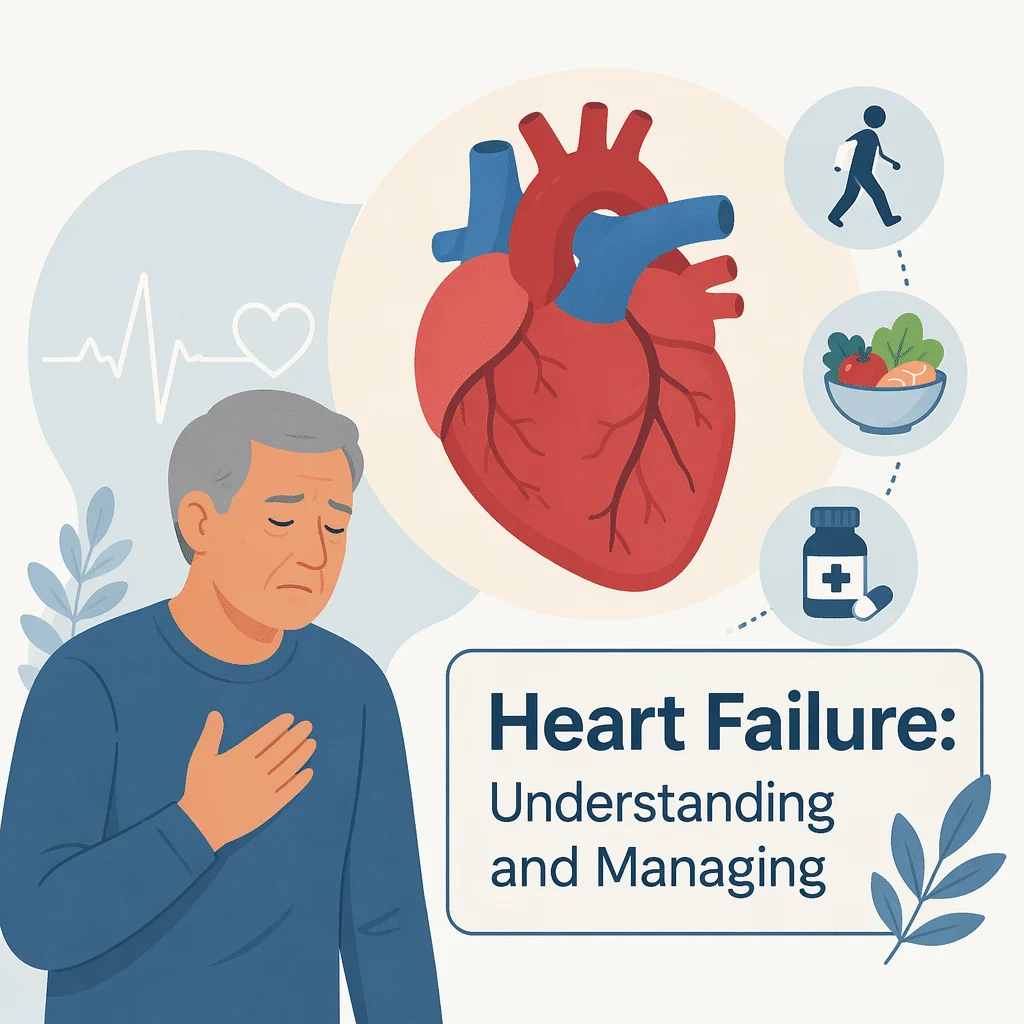
Heart failure is one of the most common reasons adults are admitted to hospital, yet the name itself is widely misunderstood. Heart failure does not mean the heart has stopped or is about to stop beating. It means the heart muscle can no longer pump or fill efficiently enough to meet the body’s needs, so blood and fluid slowly back up into the lungs, legs, and abdomen. The result is a familiar cluster of symptoms: breathlessness, fatigue, and swelling. This article explains what heart failure is, what causes it, how doctors diagnose it with blood tests and imaging, and which treatments now help people live longer and feel noticeably better. You will also learn how to read the lab values that guide everyday care.
What heart failure really means
Heart failure is a long-term condition in which a weakened or stiffened heart struggles to circulate blood. Because the pump falls behind, pressure rises in the veins and fluid leaks into surrounding tissue. Doctors often call this congestion, which is why the older term congestive heart failure is still widely used. Heart failure is not a single disease but the final common pathway of many heart problems, and it is usually classified by how well the main pumping chamber, the left ventricle, empties with each beat.
That measurement is called the ejection fraction. It describes the percentage of blood pushed out of the left ventricle per beat, and it splits heart failure into two broad types that are treated somewhat differently.
Reduced ejection fraction (HFrEF)
In heart failure with reduced ejection fraction, the heart muscle is weak and pumps out too little blood, typically an ejection fraction of 40 per cent or lower. Coronary artery disease and prior heart attacks are frequent causes. This type has the largest body of proven medication evidence behind it.
Preserved ejection fraction (HFpEF)
In heart failure with preserved ejection fraction, the ejection fraction looks normal, often 50 per cent or higher, but the heart muscle has become stiff and fills poorly between beats. High blood pressure, diabetes, obesity, and ageing are common drivers. For years this type had few effective drugs, but that has changed recently, as the advances section below explains.
What causes heart failure and who is at risk
Most heart failure develops after another cardiovascular condition has quietly damaged or overworked the heart over years. Understanding these causes matters, because treating them early is the single best way to protect the heart.
Leading causes
Coronary artery disease narrows the arteries that feed the heart and often follows years of high cholesterol. A resulting blockage can trigger a heart attack that scars the muscle. Long-standing hypertension forces the heart to work against high pressure until it thickens and stiffens, so our guide explains how to manage high blood pressure. Other causes include diseased heart valves, abnormal heart rhythms such as atrial fibrillation, and viral or toxic damage to the muscle (cardiomyopathy). Metabolic strain also plays a large part in people who are managing diabetes.
Risk factors you can influence
Several risk factors are within your control. Smoking, excess alcohol, physical inactivity, obesity, a high-salt diet, and poorly controlled blood sugar or cholesterol all raise the odds of heart failure. Age and family history cannot be changed, but managing the modifiable risks lowers your lifetime risk considerably and slows progression if heart failure has already begun.
Symptoms and the NYHA classes
Heart failure symptoms tend to build gradually, which is why they are easy to dismiss at first. Recognising the early signs of heart failure allows treatment to start sooner, when it works best.
Common symptoms
The most frequent complaints are shortness of breath (during activity, when lying flat, or waking you at night), persistent fatigue, and swelling of the ankles, feet, or abdomen. Many people notice rapid weight gain over a few days as fluid accumulates, a nagging cough, a racing or irregular heartbeat, reduced appetite, or difficulty concentrating. Symptoms often come and go, worsening during flare-ups and easing with treatment.
Which symptoms dominate depends partly on which side of the heart is struggling. When the left side falls behind, fluid backs up into the lungs, so breathlessness and coughing lead. When the right side is affected, fluid pools lower in the body, which is why swollen ankles, a bloated abdomen, and rapid weight gain stand out. Many people eventually develop features of both sides, and the mix can shift as the condition changes.
The four NYHA functional classes
Doctors describe how much symptoms limit daily life using the New York Heart Association (NYHA) scale. It helps track whether treatment is working and guides decisions.
| NYHA class | What it means day to day |
|---|---|
| Class I | No limitation; ordinary activity causes no undue breathlessness or fatigue |
| Class II | Slight limitation; comfortable at rest, but ordinary activity brings symptoms |
| Class III | Marked limitation; less-than-ordinary activity causes symptoms |
| Class IV | Symptoms present at rest; any physical activity increases discomfort |
How doctors diagnose heart failure with lab tests and imaging
Diagnosis combines your medical history, a physical examination, blood tests, and imaging. No single test stands alone, but blood markers and an ultrasound of the heart do most of the work.
Blood tests that matter
Blood tests both support the diagnosis and reveal how other organs are coping. Doctors usually begin by ordering a BNP blood test, because these natriuretic peptides rise when the heart chambers are stretched. The same blood draw often measures a troponin test, which helps rule out a heart attack. Because the heart and kidneys are closely linked, care teams regularly check a kidney function panel. They also monitor an electrolyte panel, and current guidelines recommend screening every patient with an iron studies panel. The table below summarises what each marker evaluates.
| Blood test | What it evaluates in heart failure |
|---|---|
| BNP / NT-proBNP | Hormones released when heart chambers are stretched; higher levels support the diagnosis and help track congestion over time |
| Troponin | A protein released when heart muscle is injured; helps rule out a heart attack and can flag ongoing strain |
| Creatinine and eGFR | Kidney function; guides safe medication dosing because the heart and kidneys depend on each other |
| Sodium | Low blood sodium can reflect fluid overload and is linked to more advanced disease |
| Potassium | Must stay in a narrow range, since several heart failure medicines and diuretics shift it up or down |
| Ferritin and transferrin saturation | Iron stores; iron deficiency is common in heart failure and worsens fatigue and breathlessness |
Imaging and other tests
An echocardiogram, an ultrasound of the heart, is the key imaging test. It measures the ejection fraction, shows how the valves move, and reveals stiffness or enlargement. An electrocardiogram (ECG) records the heart’s rhythm, a chest X-ray can show fluid in the lungs, and a stress test or coronary angiogram may be added when blocked arteries are suspected. Together these results confirm the diagnosis and pinpoint the underlying cause.
Treatment: the four pillars and daily habits
Heart failure treatment has advanced dramatically. The goals are to relieve symptoms, prevent hospital stays, and help people live longer, and modern care combines medicines with everyday self-management.
The four pillars of medication
For reduced ejection fraction, guidelines from the American Heart Association and the American College of Cardiology now recommend four medicine groups together, often called the four pillars: an ARNI or ACE inhibitor, a beta-blocker, a mineralocorticoid receptor antagonist (MRA), and an SGLT2 inhibitor. Each works differently, and using all four at tolerated doses gives the biggest benefit. A diuretic, or water tablet, is added on top to control fluid and ease breathlessness, though it treats symptoms rather than the underlying disease.
Lifestyle and self-care
Daily habits are just as important as prescriptions. A lower-salt diet limits fluid retention, weighing yourself each morning helps catch fluid gain early, and gentle, regular activity strengthens the body when a clinician has approved it. Stopping smoking, limiting alcohol, taking medicines exactly as prescribed, and keeping vaccinations up to date all reduce flare-ups. Small, consistent choices often make the difference between stable months and a hospital admission.
Devices and procedures for advanced cases
When medicines and lifestyle changes are not enough, specialists can add devices or procedures. An implantable cardioverter-defibrillator (ICD) guards against dangerous rhythms, whilst cardiac resynchronisation therapy (CRT) uses a specialised pacemaker to help the ventricles beat in sync. Repairing or replacing a damaged valve and reopening blocked arteries can ease strain, and in the most advanced situations a mechanical pump (an LVAD) or a heart transplant may be considered. These options are reserved for carefully selected patients and are always decided with a heart failure specialist.
When to seek emergency care
Heart failure can flare quickly, and knowing the warning signs can be lifesaving. Call emergency services or go to the nearest accident and emergency department if you experience any of the following:
- Severe or sudden shortness of breath, or breathlessness at rest that will not ease
- Chest pain, pressure, or tightness, especially if it spreads to the arm, jaw, or back
- Rapid weight gain, such as more than 4 to 5 pounds in two to three days, or fast-worsening swelling
- Fainting, near-fainting, or a racing, irregular heartbeat that does not settle
- Coughing up pink, frothy mucus, or new confusion and cold, clammy skin
These signs may point to a dangerous build-up of fluid or a heart attack, and they need urgent assessment rather than a wait-and-see approach.
Latest scientific advances in heart failure
The last few years have reshaped heart failure care, especially for the preserved-ejection-fraction type that once had few options. Here is what the newest high-quality research shows, in plain terms.
Four medicines that work together
Doctors increasingly treat reduced-ejection-fraction heart failure with the four pillars as a package rather than one drug at a time, a practical guide published in 2023 confirms. What this means for you: being on all four medicine types, at the doses your body tolerates, protects the heart more than any single pill, so it is worth working with your clinician to build up the full combination.
SGLT2 inhibitors now help across the whole spectrum
SGLT2 inhibitors, a class of tablet first developed for diabetes, have become foundational for heart failure whether the pumping is weak or preserved, according to a 2024 review in The Lancet. What this means for you: even if your ejection fraction is in the normal range (HFpEF, meaning a stiff heart that fills poorly), there is now a proven medicine that lowers the chance of hospitalisation, which was not true a few years ago.
Finerenone for stiff-heart failure
A newer once-daily tablet called finerenone, a non-steroidal MRA (a drug that blocks a hormone which makes the body hold on to salt and water), reduced worsening heart failure in people with mildly reduced or preserved ejection fraction in the FINEARTS-HF trial reported in 2024. What this means for you: it adds a fresh option for a group that historically had few. The result is still recent, and studies such as the ongoing REDEFINE-HF trial are testing finerenone in people recently hospitalised to confirm where it fits best.
Treating iron deficiency you cannot feel
Many people with heart failure are low in iron even without anaemia, and giving iron directly into a vein can help them feel less breathless and exercise more easily, as trials including HEART-FID in 2023 and the FAIR-HFpEF study in 2024 have shown. What this means for you: a simple iron blood test can uncover a treatable cause of fatigue, and in many patients it reveals low ferritin. The symptom and exercise benefits are clearer than the effect on hospital admissions, which researchers are still clarifying, so iron treatment is decided case by case.
Living with heart failure over the long term
Heart failure is usually a lifelong condition, but many people live active, fulfilling years with the right plan. The key is steady monitoring: tracking weight and symptoms, keeping regular follow-up appointments, and repeating blood tests so medications stay correctly dosed as kidney function and electrolytes shift. A follow-up visit often includes a comprehensive metabolic panel. It keeps an eye on those values as doses change over time.
Just as important is the human side. Learning to recognise your own warning signs, leaning on family or a cardiac rehabilitation team, and seeking support for the anxiety or low mood that often accompany a chronic diagnosis all improve quality of life. Heart failure care is a partnership between you and your medical team, and understanding your own numbers is part of staying in control.
Glossary
| Term | Definition |
|---|---|
| Ejection fraction (EF) | The percentage of blood the left ventricle pumps out with each beat, used to classify heart failure |
| HFrEF | Heart failure with reduced ejection fraction (40 per cent or lower), where the heart pumps too weakly |
| HFpEF | Heart failure with preserved ejection fraction (50 per cent or higher), where the heart is stiff and fills poorly |
| BNP / NT-proBNP | Natriuretic peptides, blood markers that rise when the heart is under strain |
| Diuretic | A medicine, often called a water tablet, that helps the body remove excess salt and water through urine |
| Oedema | Swelling caused by fluid building up in tissues, usually in the ankles, feet, or legs |
| NYHA class | A four-level scale describing how much symptoms limit everyday activity |
| Guideline-directed medical therapy (GDMT) | The combination of medicines proven to improve survival and reduce hospital stays in heart failure |
| SGLT2 inhibitor | A medicine first developed for diabetes that now helps many people with heart failure |
Frequently asked questions
What are the first signs of heart failure?
The earliest signs are often subtle: unusual tiredness, breathlessness during activities that used to feel easy, swelling in the ankles or feet, and unexplained weight gain over a few days. A cough that lingers or the need to prop yourself up with pillows to breathe at night can also be early clues. Because these signs are easy to attribute to ageing or being out of shape, it is worth mentioning them to a doctor, particularly if you have high blood pressure, diabetes, or a history of heart disease.
What are the four stages of heart failure?
The American College of Cardiology and American Heart Association describe four stages. Stage A means you are at risk because of conditions like hypertension or diabetes but have no heart damage or symptoms. Stage B means there are structural changes to the heart but still no symptoms. Stage C is symptomatic heart failure, the stage most people mean when they use the term. Stage D is advanced disease needing specialised therapies. The stages move in one direction, which is why early prevention and treatment matter so much.
Can heart failure be cured?
For most people, heart failure is a chronic condition that is managed rather than cured. The encouraging news is that modern treatment can control symptoms, reduce hospital stays, and help people live longer and feel better. In a minority of cases, treating the underlying cause, such as a faulty valve, a rhythm problem, or a reversible cause of muscle weakness, can improve heart function substantially. Your cardiologist can explain what is realistic in your situation.
What is the life expectancy with heart failure?
Life expectancy varies widely and depends on the type of heart failure, its stage, your age, other health conditions, and how consistently treatment is followed. Numbers from older studies can be misleading, because the four-pillar medicines now in use have improved the outlook considerably. Rather than focusing on a single statistic, it is more useful to know that early diagnosis, taking medicines as prescribed, and steady monitoring all shift the odds in your favour. Your care team can give guidance tailored to you.
Is congestive heart failure the same as heart failure?
Yes, in everyday use the terms mean the same thing. Congestive heart failure is an older name that emphasises the congestion, the fluid build-up in the lungs and body, that develops when the heart cannot keep blood moving efficiently. Doctors today usually say heart failure and then specify the type based on ejection fraction, but you will still see congestive heart failure on many records and websites.
Which blood tests check for heart failure?
The main blood marker is BNP or NT-proBNP, which rises when the heart is under strain and supports the diagnosis. Doctors also look at troponin for muscle injury, kidney function and electrolytes to guide medication, and iron studies because iron deficiency is common. These tests do not replace an echocardiogram, but together they build a clear picture of how the heart and the rest of the body are coping.
Sources
- American Heart Association — What is Heart Failure? — heart.org
- National Heart, Lung, and Blood Institute (NIH) — Heart Failure — nhlbi.nih.gov
- Mayo Clinic — Heart failure: Symptoms and causes — mayoclinic.org
- Solomon SD, et al. — Finerenone in Heart Failure with Mildly Reduced or Preserved Ejection Fraction (FINEARTS-HF) — N Engl J Med, 2024 — doi.org/10.1056/NEJMoa2407107
- Mentz RJ, et al. — Ferric Carboxymaltose in Heart Failure with Iron Deficiency (HEART-FID) — N Engl J Med, 2023 — doi.org/10.1056/NEJMoa2304968
- von Haehling S, et al. — Ferric carboxymaltose and exercise capacity in heart failure with preserved ejection fraction and iron deficiency (FAIR-HFpEF) — Eur Heart J, 2024 — doi.org/10.1093/eurheartj/ehae479
- Campbell P, et al. — Heart failure with preserved ejection fraction: everything the clinician needs to know — Lancet, 2024 — doi.org/10.1016/S0140-6736(23)02756-3
- Kaplon-Cieslicka A, et al. — Tailoring guideline-directed medical therapy in heart failure with reduced ejection fraction: a practical guide — Kardiol Pol, 2023 — doi.org/10.33963/v.kp.97248
- ClinicalTrials.gov — REDEFINE-HF: finerenone after acute heart failure with ejection fraction 40 percent or higher (NCT06008197), 2024 — clinicaltrials.gov/study/NCT06008197
Further reading
- See how doctors read a cardiac markers panel
- Understand cholesterol and triglycerides with a lipid panel
- Learn what doctors read from the BUN-to-creatinine ratio
- Explore how iron moves through the body via the transferrin blood test
- Find out what can raise high ferritin levels
Understand your lab results with AI DiagMe
Understanding your blood work is central to living well with heart failure. AI DiagMe turns complex numbers into clear, plain-language explanations, helping you make sense of results such as BNP or NT-proBNP, kidney function, sodium and potassium, and iron studies. It is designed to help you understand your labs and prepare sharper questions for your appointments. It does not diagnose disease and does not replace your doctor.
Get your results interpreted in minutes