






































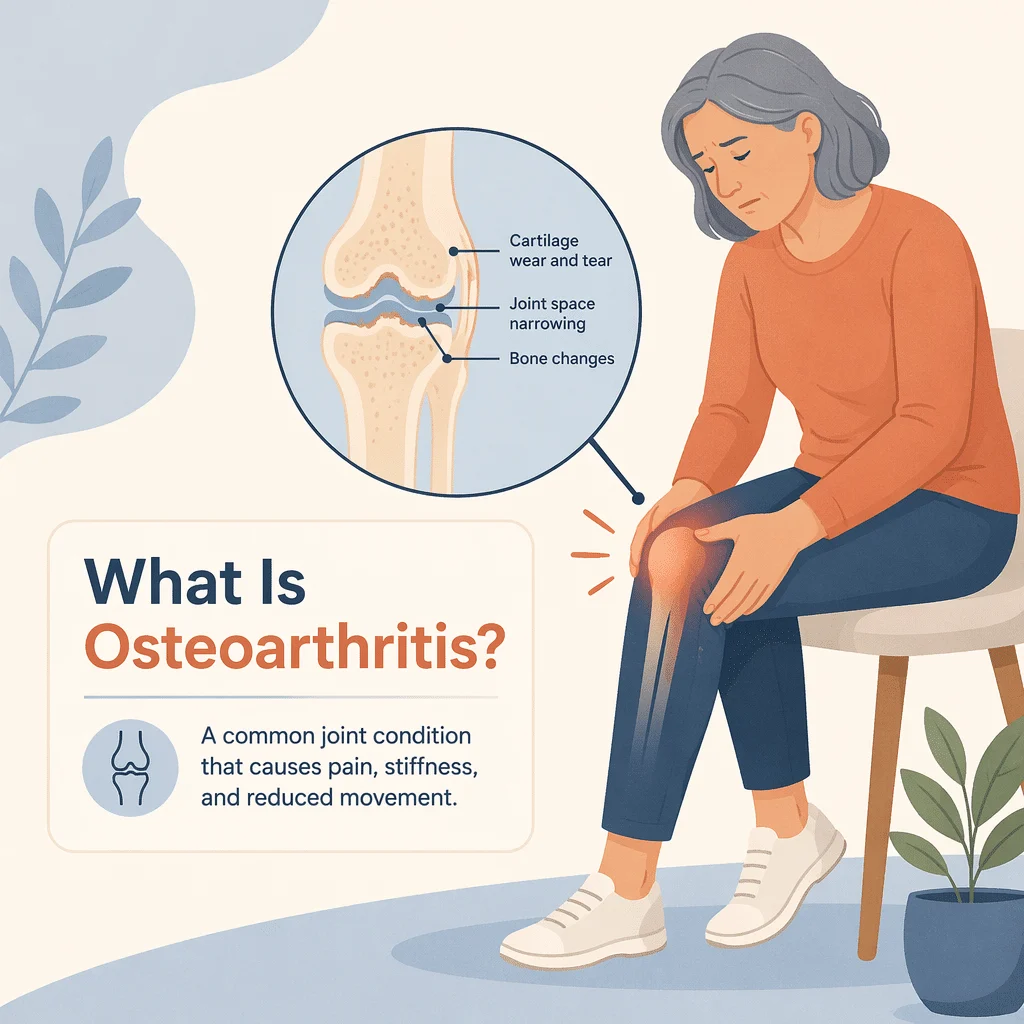
Osteoarthritis is the most common joint disease in the world, affecting hundreds of millions of adults as they grow older. Often described as “wear-and-tear” arthritis, it develops when the smooth cartilage that cushions the ends of your bones gradually breaks down, leaving joints stiff, painful, and harder to move. It most often affects the knees, hips, hands, and spine, yet it is not an unavoidable part of ageing, because many of its risk factors can be managed. In this article you’ll learn what osteoarthritis is, what causes it, how doctors recognise and diagnose it, how it differs from rheumatoid arthritis, and which treatments and recent scientific advances can help. You’ll also see why blood tests, although they cannot confirm the disease, play a valuable role in ruling out other causes of joint pain.
What is osteoarthritis?
Osteoarthritis, sometimes shortened to OA, is a chronic condition in which the cartilage inside a joint slowly wears away. Cartilage is the firm, slippery tissue that lets bones glide over each other. As it thins, the bones underneath thicken, small bony growths called osteophytes can form at the joint edges, and the joint lining can become mildly inflamed. Because it involves the whole joint rather than cartilage alone, doctors now view it as a disease of the entire joint structure.
Another common name for osteoarthritis is degenerative joint disease, or DJD, which reflects the gradual, mechanical nature of the damage. It is different from the inflammatory or autoimmune forms of arthritis, where the immune system attacks the joints. Osteoarthritis is only one member of a large family of joint disorders, and our health library explains the wider family of arthritis conditions.
What causes osteoarthritis? Risk factors to know
Osteoarthritis rarely has a single cause. Instead, several factors combine over the years to overwhelm the joint’s natural ability to repair itself. Some of these factors you cannot change, whilst others are within your control.
- Age: the risk rises steadily after 45, as cartilage becomes less able to renew itself.
- Excess weight: extra body weight loads the knees and hips, and fat tissue also releases substances that can promote low-grade inflammation.
- Previous joint injury: a past fracture, ligament tear, or surgery can set the stage for osteoarthritis years later.
- Repetitive strain: jobs or sports that involve heavy lifting, kneeling, or repeated impact can accelerate joint wear.
- Genetics: a family history of osteoarthritis, especially in the hands, increases the likelihood of developing it.
- Sex and hormones: women are more often affected, particularly after the menopause.
- Joint shape and alignment: bow legs, hip abnormalities, or uneven joints concentrate pressure on one area.
Because weight, physical activity, and injury prevention can all be influenced, prevention is genuinely possible for many people, even when family history plays a part.
Symptoms of osteoarthritis
The main symptom of osteoarthritis is pain. It is usually described as mechanical, meaning it worsens with use and movement and eases with rest. Early on, the discomfort may come and go, but over time it can become more constant. Other common signs include brief morning stiffness that typically lasts less than 30 minutes, a reduced range of motion, and a grinding or clicking sensation called crepitus when the joint moves. Some joints look larger because of bony enlargement, and mild swelling can appear during flare-ups.
Osteoarthritis in the knee
The knee is the most frequently affected joint. People often notice pain when climbing stairs, standing up, or walking longer distances, along with stiffness after sitting. Because knee discomfort has many possible origins, a dedicated article reviews the broader causes of knee pain.
Osteoarthritis in the hands
Osteoarthritis in the hands tends to affect the finger joints and the base of the thumb. It can produce firm bony bumps near the fingertips, known as Heberden’s nodes, and similar swellings on the middle finger joints, called Bouchard’s nodes. Gripping, pinching, and fine tasks may become uncomfortable.
Osteoarthritis in the hip and spine
Hip osteoarthritis often causes pain in the groin or outer thigh and can make walking or putting on shoes difficult. In the spine, worn discs and joints may lead to neck or lower-back stiffness, and occasionally to nerve-related symptoms if bony growths press on nearby nerves.
Osteoarthritis vs. rheumatoid arthritis
One of the most common questions patients ask is how osteoarthritis differs from rheumatoid arthritis. Both cause joint pain, but they are very different diseases. Osteoarthritis is a wear-related condition, whilst rheumatoid arthritis is an autoimmune disease in which the immune system mistakenly attacks the joint lining, producing widespread inflammation. Telling them apart matters, because rheumatoid arthritis needs early treatment with specific medicines to prevent lasting joint damage. For a deeper comparison, our medical team also produced a detailed rheumatoid arthritis guide.
| Feature | Osteoarthritis | Rheumatoid arthritis |
|---|---|---|
| Type of disease | Wear-and-tear (degenerative) | Autoimmune and inflammatory |
| Typical onset | Gradual, usually after age 45 | Any age, often between 30 and 60 |
| Joint pattern | Often one-sided; knees, hips, hands, spine | Usually symmetrical; small joints of hands and feet |
| Morning stiffness | Short, under 30 minutes | Prolonged, often over an hour |
| Swelling | Hard, bony enlargement | Warm, soft, tender swelling |
| Whole-body symptoms | Uncommon | Fatigue and low-grade fever are common |
| Typical blood tests | Usually normal | Often raised inflammation markers and positive antibodies |
How osteoarthritis is diagnosed
Osteoarthritis is diagnosed mainly from your medical history and a physical examination, not from a single test. A 2023 review in JAMA noted that in adults aged 45 or older with activity-related joint pain and little or no morning stiffness, osteoarthritis is by far the most likely explanation. Doctors ask about the pattern of pain, examine the joint for swelling and bony enlargement, and check how well it moves.
Clinical examination and imaging
X-rays can support the diagnosis by showing narrowing of the space between bones, osteophytes, and denser bone. Importantly, the picture on an X-ray does not always match how a person feels: some people with marked changes have little pain, whilst others with mild changes hurt a great deal. For that reason, imaging is used to confirm the diagnosis and gauge severity, not to decide treatment on its own.
Blood tests that help rule out other causes
There is no blood test that confirms osteoarthritis. Blood work is used instead to exclude other conditions that can mimic it, especially inflammatory or crystal-related arthritis. If the pattern of symptoms raises a concern, a doctor may request a C-reactive protein inflammation test, and they may also add the erythrocyte sedimentation rate test. To look for rheumatoid arthritis specifically, a doctor may order the anti-CCP antibody test. When sudden, red-hot joint attacks suggest a crystal problem, a separate guide covers gout pain relief and management.
| Blood test | What it measures | What it helps rule out |
|---|---|---|
| C-reactive protein (CRP) | General inflammation in the body | Rheumatoid arthritis, infection, other inflammatory disease |
| Erythrocyte sedimentation rate (ESR) | How fast red blood cells settle, a sign of inflammation | Inflammatory arthritis, infection |
| Rheumatoid factor (RF) | An antibody often seen in autoimmune disease | Rheumatoid arthritis |
| Anti-CCP antibodies | Antibodies highly specific to rheumatoid arthritis | Early rheumatoid arthritis |
| Uric acid | The amount of uric acid in the blood | Gout, a crystal-related arthritis |
When to see a doctor
Joint pain is common, but certain signs deserve prompt medical attention rather than watchful waiting. Consider booking an appointment if you notice any of the following:
- Joint pain or stiffness that lasts more than a few weeks or keeps you from daily activities.
- A joint that is hot, red, or suddenly very swollen, which can signal infection or gout.
- Morning stiffness that lasts well over an hour, which points towards inflammatory arthritis.
- Fever, unexplained weight loss, or fatigue alongside joint symptoms.
- A joint that locks, gives way, or changes shape.
Treatment and management of osteoarthritis
There is no cure that reverses osteoarthritis, but a wide range of treatments can ease pain, keep joints working, and protect quality of life. Care usually starts with lifestyle measures and adds medication or surgery only when needed.
Exercise and physical activity
Movement is the foundation of osteoarthritis care. Strengthening the muscles around a joint, gentle aerobic activity such as walking or swimming, and range-of-motion exercises all help reduce pain and stiffness. It may feel counterintuitive to move a sore joint, but staying active protects it far better than rest.
Weight management
For people carrying extra weight, losing even a modest amount can noticeably lighten the load on the knees and hips and reduce symptoms. Because weight and joint stress are so closely linked, weight management is one of the most effective tools available.
Medications
When pain relief is needed, guidelines generally favour topical anti-inflammatory gels for knee and hand osteoarthritis, followed by oral anti-inflammatory medicines at the lowest effective dose for the shortest time. Paracetamol offers limited benefit for some people. Steroid injections into a joint can provide short-term relief during a bad flare. Any medicine should be chosen with a clinician, taking your other health conditions into account.
Surgery
When osteoarthritis is advanced and other treatments no longer control symptoms, joint replacement surgery, most often of the knee or hip, can dramatically restore comfort and mobility. It is considered only after conservative options have been tried.
Latest scientific advances in osteoarthritis
Research on osteoarthritis has moved quickly over the past three years. The findings below are written in plain language, with what each one could mean for you.
Exercise is now backed by even stronger evidence. An updated 2024 Cochrane review, which pooled many trials of land-based exercise for knee osteoarthritis, found small-to-moderate improvements in pain and function that hold up across different programmes. What this means for you: the exact routine matters less than choosing an activity you can keep doing, so a plan you enjoy is a good plan.
Weight-loss medicines may ease knee symptoms. In a 2024 trial published in the New England Journal of Medicine, adults with obesity and knee osteoarthritis who took a once-weekly injection of semaglutide, a GLP-1 medicine originally developed for diabetes and weight loss, lost substantial weight and reported clearly less knee pain than those given a placebo. GLP-1 medicines are drugs that curb appetite and help lower body weight. What this means for you: when osteoarthritis is closely tied to excess weight, these newer treatments may help, but they act on weight and pain rather than repairing cartilage, so they are a discussion to have with your doctor.
Osteoarthritis is now seen as a whole-joint, partly metabolic disease. A 2025 overview in Nature Reviews Disease Primers described it as involving inflammation and metabolism, not just mechanical wear, yet current treatment still focuses on relieving symptoms. What this means for you: lifestyle steps such as movement and weight control remain the backbone of care while science works on deeper fixes.
Guidelines around the world largely agree, with some gaps. A 2024 systematic review comparing osteoarthritis clinical practice guidelines found strong, consistent support for exercise, weight management, and education, but conflicting advice on treatments such as joint injections. What this means for you: a good care plan should be tailored to you, and it is reasonable to ask why a particular option is or is not recommended.
A true disease-modifying drug is still missing, but the search is active. Researchers are exploring whether medicines first designed for diabetes could protect joints; a 2024 study in EBioMedicine used genetic analysis to flag several such drug targets as worth testing. A disease-modifying osteoarthritis drug, or DMOAD, would slow the joint damage itself, and none is approved yet. What this means for you: today’s treatments manage symptoms, and any promising new drug will still need years of testing before it reaches clinics.
Annual research summaries help track progress. A 2025 osteoarthritis year-in-review confirmed that obesity and inactivity remain leading, changeable drivers of the disease, and that exercise and weight loss keep the strongest evidence behind them. What this means for you: the habits within your control still make the biggest difference.
Living with osteoarthritis
Osteoarthritis is a long-term condition, but most people manage it well and stay active for years. Simple daily strategies protect your joints: pace demanding tasks, alternate activity with short rests, use supportive footwear, and consider aids such as a walking stick or jar opener when they make life easier. Applying heat can relax stiff joints, while cold can calm a swollen one.
Bone and overall health matter too. Keeping muscles strong supports the joints, and looking after bone density helps you stay steady on your feet; some people also complete a vitamin D blood test, and for a fuller picture our team explains the calcium and bone mineral panel. Finally, chronic pain can affect mood and sleep, so it is worth telling your doctor if you feel low, because addressing that is part of good osteoarthritis care.
Glossary
| Term | Definition |
|---|---|
| Cartilage | The smooth, protective tissue that cushions the ends of bones inside a joint. |
| Osteophyte | A bony outgrowth, or bone spur, that can form at the edges of a joint affected by osteoarthritis. |
| Degenerative joint disease (DJD) | Another name for osteoarthritis, describing the gradual breakdown of joint tissues. |
| Synovial fluid | The thick liquid that lubricates a joint and reduces friction during movement. |
| Crepitus | The grinding, cracking, or clicking felt or heard when moving a damaged joint. |
| Inflammatory arthritis | Joint disease driven by an overactive immune system, such as rheumatoid arthritis, rather than by wear. |
| C-reactive protein (CRP) | A blood protein that rises when there is inflammation somewhere in the body. |
| Anti-CCP antibodies | Immune proteins that strongly suggest rheumatoid arthritis when found in the blood. |
| DMOAD | Disease-modifying osteoarthritis drug; a treatment that would slow joint damage itself, none of which is yet approved. |
| Cohort | A group of people followed over time in a research study. |
Frequently asked questions about osteoarthritis
What is the difference between osteoarthritis and rheumatoid arthritis?
Osteoarthritis is a wear-related disease in which cartilage breaks down over time, usually affecting a few joints and causing short-lived morning stiffness. Rheumatoid arthritis is an autoimmune disease in which the immune system attacks the joints, often symmetrically, with prolonged stiffness and whole-body symptoms such as fatigue. Blood tests are usually normal in osteoarthritis but frequently abnormal in rheumatoid arthritis.
Is there a cure for osteoarthritis of the knee?
There is currently no cure that reverses the cartilage loss of knee osteoarthritis. However, symptoms can often be controlled well with exercise, weight management, pain-relief measures, and, in advanced cases, joint replacement surgery. Research into disease-modifying drugs is ongoing, but none is approved yet.
What are the first symptoms of osteoarthritis?
Early osteoarthritis often begins with mild, activity-related joint pain that eases with rest, along with brief stiffness after waking or sitting. You may also notice a slight grinding sensation or reduced flexibility. Because these signs are easy to dismiss, it helps to mention them to a doctor if they persist.
Does osteoarthritis affect the hands?
Yes. Osteoarthritis commonly affects the finger joints and the base of the thumb, producing firm bony bumps, stiffness, and discomfort during gripping or pinching. Hand osteoarthritis often runs in families and is more frequent in women, particularly after the menopause.
Can blood tests diagnose osteoarthritis?
No blood test can confirm osteoarthritis, because it is not an autoimmune disease and usually leaves standard markers normal. Blood tests are used to rule out conditions that resemble it, such as rheumatoid arthritis or gout. Understanding these results alongside your symptoms helps your doctor reach the right diagnosis.
What is the best treatment for knee osteoarthritis?
The best-supported treatments for knee osteoarthritis are exercise and weight management, combined with pain relief when needed. Topical anti-inflammatory gels and, at times, joint injections can help during flares, whilst joint replacement is reserved for severe cases. The right mix depends on your symptoms and overall health.
Sources
- Centers for Disease Control and Prevention (CDC) — Osteoarthritis. https://www.cdc.gov/arthritis/osteoarthritis/index.html
- National Institute of Arthritis and Musculoskeletal and Skin Diseases (NIAMS) — Osteoarthritis. https://www.niams.nih.gov/health-topics/osteoarthritis
- Mayo Clinic — Osteoarthritis: Symptoms and causes. https://www.mayoclinic.org/diseases-conditions/osteoarthritis/symptoms-causes/syc-20351925
- Tang S, et al. Osteoarthritis. Nature Reviews Disease Primers, 2025. https://doi.org/10.1038/s41572-025-00594-6
- Lawford BJ, et al. Exercise for osteoarthritis of the knee. Cochrane Database of Systematic Reviews, 2024. https://doi.org/10.1002/14651858.CD004376.pub4
- Bliddal H, et al. Once-Weekly Semaglutide in Persons with Obesity and Knee Osteoarthritis. New England Journal of Medicine, 2024. https://doi.org/10.1056/NEJMoa2403664
- Dell’Isola A, et al. Osteoarthritis year in review 2025: epidemiology and therapy. Osteoarthritis and Cartilage, 2025. https://doi.org/10.1016/j.joca.2025.08.015
- Gray B, et al. Analysis of the similarities and differences between osteoarthritis clinical practice guideline recommendations: a systematic review. Osteoarthritis and Cartilage, 2024. https://doi.org/10.1016/j.joca.2024.02.890
- Duong V, et al. Evaluation and Treatment of Knee Pain: A Review. JAMA, 2023. https://doi.org/10.1001/jama.2023.19675
- Fu K, et al. Exploring antidiabetic drug targets as potential disease-modifying agents in osteoarthritis. EBioMedicine, 2024. https://doi.org/10.1016/j.ebiom.2024.105285
Further reading
- Arthritis: understanding its causes, symptoms, and treatments
- Rheumatoid arthritis: a complete guide to symptoms, diagnosis, and treatment
- Gout pain relief: treatments and management
- Knee pain: causes, symptoms, and treatments
- High CRP levels: causes, symptoms, and treatments
Understand your lab results with AI DiagMe
Blood tests cannot diagnose osteoarthritis, but they are essential for ruling out the conditions that imitate it, from rheumatoid arthritis to gout. AI DiagMe helps you make sense of markers such as C-reactive protein, rheumatoid factor, anti-CCP antibodies, and uric acid, in clear language you can actually use. It is built to help you understand your results, not to diagnose you or replace your doctor, so you can walk into your next appointment better informed.
Get your results interpreted in minutes