








































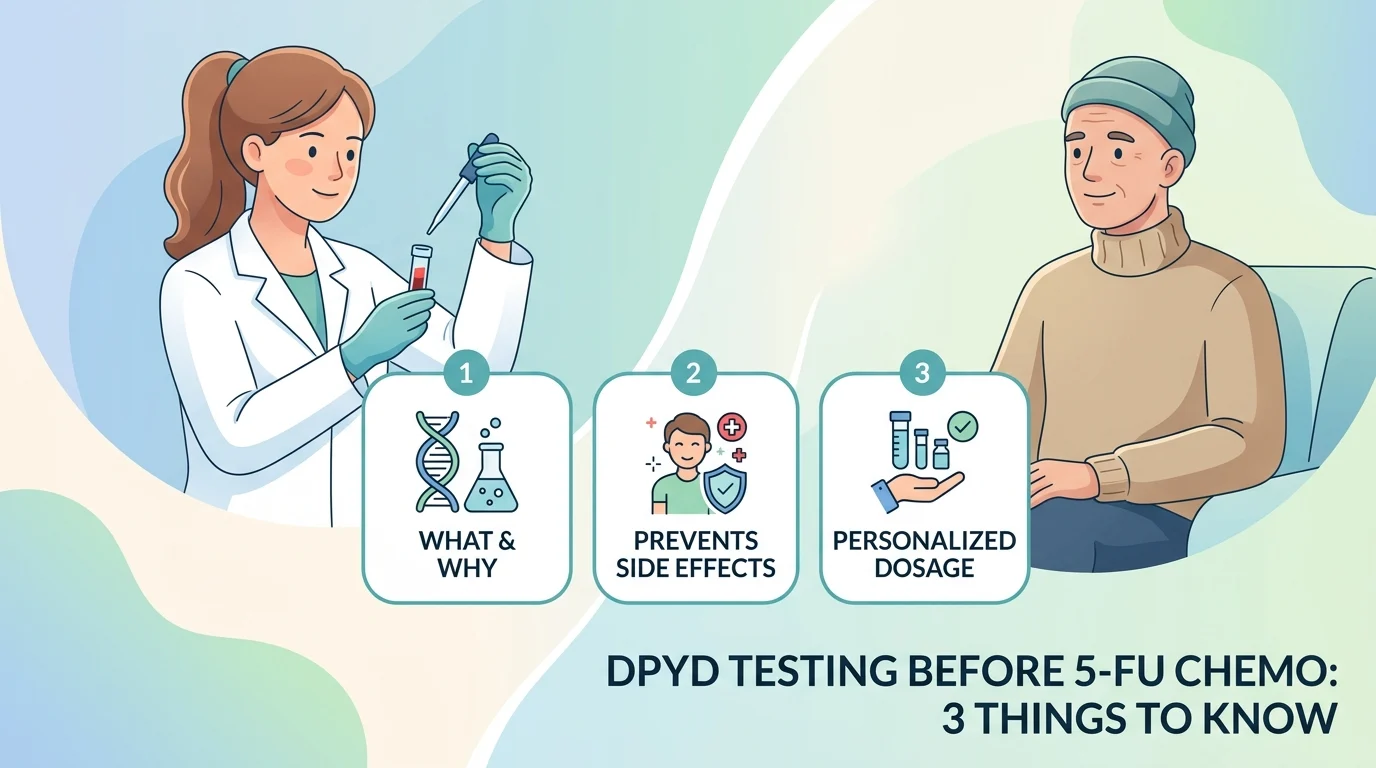
If you are about to start chemotherapy with fluorouracil (5-FU) or capecitabine, there is now a test your care team should run first. It is called DPYD testing, and it checks whether your body can clear these drugs normally. The FDA updated the labelling for both medicines with a boxed warning that advises this test before treatment begins, unless treatment cannot wait. In Europe, regulators reached the same conclusion by a different route, and France has just published a national framework for adjusting the dose when the test is abnormal. Here is what the test measures, what your result means, and what to ask.
Why this test exists
An enzyme called dihydropyrimidine dehydrogenase, or DPD, breaks down more than 80 percent of the fluorouracil that enters your body. The DPYD gene carries the instructions for building that enzyme. When a variant in that gene reduces or removes DPD activity, the drug is not cleared efficiently and accumulates to toxic levels.
The consequences are not minor. According to the National Library of Medicine, fluoropyrimidine toxicity can cause severe inflammation and ulceration of the gastrointestinal lining, with mouth sores, abdominal pain, nausea and diarrhoea. It can also drop white blood cell and platelet counts, cause hand-foot syndrome, shortness of breath and hair loss. In people with complete DPD deficiency, these reactions can be fatal.
Severe, symptomatic DPD deficiency is rare. But between 2 and 8 percent of the general population carries a silent, partial deficiency that makes them vulnerable to these reactions. Most of them have no idea until the first cycle goes wrong.
What changed in the FDA labelling
The FDA has revised the prescribing information for both capecitabine and fluorouracil, and communicated the change to clinicians in early 2026. Three elements matter to patients.
First, the boxed warning now flags the risk of serious adverse reactions or death in people with complete DPD deficiency, advises DPYD testing before starting either drug unless immediate treatment is necessary, and recommends avoiding these drugs entirely in patients with variants that abolish DPD activity.
Second, a new dosage subsection instructs prescribers to individualise dosing in patients with partial DPD deficiency rather than applying the standard protocol dose.
Third, the warnings section repeats the testing recommendation, so it appears in three separate places in the label. The FDA has said it will keep monitoring the issue and may take further regulatory action.
Two ways to test, and why it matters
There are two accepted approaches, and they do not measure quite the same thing.
Genotyping looks directly at your DNA for known DPYD variants. It is the route the FDA labelling names, and it is the dominant approach in the United States. Its limitation is coverage: it finds the variants on the panel, and a rare or population-specific variant outside that panel can be missed.
Phenotyping measures uracil in your plasma instead. Because DPD also breaks down uracil, a high uracil level is an indirect signal that the enzyme is underperforming. This is the mandatory approach in France, where it has been required before every fluoropyrimidine prescription since 2019. It captures the functional result of any cause of low DPD activity, but it is sensitive to how the sample is handled.
| Approach | What it measures | Main limitation |
|---|---|---|
| DPYD genotyping | Specific variants in the DPYD gene | Only detects variants included on the panel |
| Plasma uracil (phenotyping) | How well the enzyme is actually working right now | Sensitive to sample handling, liver and kidney status |
What a result actually leads to
A normal result means the standard protocol dose goes ahead. A result showing complete deficiency means these drugs are avoided and your oncologist looks for an alternative regimen.
The difficult middle ground is partial deficiency, and this is where guidance has been thin. On 9 September 2026, the French medicines agency and the National Cancer Institute published a national expert opinion that proposes, for the first time in that country, a shared framework for reducing the starting dose according to the measured uracil level. Their thresholds place normal status below 16 ng/mL, partial deficiency between 16 and 150 ng/mL with a graded dose reduction, and probable complete deficiency at 150 ng/mL and above. From the second cycle onward, adjustment shifts to how you actually tolerated the first one.
Latest scientific advances
Recent research has clarified one practical point that patients rarely hear. A French study published in 2023 followed 1,138 patients screened with plasma uracil over three years. Roughly one in eight came back above the deficiency threshold. But the authors found that raised liver enzymes, raised alkaline phosphatase and reduced kidney filtration were each linked to higher uracil readings, independent of the enzyme itself. Among patients who were tested a second time, the repeat result changed the conclusion in close to a quarter of cases.
What this means for you: if your liver or kidney numbers were off on the day of the blood draw, the result may overstate your deficiency, and a repeat test is a reasonable thing to raise with your oncologist. The same study found monthly abnormal-result rates fell sharply over three years as laboratories tightened sample handling, which says a great deal about how much the logistics matter.
A European survey published the same year, covering professionals across 23 countries, showed that regulatory recommendations genuinely changed practice: most countries reported more testing afterwards, and the two main obstacles — reimbursement gaps and low awareness amongst oncologists — were both receding.
The open question is whether reduced starting doses protect patients without sacrificing effectiveness. A French multicentre trial launched in 2026 plans to enrol around 400 patients with digestive cancers, grouped by their uracil level, to answer exactly that. It is ongoing, so today’s dose-reduction thresholds rest on expert consensus rather than completed prospective evidence.
What to ask before your first cycle
- Has DPYD testing been ordered, and when will the result arrive?
- If the result is abnormal, what starting dose has been chosen and on what basis?
- Were my liver and kidney results normal on the day of the sample?
- Which early symptoms should prompt me to call, and on what number?
Severe mouth sores, marked diarrhoea, fever or redness and peeling of the palms and soles in the first days after a cycle are the classic early warning signs. Report them immediately rather than waiting for the next appointment.
Throughout treatment, your team monitors blood counts. They watch your absolute neutrophil count, they track your platelet count, and they review your liver function tests between cycles. Kidney function matters too, which is why they check high BUN and creatinine results. Many people starting these drugs also read our colorectal cancer overview.
Glossary
- DPYD: the gene that carries instructions for the DPD enzyme.
- DPD: dihydropyrimidine dehydrogenase, the enzyme that clears fluorouracil and uracil.
- Fluoropyrimidines: the drug family that includes fluorouracil and capecitabine.
- Partial deficiency: reduced but present enzyme activity, compatible with a lowered dose.
- Mucositis: painful inflammation of the lining of the mouth and digestive tract.
- Hand-foot syndrome: redness, swelling and peeling of the palms and soles.
Frequently asked questions
Is DPYD testing a blood test?
Yes. Genotyping uses a blood or cheek swab sample to read your DNA, and phenotyping uses a blood sample to measure plasma uracil. Both are ordered before treatment starts.
How much does DPYD testing cost?
Cost varies by laboratory and by insurer, and coverage has been uneven. Ask your oncology team to confirm coverage before the sample is taken, since a billing surprise is the most common reason the test gets skipped.
How long does the result take?
Turnaround is typically several days, which is why the order needs to be placed early enough not to delay the first cycle.
What if I carry a DPYD variant?
A variant causing complete deficiency means avoiding these drugs and using an alternative regimen. A variant causing partial deficiency means an individualised, reduced starting dose with close monitoring.
Does a normal result mean I will not have side effects?
No. The test removes one important and predictable risk. Fluoropyrimidines still cause side effects in people with normal DPD activity, so monitoring continues throughout treatment.
Can treatment start before the result comes back?
The labelling allows it when immediate treatment is necessary. In that situation your team weighs the delay against the urgency of starting, and monitors the first cycle especially closely.
Sources
- U.S. Food and Drug Administration — Safety labelling changes regarding DPD deficiency for fluorouracil injection products
- MedlinePlus Genetics, National Library of Medicine — Dihydropyrimidine dehydrogenase deficiency
- MedlinePlus Genetics, National Library of Medicine — DPYD gene
- The ASCO Post — FDA provides safety labelling update for capecitabine and fluorouracil on risks associated with DPD deficiency, February 2026
- French National Agency for Medicines Safety — National expert opinion on fluoropyrimidine dose adaptation, September 9, 2026
- Callon S. et al., Therapeutic Advances in Medical Oncology, 2023 — Renal impairment and abnormal liver function tests in pre-therapeutic DPD deficiency screening using uracilemia
- de With M. et al., ESMO Open, 2023 — Implementation of dihydropyrimidine dehydrogenase deficiency testing in Europe
- Camilleri G. et al., Digestive and Liver Disease, 2026 — Phenotype-guided dose individualisation of fluoropyrimidine in gastrointestinal cancers
Other articles
- Colorectal Cancer: Symptoms, Screening, and Treatment
- Low Absolute Neutrophils: Causes, Symptoms, and What Your ANC Means
- Liver Function Tests (LFTs): How to Read Your Liver Panel
- Platelet Count Explained: Normal Range, Low and High Levels
Understand your lab results with AI DiagMe
A laboratory report is hard to read when you are in the middle of treatment. Understand your lab results with AI DiagMe, our artificial intelligence, validated by a committee of physicians and hosted in France, puts each value back in context and helps you prepare the questions worth asking at your next appointment.