




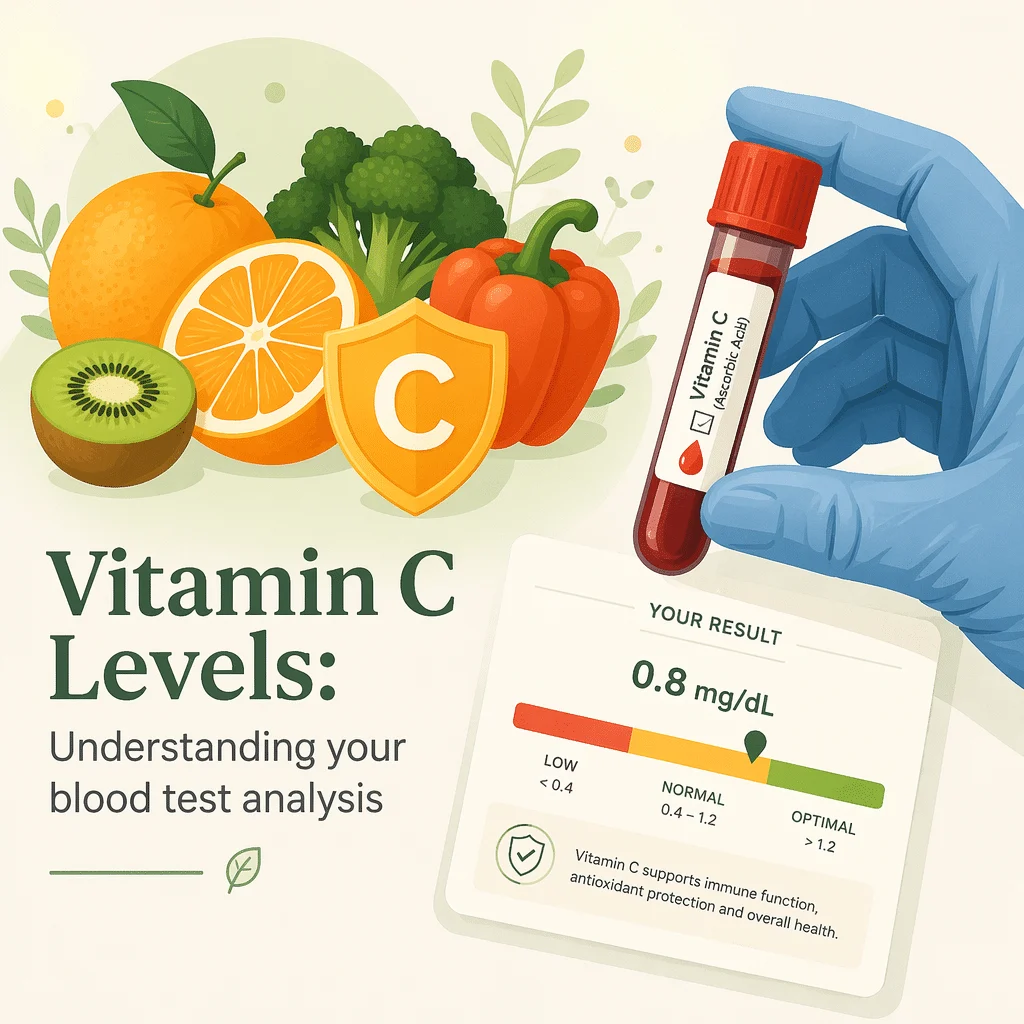
A vitamin C blood test measures how much ascorbic acid is circulating in your blood at the moment the sample is taken. It is one of the less common lines you will ever see on a lab report. Most people never have it ordered, because doctors usually recognise a vitamin C problem from diet and symptoms long before a number is needed. When the test is requested, it is generally to confirm a suspected deficiency in someone whose diet, illness or lifestyle puts them at risk.
In this article you’ll learn what vitamin C does in the body, why this test is ordered so rarely, why the sample has to be handled with unusual care, what a low or a normal result actually tells you, who is most at risk of running short, and when a conversation with your doctor is worthwhile.
What vitamin C does, and why levels are measured
Vitamin C, also called ascorbic acid, is a water-soluble vitamin. Water-soluble simply means it dissolves in water rather than in fat, so the body cannot stockpile it the way it stores vitamin D or vitamin A. Humans are also unusual amongst mammals: we lack a working version of the enzyme that most animals use to build vitamin C from sugar. Every milligram we have comes from food or supplements.
That combination — no internal production, no large reserve — is exactly why a blood level can be informative. Vitamin C does several jobs that matter every day:
- It helps build collagen, the structural protein that holds skin, gums, blood vessels, bone and tendons together. This is why a shortage shows up as bleeding gums, fragile skin and slow wound healing.
- It acts as an antioxidant, meaning it neutralises unstable molecules called free radicals before they damage cells.
- It improves the absorption of non-haem iron, the form of iron found in plants. If you are following iron results, you may want to read our guide to the serum iron blood test.
- It supports the normal functioning of several immune cells.
- It helps make carnitine, a molecule that ferries fats into the parts of the cell that produce energy.
One nuance matters when you read your result. A plasma vitamin C level mostly reflects what you have eaten recently, not the size of your body’s total reserve. It is a snapshot of intake rather than a long-term memory, which is part of why doctors interpret it alongside your diet and symptoms rather than on its own.
Why and when a vitamin C blood test is ordered
Vitamin C testing is not part of a routine check-up, and it is not included in standard panels. A doctor generally orders it when something in the clinical picture points towards deficiency. Typical triggers include:
- Unexplained easy bruising, bleeding or inflamed gums, or tiny pinpoint bleeds around hair follicles.
- Wounds or surgical sites that are healing far more slowly than expected.
- Persistent fatigue and aching joints in someone with a visibly restricted diet.
- A known risk situation: long-term alcohol use, food insecurity, dialysis, bariatric surgery, an eating disorder, or a condition that impairs absorption such as Crohn’s disease or coeliac disease.
- Anaemia that is not fully explained by the usual causes. In that situation your doctor may also want to check our guide to the complete blood count.
Why the test stays uncommon
There are sound reasons why this test is rarely used. Scurvy — the severe form of vitamin C deficiency — is diagnosed mainly on history and physical examination, and it responds so quickly to treatment that the response itself confirms the diagnosis. Not every laboratory offers the assay, results can take days to come back, and the number reflects recent intake, so a single supplement taken before the appointment can mask a chronic shortage. The test is a supporting piece of evidence, not the decision-maker.
What the test is called on your lab report
The same measurement travels under several names. You may see it printed as vitamin C, ascorbic acid, plasma ascorbic acid or serum vitamin C. Results are usually reported in micromoles per litre (µmol/L) in Europe, or in milligrams per decilitre (mg/dL) in the United States. The unit is important, because the reference range only makes sense next to it. If reference ranges in general are new to you, consult our reference chart of normal blood test ranges.
How the sample is handled, and why timing changes the result
Vitamin C is one of the most fragile substances a laboratory is ever asked to measure. Ascorbic acid oxidises — reacts with oxygen and breaks down — when exposed to light, warmth and air. A tube left sitting on a bench will quietly lose vitamin C, and the result that comes back will be lower than your true level.
Because of this, laboratories that run the test follow a strict routine: the blood goes into a chilled tube, often straight into an ice bath, it is spun in a centrifuge quickly to separate the plasma, it is shielded from light, a chemical stabiliser is frequently added, and the sample is then frozen until it is analysed. Deviating from that chain at any point can produce a falsely low reading.
What this means for you in practice is simple. Ask the laboratory in advance whether it actually performs this test and what preparation it wants, since instructions genuinely vary from site to site. Mention any vitamin C supplement you take and when you last took it, because a dose that morning can lift your level temporarily and hide a real shortfall. If your result looks surprising in either direction, sample handling is a legitimate thing to ask about before drawing conclusions. For the wider picture, read our complete guide to reading blood test results.
Reading a low vitamin C result
A low result means your recent vitamin C intake has not kept up with your needs. It is a nutritional signal rather than a diagnosis in itself. Laboratories flag results below their reference range, and the international standards used in research, cited in a 2024 review in Nutrition Reviews, define deficiency as a plasma or serum level below 11.4 µmol/L, with intermediate values described as marginal or depleted.
Deficiency does not appear overnight, and it does not appear all at once. Symptoms follow a fairly predictable sequence as reserves fall.
| Stage | Typical timing after intake stops | What people notice |
|---|---|---|
| Reserves falling | First few weeks | Usually nothing at all; the blood level drops silently |
| Early, non-specific signs | Around 4 to 12 weeks | Tiredness, low mood, irritability, loss of appetite, aching muscles |
| Collagen-related signs | After roughly 3 months | Bleeding or swollen gums, easy bruising, pinpoint bleeds around hair follicles, corkscrew-shaped body hairs, wounds that will not close |
| Advanced deficiency (scurvy) | Months of near-zero intake | Joint pain and swelling, anaemia, marked weakness; requires prompt medical care |
Timings are indicative and taken from published clinical reviews. They vary from person to person depending on starting reserves and overall health.
Scurvy is rare, but no longer purely historical
Scurvy is the name for advanced vitamin C deficiency. It is genuinely rare in high-income countries, and it should not be a source of alarm for most readers. It is worth knowing about for one reason only: it is reversible, and it is easy to miss precisely because doctors were taught to think of it as a disease of eighteenth-century sailors. Clinicians have been reporting scattered cases in specific groups — older adults living alone, people with severe alcohol use disorder, people facing food insecurity, and people with very restricted eating patterns.
Tests your doctor may add
A low vitamin C level rarely travels alone, because the diets that lack vitamin C tend to lack other nutrients too. Your doctor may therefore look at iron, folate, vitamin B12 and calcium at the same time, and may also request our guide to the zinc blood test. Inflammation also lowers circulating vitamin C, so it helps to read our article about the CRP inflammation marker alongside your result. If iron stores are in question, see our guide to low ferritin levels, and a broader assessment may be organised through our guide to the vitamin and nutritional panel.
Reading a normal or high vitamin C result
A result inside the reference range means your recent intake has been adequate. That is genuinely reassuring, and for most people it closes the question. Bear in mind, though, that a normal value reflects the last few days rather than proving your tissues are replete, which is why your doctor reads it next to your diet and your symptoms.
High levels are far less common and almost always come from supplements rather than food. It is close to impossible to reach an excessive level by eating fruit and vegetables, because absorption becomes less efficient as the dose rises and the kidneys clear the surplus into urine.
What high-dose supplements can and cannot do
The evidence here deserves a sober reading. Large doses of vitamin C do not prevent colds in the general population, and the widely repeated claim that vitamin C treats cancer is not supported by robust clinical evidence. Very high intakes carry their own drawbacks:
- Digestive effects are the most frequent problem: diarrhoea, cramping and nausea, which settle when the dose is reduced.
- The body converts surplus vitamin C into oxalate, a compound excreted by the kidneys. In men with a history of kidney stones or existing kidney disease, high supplemental intakes have been linked to a greater risk of stones. In that setting, doctors often follow our guide to the kidney function panel and our guide to the uric acid blood test.
- Vitamin C can interfere with other laboratory tests, including some blood glucose metres and faecal occult blood tests, producing misleading results.
- It may interact with certain medicines, including anticoagulants and some chemotherapy agents.
For reference points on intake, the NIH Office of Dietary Supplements sets the recommended dietary allowance at 90 mg per day for adult men and 75 mg per day for adult women, adds 35 mg per day for people who smoke, and sets a tolerable upper intake level of 2,000 mg per day for adults. These are the figures published by that authority; the right amount for you is a conversation to have with your doctor, particularly before starting any supplement.
Who is most at risk of vitamin C deficiency
Deficiency is far more about circumstances than about willpower. The groups below are recognised across clinical reviews as carrying higher risk.
| Group | Why risk is higher |
|---|---|
| People with limited access to fresh food | Food insecurity and cost make fruit and vegetables hard to obtain regularly |
| Older adults living alone | Restricted, repetitive diets and reduced shopping or cooking capacity |
| People who smoke | Higher oxidative stress consumes vitamin C faster, raising daily needs |
| Heavy alcohol use | Poorer dietary intake combined with greater losses through the kidneys |
| Malabsorption conditions | Crohn’s disease, coeliac disease and cystic fibrosis reduce uptake in the gut |
| After bariatric surgery | Reduced intake and reduced absorbing surface |
| People on dialysis or with a kidney transplant | Vitamin C is water-soluble and is removed during dialysis; dietary restrictions limit intake |
| People with eating disorders or highly selective eating | Narrow food range that may exclude all vitamin C sources |
| People who are seriously ill in hospital | Higher consumption during illness alongside poor intake |
Cooking matters too. Vitamin C is degraded by heat and leaches into cooking water, so fresh or lightly steamed produce retains considerably more than boiled produce.
When to see a doctor
Book an appointment promptly if you notice gums that bleed without an obvious dental cause, bruises appearing after minimal knocks, tiny red spots around hair follicles on your legs, or a wound that is not healing.
Speak to your doctor within a reasonable timeframe if you have persistent unexplained fatigue and joint aches together with a diet that has contained little fruit or vegetable for weeks, or if you belong to one of the risk groups listed above.
Seek medical care without delay for severe weakness, significant joint swelling or pain that limits walking, or any bleeding that concerns you.
Talk to your doctor before starting a high-dose vitamin C supplement, particularly if you have had kidney stones, have kidney disease, or take anticoagulant or chemotherapy medicines.
Latest scientific advances in vitamin C testing
Research published since 2023 has reshaped how specialists think about this marker. Here is what the recent work found, and what it means for you as a patient.
Deficiency is more common in hospital than expected
A 2024 scoping review in Nutrition Reviews by Golder and colleagues gathered every eligible study of vitamin C levels in adult hospital inpatients across wealthy countries. A scoping review is a structured survey that maps all the available evidence on a question rather than testing a single treatment. Pooling the studies, the authors found that roughly one in four hospitalised adults tested had a deficient level, with the highest rates amongst those who were severely ill or already poorly nourished. Being retired and heavy use of alcohol and tobacco stood out as independent risk factors, and deficiency was linked to greater frailty and more cognitive difficulty.
What this means for you: deficiency is not an exotic curiosity confined to history books, and it clusters in people who are already unwell. If you or a relative are in hospital with poor appetite, asking about nutrition is a reasonable thing to do. The authors themselves caution that the studies varied a great deal in who they tested, so the figure describes hospital patients who were selected for testing rather than the general public.
The sample really is as fragile as laboratories say
A 2024 study by Luo and colleagues in Annals of Nutrition and Metabolism tested how well water-soluble vitamins survive different storage conditions, using a high-precision technique called liquid chromatography-tandem mass spectrometry that separates and identifies molecules by their mass. Ascorbic acid was amongst the least stable substances tested: it degraded at room temperature and even in an ordinary fridge. Keeping whole blood in an ice bath before spinning it preserved it, and deep-freezing kept samples reliable for days.
What this means for you: the handling instructions attached to this test are not bureaucratic fuss, they are the difference between a true and a false result. It is entirely legitimate to ask how your sample was transported if a result looks unexpectedly low, and to ask whether repeating it is worthwhile.
Kidney patients are a genuinely at-risk group
Yepes-Calderón and colleagues published a 2024 study in the European Journal of Nutrition following several hundred kidney transplant recipients from the TransplantLines biobank. Vitamin C deficiency was common at every point after transplantation, and recipients consistently had lower levels than healthy potential donors. Diabetes and active smoking were the characteristics most strongly linked to deficiency, while higher intake from food or supplements was linked to lower odds of being deficient.
What this means for you: if you live with kidney disease or have had a transplant, vitamin C is a reasonable topic to raise with your nephrology team. This was an observational study, meaning it observed people rather than assigning treatments, so it shows an association and cannot prove that correcting the level changes outcomes.
Clinicians are being asked to remember an old diagnosis
A 2023 review in Diseases by Gandhi and colleagues, titled Scurvy: Rediscovering a Forgotten Disease, set out why sporadic cases still occur in developed countries and why they are so often missed. The authors describe how deficiency now presents mainly in older, malnourished or socially isolated people, and how it can even show up as bleeding in the digestive tract. A 2025 protocol in PLOS One by Ndukwe and colleagues formalises the same concern in Canada, noting that scurvy has re-emerged in specific populations and setting out a plan to map who is affected and why. A protocol describes a study that is planned rather than one that has produced results.
What this means for you: the practical value of these papers is that they prompt clinicians to consider a diagnosis that treats easily once recognised. If your symptoms fit and your circumstances fit, mentioning your diet explicitly to your doctor genuinely helps.
Glossary
| Term | Definition |
|---|---|
| Ascorbic acid | The chemical name for vitamin C, and the name most often printed on lab reports |
| Water-soluble | Dissolves in water rather than fat, so it is not stored in large amounts and surplus leaves in urine |
| Plasma | The liquid part of blood left once the cells are spun out; where vitamin C is measured |
| Collagen | The structural protein of skin, gums, blood vessels and bone, which the body cannot build properly without vitamin C |
| Antioxidant | A substance that neutralises free radicals, the unstable molecules that damage cells |
| Scurvy | The clinical illness caused by severe, prolonged vitamin C deficiency; reversible with treatment |
| Oxidation | A chemical reaction with oxygen that breaks vitamin C down, both in food and in a blood sample |
| Pre-analytical phase | Everything that happens between the blood draw and the analysis, where fragile markers are most easily lost |
| Oxalate | A compound the body makes from surplus vitamin C, excreted by the kidneys and involved in some kidney stones |
| Reference range | The span of values found in most healthy people tested by that laboratory, used as a comparison point |
Frequently asked questions
Is there actually a blood test for vitamin C?
Yes. Laboratories can measure ascorbic acid in plasma or serum, and specialist laboratories can also measure it inside white blood cells, which reflects longer-term stores more faithfully than plasma does. The plasma test is the one usually offered. It is simply not routine: it is not part of standard panels, not every laboratory runs it, and doctors reach for it only when the clinical picture suggests deficiency.
Can I take vitamin C before a blood test?
For a vitamin C test specifically, taking a supplement beforehand can raise your level for several hours and mask a genuine shortage, so tell your doctor or the laboratory what you take and when. Vitamin C can also interfere with unrelated tests, including some glucose metres and faecal occult blood tests. The safest approach is not to stop anything on your own initiative but to declare your supplements and let the laboratory or your doctor advise.
Do I need to fast for a vitamin C blood test?
Requirements vary between laboratories, and some do ask for a morning sample after an overnight fast so that the reading is not skewed by a recent meal or drink. Because vitamin C levels move with what you have just eaten, timing matters more here than for many other markers. Always follow the instructions given by the laboratory carrying out your test, and ring them in advance if none were provided.
What is the vitamin C blood test called on a lab form?
Look for vitamin C, ascorbic acid, plasma ascorbic acid or serum vitamin C. They all refer to the same measurement. You may also see leukocyte ascorbic acid, which is a different and less widely available test that measures vitamin C inside white blood cells and reflects your reserves rather than your recent intake.
How much does a vitamin C blood test cost?
Cost depends entirely on your country, your laboratory and whether the test is medically indicated. When a doctor orders it to investigate suspected deficiency, it is generally covered like other prescribed tests. Ordered privately without a medical indication, it is usually priced as a specialist assay rather than a routine one, because of the equipment and handling involved. Your laboratory can quote you directly.
Can a normal result still mean I am short of vitamin C?
It can, in one specific situation. Because plasma reflects recent intake, someone who has eaten well for a couple of days before the test, or taken a supplement, may show a normal level while their tissue stores are still low. This is why doctors weigh the number against your symptoms and your usual diet rather than treating it as the final word, and why a result that does not match how you feel is worth discussing.
Sources
- National Institutes of Health, Office of Dietary Supplements — Vitamin C: Fact Sheet for Health Professionals — https://ods.od.nih.gov/factsheets/VitaminC-HealthProfessional/
- MedlinePlus, U.S. National Library of Medicine — Scurvy: Medical Encyclopedia — https://medlineplus.gov/ency/article/000355.htm
- Maxfield L, Daley SF, Crane JS — Vitamin C Deficiency — StatPearls, NCBI Bookshelf, National Library of Medicine, 2023 — https://www.ncbi.nlm.nih.gov/books/NBK493187/
- Golder JE, Bauer JD, Barker LA, Lemoh CN, Gibson SJ, Davidson ZE — Prevalence, risk factors, and clinical outcomes of vitamin C deficiency in adult hospitalized patients in high-income countries: a scoping review — Nutrition Reviews, 2024 — https://doi.org/10.1093/nutrit/nuad157
- Luo W, Wang D, Tang Y, Cheng Q, Ma X, Yu S, Qiu L — Water-Soluble Vitamins Stability by Robust Liquid Chromatography-Mass Spectrometry — Annals of Nutrition and Metabolism, 2024 — https://doi.org/10.1159/000541587
- Yepes-Calderón M, van der Veen Y, Martín Del Campo S F, Kremer D, Sotomayor CG, Knobbe TJ, Vos MJ, Corpeleijn E, de Borst MH, Bakker SJL — Vitamin C deficiency after kidney transplantation: a cohort and cross-sectional study of the TransplantLines biobank — European Journal of Nutrition, 2024 — https://doi.org/10.1007/s00394-024-03426-7
- Gandhi M et al. — Scurvy: Rediscovering a Forgotten Disease — Diseases, 2023 — https://consensus.app/papers/details/3ac4b68ba7c55deb90e1a349d2622ae7/
- Ndukwe C et al. — Shining light on vitamin C deficiency and scurvy in Canada: A scoping review protocol of risk profiles, health outcomes, and interventions — PLOS One, 2025 — https://consensus.app/papers/details/27c0da4b370d5fc6a0b241998a64fd39/
Further reading
- To continue with the other vitamins measured in blood, read our guide to the vitamin D blood test.
- For the marker most often paired with folate, consult our guide to the vitamin B12 blood test.
- To understand a closely related B vitamin, see our guide to the folic acid blood test.
- For another antioxidant vitamin measured in blood, browse our guide to the vitamin E blood test.
- To put any flagged value in context, read our guide to abnormal blood test results.
Understand your lab results with AI DiagMe
A vitamin C result rarely stands alone. It is usually read next to iron, a full blood count or CRP, and joining those dots is exactly where a lab report starts to feel opaque. AI DiagMe turns that report into plain language, so you arrive at your appointment with better questions rather than more worry. It helps you understand your results; it does not diagnose you, and it does not replace your doctor.
Get your results interpreted in minutes