








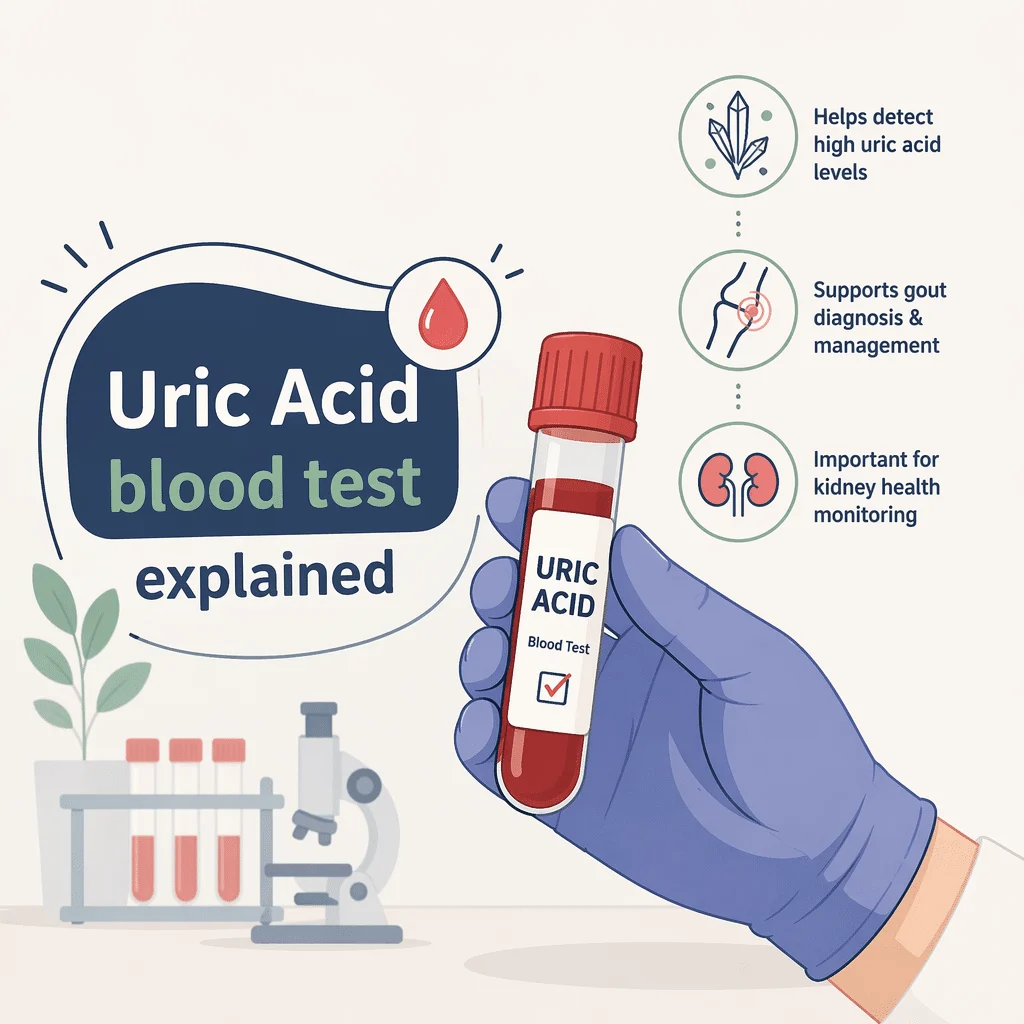
If you have just got your lab results back and you’re looking at a line that says “uric acid,” you’re probably wondering what the number actually means. A uric acid test measures a waste product your body makes when it breaks down substances called purines, and the result helps your doctor understand how your kidneys and metabolism are working. In this article, you’ll learn what uric acid is, what counts as a normal range, what causes levels to run high or low, and when a result is worth a follow-up conversation with your doctor.
What is uric acid and why does it show up on your blood test?
Uric acid is a natural byproduct of purine breakdown. Purines are compounds found in your own cells and in many foods, including red meat, offal, and certain seafood. Your liver converts purines into uric acid, which then travels through your bloodstream until your kidneys filter most of it out through urine, with your digestive system clearing the rest.
In small, steady amounts, uric acid actually serves a purpose. It acts as an antioxidant, helping to mop up unstable molecules called free radicals that can otherwise damage cells. The concern arises only when production and elimination fall out of balance, letting uric acid build up in the blood. Doctors order this test because the result reflects that balance directly: a single number that summarises how well your liver, digestive system, and kidneys are handling one specific waste product, which can offer an early clue about metabolic or kidney issues before other symptoms appear.
How the uric acid cycle works
Purines from cell turnover and diet are broken down into an intermediate compound called xanthine. An enzyme called xanthine oxidase then converts xanthine into uric acid. From there, roughly 70% is filtered out by the kidneys, while the digestive tract handles the remaining 30%. A slowdown at any point in this chain, whether from overproduction, reduced kidney filtering, or a digestive issue, can shift your blood level.
Normal uric acid ranges
Reference ranges vary slightly by laboratory, but the following table reflects the ranges most UK labs use. Because these ranges depend on the assay and population studied, always check the specific range printed on your own lab report.
| Group | Typical normal range |
|---|---|
| Adult women | 2.6–6.0 mg/dL (155–357 micromol/L) |
| Adult men | 3.5–7.2 mg/dL (208–428 micromol/L) |
| Children | 2.0–5.5 mg/dL (120–327 micromol/L), varies with age |
The difference between men and women largely comes down to hormones. Oestrogen promotes uric acid excretion, which is why premenopausal women tend to run lower than men. After the menopause, women’s levels often rise and gradually approach the male range.
Units and conversion
In the United Kingdom, uric acid is usually reported in micromoles per litre (micromol/L). Some countries, including the United States, report it in milligrams per decilitre (mg/dL). To convert, multiply mg/dL by 59.5 to get micromol/L. For example, a level of 6 mg/dL is roughly equal to 357 micromol/L. If you have lab results from more than one country or provider, checking which unit was used before comparing numbers can prevent a lot of unnecessary worry.
What causes high uric acid levels (hyperuricaemia)?
Hyperuricaemia means your uric acid level sits above the typical reference range. It’s common, and many people carry a high level for years without symptoms. Two broad mechanisms explain most cases.
- Increased production, seen in roughly 10-15% of cases, often tied to a purine-rich diet, rapid cell turnover, or certain metabolic conditions.
- Reduced elimination by the kidneys, which accounts for the large majority of cases, often linked to reduced kidney function, dehydration, or certain medications such as diuretics.
Symptoms linked to high uric acid
Not everyone with hyperuricaemia develops symptoms, but when they do appear, they typically include the following. Because these symptoms can overlap with other joint or urinary conditions, a lab result confirming an elevated uric acid level is often what helps a doctor connect the dots.
- A gout attack: sudden, intense pain in a joint, most classically the base of the big toe, along with redness, warmth, and swelling.
- Kidney stones: uric acid crystals can form solid deposits in the urinary tract, causing sharp pain.
- Tophi: visible lumps of crystal deposits under the skin, which usually develop only after years of untreated, persistently high levels.
If your report shows a high result, your doctor may recommend a kidney function panel or a comprehensive metabolic panel to check how your kidneys and broader metabolism are handling the excess.
What causes low uric acid levels (hypouricaemia)?
Hypouricaemia, a uric acid level below the normal range, is far less common than hyperuricaemia and is usually discovered incidentally, without any symptoms. It can result from reduced production, seen with certain enzyme deficiencies or malnutrition, or from increased elimination, linked to some medications or kidney disorders that let too much uric acid pass into the urine.
In rare cases, a persistently low level warrants a closer look, since it can accompany certain liver conditions or specific kidney disorders affecting how the kidneys reabsorb uric acid. Because uric acid has antioxidant properties, some researchers have also explored whether very low levels play a role in certain neurological conditions, though this connection is still being studied and isn’t considered a diagnosis on its own.
Uric acid, gout, and your joints
When uric acid concentration in the blood exceeds what body fluids can dissolve, needle-shaped crystals can form and settle in joints, most often the big toe, ankle, or knee. These crystals trigger a sharp inflammatory response, causing the sudden, severe pain characteristic of a gout attack. Not everyone with high uric acid develops gout. Genetics, joint anatomy, and other factors influence who actually experiences crystal formation and inflammation. You can read more about managing flare-ups and long-term treatment in this guide to gout pain relief and management.
The kidney and cardiovascular connection
Uric acid and kidney health influence each other in both directions. Reduced kidney function slows uric acid clearance, which raises blood levels, and in turn, chronically elevated uric acid may contribute to further kidney strain. This is one reason your doctor may order a kidney function panel alongside a uric acid test, examine your creatinine level, or check your eGFR to estimate how well your kidneys are filtering waste. A BUN test is sometimes added to build a fuller picture of kidney function.
Beyond the kidneys, researchers have studied uric acid as a possible independent cardiovascular risk marker, separate from its traditional link to gout. If you already manage high blood pressure or diabetes, your doctor may pay closer attention to uric acid trends as part of your overall cardiometabolic picture. A comprehensive metabolic panel is often used to evaluate these markers together rather than in isolation.
Diet, lifestyle, and managing your uric acid level
If your result comes back outside the normal range, simple, sustainable changes are usually the first step, with the intensity of follow-up depending on how far off the number is.
Foods and habits linked to higher uric acid
- Red meat and organ meats (liver, kidney), which are dense in purines.
- Certain seafood, including sardines, anchovies, and mackerel.
- Alcohol, particularly beer, which both supplies purines and slows uric acid excretion.
- Sugary drinks high in fructose, which can raise production.
Foods and habits that may help
- Low-fat dairy products.
- Most vegetables, even those historically flagged as purine-containing, such as spinach and asparagus, which research suggests don’t raise gout risk the way meat and seafood do.
- Cherries and vitamin C-rich foods like citrus fruits, which may support kidney elimination of uric acid.
- Adequate water intake, generally 1.5 to 2 litres a day, to help your kidneys clear uric acid efficiently.
- Gradual weight loss if you’re overweight, since rapid or extreme dieting can temporarily raise uric acid instead of lowering it.
- Regular, moderate exercise, such as a daily 30-minute walk, which supports overall metabolic health.
People managing related conditions such as high triglycerides or high cholesterol often find that the same dietary pattern, less red meat and alcohol, more vegetables and fibre, supports several markers at once. You can review your broader lipid picture in this guide to normal triglyceride ranges or this overview of high cholesterol.
When to see a doctor
Most mildly elevated or mildly low results simply call for a repeat test and routine monitoring. Reach out to a doctor sooner if:
- Your result is significantly outside the reference range.
- You experience sudden, severe joint pain, redness, or swelling.
- You have a personal or family history of gout or kidney stones.
- Your level stays elevated despite diet and lifestyle changes.
- You notice new lumps near a joint that could be tophi.
A GP can typically manage a first abnormal result, often starting with a repeat test to confirm the finding before making any changes to your diet or medications. If levels are difficult to control or complications develop, a rheumatologist (a joint and autoimmune specialist) or a nephrologist (a kidney specialist) may become part of your care team to help fine-tune your long-term plan.
How to prepare for a uric acid test
A uric acid test is a standard blood draw, usually taken from a vein in your arm. Fasting isn’t always required, but your lab may ask you to avoid heavy meals, alcohol, and intense exercise for a few hours beforehand, since these can temporarily shift your result. If you want a refresher on the general blood draw experience, this walkthrough of the blood test process covers what happens from the needle to your results, and this guide explains fasting before a blood test in more detail.
Uric acid also fluctuates slightly through the day, often running a bit higher in the morning. If you’re comparing results over time, try to get tested at a similar time of day and under similar conditions for a fairer comparison.
Recent scientific advances
According to PubMed, a 2025 update to the Chinese clinical guidelines for hyperuricaemia and gout, developed using the GRADE framework (a widely used system for rating the strength of medical evidence), refined how doctors approach treatment for people without symptoms. The update recommends tailoring urate-lowering therapy to the underlying cause of a person’s hyperuricaemia rather than applying a single approach to everyone, and it emphasises maintaining stable uric acid levels over time in people with chronic gout (Sun et al., 2025). What this means for you: if you’re diagnosed with a high uric acid level, your treatment plan may look different depending on whether the cause is overproduction or reduced kidney clearance, which is one reason your doctor may order additional tests before recommending medication.
A companion 2025 guideline update focused specifically on people managing hyperuricaemia or gout alongside other conditions, including chronic kidney disease, cardiovascular disease, and diabetes (Li et al., 2025). According to PubMed, the update recommends stricter uric acid targets for people with more advanced chronic kidney disease and highlights coordinated care between kidney, heart, and joint specialists as levels and treatment needs shift. What this means for you: if you have both a kidney condition and elevated uric acid, your care may reasonably involve more than one specialist working from the same target range, rather than treating each condition separately.
A large cohort study following over 27,000 people with chronic kidney disease for roughly a decade found that those with the highest uric acid levels had a meaningfully greater risk of heart failure and death from any cause compared with those with the lowest levels, and this pattern followed a dose-response relationship, meaning risk increased step by step as uric acid levels rose rather than jumping suddenly at one cutoff (Li et al., 2024). What this means for you: this doesn’t mean a high uric acid result causes heart problems on its own, but it does help explain why doctors monitoring kidney disease often track uric acid as one piece of a larger cardiovascular risk picture.
Separately, a nationally representative US cohort study of adults with chronic kidney disease found a J-shaped relationship between uric acid and mortality risk, meaning both unusually low and unusually high levels were associated with somewhat higher risk, with the lowest risk in a middle range (Wu et al., 2024). What this means for you: this is a reminder that lower isn’t automatically better when it comes to uric acid. The goal for most people is a level within the normal range, not the lowest number possible, and any treatment decisions should be individualised by your doctor.
Frequently Asked Questions
What is a normal uric acid level on a blood test?
Normal ranges are typically 2.6 to 6.0 mg/dL for adult women and 3.5 to 7.2 mg/dL for adult men, though exact cutoffs vary slightly by laboratory. Always compare your result to the reference range printed on your own report, since methods differ between labs.
Do I need to fast before a uric acid test?
Fasting isn’t always required for a uric acid test, but some labs request it or ask you to avoid alcohol and heavy meals beforehand, since both can temporarily raise your result. Check with the lab or your doctor’s surgery for their specific instructions before your appointment.
Does everyone with high uric acid get gout?
No. Only a proportion of people with hyperuricaemia go on to develop gout. Genetics, joint anatomy, and other individual factors influence whether crystals form and trigger inflammation, which is why two people with similar lab values can have very different experiences.
Can blood pressure medications change my uric acid level?
Yes. Some diuretics, also called water tablets, used for blood pressure can raise uric acid levels, while certain other blood pressure medications, such as losartan, may modestly lower it. If you’re on blood pressure medication and notice an unexpected change in your uric acid result, it’s worth discussing with your doctor rather than adjusting anything on your own.
Is a high uric acid level linked to heart disease?
Some research suggests elevated uric acid may be an independent marker of cardiovascular risk, separate from its role in gout, though the exact mechanisms are still being studied. A single high result isn’t a heart disease diagnosis, but your doctor may factor it into your broader cardiovascular risk assessment alongside other markers.
Can uric acid be low, and does that matter?
Yes, though low uric acid, or hypouricaemia, is much less common than high uric acid and usually causes no symptoms. It’s often found incidentally on routine blood tests. In rare cases it can be linked to certain liver or kidney conditions, so a persistently low result is still worth mentioning to your doctor.
Uric acid glossary
| Term | Definition |
|---|---|
| Purine | A natural compound found in your cells and in many foods. When purines break down, the body produces uric acid as a byproduct. |
| Hyperuricaemia | A uric acid level above the typical reference range. It’s common and often has no symptoms on its own. |
| Hypouricaemia | A uric acid level below the typical reference range. It’s uncommon and usually found by chance during routine testing. |
| Gout | A form of joint inflammation caused by uric acid crystals settling in a joint, most often the big toe. It causes sudden, intense pain, redness, and swelling. |
| Tophi | Visible deposits of uric acid crystals under the skin, usually near joints. They typically develop only after years of untreated, persistently high uric acid. |
| Xanthine oxidase | An enzyme, a protein that speeds up a chemical reaction in the body, that converts an intermediate compound called xanthine into uric acid. |
| eGFR | Estimated glomerular filtration rate, a calculation that estimates how well your kidneys are filtering waste from your blood. |
| Chronic kidney disease (CKD) | A long-term condition in which the kidneys gradually lose some of their filtering ability. It can both raise uric acid levels and be worsened by them. |
Sources
- MedlinePlus (National Library of Medicine) — Uric acid – blood, Medical Encyclopedia, 2024 — medlineplus.gov
- Cleveland Clinic — Uric Acid Stones: Causes, Symptoms & Treatment, 2023 — my.clevelandclinic.org
- National Institute of Diabetes and Digestive and Kidney Diseases (NIDDK/NIH) — Eating, Diet, & Nutrition for Kidney Stones, 2023 — niddk.nih.gov
- Sun M, Lyu Z, Wang C, et al. — 2024 Update of Chinese Guidelines for Diagnosis and Treatment of Hyperuricemia and Gout Part I: Recommendations for General Patients — International Journal of Rheumatic Diseases, 2025 — PMC12280528
- Li C, Sun M, Liu Z, et al. — 2024 Update of Chinese Guidelines for Management of Hyperuricemia and Gout Part II: Recommendations for Patients With Common Comorbidities — International Journal of Rheumatic Diseases, 2025 — PMC12375887
- Li N, Cui L, Shu R, et al. — Associations of uric acid with the risk of cardiovascular disease and all-cause mortality among individuals with chronic kidney disease: the Kailuan Study — European Journal of Preventive Cardiology, 2024 — PubMed 38946352
- Wu S, Xue W, Yu H, et al. — Serum uric acid levels and health outcomes in CKD: a prospective cohort study — Nephrology Dialysis Transplantation, 2024 — PubMed 37698875
Further reading
- Normal blood test ranges: a reference chart
- Abnormal blood test results: what they mean
- Read blood test results: a simple guide
- Kidney stones: causes, symptoms, and treatments
- Lipid panel explained: cholesterol, LDL, and HDL
Understand your lab results with AI DiagMe
Your uric acid test is just one line on a larger lab report, and its meaning often depends on the values around it. Seeing your uric acid alongside your creatinine, eGFR, and comprehensive metabolic panel results can give you a clearer picture of how your kidneys and metabolism are working together. This kind of side-by-side view can help you understand your results and prepare better questions for your doctor, but it doesn’t replace a medical diagnosis or a conversation with a healthcare professional.
Get your results interpreted in minutes