








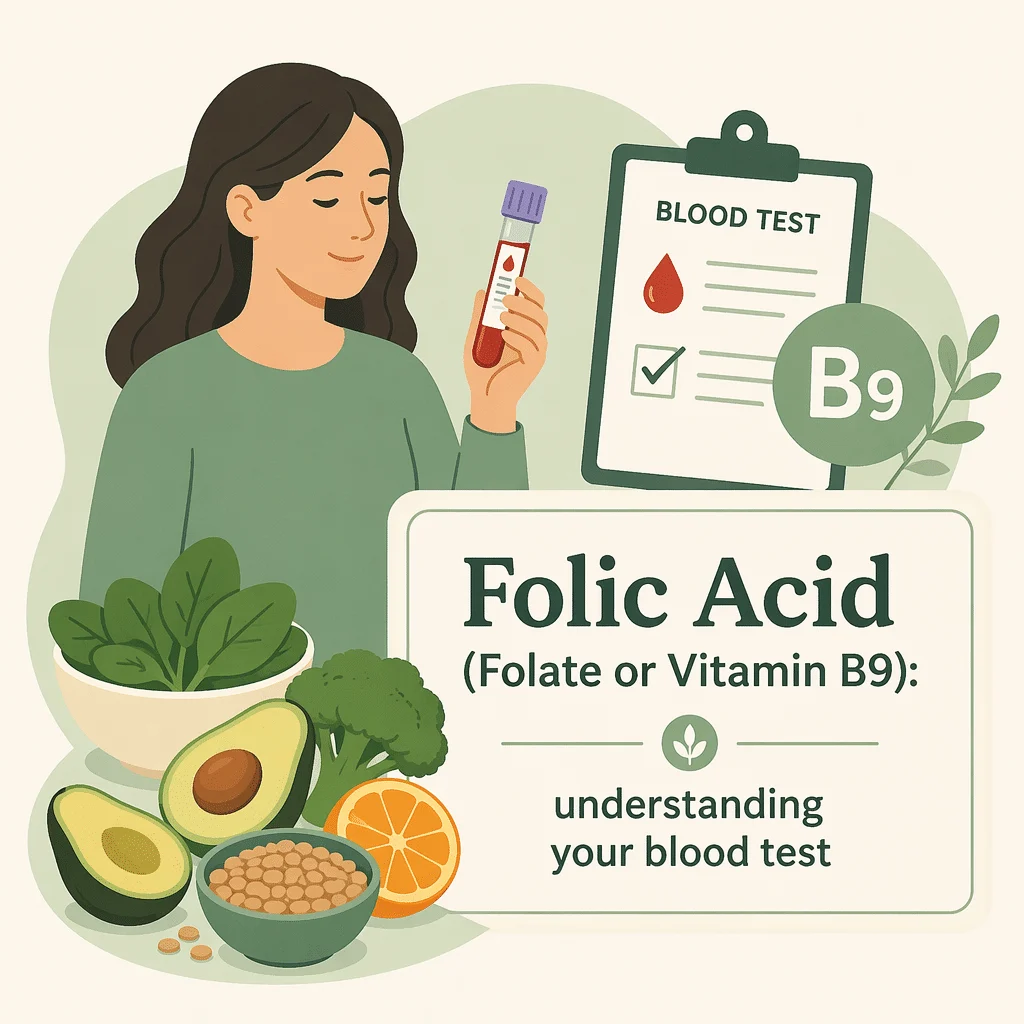
A folic acid blood test measures how much vitamin B9 is circulating in your blood, and it is one of the simplest ways to check whether your body has enough of this nutrient to build new cells. If the word “folate” or “folic acid” has appeared on your lab report, the number beside it becomes much easier to place in context once you know what the test is actually looking at.
In this article you’ll learn what folate does in the body, why a doctor orders this test, how serum folate and red cell folate differ, what low and high results usually mean, why vitamin B12 is almost always checked at the same time, and what recent research says about when this test is genuinely useful.
What folic acid and folate actually are
Folate is the general name for vitamin B9 in all its forms. Folic acid is one specific form of it: the man-made version used in supplements and in fortified foods such as breakfast cereals and enriched flour. The folate that occurs naturally in spinach, lentils or oranges is a slightly different chemical shape.
Both forms end up doing the same job. Once absorbed, your body converts them into the active form, 5-methyltetrahydrofolate (usually shortened to 5-MTHF), which is what actually circulates and gets used.
That active folate has one central task: helping your body copy and repair DNA. Every time a cell divides, it needs folate. This matters most in tissues that renew quickly, and the fastest of all is your bone marrow, where red blood cells are produced around the clock. That is why a folate shortage shows up in your blood before it shows up almost anywhere else.
Folate also helps clear homocysteine, an amino acid that builds up when B vitamins run short. If you want to understand that side of the picture, you can also read our explainer on homocysteine levels.
Why your doctor orders a folic acid blood test
This test is rarely ordered at random. It is usually requested because something else has already raised a question. Common reasons include:
- Unexplained tiredness, paleness, breathlessness on mild exertion, or a sore and unusually smooth tongue.
- A blood count showing anaemia with red blood cells that are larger than normal.
- A digestive condition that interferes with absorbing nutrients, such as coeliac disease or Crohn’s disease.
- Regular heavy alcohol use, which lowers folate through several routes at once.
- Certain long-term medications, including methotrexate, some anti-seizure drugs, and sulfasalazine.
- Planning a pregnancy, or being pregnant, where folate status carries specific importance.
In practice, folate is rarely measured on its own. It is normally read next to vitamin B12 and a full blood count, because those three results only make sense together. If your report shows anaemia, you can consult our overview of anaemia symptoms, causes and tests.
How the folic acid blood test is done
It is an ordinary blood draw from a vein in your arm, using the same sample that other markers are usually measured from. There is nothing special to prepare for beyond what your lab tells you.
Serum folate
Serum folate is the standard test, and it is what most labs report when a request simply says “folate” or “folic acid”. It measures the folate circulating in your blood right now.
Its strength is also its weakness: it is sensitive and quick to move. A folate-rich meal, or a supplement taken that morning, can lift a serum folate result within hours. A few days of eating poorly can push it down. So serum folate reflects your recent intake more than your long-term stores.
Red cell folate
Red blood cell folate (often written RBC folate or erythrocyte folate) measures folate held inside your red cells. Because red cells pick up folate when they are formed and then keep it for their whole lifespan of roughly three to four months, this test acts as a longer-term average. It is far less affected by what you ate yesterday.
Red cell folate is not ordered routinely. Doctors turn to it when a serum result looks misleading, when they want to gauge folate status over months rather than days, or in some situations around pregnancy planning.
Do you need to fast?
Fasting is not usually required for folate specifically. However, because folate is often taken alongside markers that do need an empty stomach, your lab may still ask you to fast for the appointment as a whole. If you are unsure what applies to your own appointment, check our guide to fasting before a blood test. One practical point worth knowing: if you take a folic acid supplement, mention it, and ask whether to take it after the blood draw rather than before, since a morning dose can raise a serum result.
Reading a low folate result
Low folate means your body has less vitamin B9 available than it needs. It is a finding, not a diagnosis. The useful question is always why it is low.
What causes low folate
| Cause | What is happening | Often checked alongside |
|---|---|---|
| Low dietary intake | Few leafy greens, pulses or fortified foods over a sustained period | Full blood count, vitamin B12 |
| Malabsorption | The small intestine cannot absorb folate properly, as in coeliac or Crohn’s disease | Coeliac antibodies, iron studies, endoscopy |
| Higher demand | Pregnancy, breastfeeding, or conditions with rapid cell turnover use folate faster | Full blood count, ferritin |
| Alcohol | Regular heavy use reduces absorption and increases losses | Liver enzymes, full blood count |
| Medications | Methotrexate, some anti-seizure drugs and sulfasalazine interfere with folate | Depends on the drug and the reason for it |
| Increased losses | Dialysis or some chronic conditions remove folate from circulation | Kidney function panel |
Malabsorption deserves a mention of its own, because low folate is sometimes the clue that leads to the underlying diagnosis rather than the other way round. If that applies to you, you can read our article on gluten intolerance and coeliac disease.
Symptoms and megaloblastic anaemia
Mild folate shortage often causes nothing noticeable at all. When symptoms do appear, they tend to be non-specific: fatigue that rest does not fix, irritability, difficulty concentrating, paleness, breathlessness on stairs, or mouth ulcers and a smooth, tender tongue.
If folate stays low for long enough, the bone marrow struggles to divide red cells properly. It keeps building them but cannot finish the job, so they end up abnormally large and fewer in number. This is called megaloblastic anaemia, and on a lab report its signature is a raised MCV, the average size of your red blood cells. To understand that number, see our guide to the MCV blood test. For a fuller description of how a deficiency presents, you can review the full list of folate deficiency symptoms.
One reassuring point: folate-related anaemia responds well once the cause is identified and addressed. The reason doctors do not simply start folic acid straight away is explained in the next section.
Normal and high folate results
Folate is usually reported in nanograms per millilitre (ng/mL) or nanomoles per litre (nmol/L). Reference ranges differ between laboratories because they depend on the method used, so always read your result against the range printed on your own report rather than one found elsewhere. A result inside the range simply means your folate is where it is expected to be.
High folate is common and, in itself, is not treated as a disease. The usual explanation is straightforward: a supplement, a multivitamin, or a diet with plenty of fortified foods. Since folate is water-soluble, the body handles a surplus mainly by passing it out in urine.
The reason a high result still gets attention is not the folate itself but what it can hide. That is covered below, and we go into more detail in our article on high folate levels. Less commonly, a high reading can reflect a liver problem, since the liver stores and releases folate.
Why folate and vitamin B12 are read together
This is the single most important idea on this page, and it is worth taking slowly.
Folate and vitamin B12 work as a pair when red cells are made. If either one runs short, the marrow produces the same oversized, immature red cells. In other words, folate deficiency and B12 deficiency can produce an almost identical blood count. You cannot tell them apart from the anaemia alone, which is exactly why both are measured.
| Folate deficiency | Vitamin B12 deficiency | |
|---|---|---|
| Effect on red cells | Large, immature red cells; raised MCV | Large, immature red cells; raised MCV |
| Effect on nerves | Not a typical feature | Can cause tingling, numbness, balance and memory problems |
| Homocysteine | Raised | Raised |
| Methylmalonic acid | Normal | Raised, which helps separate the two |
| Usual causes | Diet, malabsorption, alcohol, medication, pregnancy | Absorption problems, autoimmune causes, low intake over years |
Here is the part that matters clinically. Folic acid can correct the anaemia caused by a B12 deficiency. The blood count improves, the red cells normalise, and the picture looks fixed. But folic acid does nothing for the nerve damage that a B12 deficiency causes, and that damage can keep progressing quietly while the blood results look reassuring. This is what is meant when people say folic acid can mask a B12 deficiency.
This is not a reason for alarm, and it is not a reason to avoid folic acid. It is simply the reason your doctor checks B12 before starting folate treatment, and the reason a high folate result alongside a borderline B12 is worth a conversation. If this applies to you, many people also read our guide to the vitamin B12 blood test.
Folate before and during pregnancy
Folate has a specific role in early pregnancy. In the first weeks after conception, the embryo forms a structure called the neural tube, which goes on to become the brain and spinal cord. It closes very early, often before a pregnancy is known. Adequate folate supports that closure, and low folate is linked to a higher risk of neural tube defects such as spina bifida.
Because the neural tube closes so early, the timing is what matters. The CDC states that all women who could become pregnant should get 400 micrograms of folic acid daily, a recommendation made by the U.S. Public Health Service and supported by the US Preventive Services Task Force. The CDC also notes that women who have had a previous pregnancy affected by a neural tube defect are advised to discuss a higher dose with their healthcare provider. Any dose decision belongs with your own clinician, who knows your history.
Worth knowing: taking folic acid in pregnancy does not mean your folate will be measured. Testing and supplementing are separate questions, and supplementation is advised regardless of whether anyone tests your level. If you are pregnant or planning to be, you can review our guide to blood tests during pregnancy.
When to see a doctor
Book an appointment to discuss your result if any of the following apply:
- Your folate is flagged low, whether or not you feel unwell.
- You feel persistently tired, pale or breathless on light effort, or your tongue is sore and smooth.
- Your folate is low or high and your vitamin B12 was not measured at the same time.
- You have tingling, numbness, unsteadiness or memory changes, which point towards B12 rather than folate and should not wait.
- You are pregnant, planning a pregnancy, or have had a pregnancy affected by a neural tube defect.
- You take methotrexate, an anti-seizure medication, or another drug that affects folate.
- You have a digestive condition, or ongoing diarrhoea, abdominal pain or unexplained weight loss.
Seek urgent care for chest pain, fainting, or breathlessness at rest, which need assessment straight away whatever your folate result says.
Latest scientific advances in folate testing
Research since 2023 has shifted the conversation away from “what is a normal folate level” and towards “who actually benefits from having folate measured at all”. Four findings stand out.
Routine folate testing in healthy people has limited value
A nationwide cohort study of more than 20,000 children and adolescents (Vinker-Shuster and colleagues, 2024) found that folate deficiency was uncommon, and that when it did occur it was almost never the cause of megaloblastic anaemia. Deficiency clustered instead in specific groups: children with coeliac disease, and those taking antipsychotic or psychostimulant medication. The authors concluded that routine folate testing in healthy young people in developed countries has low utility, and that targeted testing makes more sense.
What this means for you: if folate was measured as part of a broad check-up and came back slightly low without any symptoms, that finding on its own is less alarming than it may look. The result carries much more weight when there is a reason to look, such as a digestive condition or a relevant medication. This was an observational study looking back at existing records, so it describes patterns rather than proving cause and effect.
Guidelines increasingly advise against routine folate testing before pregnancy
An evidence summary published in 2026 (Li and colleagues) pooled 17 guidelines and expert consensus documents on folic acid for preventing neural tube defects. Alongside the familiar advice to start supplementing before conception and to continue through the first trimester, one recommendation stands out: routine folate testing is not advised, and diet alone is generally considered insufficient.
What this means for you: not being offered a folate test before pregnancy is not an oversight. The reasoning is that supplementation is recommended anyway, so a test would not change the plan. This was a synthesis of existing guidelines rather than new patient data, and national recommendations still vary between countries.
The evidence for folic acid preventing neural tube defects continues to hold
An updated systematic review for the US Preventive Services Task Force (Viswanathan and colleagues, 2023), drawing on studies covering well over a million people, reconfirmed that folic acid supplementation around conception reduces the risk of neural tube defects. It also examined possible harms that had been raised in public debate, including autism, twin pregnancies and maternal cancer, and found no evidence of harm from folic acid taken in relation to pregnancy.
What this means for you: the core advice has not changed, and the reassurance on safety is now based on a larger body of evidence. Much of the newer evidence is observational, which is why the task force treats it as consistent with, rather than a replacement for, the older randomised trials.
Excess folic acid and vitamin B12 deficiency: what is known and what is not
A 2024 review in Food and Nutrition Bulletin (Miller and colleagues) examined the long-standing concern that high folic acid intake can worsen an existing B12 deficiency. The authors describe a consistent pattern: people who have low B12 together with high folate tend to score lower on cognitive tests and show more marked biochemical signs of B12 deficiency than people with low B12 and ordinary folate levels. Their proposed explanation is that high-dose folic acid depletes a transport protein that carries B12 to the tissues.
The authors are careful about how far this goes. Most of the evidence is correlational or from uncontrolled clinical observation, and the mechanism they propose has not yet been tested directly. Even so, they judged it compelling enough to advise heightened vigilance for B12 deficiency in people at risk, particularly older adults and anyone with absorption problems, who are also taking large amounts of folic acid.
What this means for you: standard folic acid doses, including the 400 micrograms recommended around pregnancy, are not what this research is about. The signal concerns high-dose folic acid in people who already have a B12 problem. The practical takeaway is simply to have B12 checked alongside folate rather than to worry about folic acid itself.
Glossary
| Term | Definition |
|---|---|
| Folate | The general name for vitamin B9 in all its forms, including the forms found naturally in food |
| Folic acid | The man-made form of vitamin B9 used in supplements and fortified foods |
| 5-MTHF | Short for 5-methyltetrahydrofolate, the active form of folate that circulates and is used by cells |
| Serum folate | The standard test, measuring folate circulating in the blood now; reflects recent intake |
| Red cell folate | Folate held inside red blood cells; reflects folate status over roughly the past three months |
| Megaloblastic anaemia | Anaemia in which red blood cells are abnormally large and immature, caused by low folate or low vitamin B12 |
| MCV | Mean corpuscular volume, the average size of red blood cells; rises in megaloblastic anaemia |
| Homocysteine | An amino acid that folate helps clear; it rises when folate or vitamin B12 is low |
| Methylmalonic acid | A substance that rises in vitamin B12 deficiency but not in folate deficiency, helping tell them apart |
| Neural tube defect | A birth defect of the brain or spine, such as spina bifida, that forms in the first weeks of pregnancy |
Frequently asked questions
What is a folic acid blood test called on a lab report?
Labs use several names for the same measurement. You may see it listed as folate, serum folate, folic acid, vitamin B9, or occasionally folate (serum). If your doctor specifically wanted the longer-term measure, it will appear separately as RBC folate, red cell folate or erythrocyte folate. All of these are folate tests; the distinction that matters is only whether the sample measured folate in the liquid part of your blood or inside your red cells.
What is the normal range for a folic acid blood test?
There is no single universal range. Laboratories use different analysers and different methods, so each one publishes its own reference range, and results can also be reported in two different units (ng/mL or nmol/L). A serum folate range commonly starts somewhere around 3 to 4 ng/mL at the lower end. The only range that applies to your result is the one printed next to it on your own report, which is why comparing your number with a friend’s is rarely helpful.
What does a folic acid result of 20 ng/mL mean?
On most reference ranges, a serum folate around 20 ng/mL sits at or near the top of normal, and it is a common finding in anyone taking a supplement or eating fortified foods. In itself it is not a problem, since surplus folate is largely passed out in urine. The question a doctor would ask is not about the folate but about the B12 sitting next to it. A high folate with a low or borderline B12 is the combination worth discussing, not the folate figure alone.
What is the difference between folate and folic acid on a blood test?
On a blood test, essentially nothing: the assay measures total folate in your sample regardless of which form it originally came from, so the two names are used interchangeably on reports. The distinction is about the source, not the measurement. Folate is the umbrella term and covers the natural forms in food; folic acid is the specific man-made form added to supplements and fortified products. Your body converts both into the same active form before using them.
Can taking folic acid affect a pregnancy test?
No. A home pregnancy test detects hCG, a hormone produced during pregnancy, and folic acid has no effect on it. You can take your usual folic acid without it changing the result, and there is no need to stop before testing. If a pregnancy test result seems inconsistent with how you feel, the explanation lies with the timing of the test or the hormone itself, not with your supplement.
Do oral contraceptives lower folate levels?
Long-term use of some oral contraceptives has been associated with a modest reduction in folate status, though it is generally not large enough to cause deficiency on its own in someone eating reasonably well. It becomes more relevant if you are thinking about coming off the pill to conceive, since folate matters most in the earliest weeks of pregnancy. That is a good reason to raise it with your doctor when you discuss planning, rather than a reason to change anything now.
Sources
- National Institutes of Health, Office of Dietary Supplements — Folate: Fact Sheet for Health Professionals — https://ods.od.nih.gov/factsheets/Folate-HealthProfessional/
- Centers for Disease Control and Prevention — About Folic Acid (reviewed May 2025) — https://www.cdc.gov/folic-acid/about/index.html
- US Preventive Services Task Force — Folic Acid Supplementation to Prevent Neural Tube Defects: Preventive Medication, Final Recommendation Statement, 2023 — https://www.uspreventiveservicestaskforce.org/uspstf/recommendation/folic-acid-for-the-prevention-of-neural-tube-defects-preventive-medication
- Miller JW, Smith A, Troen AM, Mason JB, Jacques PF, Selhub J — Excess Folic Acid and Vitamin B12 Deficiency: Clinical Implications? — Food and Nutrition Bulletin, 2024 — https://pubmed.ncbi.nlm.nih.gov/38987872/
- Vinker-Shuster M et al. — Low utility of serum folic acid blood tests in healthy children and adolescents, a nationwide cohort — European Journal of Pediatrics, 2024 — https://consensus.app/papers/details/8b4f6ae604185affa9164d0fc98dfd6b/
- Viswanathan M et al. — Folic Acid Supplementation to Prevent Neural Tube Defects: Updated Evidence Report and Systematic Review for the US Preventive Services Task Force — JAMA, 2023 — https://consensus.app/papers/details/7870d5f04f5155a5ba790ff6e18c4442/
- Li J et al. — Best Evidence Summary of Folic Acid Supplementation for Prevention of Neural Tube Defects in Women of Childbearing Age — Nutrients, 2026 — https://consensus.app/papers/details/46870a770c3555e1b78bef3f5501d38d/
Further reading
- Vitamin panel blood test: D, B12 and folate
- Low vitamin B12: symptoms, causes and treatments
- Complete blood count: how to read your results
- Iron studies panel: ferritin and TIBC explained
- Normal blood test ranges: a reference chart
Understand your lab results with AI DiagMe
A folate figure rarely tells the whole story on its own. It becomes meaningful once you read it alongside your vitamin B12, your full blood count and, in some cases, your homocysteine. AI DiagMe turns those numbers into plain language so you can see how they fit together and arrive at your appointment with better questions. It helps you understand your results; it does not diagnose, and it does not replace your doctor.
Get your results interpreted in minutes