




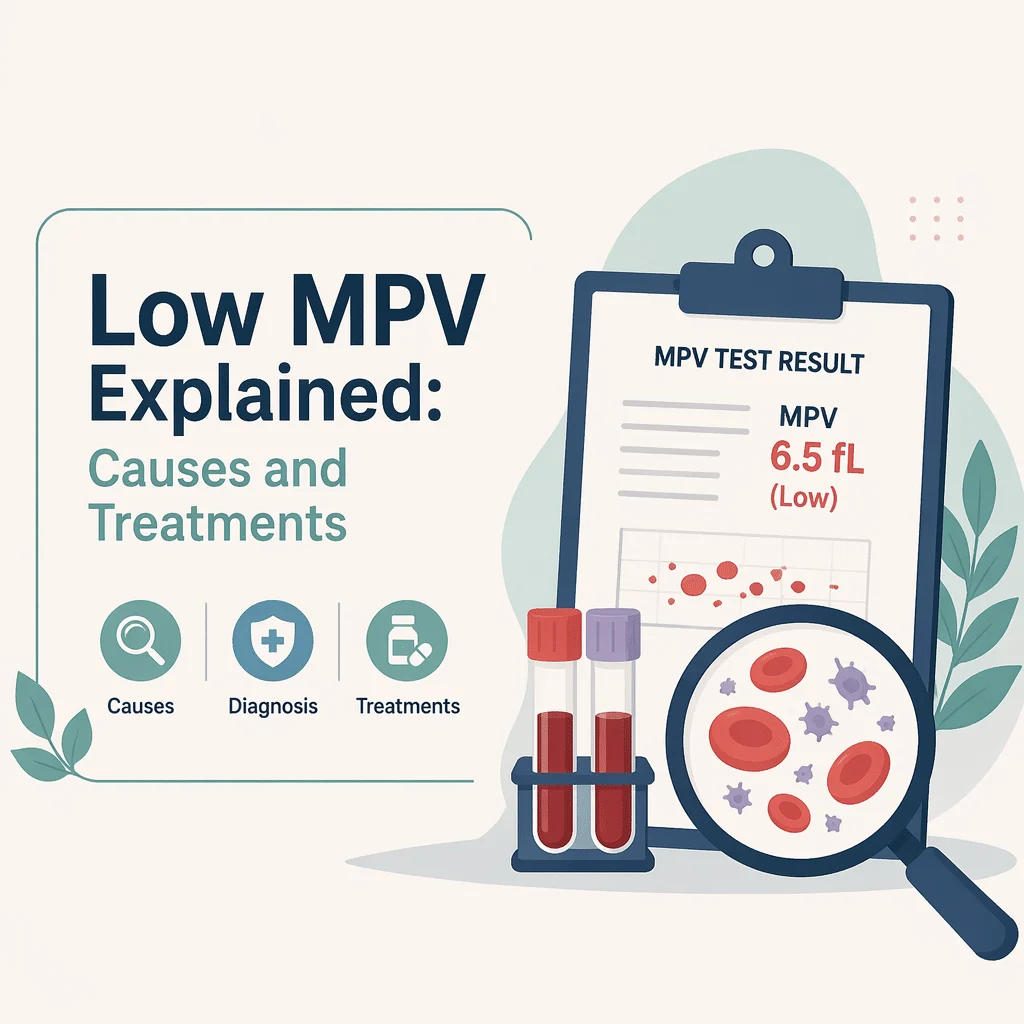
A low MPV on a complete blood count means the average size of your platelets is smaller than the range your laboratory treats as typical. It describes platelet size. It is not a diagnosis, and on its own it rarely explains much. What makes the number useful is the company it keeps: the platelet count printed beside it, the rest of your blood count, and what your clinician already knows about your health. In this article you’ll learn what platelet size actually reflects, which conditions and treatments tend to pull MPV down, how to read a low MPV against a low, normal or high platelet count, why the same blood sample can produce two slightly different MPV numbers, and what doctors usually do next.
What a low MPV actually measures
Platelets are the smallest cells in circulating blood, and their job is to seal small breaks in blood vessel walls. A complete blood count reports how many you have, and it also reports how big they are on average. That average is the mean platelet volume, written as MPV and measured in femtoliters (fL). A result below the reference interval says one thing only: the average platelet in that sample was on the small side.
Where platelet size comes from
Platelets are not made one at a time. They are shed in fragments from megakaryocytes, the large bone-marrow cells that pinch off platelets into the bloodstream. Freshly released platelets tend to be bigger; as they circulate over roughly a week to ten days, they shrink. So the average size of your platelets partly reflects how briskly your marrow has been releasing new ones. When production runs fast, the circulating mix holds more young, large platelets and MPV rises. When production is slow or suppressed, the pool skews older and smaller, and the average volume falls.
Typical ranges, and why two labs can disagree
Most adult reference intervals for MPV fall somewhere between roughly 7.5 and 12 fL, but the figures printed on your report belong to your laboratory and its analyzer, not to MPV in general. Different instruments size platelets by different physical methods, and each laboratory sets its own interval. A value flagged low at one lab can sit comfortably inside the range at another. You can check typical adult figures in our reference chart of normal blood test ranges, but read the interval on your own report first.
What pulls MPV down
A low MPV is a downstream signal, so the useful question is never how to raise the number but what is making the platelets small. Several very different mechanisms produce the same result.
Slowed or reduced platelet production
The most direct explanation is a marrow releasing fewer new platelets than usual. Because young platelets are the large ones, a marrow working at a reduced pace sends out proportionally fewer of them and the average size falls. Conditions that suppress marrow output can show up this way, including aplastic anemia, in which the marrow fails to make enough of all three blood cell types. In that setting the finding almost never travels alone: the platelet count, white cells and hemoglobin usually move too.
Chronic inflammation and autoimmune conditions
Long-running inflammation frequently lowers MPV, and the pattern is best documented in inflammatory bowel disease. The likely explanation is that inflammation pushes the marrow to release a large number of platelets, many of them small, while larger activated platelets are consumed at inflamed tissue. Long-running gut inflammation is one example, and we cover it in our article on Crohn’s disease. Clinicians often pair platelet indices with an inflammation marker, explained in our guide to C-reactive protein, because the two together say more than either alone.
Medicines and treatments that affect the marrow
Cytotoxic chemotherapy, several immunosuppressive drugs and radiation to marrow-rich bones all reduce platelet production for a time, and MPV commonly drifts down while that is happening. This is usually expected, monitored and temporary, and it is followed alongside the platelet count rather than on its own. If you are on treatment that affects the marrow, your care team is already reading these numbers in sequence, and a single small-platelet reading in that context adds little new information.
Inherited causes of small platelets
A small number of genetic conditions produce genuinely small platelets from birth. Wiskott-Aldrich syndrome and related X-linked disorders are the classic examples, and they are rare. They are also not silent: they typically appear in childhood with repeated infections, eczema or bleeding, not as an isolated laboratory finding in an adult who feels well. A small average platelet size discovered on a routine adult blood count is very unlikely to be inherited.
Nutritional and everyday contributors
Iron deficiency is often listed as a cause of small platelets, and iron status is worth checking whenever a blood count looks unusual. Its effect on platelet size, however, is inconsistent: iron deficiency turns up with low, normal and raised MPV values alike. Iron is usually checked first, and we explain the numbers in our guide to low ferritin. Your clinician may order a broader workup, described in our overview of the iron studies panel. Small platelets also turn up alongside red-cell changes, which we describe in our guide to anemia symptoms and tests.
How to read a low MPV against your platelet count
This is the most useful thing you can do with this result, and it takes about ten seconds. Find the platelet count on the same report, usually labeled PLT or platelet count, and read the two values together. The pairing narrows the possibilities far more than either number manages alone. The table below sets out the three combinations and what clinicians generally do with each.
| Low MPV combined with | What it commonly suggests | What a clinician typically looks at next |
|---|---|---|
| A low platelet count | Reduced platelet production is the leading consideration, because both the number and the size point the same way. Recent chemotherapy, marrow disease and some viral infections sit here. | A repeat count to confirm it is real, the white cell and hemoglobin figures on the same report, a review of current medicines, a blood film examined under the microscope, and referral to a hematologist if it persists. |
| A normal platelet count | The most common situation in practice and usually the least concerning. Production is evidently adequate, since the count is fine. Sample handling and normal biological variation explain many of these results. | Your symptoms and medicines, and often nothing more than a repeat count at your next routine test. If you feel well and the rest of the count is normal, further testing is frequently unnecessary. |
| A high platelet count | Points toward a reactive rise in platelets, meaning the marrow is pushing out many platelets in response to something else: inflammation, infection, iron deficiency, recent surgery or blood loss. | Inflammation markers such as C-reactive protein, iron studies, and a search for the underlying trigger. Attention goes to the cause, not to the MPV value itself. |
Why the middle row matters most
Most people who look this result up are in the middle row: the MPV is flagged, everything else on the report is normal, and they feel fine. That combination is reassuring by its own internal logic. If the marrow were failing to produce platelets, the count would be low as well. A normal count means production is working. What remains is a small average size, which is a description of the platelet population rather than evidence of disease.
Why the same blood can give two different MPV numbers
MPV carries an unusual weakness among routine blood results: it changes inside the tube. Blood for a complete blood count is collected into a tube containing EDTA, an anticoagulant that keeps the sample from clotting. Platelets sitting in EDTA gradually swell, so the measured MPV creeps upward the longer the sample waits before it is run. Laboratory work on this has shown that MPV stability depends on the anticoagulant used, the storage temperature and the interval between the blood draw and the analysis. A separate 2023 comparison of routine samples found that MPV drifted beyond acceptable laboratory limits when analysis was delayed by a day.
The practical consequence is modest but worth knowing. A borderline MPV, just below or just above the printed range, can partly reflect how long your sample sat in transit rather than anything about you. A tube drawn at a clinic and driven to a central laboratory may be measured hours later than one run on site, and the two can differ. This is a large part of why MPV is not used as a standalone test, and why clinicians read it beside the platelet count rather than by itself.
What this means for you: do not read much into a small change in MPV between two draws, particularly if the samples went to different laboratories or were collected at different times of day. If a value matters clinically, the answer is a repeat sample handled consistently, not a search for meaning in a fraction of a femtoliter. Readers who want the wider picture can review our full guide to complete blood count results.
What a low MPV does not mean
A handful of worries come up predictably, and most of them can be set down.
- It is not a bleeding test. Platelet size does not predict bleeding on its own; the platelet count and clotting tests do that work. Clotting is measured separately, and we explain those tests in our guide to the coagulation panel.
- It is not a cancer screen. Some marrow diseases can lower MPV, but the finding is far too common and far too non-specific to serve as a screening test, and an isolated small platelet size in a person who feels well is not a cancer signal.
- It is not a number to treat. There is no treatment for a low MPV itself. Where treatment is needed, it is aimed at whatever lies behind it.
- It is not a fixed personal trait. MPV shifts with inflammation, medication, recent illness and sample handling, so one value is a snapshot rather than a verdict.
If your report shows the opposite pattern, with platelets larger than average, see our companion article on high MPV.
What clinicians typically look at next
Tests commonly ordered alongside
When a low MPV genuinely needs following up, the next steps are ordinary and inexpensive. A repeat complete blood count confirms the finding and shows the direction of travel. A white cell differential and the hemoglobin figures reveal whether other cell lines are affected. Iron studies, vitamin B12 and folate cover the common nutritional contributors. An inflammation marker helps when a chronic condition is suspected. A blood film, in which a technologist looks at the cells under a microscope, can identify unusually small or clumped platelets that an analyzer may misread. Other cell lines can drift at the same time, as we describe in our guide to low lymphocytes.
When to seek care
A low MPV by itself is not a reason to seek urgent care. The following are worth raising promptly with a clinician, whatever your MPV shows:
- Bruising that appears without any knock, or bruises that keep spreading
- Small flat red or purple dots on the skin, often clustered on the lower legs
- Nosebleeds or gum bleeding that are new, frequent or slow to stop
- Bleeding that will not settle after a minor cut, or periods that have become unusually heavy
- Repeated infections, drenching night sweats, or weight loss you cannot explain
- A platelet count that is falling across repeated tests, whatever the MPV does
Bring the printed report to the appointment. Having the actual figures and your laboratory’s own reference intervals in front of you saves a great deal of guesswork, and it lets your clinician compare today’s result with earlier ones.
Latest scientific advances
Research on platelet size has moved away from treating MPV as a test in its own right and toward reading it in context. Four recent reviews show where the evidence now stands. All four are observational, meaning they describe patterns across groups of people rather than proving that one thing caused another.
Chronic gut inflammation is reliably linked to smaller platelets
What was found: a 2024 systematic review pooled 79 studies covering more than 8,000 people with inflammatory bowel disease and more than 13,000 comparison participants without it. Those with the disease had clearly higher platelet counts and clearly lower MPV. The size difference was consistent but small, averaging under one femtoliter.
What this means for you: if you live with Crohn’s disease or ulcerative colitis, a low MPV on your blood count is a recognized part of the picture rather than a surprise. It reflects the inflammation, and it is not a separate problem needing its own treatment.
MPV tends to fall further when inflammation is active
What was found: a 2026 systematic review of 18 studies in roughly 2,160 people with inflammatory bowel disease compared active flares with quiet periods. During active disease, platelet counts ran higher and MPV ran lower than during remission. The authors suggest that following platelet measurements over time gives useful information about how active the disease is.
What this means for you: the direction your own results move over months may say more than any single value. A low MPV that drifts back up as a flare settles is exactly what researchers observe, and it is a reason to compare reports rather than fixate on one.
MPV is increasingly studied as a ratio, not a lone number
What was found: a 2025 systematic review examined platelet measurements as low-cost markers in sepsis, a dangerous whole-body reaction to infection, across 14 studies. What the researchers assessed was not MPV by itself but MPV divided by the platelet count. Even then, accuracy was moderate at best, and the authors describe the approach as promising rather than proven, still needing confirmation.
What this means for you: this is the same principle as reading MPV beside the platelet count on your own report, and it is now the direction the whole field has taken. It also shows that even in research settings, MPV alone is not accurate enough to base decisions on.
Where MPV has not held up
What was found: a 2025 review of 35 studies and roughly 7,940 people with oral cancer tested whether several routine blood indices predicted outcomes. Two ratios involving white cells and platelets did show consistent associations. MPV did not. The results across studies disagreed so much that the authors could not combine them at all.
What this means for you: this is reassuring rather than worrying. Your MPV is not a hidden prognostic score. Findings like these are the reason guidelines do not ask clinicians to act on MPV in isolation, and the reason a repeat blood count and a conversation usually settle the question.
Glossary of key terms
| Term | Definition |
|---|---|
| Mean platelet volume (MPV) | The average size of the platelets in a blood sample, reported in femtoliters on a complete blood count. |
| Platelet | The smallest cell in circulating blood. Platelets gather at breaks in blood vessel walls and help seal them. |
| Megakaryocyte | A large cell in the bone marrow that sheds fragments of itself into the bloodstream. Those fragments are platelets. |
| Complete blood count (CBC) | A common blood test that counts red cells, white cells and platelets and reports several size and volume measurements, MPV among them. |
| Femtoliter (fL) | The unit used for cell volumes on a blood count. It is an extremely small volume, which is why MPV differences look tiny. |
| Thrombocytopenia | A platelet count below the laboratory reference range. It describes how many platelets there are, not how big they are. |
| Platelet distribution width (PDW) | A measure of how varied platelet sizes are within one sample. It is often reported next to MPV. |
| EDTA tube | The blood collection tube used for a complete blood count. It contains an anticoagulant that stops the sample clotting before analysis. |
| Reference interval | The range of values a particular laboratory considers typical, based on its own instrument and population. Ranges differ between laboratories. |
| Blood film | A drop of blood spread on a glass slide and examined under a microscope, used to check what an automated analyzer reported. |
Frequently asked questions
Can a low MPV cause fatigue?
No. Platelet size has no known link to energy levels, and a low MPV does not itself produce symptoms. If you are tired and your blood count shows a low MPV, the explanation is far more likely to sit elsewhere on the same report. Low hemoglobin, low iron stores, low vitamin B12 or an underactive thyroid are common causes of fatigue and are all measurable. It is worth asking your clinician to look at those figures rather than at the MPV. Fatigue that is persistent, worsening or accompanied by breathlessness deserves assessment in its own right, whatever your platelet indices show.
What does a low MPV mean if the rest of my blood test is normal?
In most cases it means very little. A normal platelet count tells you the marrow is producing platelets adequately, and normal white cells and hemoglobin indicate the other cell lines are behaving. What is left is a small average platelet size, which sits within the ordinary variation between healthy people and can be influenced by how the sample was handled. Clinicians commonly respond by rechecking the count at your next routine test rather than investigating further. If you feel well and nothing else on the report is flagged, an isolated low MPV is generally treated as an observation, not a finding to chase.
Does a low MPV mean I have cancer?
A low MPV is not a cancer test and cannot indicate cancer on its own. Some marrow conditions, including certain blood cancers, can lower MPV, but they almost always disturb other parts of the blood count at the same time, particularly the platelet count, the white cell count and hemoglobin. A low MPV with an otherwise normal count in a person who feels well points away from that scenario rather than toward it. Research also supports this: reviews that tried to link MPV to cancer outcomes found results too inconsistent to combine. If you have unexplained weight loss, night sweats or persistent lumps, raise those symptoms directly.
What counts as a normal MPV, and does it shift with age?
Adult reference intervals usually sit somewhere between roughly 7.5 and 12 fL, but the number that matters is the one printed beside your result, because every laboratory sets its own range for its own analyzer. Platelet size does vary modestly across the lifespan and between individuals, and newborns and young children can differ from adults. Sex-related and population-related differences are small. Because ranges are not interchangeable between laboratories, comparing an MPV from one lab with an MPV from another is unreliable. Comparing results from the same laboratory over time is far more informative.
Should I repeat the test if my MPV is only slightly below range?
There is usually no need to arrange an early repeat purely because of a marginal MPV. Platelet size measurements are sensitive to how long a sample waits before analysis, so a value a fraction below the range may reflect logistics rather than biology. The usual approach is to let the next routine blood count answer the question. Repeat sooner if the platelet count is also abnormal, if you have started a new medication that affects the marrow, or if you develop easy bruising or unusual bleeding. In those situations the repeat is being done for the count and the symptoms, not for the MPV.
Can a low MPV be inherited?
Inherited causes of genuinely small platelets exist but are rare, and they do not usually stay hidden. Conditions such as Wiskott-Aldrich syndrome combine small platelets with a low platelet count and typically declare themselves in early childhood through repeated infections, eczema or bleeding. An adult who has always had normal blood counts and suddenly shows a mildly low MPV is very unlikely to have an inherited platelet disorder. If several family members have low platelet counts, easy bruising or a known bleeding disorder, mention that history to your clinician, because family pattern is what prompts genetic assessment.
Sources
- MedlinePlus, National Library of Medicine — MPV Blood Test, 2024 — medlineplus.gov
- Mayo Clinic — Thrombocytopenia (low platelet count): symptoms and causes, 2025 — mayoclinic.org
- National Heart, Lung, and Blood Institute — Platelet Disorders: Thrombocytopenia, 2025 — nhlbi.nih.gov
- Xu C, Song Z, Hu LT, Tong YH, Hu JY, Shen H — Abnormal platelet parameters in inflammatory bowel disease: a systematic review and meta-analysis — BMC Gastroenterology, 2024 — doi.org/10.1186/s12876-024-03305-9
- Wang H, Shao R, Wu S, Zhu Y, Zhang Z, Cui M, Xiang M, Li S, Fan F, Li X, Tao Y — The value of platelet-associated parameters as biomarkers in evaluating the disease activity of inflammatory bowel disease: a systematic review and meta-analysis — BMC Gastroenterology, 2026 — doi.org/10.1186/s12876-026-04603-0
- Tong X, Yang S, Sun J, Jia Q, Fan H, Li Z — Platelet parameters as potential biomarkers for sepsis: a systematic review and meta-analysis — Systematic Reviews, 2025 — doi.org/10.1186/s13643-025-02979-w
- Alshahrani AM, Kaur K, Saini RS, Heboyan A — Hematological parameters as predictors of oral cancer prognosis: a systematic review and meta-analysis — Journal of Cancer Research and Clinical Oncology, 2025 — doi.org/10.1007/s00432-025-06394-5
- Buttarello M, Mezzapelle G, Plebani M — Effect of preanalytical and analytical variables on the clinical utility of mean platelet volume — Clinical Chemistry and Laboratory Medicine, 2018 — doi.org/10.1515/cclm-2017-0730
- Maroto-Garcia J, Deza S, Fuentes-Bullejos P, Fernandez-Tomas P, Martinez-Espartosa D, Marcos-Jubilar M, Varo N, Gonzalez A — Analysis of common biomarkers in capillary blood in routine clinical laboratory: preanalytical and analytical comparison with venous blood — Diagnosis, 2023 — doi.org/10.1515/dx-2022-0126
Further reading
- How to read your blood test results
- Abnormal blood test results and what they mean
- CBC versus CMP: understanding the two tests
- Low MCHC: causes, symptoms and treatment
- Low vitamin B12: symptoms, causes and treatments
Understand your lab results with AI DiagMe
A low MPV only becomes meaningful next to the rest of your blood count, and that is exactly the comparison most people cannot make on their own. AI DiagMe reads your report as a whole, putting your platelet size beside your platelet count, your hemoglobin, your iron studies and your inflammation markers, and explains in plain language what the pattern usually reflects. It is built to help you understand your results and arrive at your appointment with better questions. It does not diagnose, and it does not replace your doctor.
Get your results interpreted in minutes