






Prediabetes A1c: What the Grey Zone Really Means for Your Heart

目录

Prediabetes A1c result highlighted on a lab report beside fasting glucose and cholesterol values

⚕️ 本文仅供参考,不能替代医疗建议。请务必咨询医生以解读您的检查结果。.

A prediabetes A1c result sits in an awkward place: high enough to be flagged, not high enough to be called diabetes. In the United States that grey zone runs from 5.7% to 6.4%, and a large share of adults falls inside it without knowing. On 21 August 2026, diabetes specialist John Anderson, MD, a past president of Medicine and Science at the American Diabetes Association, argued in The American Journal of Managed Care that primary care keeps missing this window. He made one point that changes how the number should be read: cardiovascular risk begins accumulating during prediabetes, before anyone crosses a formal diagnostic threshold. In this article you will learn what that means for a result you may already have on a lab report, and which numbers deserve a second look.

What a prediabetes A1c actually measures

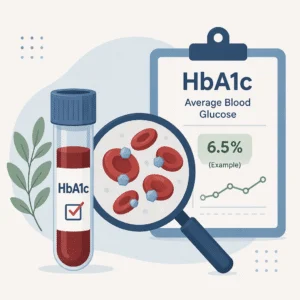
The A1c test reports the share of your haemoglobin that has sugar attached to it. Because red blood cells live around three months, the figure reflects an average rather than a single morning. That is why one high reading after a heavy weekend does not create a prediabetes A1c, and why the result is harder to game than a one-off measurement.

The Centers for Disease Control and Prevention places the prediabetes band at 5.7% to 6.4%, with 6.5% and above indicating diabetes. A routine check-up often includes a 空腹血糖检测 as well, and the grey zone there runs from 100 to 125 mg/dL. The two tests can disagree, which is normal: they measure different things over different timescales. Your report may also carry an HbA1c test result expressed as a percentage, and some laboratories supply an A1c conversion chart so you can see the equivalent average glucose.

Why the risk clock starts before 6.5%

The usual mental model treats 6.5% as a switch: below it, nothing to do; above it, a disease. The clinical picture is less tidy. Blood vessels do not consult the threshold. Damage tracks the glucose level itself, so the harm accumulates gradually across the grey zone rather than switching on at a cut-off.

This is the substance of the August 2026 commentary. Anderson noted that clinicians see these patients regularly and have well-established screening tools available, yet the prevention window is often allowed to pass. His practical position is that a result in the grey zone should prompt action rather than a note to recheck next year. There is no medicine approved specifically for prediabetes, but the evidence on lifestyle change is strong: losing 5% to 7% of body weight can substantially delay the onset of type 2 diabetes.

The numbers that define the grey zone

Reference bands vary slightly between laboratories and countries. The table below shows the values most commonly used in the United States, so you can locate your own result.

测试普通的Grey zoneDiabetes range
A1c低于 5.7%5.7% 至 6.4%6.5% 及以上
空腹血糖低于100 mg/dL100至125 mg/dL126 mg/dL or above
葡萄糖耐量试验低于140 mg/dL140至199 mg/dL200 mg/dL or above

Position inside the band matters. A result of 5.8% and a result of 6.4% both carry the same label, yet they do not carry the same outlook. It is worth noting where you sit, not just which box you land in.

最新科学进展

Three recent studies help answer the question most people actually have: does a result in the grey zone decide anything?

Prediabetes is not a one-way street

A 2025 pooled analysis in The Lancet Global Health followed more than 76,000 people across 19 long-running cohorts (a cohort is a group tracked over time). Across roughly ten years, about one in eight people with prediabetes went on to develop type 2 diabetes, while more than a third returned to normal blood sugar. However, among those whose fasting glucose sat at the top of the grey zone, going back to normal became considerably less likely. What this means for you: the label alone does not set your course, but where you sit inside the range shifts the odds.

Returning to normal roughly halves the risk

A 2025 study in Diabetologia pooled data from cohorts in the United States, Australia and Asia. People with prediabetes whose blood sugar returned to normal had roughly half the chance of later developing type 2 diabetes compared with those who stayed in the grey zone. The reduction was largest in people who also had a healthy weight, normal blood pressure and did not smoke. What this means for you: the numbers surrounding your glucose result, and not only the glucose result itself, help decide where things go next.

The number is not the win, the change behind it is

A 2023 study in JAMA Network Open tracked nearly 46,000 adults with prediabetes for a median of eight years. Seeing the number return to normal was not, on its own, linked to living longer. Among people who were physically active, though, that return was linked to a lower risk of dying during follow-up. This was an observational study in a single population, so it shows an association rather than proof of cause. What this means for you: chase the habit rather than the lab line, because the habit appears to be what carries the benefit.

What to do with a result in the grey zone

A prediabetes A1c is information, not a diagnosis of disease. Three steps make it useful. First, confirm it: a single value can drift, and clinicians normally repeat the measurement before drawing conclusions. Second, look sideways rather than only forward. Because the risk is cardiovascular as well as metabolic, the same visit usually produces a standard lipid panel, and blood pressure belongs in the picture too. Clinicians sometimes add an 胰岛素血液检测, and a few reports include a HOMA-IR胰岛素抵抗评分.

Third, act while the window is open. Modest, sustained weight loss and regular activity remain the best-supported measures, and both were the common thread across the studies above. Metabolic risk also travels with the liver, which is why many readers go on to consult a fatty liver blood test explainer. Anyone facing an unfamiliar report can review 血液检测异常结果 before their next appointment.

词汇表

学期定义
糖尿病前期Blood sugar higher than normal but below the level used to diagnose type 2 diabetes.
糖化血红蛋白 (HbA1c)The share of haemoglobin carrying attached sugar, reflecting average blood glucose over about three months.
空腹血糖Blood sugar measured after several hours without food, usually first thing in the morning.
葡萄糖耐量试验A test measuring blood sugar two hours after drinking a standard sugary solution.
胰岛素抵抗A state in which muscle, fat and liver cells respond poorly to insulin, pushing blood sugar upward.
NormoglycaemiaThe medical term for blood sugar within the normal range.
队列研究Research that follows a defined group of people over time to see what happens to them.
Cardiovascular riskThe overall chance of developing heart or blood vessel disease, such as heart attack or stroke.

常见问题解答

Is a prediabetes A1c of 5.7% serious?

It sits at the very bottom of the grey zone, so it is a signal rather than an alarm. It is worth confirming with a repeat test and reviewing alongside your fasting glucose, weight, blood pressure and cholesterol. Most people at 5.7% have considerable room to act, and research suggests returning to the normal range is a realistic outcome at this end of the band.

Can prediabetes go away?

Frequently, yes. In a large pooled analysis, more than a third of people with prediabetes returned to normal blood sugar over about ten years, which was more common than progressing to diabetes. Sustained weight loss and regular physical activity were the factors most consistently linked to that return. Reversal is less likely for those sitting at the top of the range.

Which is more reliable, A1c or fasting glucose?

Neither replaces the other. A1c reflects roughly three months and does not require fasting, while fasting glucose captures a single morning and is more sensitive to recent changes. The two can disagree, and clinicians read them together. Certain conditions affecting red blood cells, such as anaemia, can distort an A1c result, which is one reason a second test is often requested.

Do I need medication for prediabetes?

No medicine is currently approved specifically to treat prediabetes. Standard management focuses on weight, activity, diet and controlling blood pressure and cholesterol. Some doctors discuss medication for people at particularly high risk, but that is an individual decision made in consultation rather than a routine step, and it does not replace lifestyle measures.

How often should a grey-zone result be rechecked?

Annual retesting is a common approach for someone with a confirmed result in the grey zone, though your doctor may suggest a different interval based on your risk factors and how far into the band your value sits. The purpose of rechecking is to see the direction of travel, which is more informative than any single measurement.

Does prediabetes really affect the heart?

Cardiovascular risk does appear to build during the prediabetes stage rather than starting at diagnosis, which is the argument the August 2026 commentary emphasised. This is one reason clinicians review cholesterol and blood pressure alongside glucose when a result lands in the grey zone, instead of treating it as a purely metabolic finding.

来源

  • Centers for Disease Control and Prevention — A1C Test for Diabetes and Prediabetes — cdc.gov
  • National Institute of Diabetes and Digestive and Kidney Diseases (NIH) — Insulin Resistance and Prediabetes — niddk.nih.gov
  • Anderson JE, Steinzor P — Primary Care’s Role in Diabetes Prevention — The American Journal of Managed Care, 21 August 2026 — ajmc.com
  • Davoodian N, et al. — Prediabetes transitions to normoglycaemia or type 2 diabetes and associated risk factors: an individual-level pooled analysis of 19 prospective cohort studies — The Lancet Global Health, 2025 — consensus.app
  • Davoodian N, et al. — Regression from prediabetes to normoglycaemia and the role of cardiometabolic risk factors on the subsequent risk of developing type 2 diabetes — Diabetologia, 2025 — consensus.app
  • Cao Z, et al. — Risk of Death Associated With Reversion From Prediabetes to Normoglycemia and the Role of Modifiable Risk Factors — JAMA Network Open, 2023 — consensus.app

延伸阅读

利用 AI DiagMe 了解您的实验室结果

A result in the grey zone rarely travels alone. It reads best alongside your fasting glucose, cholesterol and blood pressure, which together explain far more than any single line. AI DiagMe puts each value into plain language so you can see the pattern and prepare better questions for your appointment. It helps you understand your results; it does not diagnose and does not replace your doctor.

几分钟内即可获得结果解读

作者

  • AI DiagMe

    AI DiagMe团队汇聚了医生、临床专家和医学编辑。我们的文章由健康传播专业人士撰写,并由我们科学委员会的医生进行审核和验证。该委员会由在血液科、内分泌科和全科等专科领域执业的医院医生组成。负责编辑工作的Julien Priour拥有巴黎高等商学院(HEC Paris)的MBA学位,并曾在法国国家可持续发展研究所(IRD,FUN-MOOC,2026)接受过科学写作和出版方面的培训。每篇文章都基于最新的临床指南和同行评审的医学出版物。.

    电子邮件 网站

相关文章