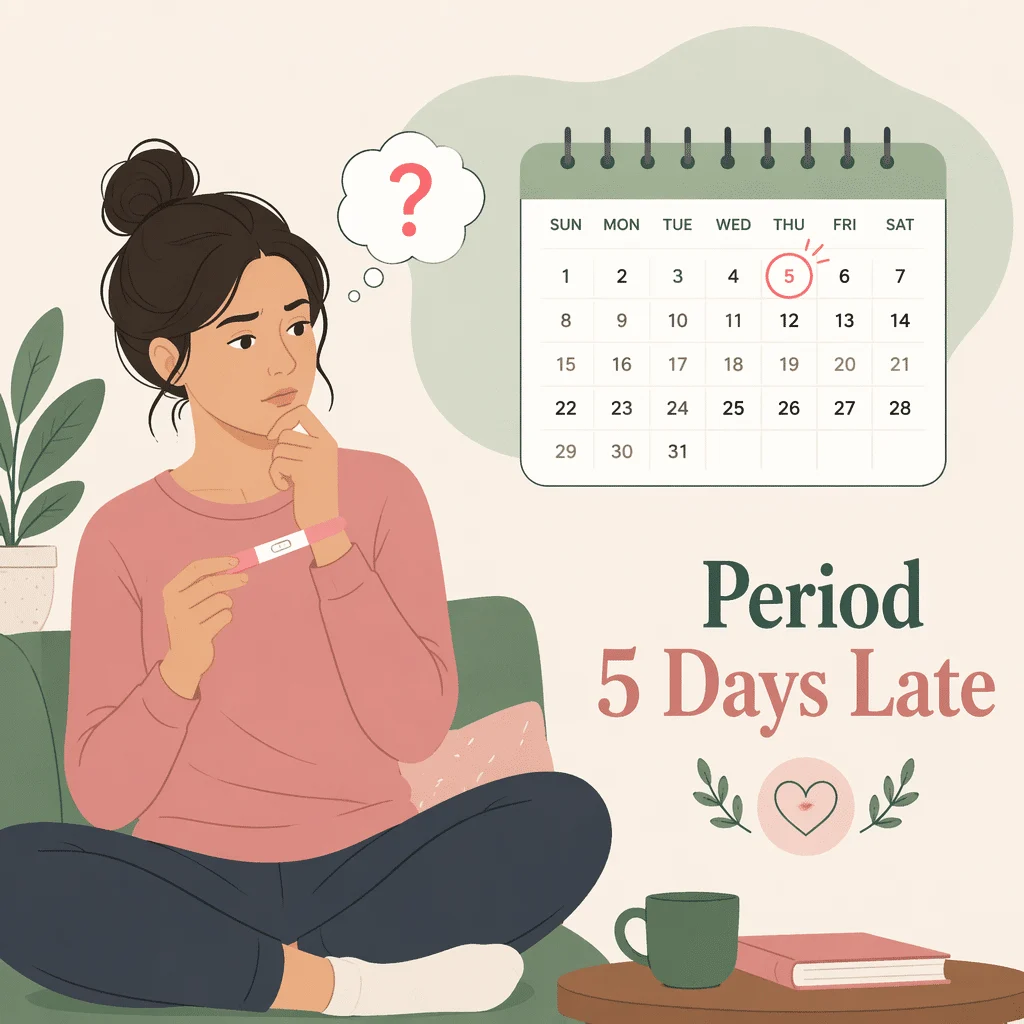
Om din mens är 5 dagar försenad är det enklaste och mest användbara du kan göra att ta ett graviditetstest – det gäller alla som kan vara gravida. Vid den här tidpunkten i cykeln är ett hemtest i regel tillförlitligt, så resultatet – oavsett vad det visar – ger dig faktisk information. Det är också bra att veta direkt att cykellängden varierar normalt, och fem dagars variation är vanligt.
I den här artikeln får du lära dig när ett hemgraviditetstest blir tillförlitligt och vad du ska göra om det är negativt, hur mycket cyklisk variation som är normal, vilka vardagliga och medicinska orsaker som kan försena mensen, varför en utebliven mens inte bör lämnas oförklarad i månader, och vilka symtom som innebär att du behöver söka vård samma dag. De akuta tecknen finns i en markerad ruta nedan – läs dem först om du har ont eller blöder just nu.
Börja med ett graviditetstest – och när det är tillförlitligt
Humant koriongonadotropin, eller hCG, är det hormon som produceras när ett embryo fäster sig i livmoderväggen. Hemtester letar efter det i urinen. Det dyker upp strax efter fästningen och stiger sedan snabbt, vilket är anledningen till att tidpunkten spelar mycket större roll än vilket märke du väljer.
Den amerikanska läkemedelsmyndigheten FDA uppger att hCG i en 28-dagarscykel vanligtvis kan påvisas i urinen ungefär 12 till 15 dagar efter ägglossningen. När mensen är fem dagar försenad har det fönstret normalt passerat. Ett negativt test i det här skedet är därför verklig information snarare än en gissning.
Verklig information är inte detsamma som ett slutgiltigt svar. En liten men reell andel graviditeter missas fortfarande den dag mensen först skulle ha kommit, vanligtvis för att ägglossningen skedde senare än man räknat med. Att använda morgonurin, när hCG är som mest koncentrerat, ökar chansen att få ett tydligt svar.
Vad du ska göra om testet är negativt
Om testet är negativt och mensen fortfarande inte har kommit ungefär en vecka senare, testa igen. Det är inte vidskepelse. Ägglossningen kan förskjutas med flera dagar under en i övrigt vanlig cykel, och om den skedde senare än du trodde kan det helt enkelt ha varit för tidigt att upptäcka en graviditet första gången. Ett nytt test en vecka senare löser de flesta sådana fall.
Tills du har ett tydligt svar rekommenderar FDA att du behandlar ett enskilt negativt resultat som preliminärt. Om du är osäker på hur du tolkar ditt resultat, se vår guide om graviditetstestets träffsäkerhet och hur du tolkar resultatet som förklarar vad strecken betyder och hur man lätt missförstår resultaten. Om du följde ägglossningen den här cykeln kan ett positivt ägglossningstest hjälpa dig att fastställa när ägglossningen faktiskt skedde, vilket visar om mensen verkligen är försenad.
Om testet är positivt, kontakta en vårdgivare för uppföljning. Oavsett vilket resultat du får, och oavsett vilket resultat du hoppades på, läs de viktiga varningssignalerna nedan innan du gör något annat.
Hur mycket variation i cykeln är normalt?
En 28-dagarscykel är ett genomsnitt, inte en regel. Hos vuxna anses cyklar på ungefär 21 till 35 dagar i allmänhet vara normala, och en skillnad på några dagar mellan månader är mycket vanligt. Fem dagars försening, i sig, hos någon vars cyklar brukar vara regelbundna, är mycket ofta ingenting mer än vanlig variation.
De Office on Women’s Health beskriver en cykel som oregelbunden när den konsekvent är kortare än 24 dagar eller längre än 38 dagar, eller när längden varierar med mer än 20 dagar mellan månader. Dessa gränsvärden är användbara eftersom de skiljer vanlig månad-till-månad-variation från ett mönster som bör undersökas.
Cykelns längd förändras också under livet. Den tenderar att bli kortare under tjugo- och trettioårsåldern, för att sedan bli längre och märkbart mer varierande i närheten av klimakteriet. En cykel som känns annorlunda vid 44 kan vara helt förväntad för det stadiet i livet.
Två saker avgör när mensen kommer: när du hade ägglossning, och hur lång lutealfasen är — perioden mellan ägglossning och blödning. Lutealfasen är relativt stabil för de flesta, så det är i cykelns första hälft som variationen finns. Det är därför en sen ägglossning ger en sen mens, och varför datumet du ringade in alltid var en uppskattning.
Vanliga orsaker till försenad mens
De flesta försenade mensen hos friska personer beror på något tillfälligt som försenade ägglossningen:
- Psykologisk stress — ett dödsfall, tentamina, en jobbkris eller ihållande press under flera veckor
- Sjukdom, inklusive en kraftig virusinfektion eller feber under veckorna före det förväntade datumet
- Störd sömn, nattskift eller ett schema som ständigt förändras
- Resor över flera tidszoner
- En markant förändring i träningsbelastning, antingen en kraftig ökning eller ett plötsligt stopp
- En tydlig förändring i kroppsvikt, i någon riktning, under en kort period
Stress är det som folk oftast viftar bort, och det bör man inte göra. Hypotalamus, som styr rytmen i reproduktionscykeln, sitter nära de system som hanterar hot och energibalans. När dessa är hårt belastade blir de hormonsignaler som utlöser ägglossning mindre frekventa, ägglossningen skjuts upp och mensen kommer försenad. Detta är en normal, reversibel reaktion. A kortisol blodprov används ibland när en läkare vill undersöka stressaxeln direkt.
Kortvarig viktförändring kring mensen i sig är ett separat fenomen, som till största delen drivs av vätska snarare än fett, och vi tar upp det i vår guide om viktuppgång under mensen.
Hormonella och medicinska orsaker till försenad mens
När försenad mens blir ett mönster snarare än ett engångsfall är det mer troligt att ett underliggande tillstånd ligger bakom. Det är dessa som läkare oftast letar efter.
Sköldkörtelsjukdom påverkar cykeln i båda riktningarna. En underaktiv sköldkörtel förknippas klassiskt med kraftigare och längre blödningar; en överaktiv sköldkörtel tenderar att göra mensen svagare och mer sällan förekommande. Båda kan fördröja den. Ett TSH-test är vanligtvis den första kontrollen, och vår sida om hypotyreos förklarar den bredare symptombilden.
Polycystiskt ovariesyndrom är en av de vanligaste orsakerna till cykler som är ihållande långa eller oförutsägbara, eftersom ägglossning sker oregelbundet eller inte alls. Det följs ofta av akne, oönskad hårväxt eller svårigheter att bli gravid. Vår guide om PCOS – symtom, orsaker och diagnos beskriver hur det utreds.
Hyperprolaktinemi – för höga nivåer av hormonet prolaktin – hämmar ägglossningen direkt. Orsaker inkluderar en godartad hypofystumör, en underaktiv sköldkörtel eller vissa läkemedel. Mjölkaktig urladdning från bröstvårtorna när du inte ammar är ett klassiskt tecken, även om många inte har några symtom alls. Se höga prolaktinnivåer för mer information.
Perimenopaus, övergångsfasen innan mensen upphör för gott, börjar vanligtvis i fyrtioårsåldern, ibland tidigare. Cyklerna förlängs, förkortas och uteblir på ett sätt som kan kännas oroande men som är förväntat. Vår klimakteriesymtom guide beskriver mönstret.
Dåligt kontrollerad diabetes kan störa cykeln, och mensen brukar ofta stabilisera sig när blodsockret är bättre reglerat. Obehandlad celiaki är en annan underdiagnostiserad orsak: näringsbrist och låg kroppsvikt kan förskjuta mensen eller få den att utebli helt. Se glutenintolerans och celiaki för de tillhörande symtomen.
Preventivmedel, läkemedel och amning
Hormonella preventivmedel förändrar blödningsmönstret avsiktligt. P-stav, p-spruta och hormonspiral gör ofta mensen lättare, mer oregelbunden eller helt frånvarande – det är en förväntad effekt, inte ett problem. Missade eller försenade kombinerade p-piller kan förskjuta en bortfallsblödning, och akut-p-piller förflyttar ofta nästa mens med flera dagar åt endera hållet.
Att sluta med preventivmedel kan också orsaka ett uppehåll. Särskilt efter att ha slutat med p-sprutan kan det ta några månader innan cyklerna återkommer.
Vissa receptbelagda läkemedel höjer prolaktinnivåerna och kan därmed fördröja eller stoppa mensen. Flera antipsykotika har den effekten, liksom vissa antidepressiva och illamåendemediciner. Om en försenad mens började efter en läkemedelsändring, ta upp det med din förskrivare i stället för att sluta ta medicinen på egen hand.
Amning hämmar ägglossningen hos många, och mensen kanske inte återkommer förrän antalet amningstillfällen minskar eller upphör. Tidpunkten varierar mycket från person till person och från graviditet till graviditet. Ägglossningen återkommer innan den första mensen gör det, så dess frånvaro säger ingenting säkert om fertiliteten – den som inte vill bli gravid igen inom kort bör diskutera preventivmedel med sin vårdgivare.
När lågt energiintag stoppar mensen
Det här är den orsak som oftast missas, och den förtjänar ett tydligt språk. När energiintaget från mat under lång tid är lågt i förhållande till energiförbrukningen – genom träning, arbete eller vardagsliv – nedprioriterar kroppen reproduktionen som icke-nödvändig. Hormonsignalerna från hypotalamus avtar, ägglossningen upphör och mensen blir oregelbunden eller försvinner helt. Det kliniska namnet är funktionell hypotalamisk amenorré.
Det är vanligt inom uthållighets- och estetiska idrotter, efter en kraftig ökning av träningsbelastningen, och hos personer som begränsar sitt matintag – oavsett om det sker medvetet eller på grund av en ätstörning. Det förekommer också hos personer som inte alls är underviktiga, vilket är anledningen till att kroppsvikt ensamt är ett dåligt screeningtest.
Detta är viktigare än bara besväret med en utebliven mens. Det låga östrogentillståndet som följer med det påverkar bentätheten och ökar risken för stressfrakturer, och är kopplat till ogynnsamma kardiovaskulära markörer. Mens som uteblir av den här anledningen är en signal om hela kroppens hälsa – inte en liten tur eller en effektivitetsvinst.
Det finns ingen anledning att skämmas för att ta upp det, och det går att behandla. Tillfrisknande innebär i regel att öka energiintaget, att dra ner på träningen snarare än att sluta helt, och att ta itu med de psykologiska aspekterna där det är relevant. Om det här låter bekant – säg det högt till en läkare. Det är mycket lättare att vända i ett tidigt skede än i ett sent.
Negativt test och fortfarande ingen mens: vad du bör göra härnäst
Här är fällan. Testet visar negativt, den omedelbara frågan känns besvarad och den uteblivna mensen läggs undan som löst. Månader går. Men ett negativt test berättar bara att du troligtvis inte är gravid. Det säger ingenting om varför du inte menstruerar, och själva frånvaron är det fynd som behöver förklaras.
Om mensen inte har kommit tillbaka efter ytterligare en vecka, upprepa testet och boka en tid. Om tre cykler passerar utan blödning uppfyller det definitionen av amenorré och motiverar utredning oavsett hur bra du mår. Att vänta månader på att det ska lösa sig fördröjer diagnosen av sköldkörtelsjukdom, förhöjt prolaktin, PCOS och låg energitillgänglighet – allt är lättare att behandla ju tidigare.
En sak du inte bör göra: ingen ört, te, kosttillskott eller högdosvitamin har visats framkalla mens på ett säkert eller effektivt sätt. Vissa preparat som säljs för detta ändamål är direkt osäkra, och inget av dem tar itu med orsaken till att blödningen upphörde. En mens som ihållande uteblir behöver en förklaring, inte ett botemedel.
| Din situation | Vad det vanligtvis betyder | Vad man ska göra |
|---|---|---|
| Fem dagar försenad, negativt test, normalt regelbundna cykler | Oftast vanlig variation – ägglossningen skedde troligen senare än vanligt den här cykeln | Vänta ungefär en vecka. Om mensen inte har kommit då, testa igen. |
| Fem dagar försenad, positivt test | Ett hemtest i det här skedet är i allmänhet tillförlitligt | Kontakta en vårdgivare för att ordna uppföljning och bekräfta datering. |
| Negativt test, fortfarande ingen mens en vecka senare | Antingen kom ägglossningen mycket senare än förväntat, eller så har något annat stört cykeln | Upprepa testet och boka en tid. Lämna det inte oförklarat. |
| Försenad mens med svår eller ensidig bäckensmärta | Kan vara en utomkvedshavandeskap eller ett annat akut problem | Sök akutvård nu. Vänta inte på ett testresultat. |
| Ingen mens alls på tre månader | Uppfyller definitionen av amenorré och behöver en orsak identifierad | Besök en läkare och fråga om sköldkörtel-, prolaktin- och andra hormonprover. |
När du bör söka läkare – och när du behöver akutvård
Ring 112 eller åk till akutmottagningen omedelbart om en försenad mens åtföljs av något av följande, oavsett om graviditetstest är positivt eller negativt:
- Kraftig bäcken- eller buksmärta, särskilt om den är koncentrerad till ena sidan
- Smärta i axelspetsen
- Yrsel, svimningskänsla eller kollaps
- Ovanlig vaginal blödning, särskilt i kombination med smärta
- Positivt graviditetstest tillsammans med smärta eller blödning
Dessa symtom kan tyda på en utomkvedshavandeskap – en graviditet som har fäst utanför livmodern, oftast i ett äggledare. Den kan inte fortsätta utan risk, och om den brister uppstår en inre blödning som är livshotande. Ett negativt hemtest utesluter det inte, så vänta inte med att söka vård för att testa igen.
Boka ett icke-akut besök, men ignorera det inte, om du inte haft mens på tre månader, om mensen upphör före 40 års ålder, eller om en utebliven mens åtföljs av mjölkaktig bröstvårtsflytning, värmevallningar, tydlig viktförändring, ny hårtillväxt i ansiktet eller på kroppen, huvudvärk eller synförändringar.
Utanför dessa situationer pekar riktlinjer från organisationer som American College of Obstetricians and Gynecologists och Office on Women’s Health på tre praktiska skäl att boka ett besök: tre eller fler uteblivna mensperioder i rad, mens som konsekvent kommer med mer än 35 dagars mellanrum, eller en utebliven mens i kombination med andra symtom. Regelbundna cykler som plötsligt blir oregelbundna är också värda att ta upp.
Vad en läkare kan undersöka
Utredningen börjar vanligtvis med en anamnes – cykler, preventivmedel, läkemedel, vikt, träning, stress – och sedan ett graviditetstest, det första som behöver fastställas eller uteslutas. Blodprover beror på vad anamnesens uppgifter tyder på.
Sköldkörtelfunktion och prolaktin kontrolleras i de flesta fall, eftersom båda är vanliga, behandlingsbara och lätta att missa. FSH och VH hjälper till att skilja ett problem i äggstocken från ett i hypofysen eller hypotalamus, och är informativa när tidig menopaus är möjlig. Om PCOS misstänks tillkommer androgener, inklusive testosteron och ett bäckenultraljud kan följa.
De senaste vetenskapliga framstegen inom förståelsen av cykelvariation
Ny forskning bekräftar vad många redan misstänkte: cykler är långt mindre enhetliga än vad läroböckerna antydde.
En studie från 2024 i Scientific Reports analyserade självrapporterad cykeldata från miljontals användare av mens-appar under hela den reproduktiva livslängden. Vad den visade: cykellängden och dess variabilitet följer ett tydligt mönster med åldern – den förkortas under tjugo- och trettioårsåldern, för att sedan förlängas och bli märkbart mer oregelbunden i närheten av klimakteriet. Vad det innebär för dig: en cykel som har börjat förändras kan spegla din fas i det reproduktiva livet snarare än ett nytt problem – men en förändring från ditt eget etablerade mönster är ändå värd att nämna för din läkare.
En studie från 2023 i Medicina följde luteiniserande hormon och en progesteronmetabolit i urinen under flera tusen cykler. Vad den visade: beräknade cykellängder var konsekvent kortare än vad användarna rapporterade, och follikelfasen – perioden före ägglossningen – varierade avsevärt mellan individer och förkortades med åldern. Författarna argumenterade direkt mot ett alltför stort beroende av en standardiserad 28-dagarsmodell. Vad det innebär för dig: dagen du förväntar dig din mens är en uppskattning baserad på antagen ägglossning – om ägglossningen kom sent, kommer mensen också att göra det.
En översiktsstudie från 2024 i Nutrients undersökte kost- och livsstilshantering av funktionell hypotalamisk amenorré. Vad den visade: menstruationsfunktionen är nära kopplad till energitillgänglighet – energiintag i förhållande till energiförbrukning – och att få tillbaka mensen beror i allmänhet på ökat intag och minskad träningsbelastning snarare än på läkemedel. Vad det innebär för dig: om mensen upphörde i samband med intensiv träning eller begränsat matintag, går vägen tillbaka genom att äta mer – inte genom kosttillskott.
En översiktsstudie från 2024 i Annals of the New York Academy of Sciences undersökte den hypotalamiska signaleringen bakom samma tillstånd, med fokus på kisspeptin – en neuropeptid som reglerar de pulser som driver den reproduktiva axeln. Vad den visade: funktionell hypotalamisk amenorré är en av de vanligaste orsakerna till sekundär amenorré, och det låga östrogentillstånd den ger upphov till har mätbara konsekvenser för ben- och hjärt-kärlhälsa. Vad det innebär för dig: en utebliven mens av denna orsak är ett hälsoproblem i sig, värt att behandla snarare än att acceptera.
En genomgång från 2023 i International Journal of Molecular Sciences, av forskare vid US National Institute of Environmental Health Sciences, kartlade hur sköldkörtelhormoner påverkar det kvinnliga reproduktionssystemet. Resultaten visade att sköldkörteldysfunktion påverkar flera delar av detta system och är kopplat till oregelbunden mens, PCOS och nedsatt fertilitet. Vad det innebär för dig: ett sköldkörteltest är ett rimligt första steg när mensen blir opålitlig, eftersom lösningen ofta är enkel.
Ordlista med nyckeltermer
| Kalla | Definition |
|---|---|
| hCG | Humant koriongonadotropin – det hormon som bildas under graviditet och som hemtester i urin mäter. |
| Ägglossning | Ägglossningen, då ett ägg frigörs från äggstocken, ungefär mitt i cykeln – men tidpunkten varierar. |
| Follikulär fas | Den första delen av cykeln, från blödningens start fram till ägglossningen. Dess längd varierar mest. |
| Lutealfasen | Perioden mellan ägglossningen och nästa mens. Den är relativt stabil hos de flesta. |
| Amenorré | Utebliven mens. Tre eller fler uteblivna cykler i rad uppfyller vanligtvis definitionen. |
| Oligomenorré | Sällan förekommande mens, typiskt sett cykler som konsekvent är längre än ungefär 35 dagar. |
| Hyperprolaktinemi | En förhöjd nivå av hormonet prolaktin, vilket kan hämma ägglossningen och stoppa mensen. |
| Funktionell hypotalamisk amenorré | Mensen upphör på grund av att energiintaget under lång tid är för lågt i förhållande till energiförbrukningen. |
| Utomkvedshavandeskap | En graviditet som sitter utanför livmodern. Det är ett medicinskt nödläge och kan inte fortgå på ett säkert sätt. |
| Perimenopaus | Övergångsfasen innan mensen slutar permanent, då cyklerna ofta blir oregelbundna. |
Vanliga frågor
Kan jag vara gravid trots negativt test fem dagar efter utebliven mens?
Det är osannolikt, men inte omöjligt. Fem dagar efter det förväntade datumet har hCG vanligtvis stigit tillräckligt för att ett hemtest ska kunna fånga upp det, så ett negativt resultat väger tungt. Undantaget är om ägglossningen skedde senare än du trodde – om du hade ägglossning en vecka eller så senare än beräknat, skulle graviditeten fortfarande vara för tidig för att kunna påvisas. Därför är det praktiska rådet att testa igen om ungefär en vecka om mensen inte har kommit. Morgonurin ger det tydligaste resultatet.
Kan stress försena mensen med 5 dagar?
Ja, och en försening på fem dagar ligger väl inom vad stress kan orsaka. Hypotalamus, som styr takten i fortplantningscykeln, sitter nära de hjärnsystem som reagerar på hot och energibrist. Under långvarig press saktar de hormonpulser som utlöser ägglossningen ner. Ägglossningen skjuts upp, och eftersom cykelns andra hälft är ungefär lika lång, kommer mensen försenad med precis så många dagar som ägglossningen försenades. Det är en normal, reversibel reaktion, och cyklerna brukar stabilisera sig när pressen lättar.
När bör jag söka läkare för en försenad mens?
Boka en tid om du har missat tre eller fler menstruationer i rad, om dina cykler konsekvent är mer än 35 dagar långa, eller om en utebliven mens åtföljs av andra symtom – mjölkaktig flytning från bröstvårtorna, värmevallningar, betydande viktförändring, ny hårtillväxt i ansiktet eller på kroppen, huvudvärk eller synförändringar. Sök även vård om mensen upphör före 40 års ålder, eller om tidigare regelbundna cykler har blivit oförutsägbara. Sök akutvård – inte bara en vanlig tid – om du har svår eller ensidig bäckensmärta, smärta i axelspetsen, yrsel eller svimning.
Finns det något som på ett säkert sätt kan påskynda mensen?
Nej. Trots hur ofta de rekommenderas på nätet har örtteer, persilja, höga doser C-vitamin och liknande medel inte visats kunna framkalla mens, och en del är osäkra – särskilt vid en oupptäckt graviditet. Viktigare är att de behandlar symtomet snarare än orsaken. Om mensen uteblir upprepade gånger är det mer meningsfullt att ta reda på varför, eftersom vanliga orsaker som sköldkörtelsjukdom, förhöjt prolaktin och låg energitillgång alla har specifika behandlingar.
Varför är min mens försenad men jag har kramper och ingen blödning?
Kramper utan blödning är vanligt när ägglossningen har försenats. Livmoderslemhinnan byggs upp som vanligt och ger bekanta premenstruella förnimmelser, men blödningen kan inte börja förrän den hormonella signalen anländer – så symtomen verkar stanna upp. Det kan också förekomma i tidig graviditet. Milda, symmetriska kramper som går över är sällan oroande i sig. Svår smärta, smärta på ena sidan, eller kramper med yrsel eller ovanlig blödning är något annat och kräver skyndsam bedömning.
Betyder oregelbunden mens att jag kommer att ha svårt att bli gravid?
Inte nödvändigtvis, men ihållande oregelbundna cykler gör det svårare att förutsäga fertila dagar och kan tyda på att ägglossningen är opålitlig. Tillstånd som PCOS, sköldkörtelsjukdom och funktionell hypotalamisk amenorré påverkar ägglossningen och hör till de mer behandlingsbara orsakerna till svårigheter att bli gravid. Det är ett skäl att låta utreda oregelbundna cykler i stället för att vänta. Om du har försökt bli gravid utan framgång, berätta om ditt cykelmönster för din läkare – det pekar ofta mot svaret.
Förstå dina labresultat med AI DiagMe
Om en läkare redan har tagit blodprover – bland annat sköldkörtelprov, prolaktin, FSH och LH – kan siffrorna i provsvaret vara svåra att förstå. AI DiagMe förklarar vad varje markör mäter och vad ditt värde betyder i sitt sammanhang, så att du kommer till ditt läkarbesök med bättre frågor. Tjänsten hjälper dig att förstå dina provsvar – den ställer inga diagnoser, kan inte bekräfta eller utesluta graviditet och är inte avsedd för akuta situationer.
Få dina resultat tolkade på några minuter
Vidare läsning
- Normala sköldkörtelvärden: förstå referensvärdena
- Guide till blodprov för 17-OH-progesteron
- Lågt testosteron hos kvinnor: orsaker, symtom och behandlingar
- Lågt ferritin: orsaker, symtom och behandling
- Förstå illamående under perimenopaus: orsaker och behandlingar
Källor
- Office on Women’s Health, US Department of Health and Human Services — Period problems
- MedlinePlus, US National Library of Medicine — Absent menstrual periods, secondary
- US Food and Drug Administration — Home-use tests: pregnancy
- Cunningham AC, Pal L, Wickham AP, Prentice C, Goddard FGB, Klepchukova A, Zhaunova L. Chronicling menstrual cycle patterns across the reproductive lifespan with real-world data. Scientific Reports, 2024
- Hills E, Woodland MB, Divaraniya A. Using hormone data and age to pinpoint cycle day within the menstrual cycle. Medicina, 2023
- Dobranowska K, Plińska S, Dobosz A. Dietary and lifestyle management of functional hypothalamic amenorrhea: a comprehensive review. Nutrients, 2024
- Patel AH, Koysombat K, Pierret A, Young M, Comninos AN, Dhillo WS, Abbara A. Kisspeptin in functional hypothalamic amenorrhea: pathophysiology and therapeutic potential. Annals of the New York Academy of Sciences, 2024
- Brown EDL, Obeng-Gyasi B, Hall JE, Shekhar S. The thyroid hormone axis and female reproduction. International Journal of Molecular Sciences, 2023