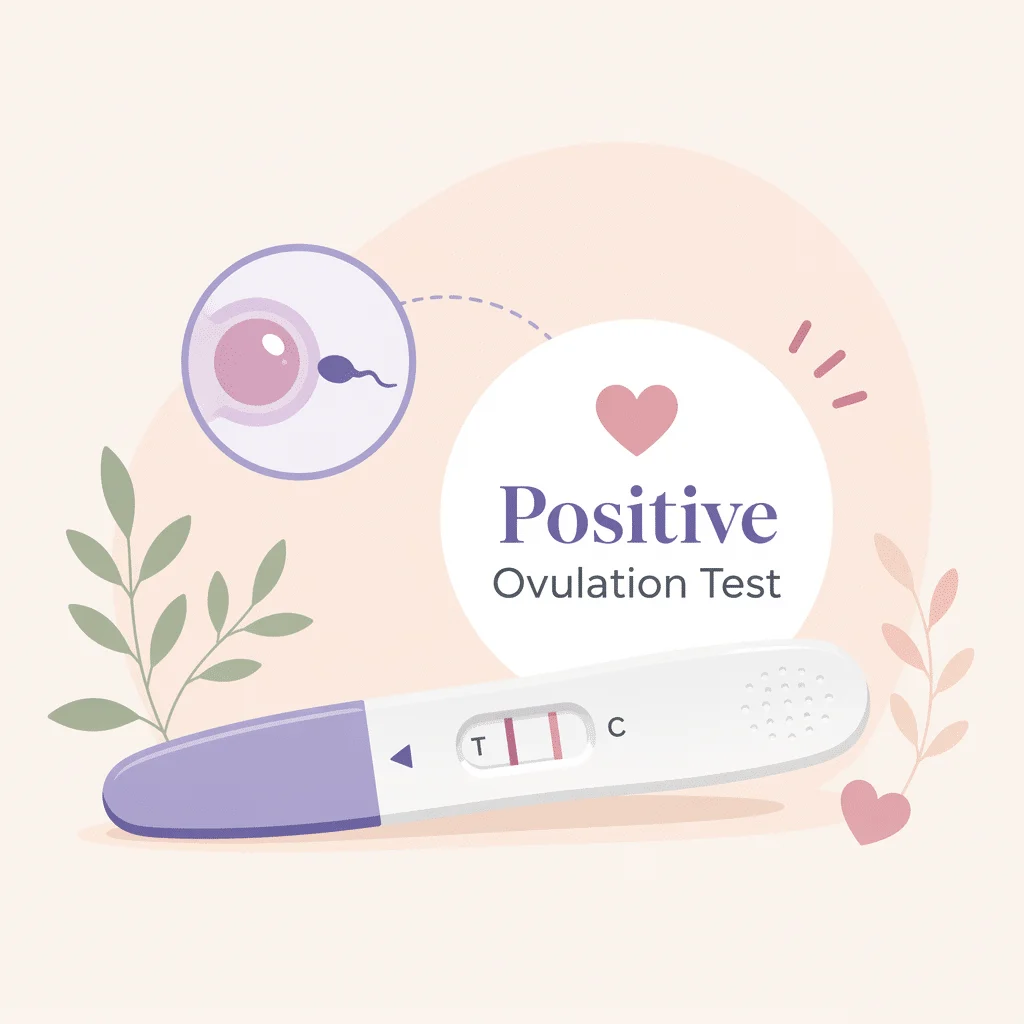
Ett positivt ägglossningstest är ett av de få ögonblicken i en cykel som känns som tydlig information: det andra strecket är mörkt, eller den digitala skärmen ändras, och det verkar som om kroppen äntligen har sagt något klart. Vad resultatet faktiskt berättar är mer begränsat än vad förpackningen antyder. Det säger att luteiniserande hormon (LH) har stigit i din urin. Det säger inte att ett ägg har frigjorts.
Det är just den skillnaden som är det vanligaste missförståndet kring dessa kit, och det förklarar mycket av den frustration som folk beskriver efter månader av testning.
I den här artikeln får du lära dig vad ett ägglossningsprediktionskit mäter, varför testlinjen måste vara lika mörk som kontrolllinjen, vad ett positivt resultat bekräftar – och inte bekräftar – hur du tajmar samlag runt det fertila fönstret, varför vissa personer får positiva resultat som aldrig stämmer överens med ägglossning, hur ägglossning faktiskt bekräftas, och när det är rimligt att sluta testa och be om en utredning.
Vad ett ägglossningstest faktiskt mäter
Ett ägglossningsprediktionskit, vanligtvis förkortat OPK, är ett urintest för luteiniserande hormon. LH frisätts av hypofysen i hjärnans bas. Under större delen av cykeln ligger det på en låg bakgrundsnivå. Strax före ägglossningen stiger det kraftigt, och det är den uppgången som testremsan är utformad för att fånga.
Två konsekvenser följer av detta, och båda påverkar hur du bör tolka dina resultat.
För det första mäter ett OPK en signal som skickas från hjärnan, inte en händelse i äggstocken. Toppen är en instruktion. Huruvida äggstocken följer den är en separat fråga som en urinremsa inte kan besvara.
För det andra, eftersom LH alltid finns på en viss nivå, är en svag linje normal och förväntad. Det är därför ägglossningstest läses annorlunda än graviditetstest, och varför så många av dem misstolkas.
Om LH även har mätts i ditt blod som en del av en utredning är det ett annat test, med laboratorievärden och referensintervall som förändras under cykeln. Vår guide till blodprovet för luteiniserande hormon (LH) tar upp dessa siffror i detalj. Den här artikeln håller sig till remsan i ditt badrum.
Hur du läser ett positivt ägglossningstest: regeln om kontrolllinjen
På ett graviditetstest räknas vilken synlig testlinje som helst, hur svag den än är, eftersom hormonet det mäter normalt sett inte ska finnas där utanför en graviditet.
Ett ägglossningstest fungerar tvärtom. LH finns alltid närvarande, så ett synligt streck i sig betyder ingenting. Teststrecket måste vara lika mörkt som kontrollstrecket, eller mörkare, innan resultatet räknas som positivt.
Ett streck som syns men är ljusare än kontrollstrecket är ett negativt resultat. Det är inte nästan positivt, och det är inte en anledning att sluta testa. Det betyder vanligtvis att toppen inte har börjat ännu, eller redan har passerat.
Digitala kit gör den jämförelsen internt och visar en symbol istället, vilket tar bort behovet av en bedömning men döljer också hur nära du var.
Vanliga misstag vid avläsning
Att läsa av testremsan utanför den tidsram som anges i bipacksedeln. Linjerna mörknar när testet torkar, och ett resultat som läses av en timme senare är inte det faktiska resultatet.
Att testa med mycket utspädd urin. Att dricka mycket vätska timmarna innan kan försvaga linjen tillräckligt för att dölja ett verkligt surge. Många upplever att sen förmiddag till tidig kväll är mer tillförlitligt än direkt på morgonen.
Att testa en gång om dagen när surget är kort. Vissa surges varar långt under ett dygn, och testning en gång dagligen kan missa dem helt.
Att jämföra fotografier. Ljussättning och kamerans bildbehandling påverkar hur mörkt ett streck ser ut. Bedöm remsan i dagsljus, i handen.
| Vad du ser | Vad det vanligtvis betyder | Vad man ska göra |
|---|---|---|
| Testlinjen tydligt ljusare än kontrolllinjen | Endast bakgrunds-LH; toppen har inte börjat, eller har redan passerat | Fortsätt testa vid samma tid varje dag; lägg till ett extra dagligt test runt det förväntade surget |
| Testlinjen lika mörk som, eller mörkare än, kontrolllinjen | En LH-topp har detekterats | Räkna de senaste dagarna och de kommande två som ditt bästa fönster; ägglossning sker vanligtvis inom ungefär 12 till 36 timmar |
| Positivt resultat flera dagar i rad | En lång eller stegvis topp, en andra LH-topp, eller en ihållande förhöjd basnivå | Notera den första positiva dagen och använd den; om detta upprepas varje cykel, ta upp det vid ditt nästa besök |
| Positivt de flesta dagar, varje cykel, utan förändring i dina mens | Ofta kroniskt förhöjt LH, som vid PCOS; testet mäter inte din ägglossning | Be om en utredning istället för att köpa fler remsor; OPK är opålitliga i den här situationen |
| Ett positivt ägglossningstest med försenad mens | Möjlig korsreaktion med hCG vid tidig graviditet | Ta ett graviditetstest; om det är negativt och mensen uteblir, kontakta en läkare |
| Inget positivt resultat vid något tillfälle under en hel cykel | Toppen missades, var kortvarig eller inträffade inte | Utöka testtiden under ytterligare en eller två cyklar och be sedan om en utredning |
Vad ett positivt ägglossningstest bekräftar – och vad det inte gör
Det här är det som de flesta förpackningar utelämnar, och det är det mest användbara på den här sidan.
Ett positivt ägglossningstest bekräftar en sak: en LH-topp har detekterats i din urin. Ägglossning följer vanligtvis ungefär 12 till 36 timmar senare.
Ordet vanligtvis gör ett viktigt jobb i den meningen. En LH-topp kan inträffa utan att ett ägg frigörs. Follikeln kan reagera på signalen, producera hormonerna som hör till cykelns andra hälft och ändå misslyckas med att brista – ett mönster som kallas luteiniserad obruten follikel. Utifrån sett, och på ett teststreck, kan den cykeln se helt normal ut.
Ett positivt resultat kan heller inte berätta för dig att ägget var moget, att ett äggledare var öppet, eller att allt som följde gick som det skulle.
Inget av detta gör ägglossningstest värdelösa. Att förutsäga det fertila fönstret innan det stängs är precis vad de är till för, och ingen annan hemmetod gör det lika direkt. Men att förutsäga och att bekräfta är olika saker, och teststreckset gör bara det första. Bekräftelse kommer från en ihållande temperaturstegring vid uppvaknandet eller ett progesteron-blodprov mitt i lutealfasen, vilket beskrivs längre ned på den här sidan.
En sak till är värd att säga rakt ut: ägglossningstest är inte en preventivmetod. De kan inte tala om för dig vilka dagar som är säkra, de missar kortvariga toppar och spermier överlever i reproduktionskanalen i flera dagar innan någon topp ens kan detekteras. Om du försöker undvika graviditet, använd en metod som är utformad för det ändamålet.
Tajma samlag och det fertila fönstret
Det fertila fönstret är ungefär de fem dagarna före ägglossningen plus själva ägglossningsdagen. Det är ojämnt fördelat av ett enkelt biologiskt skäl: spermier kan överleva i reproduktionskanalen i flera dagar, medan ägget är livsdugligt i mindre än ett dygn efter att det frigjorts.
Den asymmetrin har en praktisk konsekvens som ofta glöms bort. Att vänta på ett positivt resultat innan man börjar försöka tar bort större delen av fönstret. När testet väl visar positivt ligger de mest fertila dagarna redan delvis bakom dig.
I praktiken ger det bäst resultat att ha samlag varannan dag eller dagligen under dagarna inför den förväntade toppen, och fortsätta dagen för det positiva testet samt dagen efter.
Två eller tre testcykler brukar ge en ungefärlig bild av när din LH-topp infaller. Därefter slutar många att testa dagligen och täcker helt enkelt samma del av cykeln, vilket kostar mindre och tar mindre tid.
Andra tecken följer samma fönster. Livmoderhalssekretet blir vanligtvis klarare och mer töjbart dagarna dessförinnan, och en del märker lätt blödning mitt i cykeln eller illamående mitt i cykeln. Det här är stödjande information, inte bevis.
När ägglossningstest vilseleder
Några av de mest frustrerande testupplevelserna uppstår i situationer där testremsan fungerar precis som den ska – och ändå inte ger dig något användbart svar.
PCOS
Polycystiskt ovariesyndrom (PCOS) är den vanligaste orsaken till att ägglossningstest aldrig riktigt verkar stämma. Vid PCOS är baslinjenivån av LH ofta kroniskt förhöjd. Remsan jämför ditt LH mot ett fast tröskelvärde, så en hög baslinje kan ge ett positivt utslag – eller en rad positiva utslag – i cykler där inget ägg frigörs.
Många berättar att de testat positivt i en vecka, eller nästan varje dag, utan att något händer. Det är en vanlig upplevelse, det är inget fel du gjort, och fler teststickor löser inte problemet. Relaterade markörer inkluderar testosteron hos kvinnor och 17-OH-progesteron, och vår guide om PCOS-symptom, orsaker och tester beskriver hur diagnosen vanligtvis ställs.
Perimenopaus och nedsatt äggstocksreserv
När äggstocksreserven minskar arbetar hypofysen hårdare, och baslinjenivåerna av LH och FSH stiger båda gradvis. En högre baslinje når lättare testets tröskelvärde och ger positiva resultat som inte motsvarar ägglossning. Cyklerna i den här fasen är också mindre förutsägbara från månad till månad.
Graviditet och triggersprutor
LH och humant koriongonadotropin (hCG) är strukturellt lika, och ägglossningstest kan korsreagera med hCG. Ett ägglossningstest kan därför bli positivt tidigt i en graviditet, och det blir positivt efter en triggersputa som ges vid fertilitetsbehandling.
Om du har ett positivt ägglossningstest och din mens är försenad, ta ett graviditetstest. Ett OPK ersätter inte ett sådant. Vår artikel om en mens som är fem dagar försenad går igenom de andra möjligheterna.
Flera toppar, korta LH-toppar och utspädd urin
En del cykler ger mer än en LH-topp, varav bara en föregår ägglossningen – så ett positivt utslag följt av ett nytt positivt utslag några dagar senare är inte nödvändigtvis en motsägelse. Korta LH-toppar kan missas helt om du bara testar en gång om dagen. Och ett högt vätskeintag späder ut urinen tillräckligt för att ett genuint positivt utslag ska bli ett gränsfall.
Hur ägglossning faktiskt bekräftas
Bekräftelse kommer alltid i efterhand, eftersom den beror på vad äggstocken gör när ägget väl har lämnat den.
Basaltemperatur
Efter ägglossningen höjer progesteron från gulkroppen vilokroppstemperaturen något. Om du mäter temperaturen vid samma tid varje morgon innan du stiger upp, tyder en liten höjning som håller i sig i ungefär tre dagar på att ägglossning har skett. Det ger dig ingen förvarning, vilket är anledningen till att temperaturkurvor och ägglossningstest ofta används tillsammans snarare än i stället för varandra.
Progesteron i mitten av lutealfasen
Det mer tillförlitliga testet är ett blodprov för progesteron som tas ungefär sju dagar efter förmodad ägglossning. Det kallas ofta dag 21-test, men det som egentligen räknas är sju dagar innan din nästa mens förväntas komma – vilket är en annan dag om dina cykler är längre eller kortare än 28 dagar. En tydligt förhöjd nivå tyder på att ett gulkropp bildats, och en gulkropp bildas efter att ett ägg har frigjorts.
När ägglossning undersöks tas detta vanligtvis tillsammans med markörer som östradiol, TSH och prolaktin, eftersom sköldkörtelsjukdom och förhöjt prolaktin är behandlingsbara orsaker till utebliven ägglossning. Ultraljudsuppföljning på en klinik kan också visa att en follikel finns på en bild och är borta på nästa.
Tolkningen hör hemma hos din läkare, eftersom tidpunkten i förhållande till din egen cykel påverkar vad ett värde betyder. Det MedlinePlus-artikel om ägglossningstest för hemmabruk lyfter fram samma poäng om hemtester.
Vad det betyder om du aldrig får ett positivt resultat
En hel cykel med negativa resultat är inte ett slutgiltigt svar, och det är värt att säga innan något annat.
De troligaste förklaringarna är praktiska. Du kan ha börjat testa för sent, slutat för tidigt, testat en gång om dagen och missat en kort LH-topp, eller testat med mycket utspädd urin. Cykellängden varierar mellan olika personer och från cykel till cykel – en topp som kommer dag 12 en månad kan komma dag 19 nästa.
Ett rimligt nästa steg är att utöka testfönstret: börja några dagar tidigare än du tror att du behöver, och testa två gånger om dagen runt den förväntade tidpunkten under en eller två cykler.
Om flera cykler går utan ett enda positivt resultat är det värdefull information snarare än ett misslyckande. Utebliven eller mycket oregelbunden ägglossning har identifierbara och ofta behandlingsbara orsaker, bland annat sköldkörtelsjukdom, förhöjt prolaktin och PCOS. Ett hormonpanel för fertilitet är vanligtvis där det samtalet börjar.
Att fortsätta testa månad efter månad ger sällan mer information i det läget. Det tillför mest kostnad och stress.
När du bör söka hjälp
De vanliga riktlinjerna, som fastställts av det amerikanska Office on Women’s Health och stämmer överens med ACOG:s och ASRM:s rekommendationer, är tydliga.
Om du är under 35 år och har försökt bli gravid i 12 månader utan framgång är det den punkt då en utredning rekommenderas. Om du är 35 år eller äldre är gränsen 6 månader, eftersom tid väger tyngre.
Dessa siffror är inte ett omdöme om vad du har eller inte har gjort. De är helt enkelt de punkter då en bedömning är mer värdefull än att vänta längre.
Tidigare utredning är lämplig om dina menstruationer uteblir eller är mycket oregelbundna, om du har känd endometrios, om du har genomgått bäckenkirurgi eller haft en bäckeninfektion, om menstruationerna är kraftigt smärtsamma, om det har förekommit upprepade missfall, eller om det finns ett känt problem med mannens fertilitet.
Du har också rätt att söka hjälp tidigare, helt enkelt för att ovisshetens börda är tung att bära. Det är ett fullt giltigt skäl att söka vård.
| När du bör prata med en läkare |
|---|
| Du är under 35 år och har försökt bli gravid i 12 månader, eller du är 35 år eller äldre och har försökt i 6 månader |
| Dina menstruationer uteblir, är mycket oregelbundna eller har förändrats märkbart |
| Du får positiva ägglossningstest upprepade gånger, cykel efter cykel, utan tecken på att ägglossning har skett |
| Mensvärken är svår, eller du har känd endometrios, tidigare bäckenkirurgi eller en tidigare bäckeninfektion |
| Det finns ett känt manligt fertilitetsproblem, eller din partner har en historia av testikelkirurgi, skada eller infektion |
| Du har ett positivt ägglossningstest och en försenad mens: ta ett graviditetstest först och sök sedan rådgivning |
Senaste vetenskapliga framsteg inom ägglossningstest
Enligt studier indexerade i PubMed har forskning sedan 2023 fokuserat på hur väl hemtester stämmer överens med vad som faktiskt sker i kroppen, och på vilka grupper de befintliga testerna aldrig var utformade för.
En prospektiv studie vid ett fertilitetscenter i Boston jämförde fem vanligt tillgängliga ägglossningstest i ett steg med dagliga blodmätningar av LH i övervakade cykler. Testerna stämde väl överens med blodresultaten och presterade på liknande nivå sinsemellan, oavsett pris, även om vissa var något bättre än andra på att fånga upp en topp som faktiskt förekom.
Vad detta innebär för dig: ett dyrt test ger dig inte bättre noggrannhet. Om LH-toppar missas är det troligare att tidpunkten och hur ofta du testar är förklaringen.
En genomförbarhetsstudie genomförd vid Massachusetts General Hospital och Harvard syftade till att utveckla ett salivbaserat, AI-avläst ägglossningstest för personer med oregelbundna cykler och PCOS. Studiens utgångspunkt är talande: de flesta receptfria tester bygger på LH i urinen och optimerades för personer med regelbundna cykler och en förutsägbar LH-topp mitt i cykeln. Forskarna noterade också att vissa deltagare avbröt studien på grund av den oro det innebar att följa cykler utan ägglossning.
Vad detta innebär för dig: om dina cykler är oregelbundna eller om du har PCOS, är vanliga OPK-tester inte utformade för din situation. Det är en begränsning hos verktyget, inte en brist hos dig.
En valideringsstudie på nordamerikanska kvinnor jämförde två kvantitativa hemmonitorer för hormoner i urinen, som mäter LH och en östrogenmetabolit som siffror snarare än streck, under övergångarna efter förlossning och i perimenopaus. De två enheterna identifierade dagen för LH-toppen på ett konsekvent sätt i förhållande till varandra.
Vad detta innebär för dig: kvantitativa monitorer kan följa en topp genom dessa mindre förutsägbara faser, men de identifierar ändå en LH-topp – inte ett frigjort ägg.
En översiktsartikel i Seminars in Reproductive Medicine kartlade det bredare fältet för digital ägglossningsdetektering, inklusive cykelapplikationer, bärbara enheter som mäter temperatur och hjärtfrekvens samt hormonenheter för urin eller saliv. Den framställer ägglossning som ett hälsotecken i sig självt, påverkat av sköldkörtelhormoner, prolaktin och androgener.
Vad detta innebär för dig: när ingen topp någonsin dyker upp är det oftast mer informativt att kontrollera sköldkörtel-, prolaktin- och androgenmarkörer än att köpa ytterligare en förpackning teststickor.
Slutligen byggde en studie baserad på data från tusentals naturliga cykler en maskininlärningsmodell för att planera insemination eller tidsbestämd samlag. Den fungerade väl just för att den kombinerade östradiol, progesteron och LH i stället för att enbart förlita sig på LH-toppen.
Vad detta innebär för dig: även på kliniker med dagliga blodprover är LH-toppen bara en av flera faktorer. Det är ett gott skäl att inte behandla ett enskilt positivt hemtest som hela bilden.
Ordlista med nyckeltermer
| Kalla | Definition |
|---|---|
| Anovulation | En cykel där inget ägg frigörs, även om blödning ändå kan förekomma |
| Basaltemperatur | Vilokroppstemperatur som tas vid samma tid varje morgon innan du stiger upp |
| Kontrollinje | Referenslinjen på en teststicka som visar att testet fungerade korrekt, och mot vilken testlinjen jämförs |
| Corpus luteum | Den struktur som bildas efter att ett ägg har frigjorts och som producerar progesteron |
| Det fertila fönstret | De ungefär fem dagarna före ägglossning plus själva ägglossningsdagen |
| hCG | Humant koriongonadotropin, graviditetshormonet, som liknar LH tillräckligt mycket för att reagera med vissa ägglossningstest |
| LH-surge | Den kraftiga ökningen av luteiniserande hormon som normalt föregår ägglossning med ungefär 12 till 36 timmar |
| Luteiniserad orupturerad follikel | En follikel som svarar på LH-toppen och producerar luteala hormoner men inte frigör ägget |
| Progesteron i mitten av lutealfasen | Ett blodprov som tas ungefär sju dagar efter förmodad ägglossning, för att kontrollera om ägglossning har skett |
| Triggerinjektion | En injektion baserad på hCG eller LH som används vid fertilitetsbehandling för att utlösa ägglossning, vilket gör ägglossningstest positiva |
Vanliga frågor
Betyder ett positivt ägglossningstest att jag har ägglossning?
Nej. Ett positivt resultat innebär att en LH-topp har detekterats i ditt urin, och ägglossning sker vanligtvis inom ungefär 12 till 36 timmar. Det är inte en bekräftelse på att ett ägg faktiskt frigjordes. En LH-topp kan uppstå utan att follikeln brister, och teststickan kan inte avgöra skillnaden. Om du behöver veta om ägglossning verkligen skedde finns det två vanliga metoder: en varaktig höjning av basaltemperaturen efteråt, eller ett progesteronblodprov taget ungefär sju dagar efter den förmodade ägglossningen. Båda ser bakåt i tiden, vilket är anledningen till att de kompletterar ägglossningstest snarare än ersätter dem.
Kan ett ägglossningstest vara positivt om jag är gravid?
Ja. LH och hCG är strukturellt lika, och ägglossningstest kan reagera med hCG. Det innebär att ett ägglossningstest kan bli positivt i tidig graviditet, och det kommer att bli positivt efter en triggerinjektion som används vid fertilitetsbehandling. Ett ägglossningstest är inte ett graviditetstest och ska aldrig användas som ett sådant, eftersom det inte är utformat för det hormonet och resultatet inte kan tolkas på ett tillförlitligt sätt. Om din mens är försenad och ett ägglossningstest är positivt, ta ett riktigt graviditetstest.
Varför får jag positiva ägglossningstest nästan varje dag?
Den vanligaste orsaken är ett kroniskt förhöjt baslinjevärde av LH, vilket är typiskt vid PCOS. Eftersom testet jämför ditt LH mot ett fast tröskelvärde snarare än mot din egen normalnivå, kan ett högt baslinjevärde ge upprepade positiva utslag under cykler där inget ägg frigörs. Stigande baslinjenivåer av LH under perimenopaus eller vid nedsatt äggstocksreserv kan ge samma resultat. Det här är frustrerande och det är inget du gör fel. Om det händer cykel efter cykel ger en utredning dig mer information än att fortsätta testa.
Kan jag använda ägglossningstest för att undvika att bli gravid?
Nej, och det är viktigt att känna till. Ägglossningstest är inte en preventivmetod och är opålitliga för att undvika graviditet. Spermier kan överleva i flera dagar, så det fertila fönstret öppnar sig långt innan någon LH-topp kan upptäckas. Toppar kan också vara korta, missas eller inträffa vid fel tidpunkt. När ett test visar positivt kan de dagar då befruktning var mest sannolik redan ha passerat. Om du vill undvika graviditet, tala med en läkare eller apotekspersonal om en metod som är utformad för det ändamålet.
Vad betyder ett svagt streck på ett ägglossningstest?
En svag linje är ett negativt resultat. LH finns i urinen under hela cykeln, så en ljus linje återspeglar helt enkelt den bakgrundsnivån. Det betyder att toppen inte har börjat, eller redan är över. Det är värt att fortsätta testa, helst två gånger om dagen runt den tid du förväntar dig toppen, eftersom förändringen från svag till helt mörk linje kan ske på några timmar. Mycket utspädd urin gör också linjerna ljusare, så undvik att dricka stora mängder vätska timmarna innan du testar.
Hur många dagar efter ett positivt test bör vi ha samlag?
Dagen för det positiva utslaget och dagen därpå är de mest värdefulla dagarna efter att ett positivt resultat visas. Men det fertila fönstret öppnade sig redan innan dess. Eftersom spermier överlever i flera dagar men ägget inte gör det, ger samlag varannan dag eller varje dag under dagarna inför den förväntade LH-toppen ett bättre täckning av det fertila fönstret än att vänta på att testet ska ändras. Om du har tajmat allt exakt kring ett positivt utslag utan att det fungerat, är det värt att se över det mönstret med en läkare snarare än att försöka tajma ännu mer exakt.
Källor
- MedlinePlus, US National Library of Medicine. Ovulation home test. https://medlineplus.gov/ency/article/007062.htm
- Office on Women’s Health, US Department of Health and Human Services. Infertility. https://womenshealth.gov/a-z-topics/infertility
- Eunice Kennedy Shriver National Institute of Child Health and Human Development (NICHD). Vilka är några möjliga orsaker till kvinnlig infertilitet? https://www.nichd.nih.gov/health/topics/infertility/conditioninfo/causes/causes-female
- Vanderhoff AC, Lanes A, Waldman I, Ginsburg E. Similar accuracy and patient experience with different one-step ovulation predictor kits. Fertility and Sterility, 2025. https://doi.org/10.1016/j.fertnstert.2024.09.031
- Peebles E, Finlay W, Nguyen TM, Barrett S, Thirumalaraju P, Kanakasabapathy MK, Kandula H, Sarcione C, James KE, Shafiee H, Mahalingaiah S. Digitally enabled AI-interpreted salivary ferning-based ovulation prediction: feasibility study. Journal of Medical Internet Research, 2025. https://doi.org/10.2196/73028
- Bouchard TP, Doyle-Baker PK, Yong PJ, Fehring R, Schneider M. Validating at-home urinary hormone measurements in postpartum and perimenopause fertility transitions. Women’s Health Reports, 2025. https://doi.org/10.1089/whr.2024.0157
- Shkodzik K. Innovative approaches to digital health in ovulation detection: a review of current methods and emerging technologies. Seminars in Reproductive Medicine, 2024. https://doi.org/10.1055/s-0044-1793829
- Youngster M, Luz A, Baum M, Hourvitz R, Reuvenny S, Maman E, Hourvitz A. Artificial intelligence in the service of intrauterine insemination and timed intercourse in spontaneous cycles. Fertility and Sterility, 2023. https://doi.org/10.1016/j.fertnstert.2023.07.008
Vidare läsning
- Luteiniserande hormon (LH): förstå dina blodresultat
- PCOS: symtom, orsaker, diagnos och prover
- Fertilitetsblodprov: vad mäts och varför
- FSH (follikelstimulerande hormon) blodprov
- Blödning vid ägglossning: orsaker och symtom
Förstå dina labresultat med AI DiagMe
Om ägglossningen utreds kan du hamna med en sida full av siffror: LH, FSH, progesteron, TSH, prolaktin. AI DiagMe omvandlar dessa provsvar till ett begripligt språk så att du kan se vad varje markör mäter och vilka frågor du bör ta med till ditt läkarbesök. Det hjälper dig att förstå dina provsvar. Det diagnostiserar inte infertilitet, det bekräftar inte att ägglossning har skett och det ersätter inte din läkare.
Få dina resultat tolkade på några minuter