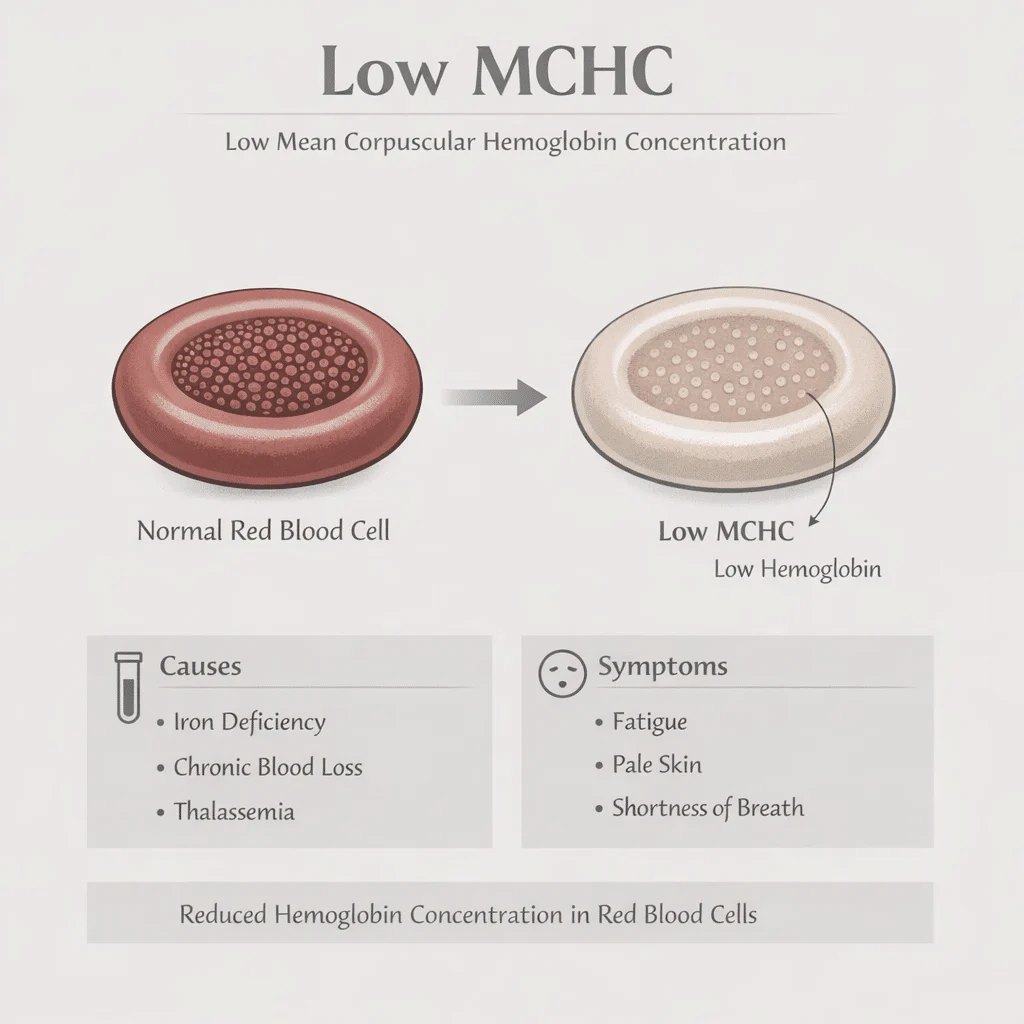
Un MCHC scăzut în hemoleucogramă înseamnă că, în medie, globulele tale roșii conțin puțin mai puțină hemoglobină față de dimensiunea lor decât se așteaptă intervalul de referință din acel buletin. Nu este un diagnostic și nu este o boală în sine. Valoarea este calculată, nu măsurată direct — rezultă din alte două cifre de pe aceeași pagină — și, privită izolat, spune foarte puțin. Ceea ce face totuși este să restrângă lista posibilelor explicații la câteva cauze, dintre care majoritatea sunt frecvente și gestionabile. În acest articol vei afla cum se obține această valoare, de ce contează doar alături de MCV, MCH și RDW, care cauze merită investigate, când rezultatul reflectă o eroare de măsurare și nu o modificare reală a sângelui tău, și ce analize urmează.
Ce măsoară de fapt un MCHC scăzut
Cum se obține această valoare
MCHC este abrevierea pentru concentrația medie de hemoglobină corpusculară, unde „corpuscular" se referă la celulele sanguine. Analizorul nu o măsoară direct. Ia hemoglobina totală din eprubetă, o împarte la hematocrit și raportează rezultatul în grame pe decilitru. Hemoglobina este proteina care transportă oxigenul, iar un articol separat explică ce îți spune un rezultat al hemoglobinei. Hematocritul reprezintă proporția din volumul sanguin ocupată de globulele roșii, iar un alt ghid descrie cum măsoară laboratoarele hematocritul. Deoarece MCHC este derivat din aceste două valori, orice modificare a uneia dintre ele se reflectă și în MCHC.
Ce se consideră valoare scăzută
MedlinePlus, serviciul de informații pentru pacienți al Bibliotecii Naționale de Medicină, publică un MCHC normal la adult de aproximativ 32 până la 36 grame pe decilitru. Valorile tipărite pe buletinul tău sunt cele care contează, deoarece intervalele de referință diferă în funcție de analizor, laborator și grupă de vârstă. Un rezultat puțin sub limita inferioară este cu totul altceva față de unul cu mai multe puncte sub ea, iar o singură valoare la limită are mult mai puțină semnificație decât aceeași valoare obținută la o a doua recoltare. Acest articol se concentrează pe capătul inferior al scalei, iar un ghid separat acoperă intervalul complet al valorilor MCHC.
Termenul pe care îl poate folosi buletinul tău de analize
Laboratoarele descriu adesea celulele palide ca hipocrome. Hipocromia observată pe un frotiu de sânge și un MCHC redus pe buletinul tipărit sunt două moduri de a constata același lucru — unul vizual și unul prin calcul. Niciunul nu îți spune de ce s-a întâmplat.
Interpretarea unui MCHC scăzut alături de MCV, MCH și RDW
Cele trei valori care îi dau sens
Niciun clinician cu experiență nu citește MCHC-ul izolat. Acesta face parte dintr-un grup de patru indici eritrocitari, iar tiparul de ansamblu este cel care oferă informații. Volumul corpuscular mediu raportează dimensiunea medie a celulelor, iar un articol însoțitor explică ce înseamnă un rezultat MCV la analiza de sânge. MCH raportează cantitatea medie de hemoglobină per celulă, iar un alt ghid descrie ce măsoară MCH la analiza de sânge. Lățimea distribuției eritrocitelor arată cât de neuniforme sunt celulele ca dimensiune, și explicăm ce înseamnă un RDW crescut. Un MCHC însoțit de un MCV scăzut și un MCH scăzut formează un tablou coerent. Un MCHC scăzut izolat, în timp ce ceilalți trei parametri sunt perfect normali, de obicei nu.
Tipare frecvente și ce pot indica
Tabelul de mai jos prezintă combinațiile întâlnite cel mai des. Arată cum sunt citiți indicii împreună, iar nicio linie din el nu stabilește singură ce se întâmplă la o persoană anume.
| Tiparul din buletin | Ce sugerează de obicei | Pasul următor obișnuit |
|---|---|---|
| MCHC, MCV și MCH toate scăzute; RDW crescut | Deficit de fier acumulat pe parcursul mai multor luni, astfel că celulele vechi și cele noi diferă ca dimensiune | Feritina, apoi un panel complet de fier dacă feritina este echivoce |
| MCHC, MCV și MCH toate scăzute; RDW normal | O variantă hemoglobinică moștenită, cum ar fi trăsătura talasemică, în care celulele sunt uniform mici | Feritina mai întâi; dacă rezervele de fier sunt adecvate, un test al tipurilor de hemoglobină |
| MCHC scăzut; MCV, MCH și hemoglobina normale | Adesea un rezultat nesemnificativ sau la limită, fără o boală la bază | Repetă hemoleucograma în timp util; verifică feritina doar dacă există un motiv |
| MCHC scăzut în prezența unei boli cronice | Anemia din inflamația cronică, în care fierul este prezent, dar reținut de la utilizare | Studiile fierului citite împreună cu markerii inflamatori |
| Un MCHC care nu se corelează cu niciun alt parametru de pe pagină | O problemă de manipulare a probei sau de analizor, mai degrabă decât o modificare reală a sângelui tău | Repetă pe o probă proaspătă înainte de a lua orice măsură |
Cauze frecvente ale unui MCHC scăzut
Deficit de fier
Deficiența de fier este explicația întâlnită cel mai frecvent. Fără suficient fier, măduva osoasă nu poate umple celulele roșii noi cu cantitatea obișnuită de hemoglobină, astfel că acestea apar mai mici și mai palide, iar MCHC calculat scade. Institutul Național pentru Inimă, Plămâni și Sânge din SUA menționează pierderea de sânge drept principala cauză la adulți: menstruații abundente, sângerări la nivelul tractului digestiv sau utilizarea îndelungată a antiinflamatoarelor. Problemele de absorbție, precum boala celiacă și boala Crohn, reprezintă o altă cauză frecventă, iar boala cronică de rinichi contribuie și ea. Feritina, care reflectă rezervele de fier din organism, este de obicei primul test verificat; un articol dedicat explică cum să citești un test de sânge pentru ferită.
Trăsătura talasemică și alte variante ereditare
Trăsătura talasemică este un tipar ereditar în care organismul produce mai puțin eficient unul dintre blocurile de construcție ale hemoglobinei. Purtătorii sunt în general sănătoși și nu au nevoie de tratament, însă celulele lor roșii sunt permanent mici și palide, astfel că indicele apare scăzut la fiecare analiză de sânge. Elementul care o diferențiază de deficiența de fier este constanța: indicii rămân aproximativ la același nivel an de an, RDW-ul este adesea normal deoarece celulele sunt uniform mici, iar rezervele de fier sunt adecvate. Confundarea cu deficiența de fier duce la administrarea de suplimente care nu vor ajuta și care, luate pe termen nelimitat, nu sunt lipsite de riscuri.
Inflamația, pierderea de sânge și alte cauze
O infecție de lungă durată, o afecțiune autoimună sau o altă boală cronică pot produce anemie din inflamație, în care organismul are fier, dar îi restricționează accesul. O intervenție chirurgicală recentă sau o sângerare semnificativă pot scădea indicii timp de câteva săptămâni, până când măduva recuperează, iar sarcina crește suficient de mult necesarul de fier pentru a-i reduce ușor în trimestrul al doilea și al treilea. Rar, expunerea la plumb sau o problemă moștenită cu producția de hem este responsabilă. Pentru o imagine mai completă a investigației anemiei, un alt articol prezintă simptomele și cauzele frecvente ale anemiei. Iar când feritina în sine este valoarea care a scăzut, descriem cauzele și consecințele unui nivel scăzut de ferită.
Când un MCHC scăzut este un artefact de laborator
De ce analizorul poate greși
Deoarece MCHC este calculat și nu măsurat direct, o eroare în oricare dintre valorile de intrare devine o eroare în MCHC. Sângele recoltat dintr-un braț în care curge o perfuzie intravenoasă poate fi diluat de lichidul administrat. O probă lăsată prea mult timp înainte de procesare poate permite celulelor să se umfle, crescând hematocritul măsurat și scăzând MCHC-ul calculat. Un număr foarte mare de globule albe poate interfera cu rezultatele. Niciunul dintre aceste aspecte nu reflectă ceva ce se întâmplă în corpul tău.
Artefacte care împing valoarea în sens invers
Interferența de laborator împinge mai des MCHC-ul în sus decât în jos. Plasma tulbure și grasă după o masă foarte bogată în grăsimi poate crește fals valoarea hemoglobinei, la fel ca și celulele roșii care s-au spart în eprubetă. Aglutininele la rece — anticorpi care fac celulele roșii să se aglomereze odată ce sângele se răcește — distorsionează întregul grup de celule roșii dintr-o dată. Dacă raportul tău arată un MCHC surprinzător de ridicat, nu unul scăzut, un artefact este prima explicație de luat în considerare.
Cum se rezolvă în practică
Soluția este simplă și eficientă: repetarea analizei pe o probă proaspătă, recoltată corect, și citirea întregului buletin, nu doar a unui singur rând. Laboratoarele efectuează verificări interne menite să semnaleze rezultatele care nu se corelează între ele, iar un tehnician poate examina un frotiu de sânge la microscop înainte ca buletinul să fie eliberat. Pentru a înțelege cum se leagă valorile din jur, un ghid separat explică în detaliu fiecare linie a unui buletin de hemoleucogramă completă.
Simptome și ce nu explică un MCHC scăzut
Valoarea în sine nu provoacă nimic
Merită spus clar, pentru că aici greșesc multe articole de pe internet. Un MCHC scăzut nu are simptome proprii. Este o cifră pe o hârtie. Orice simptome ai sunt cauzate de ceea ce se ascunde în spatele acelei cifre, iar în marea majoritate a cazurilor asta înseamnă anemie sau deficit de fier, nu indicele în sine. Un MCHC ușor scăzut cu hemoglobina normală nu provoacă de obicei nimic, iar mulți oameni care îl au se simt perfect bine.
Ce observă oamenii când este prezentă anemia
Atunci când deficitul este suficient de semnificativ pentru a scădea hemoglobina, cele mai frecvente acuze sunt oboseala care nu dispare după odihnă, lipsa de aer la urcat scările, paloarea pielii, mâinile și picioarele reci, durerile de cap și bătăile rapide ale inimii. Deficitul de fier poate adăuga unghii fragile, căderea părului, durere la nivelul limbii, sindromul picioarelor neliniștite noaptea și, uneori, pofta de a mesteca gheață. Acestea aparțin deficitului, nu MCHC-ului.
Când să mergi la medic
- Lipsa de aer, durerea în piept sau bătăile rapide ale inimii în repaus, ori leșinul, care necesită consultarea medicului în aceeași zi, nu o programare de rutină.
- Scaune negre, gudronate sau cu sânge vizibil, ori vărsături cu aspect de zaț de cafea, care pot indica o sângerare în tractul digestiv.
- Menstruații atât de abundente încât protecția se îmbibă în fiecare oră, cu cheaguri mari sau care te țin acasă.
- Oboseală instalată treptat de-a lungul mai multor luni, însoțită de un MCHC scăzut la hemoleucogramă, mai ales dacă și hemoglobina a scăzut.
- Un MCHC scăzut la un bărbat de orice vârstă sau la o femeie după menopauză, unde pierderea menstruală nu poate fi explicația și se caută de obicei o sursă de sângerare.
- Scădere în greutate neintenționată, transpirații nocturne sau modificări persistente ale tranzitului intestinal apărute în paralel cu indici eritrocitari anormali.
Analize și tratament în funcție de cauza de bază
Analizele care urmează de obicei
Un MCHC scăzut izolat rareori declanșează ceva dramatic. Dacă hemoglobina este și ea scăzută sau tabloul este convingător microcitar, feritina este aproape întotdeauna primul test solicitat, deoarece este cel mai bun indicator individual al rezervelor de fier la o persoană care nu este acut bolnavă. Când feritina este la limită sau inflamația ar putea să o distorsioneze, un panel mai larg adaugă fierul seric, transferina și capacitatea totală de legare a fierului, și explicăm analizele individuale dintr-un profil al fierului. Saturația transferinei, proporția proteinei de transport care transportă efectiv fier, este adesea cel mai decisiv parametru din acest grup, iar articolul său propriu explică ce înseamnă valorile saturației fierului. Numărul de reticulocite arată dacă măduva răspunde, iar dacă studiile fierului revin normale, un test al tipurilor de hemoglobină este următorul pas logic.
Tratarea cauzei, nu a indicelui
Nu se prescrie nimic specific pentru un MCHC scăzut ca atare. Nu există un medicament pentru el, nicio valoare țintă de urmărit și niciun beneficiu în a corecta doar cifra în sine. Ceea ce se tratează este cauza din spatele ei. În cazul deficienței de fier, asta înseamnă suplimentarea cu fier și, la fel de important, identificarea motivului pentru care fierul a fost pierdut. Institutul Național pentru Inimă, Plămâni și Sânge notează că fierul administrat oral necesită de obicei trei până la șase luni pentru a reface rezervele, în timp ce fierul intravenos acționează în una sau două ședințe și este rezervat cazurilor mai grave sau prost tolerate. Mayo Clinic recomandă luarea comprimatelor împreună cu o sursă de vitamina C, evitarea antiacidelor, cafelei și ceaiului și așteptarea unei ameliorări în aproximativ o săptămână, chiar dacă normalizarea hemogramei durează mult mai mult.
Când nu este nevoie de tratament
Trăsătura talasemică nu necesită niciun tratament, iar fierul administrat cuiva care o poartă nu va îmbunătăți indicii. O scădere izolată cu celule normale, hemoglobină normală și fără simptome nu necesită adesea nimic altceva decât repetarea analizei la un interval rezonabil. A recunoaște când să lași o valoare în pace este la fel de important în practica medicală bună ca a ști când să acționezi.
Cele mai recente progrese științifice
Cercetările din ultimii trei ani au rafinat modul în care sunt interpretați indicii eritrocitari.
Interferențele pot distorsiona mai mulți indici simultan
Un studiu de laborator din 2026 a analizat probe care conțineau aglutinine la rece, anticorpi care determină aglomerarea globulelor roșii atunci când sângele se răcește. Aglomeratele induc în eroare analizorul, care raportează apoi valori distorsionate ale numărului de globule roșii, hematocritului, VEM, HEM și CHEM împreună. Încălzirea probei și reanalizarea ei într-un mod dedicat a restabilit valori credibile. Ce înseamnă asta pentru tine: atunci când un indice pare imposibil față de restul buletinului, o problemă cu proba este o posibilitate reală, iar repetarea analizei pe o probă proaspătă o clarifică.
Direcția modificării contează
O analiză din 2024 privind diagnosticul sferocitозei ereditare, o afecțiune moștenită în care globulele roșii sunt neobișnuit de rotunde și fragile, a descris indicii de rutină folosiți ca primă filtrare. În acest caz, CHEM este caracteristic crescut, nu scăzut. Ce înseamnă asta pentru tine: direcția în care s-a modificat un indice este adesea mai informativă decât simplul fapt că s-a modificat.
Calculele rapide ajută, dar nu decid
Când MCHC, MCV și MCH sunt toate scăzute, întrebarea este dacă deficiența de fier sau o variantă moștenită a hemoglobinei este responsabilă. Clinicienii au folosit de mult timp formule simple bazate pe indici, cea mai cunoscută fiind indicele Mentzer. Un studiu din 2023 a constatat că această metodă rapidă a separat util cele două grupuri; un studiu din 2024 realizat în altă parte a concluzionat că nu este suficient de fiabilă pentru a fi folosită singură. Ce înseamnă asta pentru tine: aceste formule orientează spre testul următor, ele nu pun un diagnostic. Feritina și, acolo unde este necesar, o analiză directă a tipurilor tale de hemoglobină lămuresc situația.
Întrebarea despre cancer, răspunsă cu date
O îngrijorare frecventă este dacă un CHEM scăzut poate indica cancer. O analiză din 2025 pe mai mult de 450.000 de adulți urmăriți prospectiv în timp a testat dacă indicii de rutină ai globulelor roșii sunt legați de diagnosticele ulterioare de cancer. Indicii care au arătat o relație au fost VEM, HEM și lărgimea distribuției globulelor roșii. CHEM nu s-a numărat printre ei. Ce înseamnă asta pentru tine: dovezile nu leagă CHEM de riscul de cancer. Acolo unde cancerul intră în discuție, este pentru că o deficiență de fier inexplicabilă determină căutarea unei surse de sângerare, ceea ce este o întrebare diferită.
Modul în care se suplimentează fierul este în continuare perfecționat
Două recenzii Cochrane publicate în 2024 au analizat suplimentarea cu fier acolo unde deficiența este cel mai frecventă. Recenziile Cochrane reunesc mai multe studii clinice și evaluează gradul de încredere pe care îl merită rezultatele. Una a comparat fierul administrat prin perfuzie cu fierul luat pe cale orală în sarcină; cealaltă a evaluat tratamentele după naștere. Ambele tratează soliditatea dovezilor ca pe o întrebare de sine stătătoare. Ce înseamnă asta pentru tine: corectarea deficienței este cea care influențează hemograma, calea de administrare este o decizie clinică, iar o hemogramă repetată la câteva săptămâni după începerea tratamentului îți spune mai mult decât una făcută imediat.
Glosar
| Termen | Definiție |
|---|---|
| MCHC | Concentrația medie a hemoglobinei corpusculare. Concentrația medie a hemoglobinei din interiorul globulelor roșii, calculată prin împărțirea hemoglobinei la hematocrit, nu măsurată direct. |
| VEM | Volumul corpuscular mediu, adică dimensiunea medie a globulelor tale roșii. Celulele mici se numesc microcitare, iar cele mari – macrocitare. |
| HEM (hemoglobina eritrocitară medie) | Hemoglobina corpusculară medie, adică cantitatea medie de hemoglobină transportată de un singur globul roșu. |
| RDW | Lărgimea distribuției eritrocitare, o măsură a variației dimensiunii globulelor roșii. Crește atunci când apare o nouă populație de celule cu dimensiuni diferite. |
| Hematocrit | Proporția din volumul sanguin reprezentată de globulele roșii, raportată de obicei ca procent. |
| Hipocromie | Aspectul palid al globulelor roșii care conțin mai puțină hemoglobină decât în mod normal. Este echivalentul vizual al unui MCHC scăzut. |
| Feritină | O proteină care stochează fierul. Nivelul din sânge reflectă în linii mari cât fier are organismul în rezervă, deși crește și în caz de inflamație. |
| Saturația transferrinei | Procentul din proteina de transport a fierului din sânge care transportă efectiv fier. O valoare scăzută susține diagnosticul de deficit de fier. |
| Trăsătura talasemică | Un tipar ereditar în care un bloc de construcție al hemoglobinei este produs mai puțin eficient. Purtătorii sunt de obicei sănătoși, dar au globule roșii permanent mici și palide. |
| Aglutinină la rece | Un anticorp care determină aglomerarea globulelor roșii atunci când o probă se răcește. Aglomerarea poate distorsiona simultan mai multe măsurători ale globulelor roșii. |
Întrebări frecvente
Ce nivel al MCHC este considerat periculos?
Nu există o valoare a MCHC care să fie periculoasă prin ea însăși, deoarece acest indice este un calcul, nu o cantitate fizică pe care organismul tău trebuie să o mențină. Ceea ce poate fi periculos este o hemoglobină sever scăzută, iar aceasta apare pe un rând separat în același buletin de analize. Medicii evaluează urgența în funcție de hemoglobină, de cât de rapid a scăzut, de simptomele tale și de orice sângerare activă – nu de cât de mult se situează MCHC sub intervalul de referință. Dacă MCHC-ul tău este marcat ca scăzut, uită-te la valoarea hemoglobinei de lângă el. O hemoglobină semnificativ scăzută însoțită de dificultăți de respirație, dureri în piept sau leșin necesită atenție medicală promptă, indiferent de valoarea MCHC.
Poți avea MCHC scăzut, dar fier și feritină normale?
Da, și se întâmplă destul de des. Cea mai frecventă explicație este o variantă moștenită a hemoglobinei, cum ar fi trăsătura talasemică, în care celulele sunt permanent mici și palide, deși rezervele de fier sunt perfect normale. Anemia din inflamația cronică este o altă cauză: fierul există în organism, dar este blocat și nu ajunge la măduvă, astfel că feritina poate fi normală sau chiar crescută, în timp ce globulele roșii rămân palide. O a treia posibilitate este un rezultat la limită care nu reflectă altceva decât variația biologică normală. Dacă analizele de fier sunt cu adevărat normale și tabloul persistă, pasul următor obișnuit este un test care examinează direct tipurile de hemoglobină, nu mai multe analize de fier.
Ce înseamnă dacă MCHC este scăzut, dar restul analizelor sunt normale?
O scădere izolată a CHEM, cu hemoglobină normală, VEM normal, HEM normal și lărgime a distribuției globulelor roșii normală, este de obicei nesemnificativă. Intervalele de referință sunt stabilite astfel încât o proporție din persoanele sănătoase să se situeze ușor în afara lor, iar CHEM este deosebit de predispus la mici variații, deoarece este derivat din alte două măsurători. În această situație, mulți medici vor repeta pur și simplu hemoleucograma la o dată ulterioară, în loc să demareze o investigație. Reducerile persistente și mai marcate pe mai multe rezultate sunt tratate diferit, iar dozarea feritinei este rezonabilă dacă există orice motiv independent de a suspecta o deficiență de fier.
Un MCHC scăzut înseamnă cancer?
Nu. Nu există nicio legătură dovedită între MCHC și riscul de cancer. Un studiu de cohortă amplu din 2025, care a analizat indicii eritrocitari în raport cu diagnosticele ulterioare de cancer, a identificat asocieri pentru MCV, MCH și RDW, dar nu și pentru MCHC. Cancerul intră uneori în discuție dintr-un motiv indirect: o deficiență de fier inexplicabilă la un adult — în special la un bărbat sau la o femeie după menopauză — determină căutarea unei surse ascunse de sângerare, iar intestinul este unul dintre organele verificate. Această investigație este motivată de deficiența de fier și de vârsta și istoricul tău medical, nu de valoarea MCHC în sine.
Ce înseamnă împreună un MCV scăzut, un MCH scăzut, un MCHC scăzut și un RDW crescut?
Această combinație este semnătura clasică a deficienței de fier. Celule mici, mai puțină hemoglobină în fiecare, o concentrație generală mai scăzută și o distribuție mai largă, deoarece celulele normale mai vechi circulă în continuare alături de cele noi, mai mici. RDW-ul crescut este elementul care diferențiază acest tablou de trăsătura talasemică, în care celulele tind să fie mici, dar uniforme. Tabloul este sugestiv, nu concludent, așa că urmează de obicei dozarea feritinei și adesea un profil complet al fierului. Dacă acestea revin normale, tabloul este reconsiderat și se testează de regulă tipurile de hemoglobină.
Poți avea un MCHC scăzut fără anemie?
Da. Anemia este definită printr-o hemoglobină scăzută, nu prin indici, deci este pe deplin posibil să ai un MCHC redus cu o hemoglobină care se încadrează confortabil în limite normale. Acest lucru este frecvent în stadiile incipiente ale deficienței de fier, când rezervele scad și celulele noi sunt deja produse cu mai puțină hemoglobină, dar numărul total nu a scăzut încă. Este, de asemenea, tipic pentru trăsătura de talasemie, unde mulți purtători au hemoglobina normală sau aproape normală pe tot parcursul vieții. Acest tipar merită notat și uneori investigat, dar nu este același lucru cu a fi anemic.
Surse
- MedlinePlus, National Library of Medicine — Red Blood Cell (RBC) Indices, 2024 — medlineplus.gov
- National Heart, Lung, and Blood Institute — Anemia: Iron-Deficiency Anemia — nhlbi.nih.gov
- Mayo Clinic — Iron deficiency anemia: diagnosis and treatment — mayoclinic.org
- Yang Y, Wang Q, Lu M — Impact of Severe Cold Agglutination on Routine Red Blood Cell Parameters and Correction Strategies — Clinical Laboratory, 2026 — doi.org/10.7754/Clin.Lab.2025.250726
- Polizzi A et al. — Overview on Hereditary Spherocytosis Diagnosis — International Journal of Laboratory Hematology, 2024 — doi.org/10.1111/ijlh.14376
- Shah TP, Shrestha A, Agrawal JP, Rimal S, Basnet A — Role of Mentzer Index for Differential Diagnosis of Iron Deficiency Anaemia and Beta Thalassemia Trait — Journal of Nepal Health Research Council, 2023. PubMed
- Althumairi A et al. — Performanța diagnostică a indicelui Mentzer în diferențierea trăsăturii de beta-talasemie față de anemia feriprivă — Frontiers in Medicine, 2024 — doi.org/10.3389/fmed.2024.1361805
- Fu C et al. — Red cell indices as predictors of cancer risk — BMC Cancer, 2025 — doi.org/10.1186/s12885-025-14679-8
- Nicholson L et al. — Intravenous versus oral iron for iron deficiency anaemia in pregnancy — Cochrane Database of Systematic Reviews, 2024 — doi.org/10.1002/14651858.CD016136
- Jensen MCH et al. — Treatment for women with postpartum iron deficiency anaemia — Cochrane Database of Systematic Reviews, 2024 — doi.org/10.1002/14651858.CD010861.pub3
Lectură suplimentară
- VEM scăzut: cauze, simptome și tratamente
- Numărul de globule roșii: ce înseamnă valoarea ta RBC
- Numărul de reticulocite: cum îți citești rezultatele
- Valori normale ale analizelor de sânge: tabel de referință
- Cum să citești rezultatele analizelor de sânge: un ghid simplu
Înțelege-ți rezultatele analizelor cu AI DiagMe
Un MCHC scăzut are sens doar privit alături de restul hemogramei tale, iar tocmai acest tip de lectură corelată este greu de făcut pe cont propriu. AI DiagMe preia buletinul de analize pe care îl ai deja și îți explică ce înseamnă fiecare linie în limbaj obișnuit, inclusiv hemograma completă, feritina, profilul fierului și numărul de reticulocite. Te ajută să îți înțelegi rezultatele și să pregătești întrebări mai bune pentru consultație. Nu pune diagnostice și nu îl înlocuiește pe medicul tău.
Obține interpretarea rezultatelor în câteva minute