
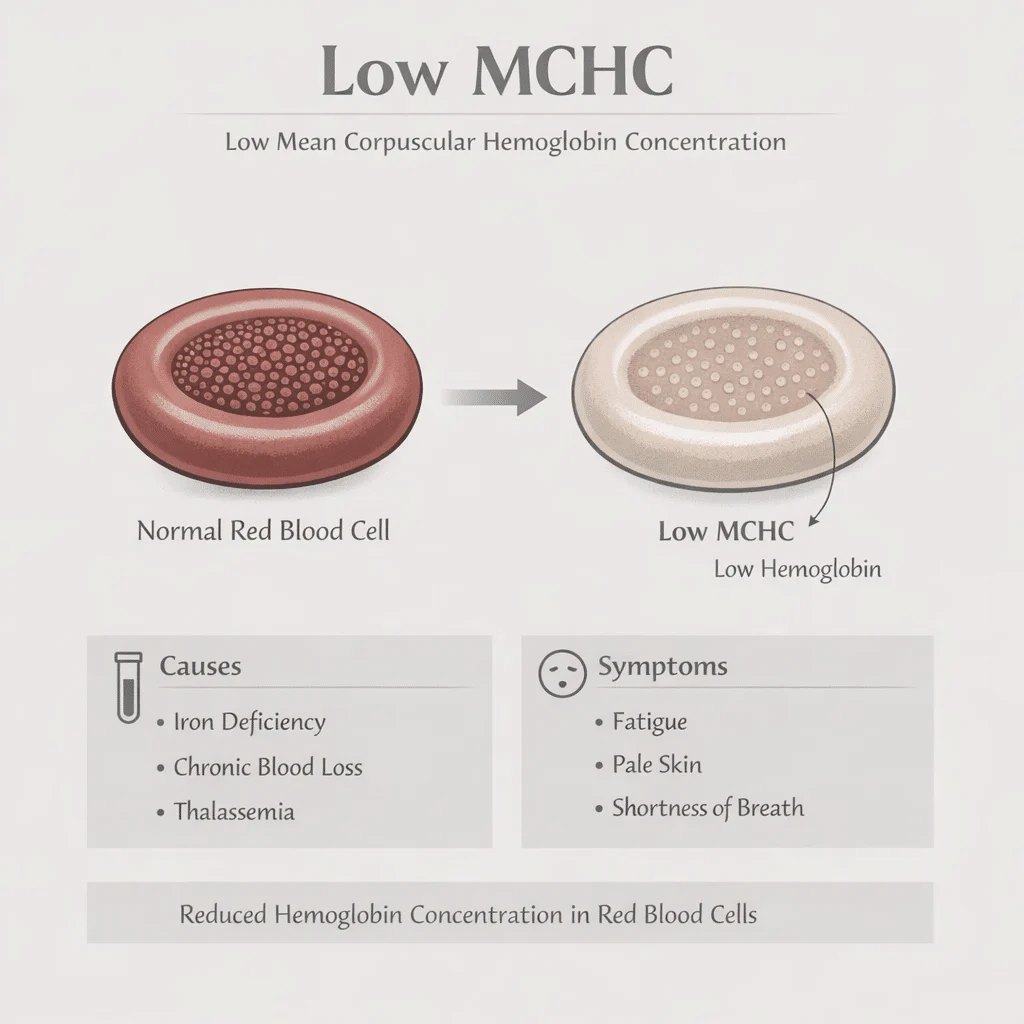
A low MCHC on a blood count report means that, on average, your red blood cells carry slightly less hemoglobin for their size than the reference range on that report expects. It is not a diagnosis, and it is not a disease in its own right. The figure is calculated rather than measured, worked out from two other numbers on the same page, and read alone it says very little. What it does do is narrow the field to a short list of explanations, most of them common and most of them manageable. In this article you’ll learn how the number is produced, why it only means something alongside MCV, MCH and RDW, which causes are worth chasing, when the result is a measurement problem rather than a change in your blood, and which tests come next.
What a low MCHC actually measures
How the number is produced
MCHC stands for mean corpuscular hemoglobin concentration, corpuscular meaning relating to the cells. The analyzer does not measure it directly. It takes the total hemoglobin in the tube, divides it by the hematocrit, and reports the answer in grams per deciliter. Hemoglobin is the protein that carries oxygen, and a separate article explains what a hemoglobin result tells you. The hematocrit is the share of your blood volume made up of red cells, and another guide describes how laboratories measure the hematocrit. Because the MCHC is derived from those two inputs, anything that shifts either one shifts the MCHC with it.
What counts as low
MedlinePlus, the patient information service of the National Library of Medicine, publishes a normal adult MCHC of roughly 32 to 36 grams per deciliter. The figures printed on your own report are the ones that matter, because ranges differ between analyzers, laboratories and age groups. A result a fraction below the lower limit is a different proposition from one several points below it, and a single borderline value carries far less weight than the same value on a repeat sample. This article stays with the low end of the scale, and a separate guide covers the full range of MCHC results.
The word your report may use instead
Laboratories often describe pale cells as hypochromic. Hypochromia seen on a blood film and a reduced MCHC on the printed report are two ways of noticing the same thing, one by eye and one by arithmetic. Neither tells you why it has happened.
Reading a low MCHC alongside MCV, MCH and RDW
The three numbers that give it meaning
No experienced clinician reads the MCHC alone. It sits in a group of four red cell indices, and the pattern across all four is what carries the information. The mean corpuscular volume reports average cell size, and a companion article explains what a MCV blood test result means. The MCH reports the average amount of hemoglobin per cell, and another guide describes what a MCH blood test measures. The red cell distribution width reports how uneven the cells are in size, and we explain what a high RDW result means. An MCHC accompanied by a low MCV and a low MCH is a coherent picture. A low MCHC on its own, with the other three squarely normal, usually is not.
Common patterns and what they point towards
The table below sets out the combinations seen most often. It shows how the indices are read together, and no single row of it settles what is happening in any individual person.
| Pattern on the report | What it commonly suggests | Usual next step |
|---|---|---|
| MCHC, MCV and MCH all low; RDW raised | Iron deficiency building up over months, so old and new cells differ in size | Ferritin, then a full iron panel if ferritin is equivocal |
| MCHC, MCV and MCH all low; RDW normal | An inherited hemoglobin variant such as thalassemia trait, where cells are uniformly small | Ferritin first; if iron stores are adequate, a test of hemoglobin types |
| MCHC low; MCV, MCH and hemoglobin normal | Often an unremarkable or borderline finding with no illness behind it | Repeat the count in due course; check ferritin only if there is a reason to |
| MCHC low alongside a long-standing illness | Anemia of chronic inflammation, where iron is present but held back from use | Iron studies read together with inflammatory markers |
| An MCHC that clashes with every other number on the page | A sample handling or analyzer problem rather than a change in your blood | Repeat on a fresh sample before anything is acted on |
Common causes of a low MCHC
Iron deficiency
Iron deficiency is the explanation found most often. Without enough iron the bone marrow cannot fill new red cells with their usual load of hemoglobin, so the cells emerge smaller and paler and the calculated MCHC drifts down. The National Heart, Lung, and Blood Institute lists blood loss as the leading cause in adults, from heavy periods, bleeding in the digestive tract, or regular use of anti-inflammatory painkillers. Absorption problems such as celiac disease and Crohn’s disease account for another share, and long-term kidney disease for a further one. Ferritin, which reflects stored iron, is the usual first check, and a dedicated article sets out how to read a ferritin blood test.
Thalassemia trait and other inherited variants
Thalassemia trait is an inherited pattern in which the body makes one of the hemoglobin building blocks less efficiently. Carriers are generally well and need no treatment, but their red cells are permanently small and pale, so the index reads low on every blood count they ever have. The clue that separates it from iron deficiency is consistency: the indices sit in much the same place year after year, the RDW is often normal because the cells are uniformly small, and iron stores are adequate. Mistaking it for iron deficiency leads to supplements that will not help and, taken indefinitely, are not harmless.
Inflammation, blood loss and the rest
A long-running infection, an autoimmune condition or another chronic illness can produce anemia of inflammation, in which the body has iron but restricts access to it. Recent surgery or a significant bleed can pull the indices down for weeks while the marrow catches up, and pregnancy raises iron demand enough to nudge them down in the second and third trimesters. Rarely, lead exposure or an inherited problem with heme production is responsible. For the wider picture of an anemia workup, another article sets out the common symptoms and causes of anemia. And when ferritin itself is the number that has fallen, we describe the causes and consequences of a low ferritin level.
When a low MCHC is a laboratory artifact
Why the analyzer can be wrong
Because the MCHC is calculated rather than measured, an error in either input becomes an error in the MCHC. Blood drawn from an arm carrying an intravenous drip can be diluted by the fluid running into it. A sample left too long before processing can let the cells swell, raising the measured hematocrit and pulling the calculated MCHC down. A very high white cell count can interfere with the readings. None of these reflect anything happening in your body.
Artifacts that push the number the other way
Laboratory interference more often pushes the MCHC up than down. Cloudy, fatty plasma after a very high-fat meal can falsely raise the hemoglobin reading, and red cells that have broken open in the tube do the same. Cold agglutinins, antibodies that make red cells clump once blood cools, distort the whole red cell group at once. If your report shows a strikingly high MCHC rather than a low one, an artifact is a realistic first consideration.
How this is settled in practice
The remedy is unglamorous and effective: repeat the test on a fresh, properly handled sample, and read the whole report rather than one line of it. Laboratories run internal checks designed to flag results that do not hang together, and a technologist may examine a blood film by eye before a report is released. To see how the surrounding numbers fit together, a separate guide walks through every line of a complete blood count report.
Symptoms, and what a low MCHC does not explain
The number itself causes nothing
This deserves saying plainly, because it is where a great deal of online writing goes astray. A low MCHC has no symptoms of its own. It is a figure on a page. Any symptoms you have come from whatever is behind that figure, and in the great majority of cases that means anemia or iron deficiency rather than the index. A mildly reduced MCHC with a normal hemoglobin frequently causes nothing whatsoever, and many people carrying one feel entirely well.
What people notice when anemia is present
Where the deficiency is significant enough to lower the hemoglobin, the usual complaints are tiredness that rest does not fix, breathlessness on stairs, pale skin, cold hands and feet, headaches and a pounding heartbeat. Iron deficiency can add brittle nails, hair shedding, a sore tongue, restless legs at night and occasionally a craving to chew ice. These belong to the deficiency, not to the MCHC.
When to see a doctor
- Breathlessness, chest pain or a pounding heartbeat at rest, or fainting, which need same-day medical attention rather than a routine appointment.
- Black, tarry or visibly bloody stools, or vomiting that looks like coffee grounds, which suggest bleeding in the digestive tract.
- Periods heavy enough to soak through protection hourly, to pass large clots, or to keep you at home.
- Tiredness that has built up over months alongside a low MCHC on a blood count, particularly if the hemoglobin has fallen too.
- A low MCHC in a man of any age, or in a woman past the menopause, where menstrual loss cannot be the explanation and a source of bleeding is usually looked for.
- Unintended weight loss, night sweats or a persistent change in bowel habit occurring alongside abnormal red cell indices.
Tests and treatment that follow the underlying cause
The tests that usually come next
A low MCHC on its own rarely triggers anything dramatic. If the hemoglobin is also low, or the picture is convincingly microcytic, ferritin is almost always the first test requested, because it is the best single indicator of iron stores in someone who is not acutely unwell. Where ferritin is borderline or inflammation may be distorting it, a wider panel adds serum iron, transferrin and total iron binding capacity, and we explain the individual tests in an iron studies panel. Transferrin saturation, the proportion of the transport protein actually carrying iron, is often the most decisive figure in that group, and its own article explains what iron saturation levels mean. A reticulocyte count shows whether the marrow is responding, and where iron studies come back normal, a test of hemoglobin types is the logical next move.
Treating the cause, not the index
Nothing is prescribed for a low MCHC as such. There is no medication for it, no target value to chase, and no benefit in moving the number in isolation. What gets treated is the reason behind it. For iron deficiency that means iron replacement and, just as importantly, finding out why the iron was lost. The National Heart, Lung, and Blood Institute notes that oral iron typically takes three to six months to rebuild stores, while intravenous iron works in one or two sessions and is reserved for more serious or poorly tolerated cases. Mayo Clinic advises taking tablets with a source of vitamin C, keeping them away from antacids, coffee and tea, and expecting to feel better within about a week even though the blood count takes far longer to normalise.
When nothing needs treating
Thalassemia trait needs no treatment at all, and iron given to someone who carries it will not improve their indices. An isolated dip with normal cells, normal hemoglobin and no symptoms often needs nothing beyond a repeat count at a sensible interval. Recognising when to leave a number alone is as much a part of good practice as knowing when to act on it.
Latest scientific advances
Research from the past three years has sharpened how the red cell indices are read.
Interference can distort several indices at once
A 2026 laboratory study looked at samples containing cold agglutinins, antibodies that make red cells clump once blood cools. The clumps mislead the analyzer, which then reports a distorted red cell count, hematocrit, MCV, MCH and MCHC together. Warming the sample and re-running it in a dedicated mode restored credible figures. What this means for you: when one index looks impossible next to the rest of the report, a sample problem is a real possibility, and a repeat on a fresh sample settles it.
The direction of the change matters
A 2024 review of how hereditary spherocytosis is diagnosed, an inherited condition in which red cells are unusually round and fragile, set out the routine indices used as a first filter. There the MCHC characteristically runs high, not low. What this means for you: which way an index has moved is often more informative than the fact that it has moved.
Arithmetic shortcuts help but do not decide
When MCHC, MCV and MCH are all low, the question is whether iron deficiency or an inherited hemoglobin variant is responsible. Clinicians have long used simple formulas built from the indices, the best known being the Mentzer index. A 2023 study found the shortcut separated the two groups usefully; a 2024 study elsewhere concluded it was not dependable enough to be used alone. What this means for you: these formulas prompt the next test, they do not diagnose. A ferritin and, where needed, a direct look at your hemoglobin types settle it.
The cancer question, answered with data
A common worry is whether a low MCHC signals cancer. A 2025 analysis of more than 450,000 adults followed forwards over time tested whether routine red cell indices related to later cancer diagnoses. The indices that showed a relationship were the MCV, the MCH and the red cell distribution width. The MCHC was not among them. What this means for you: the evidence does not link the MCHC to cancer risk. Where cancer enters the conversation it is because unexplained iron deficiency prompts a search for bleeding, which is a different question.
How iron is replaced is still being refined
Two Cochrane reviews published in 2024 examined iron replacement where deficiency is most common. Cochrane reviews pool many trials and grade how much confidence the result deserves. One compared iron given by drip with iron taken by mouth in pregnancy; the other assessed treatments after childbirth. Both treat the strength of the evidence as a question in its own right. What this means for you: correcting the deficiency is what moves the blood count, the route is a clinical judgement, and a repeat count weeks after treatment starts tells you more than one taken immediately.
Glossary
| Term | Definition |
|---|---|
| MCHC | Mean corpuscular hemoglobin concentration. The average concentration of hemoglobin inside your red blood cells, calculated by dividing hemoglobin by hematocrit rather than measured directly. |
| MCV | Mean corpuscular volume, the average size of your red blood cells. Small cells are called microcytic and large ones macrocytic. |
| MCH | Mean corpuscular hemoglobin, the average amount of hemoglobin carried in a single red blood cell. |
| RDW | Red cell distribution width, a measure of how much your red cells vary in size. It rises when a new population of differently sized cells appears. |
| Hematocrit | The proportion of your blood volume made up of red blood cells, usually reported as a percentage. |
| Hypochromia | The pale appearance of red blood cells that contain less hemoglobin than usual. It is the visual counterpart of a reduced MCHC. |
| Ferritin | A protein that stores iron. The blood level broadly reflects how much iron the body has in reserve, though it also rises with inflammation. |
| Transferrin saturation | The percentage of the blood’s iron transport protein that is actually carrying iron. A low figure supports a diagnosis of iron deficiency. |
| Thalassemia trait | An inherited pattern in which one hemoglobin building block is made less efficiently. Carriers are usually well but have permanently small, pale red cells. |
| Cold agglutinin | An antibody that makes red blood cells clump together when a sample cools. The clumping can distort several red cell measurements at once. |
Frequently asked questions
What is a dangerously low MCHC level?
There is no MCHC value that is dangerous by itself, because the index is a calculation rather than a physical quantity your body has to maintain. What can be dangerous is a severely low hemoglobin, and that is a separate line on the same report. Doctors judge urgency from the hemoglobin, from how quickly it has fallen, from your symptoms and from any active bleeding, not from how far the MCHC sits below its reference range. If your MCHC is flagged low, look at the hemoglobin next to it. A markedly low hemoglobin with breathlessness, chest pain or fainting needs prompt medical attention regardless of what the MCHC reads.
Can you have a low MCHC but normal iron and ferritin?
Yes, and it happens often. The commonest explanation is an inherited hemoglobin variant such as thalassemia trait, in which cells are permanently small and pale despite perfectly adequate iron stores. Anemia of chronic inflammation is another: iron is present in the body but locked away from the marrow, so ferritin can read normal or even high while the red cells still turn out pale. A borderline result that reflects nothing more than normal biological variation is a third possibility. If your iron studies are genuinely normal and the picture persists, the usual next step is a test that looks directly at your hemoglobin types rather than more iron testing.
What does it mean if the MCHC is low but everything else is normal?
An isolated dip in the MCHC, with a normal hemoglobin, a normal MCV, a normal MCH and a normal RDW, is usually unremarkable. Reference ranges are drawn so that a proportion of healthy people fall just outside them, and the MCHC is particularly prone to small shifts because it is derived from two other measurements. In this situation many doctors will simply repeat the count at a later date rather than launch an investigation. Persistent, more marked reductions across several results are treated differently, and a ferritin is reasonable if there is any independent reason to suspect iron deficiency.
Does a low MCHC mean cancer?
No. There is no established link between the MCHC and cancer risk, and a large 2025 cohort study that tested the red cell indices against later cancer diagnoses found relationships for the MCV, the MCH and the RDW, but not for the MCHC. Cancer sometimes enters the discussion for an indirect reason: unexplained iron deficiency in an adult, particularly a man or a woman past the menopause, prompts a search for a hidden source of bleeding, and the bowel is one place that gets checked. That investigation is driven by the iron deficiency and by your age and history, not by the MCHC figure itself.
What does low MCV, low MCH, low MCHC and a high RDW mean together?
That combination is the classic signature of iron deficiency. Small cells, less hemoglobin in each, a lower concentration overall, and a widened distribution because older normal cells are still circulating alongside newer smaller ones. The raised RDW is the part that points away from thalassemia trait, in which the cells tend to be small but uniform. The pattern is suggestive rather than conclusive, so a ferritin and often a full iron panel follow. If those come back normal, the picture is reconsidered and hemoglobin types are usually tested.
Can you have a low MCHC without anemia?
Yes. Anemia is defined by a low hemoglobin, not by the indices, so it is entirely possible to have a reduced MCHC with a hemoglobin that sits comfortably in range. This is common in the early stages of iron deficiency, when stores are falling and new cells are already being made with less hemoglobin but the overall count has not yet dropped. It is also typical of thalassemia trait, where many carriers have normal or near-normal hemoglobin for life. That pattern is worth noting and sometimes worth investigating, but it is not the same as being anemic.
Sources
- MedlinePlus, National Library of Medicine — Red Blood Cell (RBC) Indices, 2024 — medlineplus.gov
- National Heart, Lung, and Blood Institute — Anemia: Iron-Deficiency Anemia — nhlbi.nih.gov
- Mayo Clinic — Iron deficiency anemia: diagnosis and treatment — mayoclinic.org
- Yang Y, Wang Q, Lu M — Impact of Severe Cold Agglutination on Routine Red Blood Cell Parameters and Correction Strategies — Clinical Laboratory, 2026 — doi.org/10.7754/Clin.Lab.2025.250726
- Polizzi A et al. — Overview on Hereditary Spherocytosis Diagnosis — International Journal of Laboratory Hematology, 2024 — doi.org/10.1111/ijlh.14376
- Shah TP, Shrestha A, Agrawal JP, Rimal S, Basnet A — Role of Mentzer Index for Differential Diagnosis of Iron Deficiency Anaemia and Beta Thalassemia Trait — Journal of Nepal Health Research Council, 2023. PubMed
- Althumairi A et al. — Diagnostic test performance of the Mentzer index in differentiating beta thalassemia trait from iron deficiency anemia — Frontiers in Medicine, 2024 — doi.org/10.3389/fmed.2024.1361805
- Fu C et al. — Red cell indices as predictors of cancer risk — BMC Cancer, 2025 — doi.org/10.1186/s12885-025-14679-8
- Nicholson L et al. — Intravenous versus oral iron for iron deficiency anaemia in pregnancy — Cochrane Database of Systematic Reviews, 2024 — doi.org/10.1002/14651858.CD016136
- Jensen MCH et al. — Treatment for women with postpartum iron deficiency anaemia — Cochrane Database of Systematic Reviews, 2024 — doi.org/10.1002/14651858.CD010861.pub3
Further reading
- Low MCV: causes, symptoms and treatments
- Red blood cell count: what your RBC number means
- Reticulocyte count: how to read your results
- Normal blood test ranges: a reference chart
- Read blood test results: a simple guide
Understand your lab results with AI DiagMe
A low MCHC only makes sense next to the rest of your blood count, and that is exactly the kind of joined-up reading that is hard to do on your own. AI DiagMe takes the report you already have and explains what each line means in ordinary language, including the complete blood count, ferritin, the iron studies panel and the reticulocyte count. It helps you understand your results and prepare better questions for your appointment. It does not diagnose, and it does not replace your doctor.
Get your results interpreted in minutes