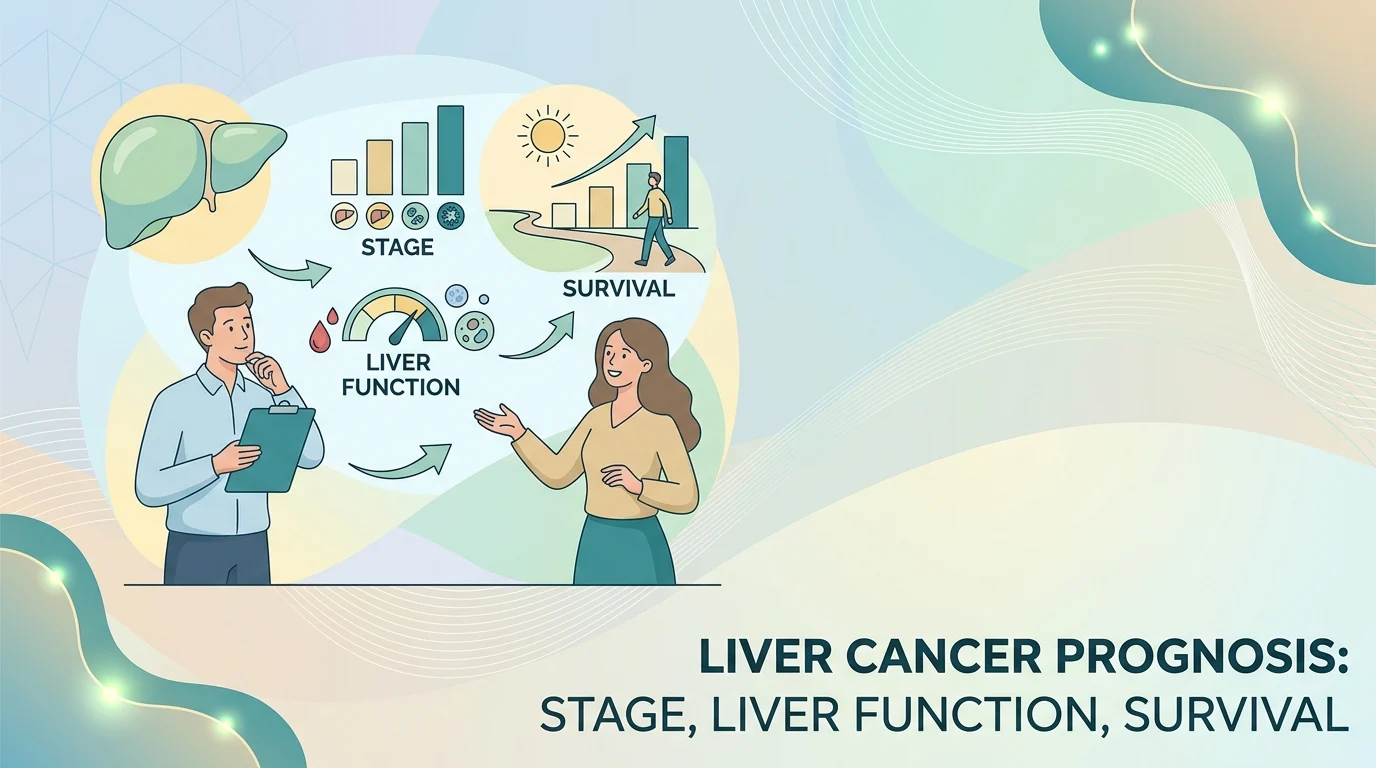
Liver cancer prognosis is one of the hardest things to look up honestly, because the single number most people find first is close to meaningless for any individual. The 21.9 percent five-year relative survival published by the National Cancer Institute pools every stage, every tumor type, and every level of underlying liver damage into one figure. What clinicians actually use is quite different: a combination of how far the tumor has spread, how well the liver still works, and how well the person is functioning day to day. Those three inputs pull the outlook across a very wide range, from disease that is potentially curable to disease where the goal is comfort. This guide explains how that assessment is made, what the stage-specific figures are, and what genuinely changes the picture.
Why liver cancer prognosis works differently
In most cancers, the outlook is driven by the tumor. In liver cancer it is driven by two diseases at once. Around 80 to 90 percent of hepatocellular carcinomas develop on a background of cirrhosis, and that scarred liver is itself a life-limiting condition. A person can have a small, technically treatable tumor and still be unable to undergo surgery because removing liver tissue would tip the remaining organ into failure.
This is why staging systems built only on tumor anatomy perform poorly here. The National Cancer Institute notes that the clinical use of TNM staging in liver cancer is limited precisely because liver function is not part of it. The three factors that determine prognosis are the anatomical extent of the tumor, the person’s performance status, and the functional hepatic reserve measured by the Child-Pugh score. A useful way to hold this: the tumor decides what treatment would help, and the liver decides what treatment is survivable.
How liver cancer is staged
The BCLC system
The Barcelona Clinic Liver Cancer system is the most widely used framework internationally, because it is the one that combines tumor burden, liver function, and physical status, and then links each stage directly to a treatment strategy. Exact criteria differ slightly between guideline versions, so the table below is the general shape rather than a rulebook.
| BCLC stage | Broadly defined by | Usual treatment intent |
|---|---|---|
| 0, very early | A single small tumor, preserved liver function, fully active person | Curative: ablation or resection |
| A, early | A single tumor or a few small nodules, preserved function | Curative: resection, transplant, or ablation |
| B, intermediate | Multiple tumors confined to the liver, still functioning well | Locoregional therapy, sometimes with systemic drugs |
| C, advanced | Invasion of blood vessels, spread outside the liver, or reduced activity | Systemic therapy, usually immunotherapy combinations |
| D, terminal | Severely impaired liver function or very limited physical status | Symptom control and supportive care |
Two people with identical scans can sit in different BCLC stages if one has a well-compensated liver and the other does not. That is a feature of the system rather than a flaw.
Child-Pugh class and what it measures
The Child-Pugh score grades how much working liver remains. It combines five items: bilirubin, albumin, clotting time expressed as INR, the presence of fluid in the abdomen, and any confusion caused by liver failure. Two of those five are ordinary blood values you may already have on a report, which is why the panel matters here; our liver function tests guide explains how those markers are read together. For the protein that falls as function declines, see our low albumin guide, and for the pigment behind jaundice, open our total bilirubin guide.
| Class | Score | What it means for treatment |
|---|---|---|
| A | 5 to 6 | Well-compensated liver; the full range of options is usually open |
| B | 7 to 9 | Significant impairment; options narrow and are weighed case by case |
| C | 10 to 15 | Advanced failure; cancer treatment is rarely tolerated, transplant assessment may apply |
An older framework, the Okuda system, used bilirubin, albumin, ascites, and tumor size together, but it lacks sensitivity for early disease and has largely been superseded.
Why cancer registry stages look different
Population statistics are not reported in BCLC stages. Cancer registries group cases as localized, regional, or distant, which describes anatomical spread only and says nothing about liver function. When you compare a survival table online with what a clinician has told you, you are often comparing two different systems, and that mismatch is a common source of confusion.
Survival by stage, and what those numbers mean
According to SEER data covering 2016 to 2022, five-year relative survival for liver and intrahepatic bile duct cancer breaks down as follows.
- Localized disease, 45 percent of cases: 37.4 percent
- Regional spread, 23 percent of cases: 13.4 percent
- Distant spread, 21 percent of cases: 3.6 percent
- Unstaged, 10 percent of cases: 11.6 percent
Four cautions apply before anyone reads their own future into those figures. They describe people diagnosed several years ago and treated with the options available then, which have since changed substantially. They combine hepatocellular carcinoma with bile duct cancer, which behave differently. They take no account of Child-Pugh class, which can matter more than tumor size. And relative survival is a statistical construction comparing a group with the cancer to a matched group without it; it is not a countdown clock for a person. The median age at diagnosis is 68, and 42,340 new cases with 30,980 deaths are projected in the United States for 2026.
What actually changes the outlook
Factors associated with a better prognosis
- A single tumor rather than several, and a smaller one rather than larger
- No invasion of the portal vein or other blood vessels
- No spread outside the liver
- Child-Pugh class A, meaning the liver is still compensated
- Good performance status, meaning normal or near-normal daily activity
- Being found through surveillance rather than after symptoms appeared
- Eligibility for a treatment given with curative intent
Factors associated with a worse prognosis
- Portal vein tumor invasion, one of the strongest single adverse factors
- Decompensated cirrhosis with ascites or encephalopathy
- Spread to lymph nodes, lungs, or bone
- A markedly elevated alpha-fetoprotein, although this marker is imperfect in both directions; our AFP blood test guide covers why
- Continuing alcohol use or untreated viral hepatitis
- Poor nutritional status and muscle loss
Several routine blood values feed into this picture indirectly, since they track the liver reserve that governs treatment eligibility. A falling albumin-to-globulin ratio has been studied as a prognostic signal before liver surgery, and our albumin to globulin ratio guide explains what that ratio represents. None of these values diagnoses or grades cancer on its own.
Prognosis is not fixed at diagnosis
This is the point most survival tables obscure. The underlying liver disease can be treated, and when it is, the outlook shifts. Controlling hepatitis B or hepatitis C, stopping alcohol, and managing metabolic liver disease all act on the organ that sets the ceiling on treatment. If your hepatitis status is unclear, see our hepatitis B surface antigen guide and our hepatitis blood test guide. Tumors that are initially inoperable are sometimes brought back into curable territory by shrinking them first, an approach described in guidelines as downstaging or curative conversion. And because how the disease is found shapes the stage it is found at, understanding the signals matters too; read our guide to liver cancer symptoms.
Latest scientific advances
Research in the last three years has sharpened both halves of the prognosis equation, the tumor and the liver. The summaries below come from peer-reviewed studies and guidelines and are simplified for general readers.
The most directly useful finding for people weighing options is that treatments for localized disease are not interchangeable. A 2024 systematic review and pairwise meta-analysis in JAMA Network Open pooled 40 randomized trials covering 11,576 patients with non-metastatic liver cancer and found a clear hierarchy. Surgery combined with adjuvant therapy outperformed surgery alone for both progression-free and overall survival, surgery outperformed radiofrequency ablation, and radiotherapy and hepatic arterial infusion chemotherapy each outperformed chemoembolization. The authors concluded that surgery-based management was associated with the best outcomes and embolization-based options with the worst. That does not mean surgery is right for everyone, since eligibility depends on liver function, but it does mean the choice of local treatment is a genuine prognostic variable worth discussing.
The second finding is more hopeful and less well known. A 2025 systematic review and meta-analysis of 27 studies and 9,063 patients with decompensated cirrhosis examined recompensation, meaning the recovery of liver function after the underlying cause is controlled. Around 35 percent of patients recompensated, most often those with hepatitis B-related cirrhosis, where the figure reached 50 percent. Recompensated patients had substantially lower odds of developing liver cancer and of dying, with the evidence graded as low certainty because of variation between studies. The practical message is that a Child-Pugh class recorded at one moment is a measurement, not a verdict.
Treating viral hepatitis acts earlier in the same chain. A 2024 systematic review and meta-analysis covering 103 studies of chronic hepatitis B in the so-called indeterminate phase found an annual liver cancer incidence of 0.32 percent, and reported that antiviral therapy was associated with a lower risk of developing liver cancer. Heterogeneity between studies was high, so the authors stopped short of recommending treatment for everyone in that group, but the direction of effect supports current guideline emphasis on accurate staging of liver fibrosis and timely treatment decisions.
For intermediate-stage disease, where the outlook has historically been the most variable, a 2025 consensus guideline from the Taiwan Liver Cancer Association set out criteria for when chemoembolization is unsuitable and when to move to systemic therapy earlier, with the explicit aim of enabling curative conversion and downstaging in patients who would previously have been treated palliatively.
Detection is improving in parallel. A 2024 meta-analysis of 44 studies assessed artificial intelligence algorithms for detecting liver cancer on imaging, reporting pooled sensitivity of 84 percent and specificity of 92 percent on internal validation, 85 percent and 84 percent on external validation, against 70 percent and 85 percent for clinicians assessed the same way. The authors positioned these tools as a supplement that flags regions of interest for radiologists rather than a replacement, and external validation remains the weaker half of the evidence. Finally, a search of ClinicalTrials.gov in September 2026 returns 46 recruiting phase 3 trials in hepatocellular carcinoma, many combining immunotherapy with locoregional treatment, and one testing a drug specifically in patients with Child-Pugh B7 cirrhosis, a group historically excluded from trials. Because published survival statistics lag practice by years, today’s figures do not yet reflect these changes.
Glossary
| Term | Meaning |
|---|---|
| BCLC | The staging system combining tumor burden, liver function, and physical status. |
| Child-Pugh score | A five-item score grading how much working liver remains. |
| Performance status | A scale describing how much normal daily activity a person can manage. |
| Compensated cirrhosis | Scarred liver that is still performing its essential functions. |
| Decompensation | The point at which cirrhosis causes ascites, bleeding, or confusion. |
| Recompensation | Recovery of liver function after the underlying cause is controlled. |
| Portal vein invasion | Tumor growing into the main vein feeding the liver, a strong adverse factor. |
| Downstaging | Shrinking a tumor so that curative treatment becomes possible. |
| Relative survival | Survival in a group with the cancer compared with a matched group without it. |
Frequently asked questions
What is the life expectancy with liver cancer?
There is no single answer, and any source giving one is oversimplifying. Outcomes span from potentially curable early disease to advanced disease where treatment aims at control rather than cure. The five-year relative survival is 37.4 percent for localized disease and 3.6 percent once the cancer has spread to distant sites, but neither figure accounts for liver function, which can matter more than tumor size. Your own medical team, with your scans and blood results in front of them, is the only source that can frame this for your situation.
What matters more, the tumor or the liver?
Both, and that is the defining feature of this disease. The tumor determines which treatments could help; the state of the liver determines which of those treatments a person can actually tolerate. Someone with a small tumor and Child-Pugh class C cirrhosis may have fewer options than someone with a larger tumor and a well-compensated liver.
What is the prognosis for stage 4 liver cancer?
Stage 4 in the registry sense corresponds to distant spread, where the five-year relative survival is 3.6 percent. Systemic treatment, particularly immunotherapy combinations, is the main approach, and first-line options have changed substantially since the period those statistics cover. Discussing clinical trial eligibility with a specialist is reasonable at this stage.
Can liver cancer prognosis improve over time?
It can. Treating the underlying cause sometimes allows liver function to recover, which widens the treatment options available. In one 2025 meta-analysis, about a third of patients with decompensated cirrhosis achieved recompensation after the cause was controlled, and they had lower odds of developing liver cancer and of dying. Separately, tumors that are inoperable at first are sometimes downstaged into curable territory.
Is the prognosis different for hepatocellular carcinoma and bile duct cancer?
Yes. They arise from different cells, behave differently, and are treated differently. Published registry statistics often combine them, which blurs a real distinction. Hepatocellular carcinoma accounts for about 90 percent of primary liver cancers, so pooled figures mostly reflect it.
How accurate are survival statistics for one person?
They describe groups, not individuals, and they lag current practice by several years. Two people with the same registry stage can have very different outlooks depending on liver function, performance status, tumor location, and which treatments they are eligible for. Statistics are useful for understanding the landscape, not for predicting a personal outcome.
Sources
- Cancer Stat Facts: Liver and Intrahepatic Bile Duct Cancer — SEER Program, National Cancer Institute
- Primary Liver Cancer Treatment (PDQ) Health Professional Version — National Cancer Institute, National Institutes of Health
- Liver Cancer Treatment (PDQ) Patient Version — National Cancer Institute, National Institutes of Health
- Liver Cancer — MedlinePlus, National Library of Medicine
- Liver Cancer: Symptoms, Signs, Causes and Treatment — Cleveland Clinic
- EASL Clinical Practice Guidelines on the management of hepatocellular carcinoma — Journal of Hepatology, 2024 (indexed in PubMed)
- Patel K.R. et al. Locoregional Therapies for Hepatocellular Carcinoma: A Systematic Review and Meta-Analysis — JAMA Network Open, 2024 (indexed in PubMed)
- Goh X.E. et al. Prevalence and Clinical Outcomes of Recompensation in Decompensated Cirrhosis: A Systematic Review and Meta-Analysis — Clinical Gastroenterology and Hepatology, 2025 (indexed in PubMed)
- Lai J.C. et al. Histological severity, clinical outcomes and impact of antiviral treatment in indeterminate phase of chronic hepatitis B: A systematic review and meta-analysis — Journal of Hepatology, 2024 (indexed in PubMed)
- Lee I.C. et al. Taiwan Liver Cancer Association management consensus guidelines for intermediate-stage hepatocellular carcinoma — Clinical and Molecular Hepatology, 2025 (indexed in PubMed)
- Salehi M.A. et al. Diagnostic Performance of Artificial Intelligence in Detection of Hepatocellular Carcinoma: A Meta-analysis — Journal of Imaging Informatics in Medicine, 2024 (indexed in PubMed)
- Namodenoson in Advanced Hepatocellular Carcinoma in Patients With Child-Pugh Class B7 Cirrhosis (NCT05201404) — ClinicalTrials.gov
- Livmoniplimab in Combination With Budigalimab in Locally Advanced or Metastatic Hepatocellular Carcinoma (NCT06109272) — ClinicalTrials.gov
Other articles
- Liver Cancer Symptoms: Early Signs and When to Act
- Liver Function Tests (LFTs): How to Read Your Liver Panel
- AFP blood test: how to understand your results
- Low Albumin: Causes, Symptoms, and Risks
- Total bilirubin levels: normal ranges, causes, and care
- Albumin to Globulin Ratio: How to Read a Low or High Result
- HBsAg Positive: What It Means and What Happens Next
- Hepatitis Blood Test: What Your Results Mean
Bilirubin, albumin, and clotting values are not just numbers on a page here: they are the same inputs clinicians use to judge what the liver can still tolerate. Understand your lab results with AI DiagMe, which reads your report line by line and explains each value in plain language, with interpretation reviewed by a committee of physicians.