





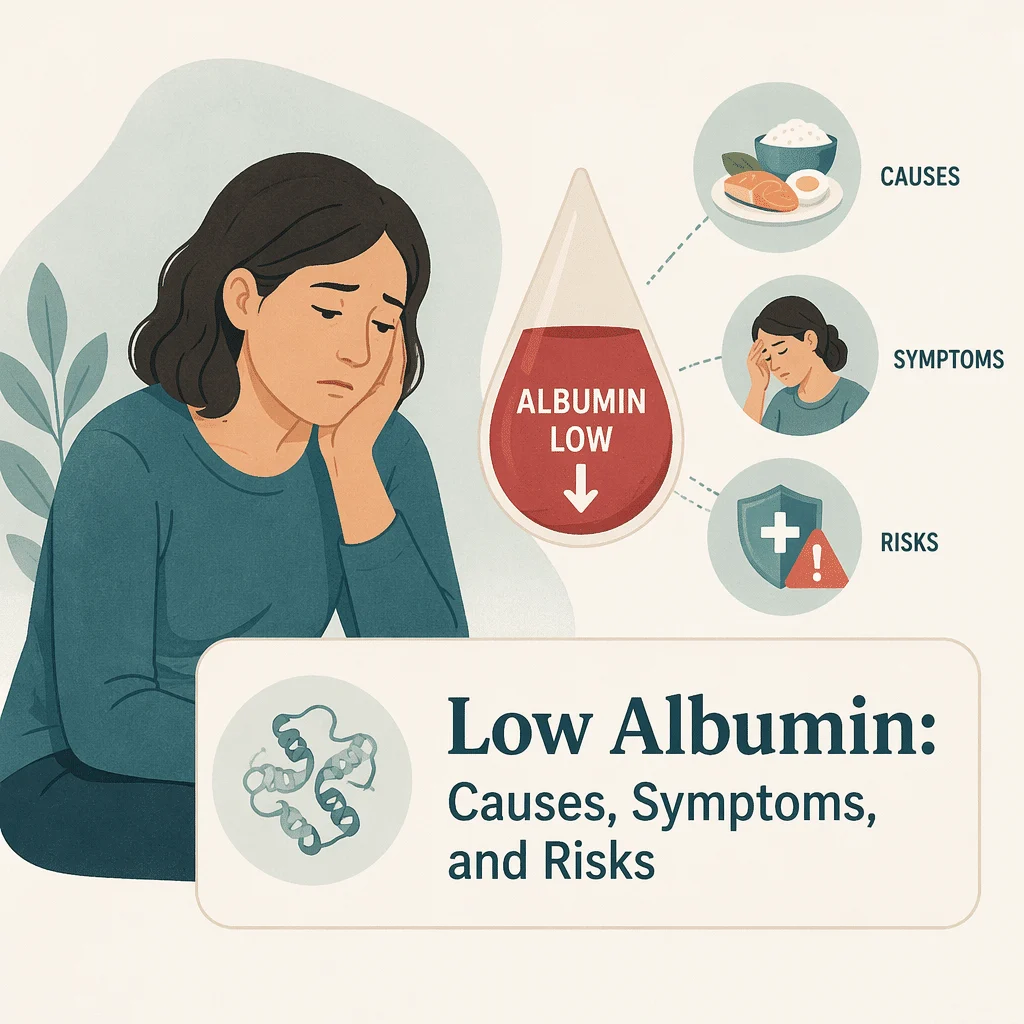
A low albumin result on a blood test means the main protein circulating in your blood has fallen below the usual range. Albumin is made by the liver, and its main job is holding fluid inside your blood vessels, so a drop often shows up as swelling in the ankles, legs, or around the eyes. Many people assume the cause is poor nutrition. In practice, the likeliest explanation is inflammation from an infection, an injury, recent surgery, or a flare of a chronic condition. In this article you will learn what albumin measures, the four situations that lower it, which follow-up tests tell them apart, and when a falling result deserves medical attention.
What albumin does in the body
Albumin is the most abundant protein in blood plasma. Your liver produces it continuously and releases it into the circulation, where it does two jobs that matter day to day.
It keeps fluid inside your blood vessels
Blood vessels are slightly leaky by design. Albumin creates an inward pull, called oncotic pressure, that draws water back from surrounding tissue into the vessel. When albumin falls far enough, that pull weakens and fluid collects in tissue. This is why swelling is the symptom most closely tied to a low albumin result, and why it appears first where gravity pools fluid.
It carries hormones, drugs, and calcium
Albumin also works as a transport vehicle, binding and ferrying thyroid hormone, calcium, bilirubin, fatty acids, and many medications. That role has a practical consequence: when albumin is low, the total calcium on your panel can look falsely low even though the active calcium is normal. Clinicians correct for this, which is why the two are reported together.
Albumin reference ranges and what counts as low
Most laboratories in the United States report adult serum albumin as roughly 3.5 to 5.0 grams per deciliter, the same as 35 to 50 grams per liter. The StatPearls clinical reference gives that interval as normal for adults, and research studies most often define hypoalbuminemia, the medical term for low albumin, as a value under 3.5 grams per deciliter.
Mild, moderate, and marked reductions
There is no official grading scale, but clinicians think in bands. A result just under the range, in the low 3s, is common and often temporary. A result in the high 2s usually points to an active problem. Below about 2.5 grams per deciliter, swelling becomes likely. What matters most is the direction of travel: one slightly low reading means far less than a value that keeps sliding.
Why your laboratory range may differ
Each laboratory sets its own interval, so the printed range on your report is the one that applies to you. Albumin also runs lower in older adults and during pregnancy, when blood volume expands and dilutes the concentration, and lying down for a while can lower a reading slightly. One guide details normal albumin levels in blood and urine.
The four reasons albumin runs low
Almost every cause fits one of four mechanisms: the liver makes less, the kidneys leak it out, the gut loses it, or inflammation suppresses production and pushes albumin out of the bloodstream. Sorting out which applies is the point of follow-up testing.
Inflammation and acute illness, the most common and most misunderstood cause
Albumin is what laboratory medicine calls a negative acute-phase reactant. When your body mounts an inflammatory response, the liver reprioritizes: it ramps up proteins such as C-reactive protein while dialing down albumin. Inflammation also makes capillaries leakier, so albumin escapes into surrounding tissue. The result is a genuinely low blood level that has nothing to do with what you have been eating.
This matters for interpretation. A pneumonia, a urinary infection, a recent operation, or an arthritis flare will all pull albumin down within days, and the number usually recovers over the following weeks. If your albumin came back low while your C-reactive protein came back high, inflammation is by far the likeliest explanation, and chasing a nutritional cause would be a detour. A separate article explains high CRP levels.
Liver disease
Because the liver manufactures albumin, sustained damage eventually reduces the supply. Albumin has a half-life of about three weeks, so the level responds gradually rather than overnight, and a low albumin from liver disease usually signals a long-standing problem. Cirrhosis is the classic setting, and the National Institute of Diabetes and Digestive and Kidney Diseases lists swelling in the legs, ankles, or feet and fluid buildup in the abdomen among its symptoms.
Liver-related low albumin rarely arrives alone. Liver enzymes, bilirubin, and clotting times usually shift as well, which is why albumin sits on the standard liver panel. Another guide covers liver function tests.
Kidney loss through the urine
Healthy kidneys keep protein in the blood and out of the urine. When the filtering units are damaged, albumin escapes into the urine and the blood level falls to match. Nephrotic syndrome is the extreme version, producing a recognizable trio: heavy protein in the urine, low blood albumin, and swelling. The same institute describes this pattern, including puffy eyelids and swelling in the legs and feet.
If low albumin appears without an obvious infection or liver problem, checking the urine is the most useful next step. A urine albumin-to-creatinine ratio, abbreviated ACR, measures how much albumin is leaking relative to urine concentration and runs on a single sample. Persistently frothy urine is a clue worth mentioning. Our library explains the kidney function panel, and a dedicated page covers foamy urine. We also cover protein in urine.
Gut losses and inadequate intake
The digestive tract can lose protein directly or fail to absorb the building blocks needed to make it. Inflammatory bowel disease, celiac disease, and a group of conditions called protein-losing enteropathy all let protein drain out through a damaged bowel wall.
Inadequate protein intake can lower albumin, but it takes sustained deprivation to do so in a healthy person, because albumin turns over so slowly. Low albumin caused purely by diet is uncommon outside severe eating disorders, advanced illness, or difficulty swallowing. When poor intake is the driver, there are almost always other signs: weight loss, muscle wasting, and low iron or vitamin levels. Our library covers gluten intolerance and celiac disease.
Comparing the four causes
| What is happening | Clues on the same blood panel | Test that usually settles it |
|---|---|---|
| Inflammation or acute illness | C-reactive protein raised, globulins often raised, albumin fell over days | C-reactive protein plus a repeat albumin after recovery |
| Liver disease | Liver enzymes and bilirubin abnormal, clotting slower | Liver panel, clotting tests, and liver imaging |
| Kidney loss | Normal liver enzymes, prominent swelling, cholesterol often raised | Urine protein and urine albumin-to-creatinine ratio |
| Gut loss or low intake | Low iron or vitamin levels, weight loss, digestive symptoms | Celiac testing, fecal calprotectin, dietary review |
Symptoms of low albumin
Mild reductions usually cause nothing and are found incidentally on a routine panel. Symptoms appear as the level drops further, and most trace back to fluid leaving the bloodstream.
Swelling and where it appears
Swelling, known medically as edema, is the hallmark. It typically starts in the feet and ankles and worsens through the day as you stand and walk. Pressing a finger into the skin over the shinbone may leave a dent that fills slowly, called pitting. Puffiness around the eyes on waking is common in kidney-related cases. Fluid can also gather in the abdomen or around the lungs, causing breathlessness.
Symptoms that belong to the underlying cause
Beyond swelling, most of what people notice comes from whatever is driving the albumin down rather than the low protein itself. Fatigue, poor appetite, and weakness are frequent but nonspecific. Yellowing of the skin or eyes points toward the liver, frothy urine toward the kidneys, diarrhea and weight loss toward the gut, and fever toward infection.
The tests that surround albumin on your report
Albumin is almost never measured alone. Its neighbors on the report often explain the result faster than the albumin value itself.
Total protein and the albumin to globulin ratio
Total protein adds albumin to the globulins, the other main protein family, which includes antibodies. Because albumin normally makes up a little over half the total, the balance between the two is informative, and MedlinePlus describes this comparison as standard. Low albumin with raised globulins suggests chronic inflammation. Low albumin with low globulins suggests loss, from the kidneys or the gut. One article explains the albumin to globulin ratio, we also describe low globulin levels, and another guide explains protein electrophoresis results.
Why prealbumin is not the nutrition marker it was thought to be
Prealbumin, also called transthyretin, was long promoted as a faster nutrition marker because it turns over in about two days rather than three weeks. The problem is that prealbumin behaves exactly like albumin during inflammation, falling when the body is stressed regardless of intake. A 2025 review of laboratory nutrition assessment concluded that albumin and transthyretin reflect the acute-phase response and should not be treated as markers of malnutrition. A low prealbumin therefore does not confirm a nutritional cause.
When albumin is ordered and what happens next
Albumin is rarely requested by itself. It arrives as one line on a comprehensive metabolic panel, a fourteen-test blood panel used for general health checks, or on a liver panel. It also features in pre-operative assessments and in monitoring of kidney and liver disease. A companion article explains the comprehensive metabolic panel.
The sequence most doctors follow
Because a single low reading has many explanations, the workup is stepwise. Your doctor will ask whether you have been unwell recently, then read the rest of the panel before ordering anything new.
- Confirm the result. A repeat test, once any acute illness has passed, separates a temporary dip from a persistent fall.
- Check for inflammation. C-reactive protein and a blood count identify an acute-phase response.
- Check the liver. Enzymes, bilirubin, and clotting time show whether production is the problem.
- Check the urine. A urine albumin-to-creatinine ratio or a protein measurement identifies kidney losses.
- Check the gut and nutrition. Celiac testing, stool markers, iron studies, and a dietary history come in when earlier steps are unrevealing.
What treatment actually involves
No medication raises albumin as an end in itself. Treatment targets the cause: antibiotics for an infection, immunosuppression for a kidney or bowel condition, management of cirrhosis, or nutritional support where intake is truly the issue. Intravenous albumin exists, but it is a hospital treatment for specific situations, not a remedy for a low number on a report. Eating extra protein will not correct a low albumin caused by inflammation or urinary loss.
When to see a doctor
Most low albumin results are found on routine testing and can wait for a normal appointment. Some warrant faster contact.
- Arrange urgent care for breathlessness at rest or when lying flat, since this can indicate fluid around the lungs.
- Arrange urgent care for rapid abdominal swelling, severe abdominal pain, or fever alongside swelling.
- Contact your doctor promptly for swelling in both legs, puffy eyelids in the morning, or persistently foamy urine.
- Contact your doctor promptly for yellowing of the skin or eyes, or for confusion in someone with known liver disease.
- Book a routine appointment for a mildly low result with no symptoms, and expect a repeat test rather than investigation.
- Book a routine appointment if you have unintentionally lost weight, have ongoing diarrhea, or have a long-term kidney, liver, or bowel condition.
Latest scientific advances
Research from the past three years has sharpened how clinicians read a low albumin. The direction of travel is consistent: albumin gauges how ill someone is, not how well they have been eating.
Albumin is a severity signal, not a nutrition score
A 2025 review of laboratory nutrition assessment in intensive care concluded that albumin reflects inflammation, fluid shifts, and organ function rather than nutritional intake, and should not be treated as a marker of malnutrition. What this means for you is that a low albumin during or just after an illness is not evidence that you need more protein. It is evidence that your body is dealing with something, and the sensible response is to find and treat that, then recheck.
A 2023 study of people with advanced chronic liver disease measured how fast the liver was building albumin and found production genuinely reduced, in step with how impaired the liver was, and unlike acute inflammatory states. What this means for you is that liver-related low albumin reflects a real manufacturing shortfall that builds slowly, and is followed over months rather than week by week.
A 2025 Danish study of people with heavy protein loss in the urine and low blood albumin found that most had visible swelling by the time the problem was identified. What this means for you is that puffiness is worth reporting to your doctor, because it tends to appear alongside the falling number rather than long afterwards.
Low albumin predicts a harder recovery from surgery
A 2026 systematic review pooling twenty-three studies and more than six hundred thousand abdominal surgery patients found that people with low albumin beforehand had roughly twice the risk of a wound infection afterwards. A separate 2025 review of joint replacement surgery found low albumin linked to more readmissions and repeat operations. A 2023 meta-analysis of colorectal cancer surgery found more complications and longer hospital stays below 3.5 grams per deciliter, though the link with death was unclear.
What this means for you is that if surgery is planned and your albumin is low, your team may want to understand why first. These reviews describe an association, not proof that low albumin causes the complications; it often marks underlying illness that may itself be doing the damage. A meta-analysis combines results from many earlier studies into one overall estimate.
Falling albumin tracks the severity of acute infection
A 2025 systematic review of dengue, pooling seventeen studies, found that patients whose albumin dropped were more than twice as likely to develop severe disease, most markedly in children. What this means for you illustrates the acute-phase principle: in a short, intense infection, albumin falls in proportion to how hard the illness is hitting, over days. Nutrition plays no part on that timescale.
Giving albumin back does not fix the underlying problem
This is the most useful research for anyone tempted to treat the number. A 2024 review pooling twenty-four randomized trials of intravenous albumin in adults with sepsis found no overall survival benefit, and a 2025 expert review of albumin therapy in cirrhosis concluded that it is not a one-size-fits-all treatment, helping in some scenarios and disappointing in others. What this means for you is that correcting the laboratory value is not itself the goal. A randomized trial allocates people to treatments by chance, the strongest test of whether a treatment works. This is why your doctor investigates the cause rather than topping up the protein.
Frequently asked questions
What albumin level is considered dangerously low?
There is no universal threshold, and context matters more than the figure. Values below roughly 2.5 grams per deciliter are where swelling becomes likely and where an underlying condition is usually significant enough to need active management. A result in the low 3s in someone who has just had an infection or an operation is common and often temporary. Your doctor will weigh the number against your symptoms, the rest of your panel, and how the value has changed over time rather than treating any single figure as a cutoff.
Can low albumin be reversed?
Frequently, yes, when the underlying cause can be treated. Albumin that fell because of an infection or an operation usually climbs back on its own over several weeks once you recover. Albumin lost through the kidneys typically improves when the kidney condition is brought under control. Low albumin from advanced cirrhosis is harder to reverse because the manufacturing capacity is genuinely reduced, though managing the liver disease helps. Recovery is measured in weeks to months rather than days, because albumin turns over slowly.
Does eating more protein raise albumin?
Only when genuinely inadequate intake is the cause, which is the least common of the four mechanisms in well-resourced settings. If inflammation, kidney loss, or liver disease is driving the result, extra dietary protein will not correct it, and in some kidney and liver conditions a very high protein intake can be unhelpful. Good nutrition supports recovery and is worth attending to, but it is a supporting measure rather than a treatment. Ask your doctor before making major dietary changes when a kidney or liver condition is involved.
Why is albumin low in cancer patients?
Usually because of the inflammatory response that accompanies cancer, compounded in some people by reduced appetite and by the effects of treatment. Tumors and the immune activity around them release signals that suppress albumin production and make blood vessels leakier, the same acute-phase mechanism seen in infection. This is why low albumin is often used as a general marker of how advanced or aggressive a situation is, and why it appears in many prognostic scores across different cancers.
Does low albumin always mean something serious?
No. A mildly low result is a common incidental finding, particularly after an illness, during pregnancy, in older adults, or after a period lying in a hospital bed. It becomes more meaningful when it is markedly low, when it stays low on a repeat test taken after recovery, when it is accompanied by swelling, or when other results on the same panel are also abnormal. That combination, rather than the isolated value, is what prompts investigation.
How long does it take for albumin to improve?
Albumin has a half-life of around three weeks, so meaningful change is slow by the standards of most blood tests. After an infection or surgery resolves, expect several weeks before the value returns to baseline, and doctors typically wait at least two to four weeks before rechecking. Retesting too soon often shows little change and can cause unnecessary worry. If your result is being monitored for a long-term liver or kidney condition, intervals of three to six months are more usual.
Glossary
| Term | Definition |
|---|---|
| Albumin | The most plentiful protein in blood plasma, made by the liver. It holds fluid inside blood vessels and carries hormones, calcium, and many medicines. |
| Hypoalbuminemia | The medical term for a blood albumin level below the laboratory reference range, most often defined as under 3.5 grams per deciliter. |
| Negative acute-phase reactant | A blood protein that goes down rather than up when the body is inflamed. Albumin is the best-known example, which is why it falls during infection or after surgery. |
| Oncotic pressure | The inward pull that proteins in the blood exert on water, keeping fluid inside vessels. When albumin drops, this pull weakens and fluid leaks into tissue. |
| Edema | Swelling caused by fluid collecting in body tissues, most visibly in the feet, ankles, lower legs, and around the eyes. |
| Nephrotic syndrome | A kidney disorder combining heavy protein loss in the urine, low blood albumin, and swelling, caused by damage to the kidney filters. |
| Albumin-to-creatinine ratio (ACR) | A urine test comparing albumin with creatinine to show how much albumin is leaking, adjusted for how dilute the sample is. |
| Protein-losing enteropathy | A group of conditions in which protein drains out of the body through a damaged or inflamed bowel wall. |
| Prealbumin (transthyretin) | A blood protein that turns over in about two days. Once used as a nutrition marker, it is now known to fall with inflammation as well. |
| Comprehensive metabolic panel (CMP) | A routine group of fourteen blood tests covering kidney function, liver enzymes, electrolytes, glucose, and proteins including albumin. |
Sources
- MedlinePlus, National Library of Medicine — Albumin Blood Test. MedlinePlus
- MedlinePlus, National Library of Medicine — Total Protein and Albumin/Globulin (A/G) Ratio. MedlinePlus
- National Institute of Diabetes and Digestive and Kidney Diseases — Nephrotic Syndrome in Adults. NIDDK
- National Institute of Diabetes and Digestive and Kidney Diseases — Symptoms and Causes of Cirrhosis. NIDDK
- Gounden V, Vashisht R, Jialal I — Hypoalbuminemia — StatPearls, NCBI Bookshelf, 2024. NCBI Bookshelf
- Ostermann M — Laboratory assessment of nutritional status in ICU patients — Current Opinion in Clinical Nutrition and Metabolic Care, 2025. PubMed
- Amouzandeh M, Sundstrom A, Wahlin S, Wernerman J, Rooyackers O, Norberg A — Albumin and fibrinogen synthesis rates in advanced chronic liver disease — American Journal of Physiology: Gastrointestinal and Liver Physiology, 2023. PubMed
- Kelddal S, Tofig BJ, Hvas AM, Grove EL, Christiansen CF, Birn H — Edema and outcome in patients with nephrotic-range albuminuria and hypoalbuminemia: a Danish multicenter cohort study — American Journal of Nephrology, 2025. PubMed
- Omer HFE, Saga MBA, Naser YWS, et al. — Association between preoperative hypoalbuminemia and surgical site infection in abdominal surgery: a systematic review and meta-analysis — Patient Safety in Surgery, 2026. PubMed
- Tischler EH, Tsai SHL, McDermott JR, et al. — Hypoalbuminemia associated perioperative mortality, reoperation, and readmission rates among total joint arthroplasty procedures: a systematic review and meta-analysis — European Journal of Orthopaedic Surgery and Traumatology, 2025. PubMed
- Christina NM, Tjahyanto T, Lie JG, et al. — Hypoalbuminemia and colorectal cancer patients: any correlation? A systematic review and meta-analysis — Medicine, 2023. PubMed
- Shabil M, Bushi G, Apostolopoulos V, et al. — Hypoalbuminemia as a predictor of severe dengue: a systematic review and meta-analysis — Expert Review of Anti-infective Therapy, 2025. PubMed
- Bai Z, Lai Y, Han K, Shi L, Guan X, Xu Y — Human albumin for adults with sepsis: an updated systematic review and meta-analysis of randomized controlled trials — Medicine, 2024. PubMed
- Trebicka J, Garcia-Tsao G — Controversies regarding albumin therapy in cirrhosis — Hepatology, 2025. PubMed
Further reading
- AST/ALT ratio: meaning and interpretation
- High ALT: causes, levels, and when to worry
- Urine creatinine levels: guide and interpretation
- Fecal calprotectin: understanding test results
- Read blood test results: a simple guide
Understand your lab results with AI DiagMe
A low albumin result makes sense only next to the rest of your panel: the liver enzymes that show how well your liver is working, the total protein and globulins that reveal whether protein is being lost or produced, the C-reactive protein that flags inflammation, and the urine protein that points to the kidneys. AI DiagMe reads those values together and explains in plain language what the combination suggests and which questions are worth raising. It helps you understand your results; it does not diagnose you and it does not replace your doctor.
Get your results interpreted in minutes