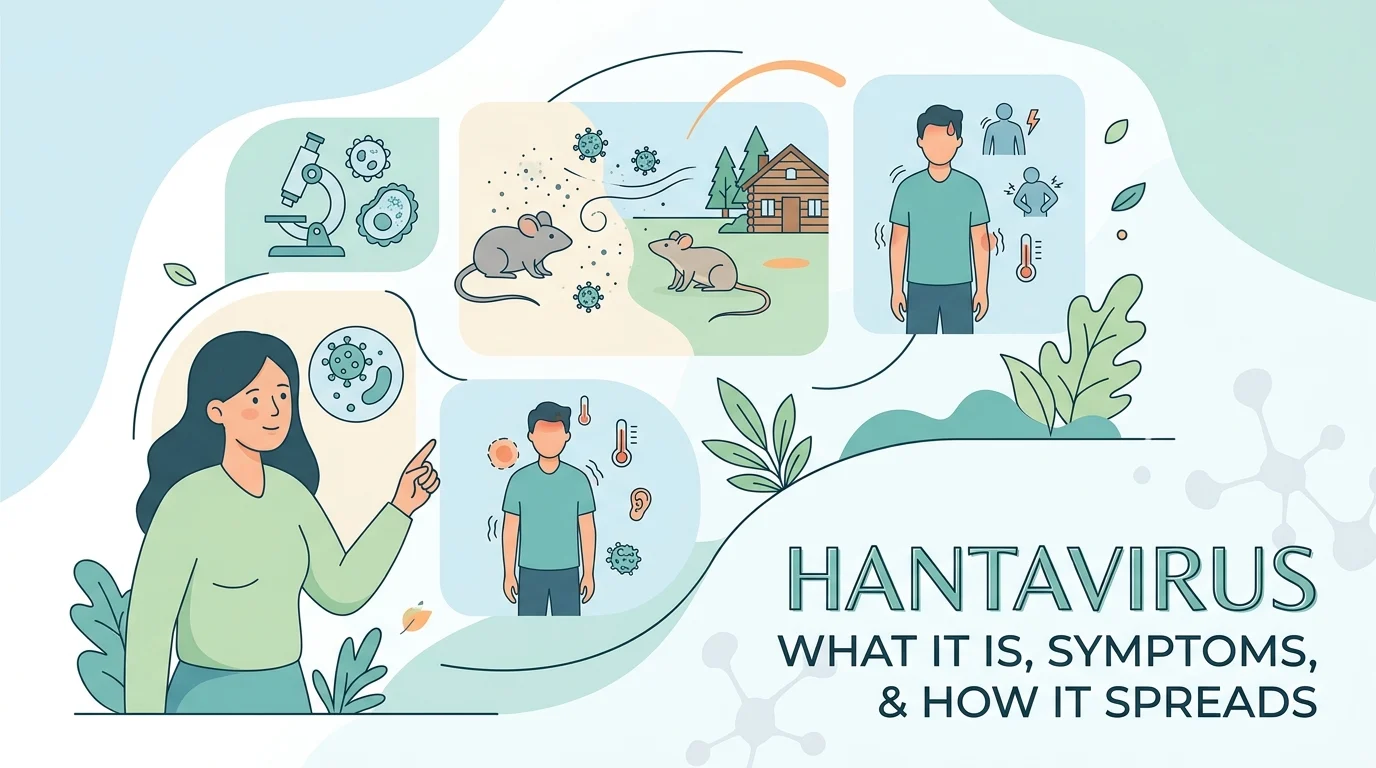
Hantavirus is a group of rodent-borne viruses that can, in rare cases, cause serious lung or kidney disease in people. The name has returned to the headlines because an infection long considered exceptional is again drawing the attention of public health agencies. This article explains in plain language what hantavirus is, how it spreads, which symptoms should prompt concern, how doctors diagnose it from a blood test, and what recent research adds. The goal is to give you reliable reference points, without alarm, so you know when to seek care and how to protect yourself.
A better-known animal-borne virus raises the same questions: see how Ebola spreads and what treatment now exists.
What is hantavirus?
Hantavirus is not a single virus but a family of RNA viruses grouped under the genus Orthohantavirus. Their natural reservoir is rodents — voles, mice, and rats — which carry the virus without getting sick. They shed it for long periods in their urine, droppings, and saliva.
Each type of hantavirus is tied to a specific rodent species and a region of the world. That is why the disease does not look the same in the Americas as it does in Europe or Asia. Like other illnesses passed from animals to people, such as Lyme disease, hantavirus is a zoonosis.
The two main syndromes
Depending on the virus involved, hantavirus infection takes two main forms:
- Hantavirus pulmonary syndrome (HPS), caused by “New World” hantaviruses in the Americas (such as Sin Nombre and Andes virus). It mainly affects the lungs and can progress very quickly to breathing failure.
- Hemorrhagic fever with renal syndrome (HFRS), caused by “Old World” hantaviruses in Europe and Asia (such as Puumala, Hantaan, Dobrava, and Seoul). It mainly affects the kidneys.
In both forms, the shared mechanism is a leak from the smallest blood vessels: the virus makes capillary walls more permeable, allowing plasma to escape into the tissues.
How do you get hantavirus?
Almost all infections happen by breathing in dust contaminated with the droppings, urine, or saliva of infected rodents. The risk is highest in enclosed, poorly ventilated spaces — a shed, attic, barn, cabin, or a vehicle left closed for a long time — especially while sweeping or stirring up dust.
Less often, infection can follow a rodent bite or touching the mouth, nose, or eyes with contaminated hands. People at higher risk include farmers, forestry and outdoor workers, anyone cleaning a rodent-infested space, and campers.
Person-to-person spread is rare
This point matters for keeping perspective: almost all hantaviruses do not spread from one person to another. The only documented exception is Andes virus in South America, and only through close, prolonged contact (within a household or between intimate partners). An infected person is contagious only while symptoms are present. Unlike the flu or COVID-19, hantaviruses do not spread efficiently between people.
Hantavirus symptoms: from flu-like illness to emergency
The first symptoms of hantavirus are misleading because they look like the flu. They usually appear 1 to 8 weeks after exposure (about 2 weeks on average).
The early (flu-like) phase
It most often combines:
- sudden fever and chills;
- muscle aches, especially in the thighs, hips, back, and sometimes the shoulders;
- marked fatigue and headache;
- in about half of patients: nausea, vomiting, diarrhea, abdominal pain, or dizziness.
Because these signs also suggest the flu, a common infection, hantavirus is easy to miss without a history of rodent exposure.
The severe (lung or kidney) phase
A few days later (often 4 to 10 days after the first signs), the illness can shift:
- In hantavirus pulmonary syndrome, fluid fills the lungs: cough, shortness of breath, chest tightness, then breathing failure that may require intensive care.
- In hemorrhagic fever with renal syndrome, the kidneys are affected: a drop in blood pressure, reduced urine output, and sometimes bleeding. HFRS classically moves through five phases (febrile, hypotensive, oliguric, polyuric, then recovery).
The table below summarizes the differences between the two forms.
| Feature | Pulmonary syndrome (HPS) | Renal syndrome (HFRS) |
|---|---|---|
| Regions | Americas | Europe, Asia |
| Typical viruses | Sin Nombre, Andes | Puumala, Hantaan, Dobrava, Seoul |
| Main organ | Lungs | Kidneys |
| Key warning sign | Sudden shortness of breath | Low urine output, low back pain |
| Indicative fatality | High (about 30-40%, sometimes more) | Low to moderate (about 0.4% to 10%) |
How common is hantavirus, and where?
In the United States, hantavirus disease is rare. About 50 cases are reported each year, the large majority west of the Mississippi River, and the virus is usually Sin Nombre, carried by the deer mouse. Among people with severe respiratory disease, the case fatality rate is roughly 38%, according to the CDC.
Andes virus, which can spread person to person, is found in South America; the rodents that carry it are not found in the United States. The topic returned to the news in the spring of 2026 with an Andes virus outbreak aboard a cruise ship in the South Atlantic, the MV Hondius. International and U.S. health authorities set up case finding, monitoring, and contact tracing in response. The episode is geographically limited and does not change the very low risk for the general U.S. population.
How is hantavirus diagnosed?
Hantavirus is hard to diagnose early, precisely because the symptoms look like other infections. A blood test often points the way first. To make sense of your numbers, our guides on how to read a blood test and on the complete blood count (CBC) can help.
Several findings on the complete blood count strongly orient the doctor:
- a drop in platelets (thrombocytopenia), the cells that help blood clot;
- hemoconcentration, shown by a high hematocrit (red cells look “concentrated” because plasma has leaked out);
- a rise in white blood cells with large activated lymphocytes, called immunoblasts;
- elevated LDH and sometimes a higher CRP, a marker of inflammation.
In the renal form, tests may also show rising creatinine and a strained kidney function.
Confirmation rests on two specialized tests: serology, which looks for IgM and IgG antibodies against the virus, and RT-PCR, which detects the virus’s genetic material directly.
Treatment and prevention
To date, there is no specific antiviral and no widely available vaccine for hantavirus. Care is supportive: rest, careful fluids, oxygen, and, in severe cases, breathing support in an intensive care unit. For the most severe, refractory lung cases, a technique that oxygenates the blood outside the body — extracorporeal membrane oxygenation (ECMO) — can be lifesaving in specialized centers. The antiviral ribavirin has shown some benefit in the renal form but not in the lung phase.
How to protect yourself
The best protection is to limit contact with rodents and their droppings:
- air out a closed space well before entering or cleaning it;
- do not sweep or vacuum dry droppings: dampen them first with diluted bleach (about 1 part bleach to 10 parts water);
- wear gloves and an N95-type respirator when cleaning infested spaces;
- seal entry points, store food securely, and keep rodents from settling in the home.
Latest scientific advances
Research on hantavirus has clearly accelerated since the 2026 Andes virus outbreak aboard the MV Hondius. Based on recent articles indexed in PubMed, several lessons stand out — and they should be read as lines of investigation under evaluation, not as settled medical facts.
A pandemic risk judged to be low. Several 2026 analyses stress that Andes virus is not “the next SARS-CoV-2.” Its ecology is rodent-borne, person-to-person spread requires close and prolonged contact, and the virus is not very stable in the environment. A review in Eurosurveillance (Bal et al., 2026) underlines these differences and confirms that diagnosis rests on blood PCR and serology. A review in Current Opinion in Immunology (Acharya et al., 2026) likewise concludes that the immediate global pandemic risk is low, while calling for stronger surveillance.
Treatment leads that are still preliminary. No drug has definitively proven its worth, but signals are emerging. A short case series in The Lancet Infectious Diseases (Tortosa et al., 2026) describes the use of tocilizumab, an anti-inflammatory that targets interleukin-6, in patients with severe pulmonary disease: four of five treated patients survived, compared with none of five eligible but untreated patients. The numbers are very small, and the authors themselves call for comparative trials before any conclusion. A critical care review (Chediack et al., 2026) also supports ECMO in refractory cases, finds no benefit from ribavirin in the lung phase, and describes convalescent plasma as still investigational.
Why cases may rise. A European study using data from 2011 to 2021 (Guo et al., 2026) applied machine learning to identify the main drivers of human risk: temperature, habitat diversity, and socioeconomic factors. Climate change, deforestation, and urbanization — by increasing contact between people and rodents — could raise the number of cases. This is one of the arguments behind the One Health approach, which links human, animal, and environmental health. These findings come from articles indexed in PubMed; full references appear in the Sources section.
When to see a doctor
The most useful reflex is to tell your clinician about any recent rodent exposure. Seek care promptly if, in the weeks after cleaning an infested space, doing farm or forestry work, or staying in a rural area, you develop:
- a high fever with intense muscle aches that worsen over several days;
- shortness of breath, a cough, or chest tightness;
- a marked drop in urine output, low back pain, or unusual bleeding.
Sudden shortness of breath or difficulty breathing warrants an immediate call to emergency services (911). The earlier care begins, the better the chances of recovery. These signs do not mean you have hantavirus — they are common to many conditions — but they deserve prompt medical advice after an exposure.
Glossary
| Term | Definition |
|---|---|
| Aerosol | Tiny particles suspended in the air, here from rodent droppings. |
| Deer mouse | The small rodent that carries Sin Nombre virus in North America. |
| Hantavirus pulmonary syndrome (HPS) | The form of the infection that affects the lungs, seen in the Americas. |
| Hemoconcentration | An apparent rise in blood concentration as plasma leaks out of the vessels. |
| Hemorrhagic fever with renal syndrome (HFRS) | The form of the infection that mainly affects the kidneys, seen in Europe and Asia. |
| Immunoblasts | Large activated lymphocytes sometimes seen on the CBC during infection. |
| Orthohantavirus | The viral genus to which all hantaviruses belong. |
| RT-PCR | A lab test that detects the virus’s genetic material. |
| Serology | Testing the blood for antibodies (IgM, IgG) against the virus. |
| Thrombocytopenia | An abnormally low platelet count. |
| Zoonosis | A disease that can pass from animals to people. |
Frequently asked questions
Is hantavirus contagious from person to person?
In the vast majority of cases, no. Almost all hantaviruses are caught from rodents, not from other people. The only known exception is Andes virus in South America, which can spread through close, prolonged contact, and only when the person has symptoms. The viruses that cause hantavirus disease in the United States do not pass from person to person.
How long after exposure do hantavirus symptoms appear?
The incubation period usually runs from 1 to 8 weeks, with an average of about 2 weeks. So a fever that appears several weeks after cleaning a rodent-infested space can still be linked to that exposure. Be sure to mention it to your clinician, because this timing helps guide the diagnosis.
Is hantavirus fatal, and can you recover from it?
It depends on the form. The European renal form (Puumala virus) is usually mild and resolves without lasting harm, with a low fatality rate. The American lung form is far more serious. Recovery is possible, especially when hospital care starts early. There is no specific antiviral treatment: care focuses on supporting breathing and circulation.
Can dogs or cats get hantavirus?
Dogs and cats are not reservoirs of hantavirus and do not pass it to people. That said, a hunting cat may bring infected rodents into the home — the risk then comes from the rodent, not the pet. Handle dead prey with gloves and avoid sweeping up droppings dry.
Is there a vaccine for hantavirus?
There is no widely available vaccine in the United States or Europe. Vaccines against the renal form are used in some Asian countries, but they are not recommended or distributed in the United States. Prevention therefore rests on hygiene measures and rodent control.
Do the latest research findings change how hantavirus is treated today?
Not yet. Recent signals, such as the use of tocilizumab or ECMO in severe cases, come from small studies or specialized centers. They open promising directions but are not, at this point, a validated standard of care. Only a clinician can decide what is appropriate in an individual situation.
Sources
- CDC – About Andes Virus (Hantavirus)
- Mayo Clinic – Hantavirus pulmonary syndrome: symptoms and causes
- Cleveland Clinic – Hantavirus
Recent studies (PubMed) cited in the “Latest scientific advances” section:
- Bal A. et al. Eurosurveillance, 2026. DOI
- Acharya A. et al. Current Opinion in Immunology, 2026. DOI
- Tortosa F. et al. The Lancet Infectious Diseases, 2026. DOI
- Chediack V. et al. Medicina Intensiva, 2026. DOI
- Guo J. et al. Environmental Research, 2026. DOI
Further reading
- Read blood test results: a simple guide
- Complete blood count: read your results
- Platelet count: how to read your test results
- Influenza: causes, symptoms, treatments, and prevention
- Lyme disease: causes, symptoms, and treatments
Understand your lab results with AI DiagMe
An infection like hantavirus often leaves traces in a blood test: a drop in platelets, a high hematocrit, rising LDH, or strained kidney function (urea and creatinine). These results can be confusing when you read them alone on a report. AI DiagMe helps you understand what your lab results mean (blood, urine, stool), in plain language, without making a diagnosis and without replacing your doctor. It is a useful reference point to prepare for your visit and ask the right questions.
➡️ Get your results interpreted in minutes