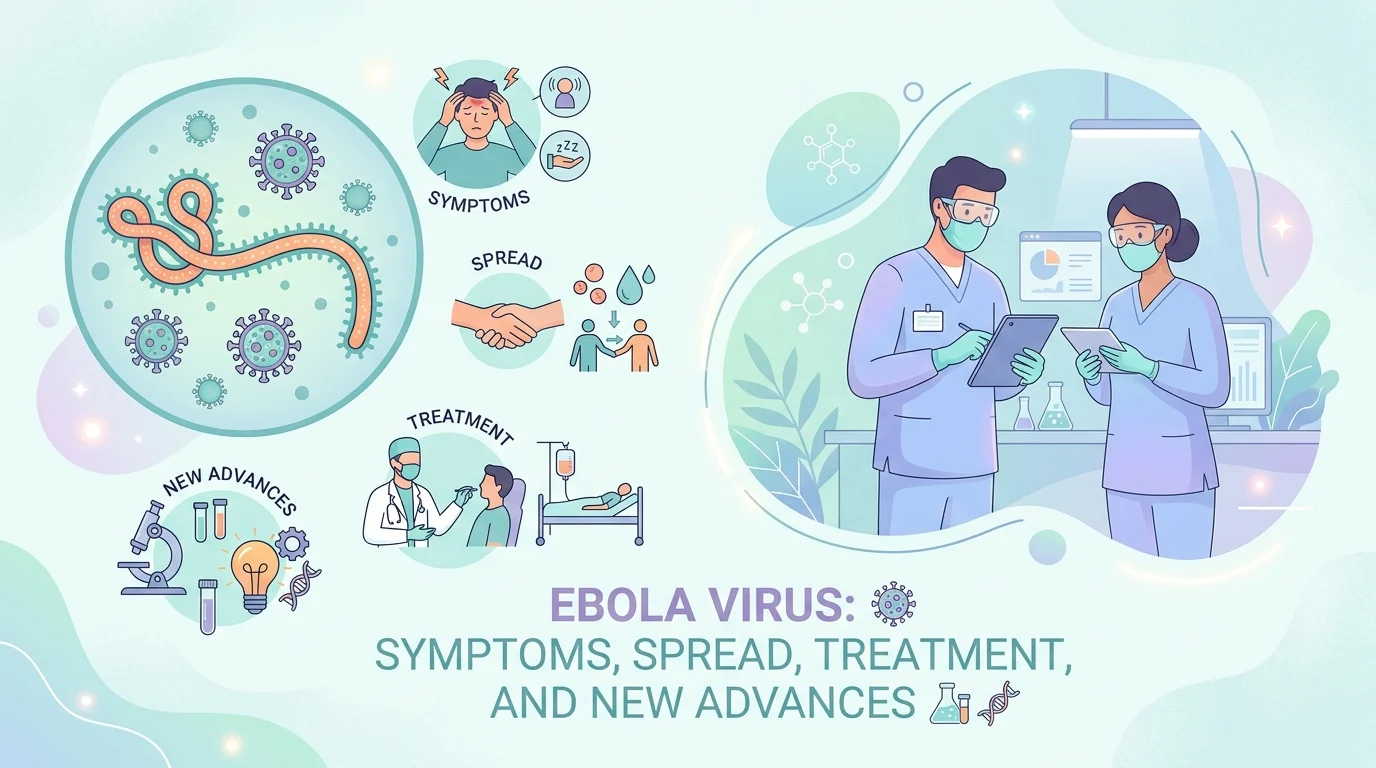
The Ebola virus causes a rare but serious illness, with an average fatality rate of around 50 percent. People often ask the same questions: how does it spread, what are the symptoms, is there a vaccine, and what has recent research changed? This guide explains, in plain language, what we know about the Ebola virus: where it comes from, how it spreads, its warning signs, how it is diagnosed, how it is treated, and how it is prevented. You will also find a summary of the latest scientific advances and clear guidance on when to see a doctor. The aim is not to alarm you, but to give you reliable, measured information that reflects 2026 guidance.
Another rare animal-borne virus raises similar questions: see how hantavirus spreads and what it does.
What is the Ebola virus?
The Ebola virus belongs to the Filoviridae family and the genus Orthoebolavirus (formerly Ebolavirus). These are thread-like viruses, among the longest known. They cause Ebola virus disease (EVD), a viral hemorrhagic fever that can be fatal.
There are six species, three of which have caused major outbreaks: Ebola virus itself (the Zaire species), Sudan virus, and Bundibugyo virus. A fourth, Taï Forest virus, has affected only one person, in 1994. This distinction matters: the approved vaccines and treatments currently target only the Zaire species of Ebola virus.
The virus was discovered in 1976 during two simultaneous outbreaks in what is now South Sudan (Nzara) and the Democratic Republic of the Congo (Yambuku). It takes its name from the Ebola River, near the first identified outbreak. Since then, several outbreaks have occurred in Africa. The largest was the West African epidemic of 2014 to 2016, with roughly 29,000 cases and more than 11,300 deaths.
How deadly is the Ebola virus?
The average case fatality rate is about 50 percent. Across outbreaks, and depending on the quality of care, it has ranged from 25 to 90 percent. Without treatment, mortality can reach 80 to 90 percent. Because early care makes such a large difference, seeking medical help quickly can be life-saving.
How does the Ebola virus spread?
The Ebola virus does not spread through the air, unlike influenza or COVID. You cannot catch it simply by passing near someone. Transmission happens through direct contact with the body fluids (blood, vomit, stool, urine, sweat, breast milk, semen) of a person who is sick or has died, or with objects and surfaces soiled by those fluids.
A person is only contagious after symptoms appear, and becomes more contagious as the illness progresses. The bodies of people who have died remain highly contagious, so funeral rites that involve contact with the body are a frequent source of transmission. A recovered person no longer transmits the virus, except through semen, where it can persist for several months; sexual transmission has been reported up to a year after recovery.
The natural reservoir has not been formally proven, but fruit bats (the Pteropodidae family) are the leading suspects. The virus can reach people through contact with infected animals, including bats, great apes, and forest antelopes, especially during hunting or preparing bushmeat.
Ebola virus symptoms
The incubation period (the time between infection and the first signs) ranges from 2 to 21 days, most often 8 to 10 days. Symptoms often begin suddenly and at first resemble the flu, which makes early diagnosis difficult.
Doctors often describe two stages: early “dry” symptoms, followed by “wet” symptoms as the illness worsens.
| Stage | Usual timing | Common signs |
|---|---|---|
| Early (“dry”) signs | Days 1 to 3 | Sudden fever above 100.4°F (38°C), severe fatigue, muscle aches, headache, sore throat |
| Established (“wet”) phase | Days 3 to 10 | Vomiting, diarrhea, abdominal pain, rash, liver and kidney involvement |
| Severe forms | From day 5 onward | Internal and external bleeding, confusion, agitation (nervous system involvement), organ failure |
Contrary to the popular image, bleeding is not the most common symptom: it affects only some patients and tends to appear later in the illness. The severity varies widely from one person to another, and prompt care clearly improves the chances of survival.
How is the Ebola virus diagnosed?
Early on, the signs are not specific and can resemble other illnesses common in tropical regions, such as malaria, typhoid fever, or meningitis. Only laboratory tests can confirm the diagnosis.
The reference test is RT-PCR, which detects the virus’s genetic material. Antibody tests (IgM and IgG) are used mainly for late or retrospective diagnosis. These analyses are performed in very high-security laboratories, because the samples are extremely infectious.
What a routine blood test can show
Ebola is diagnosed with specialized tests, not with an ordinary blood test. That said, a severe infection often disturbs markers found on a routine complete blood count: a drop in platelets (thrombocytopenia), a fall in white cells such as lymphocytes, rising liver enzymes on liver function tests, a higher creatinine on a kidney function panel, and clotting problems visible on a coagulation panel, sometimes progressing to disseminated intravascular coagulation. Inflammation markers such as CRP may also rise. As with a viral test such as HIV screening, confirming a specific virus needs a dedicated assay. None of these routine changes is specific to Ebola, but they show why learning to read your blood test results helps you have a clearer conversation with your doctor.
How is the Ebola virus treated?
The foundation of treatment is supportive care: rehydration, correcting body salts (electrolytes) and blood sugar, supporting blood pressure, managing pain, treating co-infections such as malaria, and supporting organs that are failing. Given early, this care strongly improves survival.
Since 2020, two monoclonal antibodies have been approved to treat infection with the Ebola virus (Zaire species): Inmazeb (a mix of three antibodies, approved in October 2020) and Ebanga (ansuvimab, approved in December 2020). A monoclonal antibody is a lab-made protein that binds to the virus and blocks it from entering cells. The World Health Organization strongly recommends one of these two treatments, given as soon as possible after diagnosis.
One key point: these treatments are validated only against the Zaire species of Ebola virus. There is still no approved treatment for Sudan virus or Bundibugyo virus.
How is the Ebola virus prevented, and is there a vaccine?
Prevention starts with simple measures: avoiding contact with the body fluids of people who are sick, not handling bodies during funerals without protection, and limiting contact with wild animals that may be infected.
Two vaccines are approved against the Ebola virus (Zaire species):
- Ervebo, a single-dose vaccine, recommended for people at high risk in outbreak areas, such as health workers and contacts.
- Zabdeno and Mvabea, given as a two-dose schedule.
These vaccines are used mainly in outbreak response (so-called “ring vaccination,” around confirmed cases) rather than in mass preventive campaigns. They do not protect against the other species of Ebola virus; vaccines targeting Sudan virus and Bundibugyo virus are in development.
Latest scientific advances on the Ebola virus
Research is moving quickly. Below is a summary of recent peer-reviewed work (sourced from PubMed), with its level of evidence. A recent finding is not the same as settled consensus, so it should be read with care.
| Advance | Study type | What it changes | Evidence level |
|---|---|---|---|
| Ebola mortality estimated at 54 percent on average, lower in recent outbreaks | Systematic review and meta-analysis (2026) | Confirms that survival improves with better care | High |
| Vaccine-induced cellular immunity sustained up to 5 years | Randomized trial, PREVAC (2024) | Helps define the need for boosters | High |
| A delayed booster strengthens antibodies for longer | Phase 2 randomized trial (2024) | Optimizes the vaccine schedule for exposed people | High |
| Limited cross-protection between virus species | Translational study (2025) | Supports separate vaccines for each virus | Moderate |
| “Bispecific” antibodies protecting against several species | Preclinical animal study (2026) | A broad-spectrum treatment lead, still early | Low (preclinical) |
| First trial of an antiviral pill for post-exposure prevention | Scientific news report (2026) | Could simplify prevention, not yet confirmed | Very preliminary |
Several lessons stand out. First, survival is improving: a meta-analysis (a synthesis of several studies) published in 2026 estimated average mortality at 54 percent, lower in recent Central African outbreaks than during the West African epidemic, and identified bleeding (hemorrhagic) signs as a major marker of severity.
Second, vaccines provide lasting protection. The five-year follow-up of the PREVAC trial showed immune responses (T cells) maintained for up to 60 months, and a phase 2 trial found that a delayed booster, given at 18 months, raised antibodies markedly and durably. These results matter most for exposed groups such as health workers.
Finally, several studies highlight today’s limits. Existing vaccines offer little protection against the other species, which is why species-specific vaccines are needed. Promising leads exist, including broad-spectrum “bispecific” antibodies and an antiviral pill for post-exposure prevention now being tested in the Democratic Republic of the Congo and Uganda. But these remain early or preclinical and are not yet validated in people.
When to see a doctor: warning signs
The risk of Ebola virus disease is very low outside outbreak areas, which are in sub-Saharan Africa. The virus does not circulate in the United States apart from rare imported cases.
Seek medical advice promptly if, within 21 days of travel to a region with an active outbreak, you develop:
- a sudden fever above 100.4°F (38°C)
- severe fatigue, muscle aches, or a marked headache
- vomiting, diarrhea, or abdominal pain
- and, above all, any unusual bleeding
If in doubt, call your doctor or a health line before traveling to a facility, and mention your recent travel: this allows safe, appropriate care without exposing others. In the absence of relevant travel, these symptoms almost always reflect common, mild infections.
Glossary
| Term | Definition |
|---|---|
| Case fatality rate | The share of people with a disease who die from it. |
| Filoviridae | The family of thread-like viruses that includes the Ebola virus. |
| Incubation period | The time between infection and the first symptoms. |
| Meta-analysis | A study that combines results from several studies for a stronger conclusion. |
| Monoclonal antibody | A lab-made protein that binds to a specific target, here the virus, to neutralize it. |
| Orthoebolavirus | The genus of viruses (formerly Ebolavirus) that includes the species causing Ebola virus disease. |
| Reservoir | An animal species that carries a virus over the long term, here likely fruit bats. |
| RT-PCR | The reference test that detects a virus’s genetic material. |
| Viral hemorrhagic fever | A serious viral illness that can involve bleeding and damage to several organs. |
| Zoonosis | A disease that spreads from animals to humans. |
Frequently asked questions
Is the Ebola virus airborne?
No. The Ebola virus does not spread through the air, unlike the flu or COVID. You cannot catch it by breathing near someone or by sharing a public space. Transmission requires direct contact with the body fluids (blood, vomit, stool, urine, sweat, semen) of a person who is sick or has died, or with surfaces soiled by those fluids. Airborne spread is very limited and mainly a concern during certain medical procedures, such as intubation in intensive care. This is why close contacts and health workers are the most exposed.
Can you survive Ebola?
Yes. The disease is serious, but a substantial share of patients survive, especially with early care. Average mortality is around 50 percent, but it varies widely with the virus species, the person’s health, and above all how quickly care begins. Supportive care (rehydration, correcting body salts, treating complications) and, for the Zaire species, monoclonal antibodies clearly improve the chances of recovery. People who recover may have lasting effects, such as fatigue, aches, or vision problems, and benefit from medical follow-up.
Is there a vaccine for the Ebola virus?
Yes, but only against one species. Two vaccines are approved against the Zaire species of Ebola virus: Ervebo (a single dose) and the combination Zabdeno and Mvabea (two doses). They are used mainly around confirmed cases during outbreaks, and to protect health workers and frontline responders. There is no approved vaccine yet against Sudan virus or Bundibugyo virus, although several candidates are being evaluated, including in a trial launched in Uganda in early 2025.
How long is the Ebola incubation period?
The incubation period ranges from 2 to 21 days, most often 8 to 10 days. During this phase, the infected person has no symptoms and does not spread the virus. Contagiousness begins only with the first signs. This is why people returning from an at-risk area are asked to monitor their temperature and general health for 21 days, and to seek care without delay if a fever develops.
Is the Ebola virus present in the United States?
No, the Ebola virus does not circulate in the United States. Outbreaks occur in sub-Saharan Africa. The risk to travelers and the general public is very low, because transmission requires close contact with a sick person or their body fluids. Isolated imported cases are theoretically possible, but surveillance and isolation systems make it possible to detect and manage them quickly. Traveling to a country near an outbreak area does not, by itself, expose you to the virus.
How do you know if you have the Ebola virus?
You cannot tell on your own: the first symptoms (fever, fatigue, body aches) resemble those of many common infections. Only a specialized laboratory test (RT-PCR) confirms the diagnosis. What should raise concern is the combination of these symptoms with recent travel (within 21 days) to a region affected by an outbreak, or contact with a known case. In that situation, contact a doctor or a health line and explain the context, rather than going straight to an emergency room.
Sources
- Ebola Disease Basics — Centers for Disease Control and Prevention (CDC)
- Ebola — U.S. Food and Drug Administration (FDA)
- Ebola — MedlinePlus, U.S. National Library of Medicine (NIH)
- Kayembe B. et al., Clinical factors associated with mortality in Ebola virus disease: a systematic review and meta-analysis, BMC Infectious Diseases, 2026 — DOI
- Wiedemann A. et al., Long-term cellular immunity of vaccines for Zaire Ebola Virus Diseases (PREVAC trial), Nature Communications, 2024 — DOI
- Davey R.T. et al., Safety and immunogenicity of a delayed booster dose of the rVSVΔG-ZEBOV-GP vaccine, The Lancet Microbe, 2024 — DOI
- Mdluli T. et al., Ebola virus vaccination elicits Ebola virus-specific immune responses without substantial cross-reactivity to other filoviruses, Science Translational Medicine, 2025 — DOI
- Zhou J. et al., Engineered bispecific antibodies achieve broad and potent protection against multiple ebolavirus species, Emerging Microbes & Infections, 2026 — DOI
- Kupferschmidt K., Antiviral pill gets first test for Ebola prevention, Science, 2026 — DOI
Further reading
- How to read your blood test results: a complete guide
- Complete blood count (CBC): how to read your results
- Platelet count: how to read your blood test results
- Coagulation panel explained: PT, PTT, INR, and D-dimer
- Liver function tests: how to read your liver panel
Understand your lab results with AI DiagMe
The Ebola virus is diagnosed with specialized tests, but the more common infections often show up on a simple blood test. AI DiagMe helps you understand your results for a complete blood count, liver enzymes (ALT and AST), kidney markers (creatinine), or inflammation (CRP) in minutes and in plain language. It does not diagnose you and does not replace your doctor: it helps you arrive better prepared for your appointment. Your data is hosted securely, and the interpretation is backed by a committee of physicians.
➡️ Get your results interpreted in minutes