







































Late October usually feels like the end of mosquito season, yet West Nile virus is still making headlines. On October 28, 2026, California health officials reported 452 human cases and 29 deaths so far this year, and late-month rain has raised concerns about a few more weeks of mosquito activity. Many people who had a fever, a bad headache or weeks of fatigue after a summer of bites now ask the same question: is there a West Nile virus test, and would it even show anything now?
The answer is yes, but timing and test choice matter. This guide explains how the West Nile virus test works, why an early result can be falsely reassuring, and what an antibody result really means.
What is happening with West Nile virus this fall
West Nile virus is the most common mosquito-borne infection acquired in the continental United States. It spreads mainly through bites from Culex mosquitoes, which pick up the virus from infected birds. Each year, roughly 1,300 people develop severe neurological illness and about 130 die, according to the CDC and a 2026 review in the American Journal of Tropical Medicine and Hygiene.
In 2026, California is one of the hardest-hit states. The California Department of Public Health counted 452 human cases and 29 deaths as of October 23, and Medical Daily reported on October 28 that recent rain could prolong the risk. The CDC updated its national dashboard on October 27 and notes that state and local health departments may have more recent numbers. Europe is also having an unusual season: France reported a record number of locally acquired infections this year.
The key point for patients is simple. Most infections go unnoticed, so the cases counted above are only the visible part of the epidemic.
West Nile virus symptoms: who gets sick
According to the CDC, about 8 in 10 infected people never develop symptoms. About 1 in 5 develop a flu-like illness, and fewer than 1 in 100 develop severe disease of the brain or spinal cord. Symptoms usually start 2 to 6 days after the bite, but can appear up to 14 days later.
- Mild illness: fever, headache, body aches, joint pain, vomiting, diarrhea or a rash. Fatigue and weakness can last for weeks or months.
- Severe (neuroinvasive) illness: high fever, stiff neck, confusion or disorientation, muscle weakness or paralysis. This can be encephalitis (brain inflammation) or meningitis.
The risk of severe disease rises with age: the CDC says people 65 and older are three times as likely to develop neurologic illness as younger people. People with cancer, diabetes, high blood pressure, kidney disease, organ transplants or a weakened immune system are also at higher risk. About 1 in 10 people with severe neurological illness die. For background on the warning signs of brain-membrane infection, see our guide to meningitis symptoms and testing.
How the West Nile virus test works
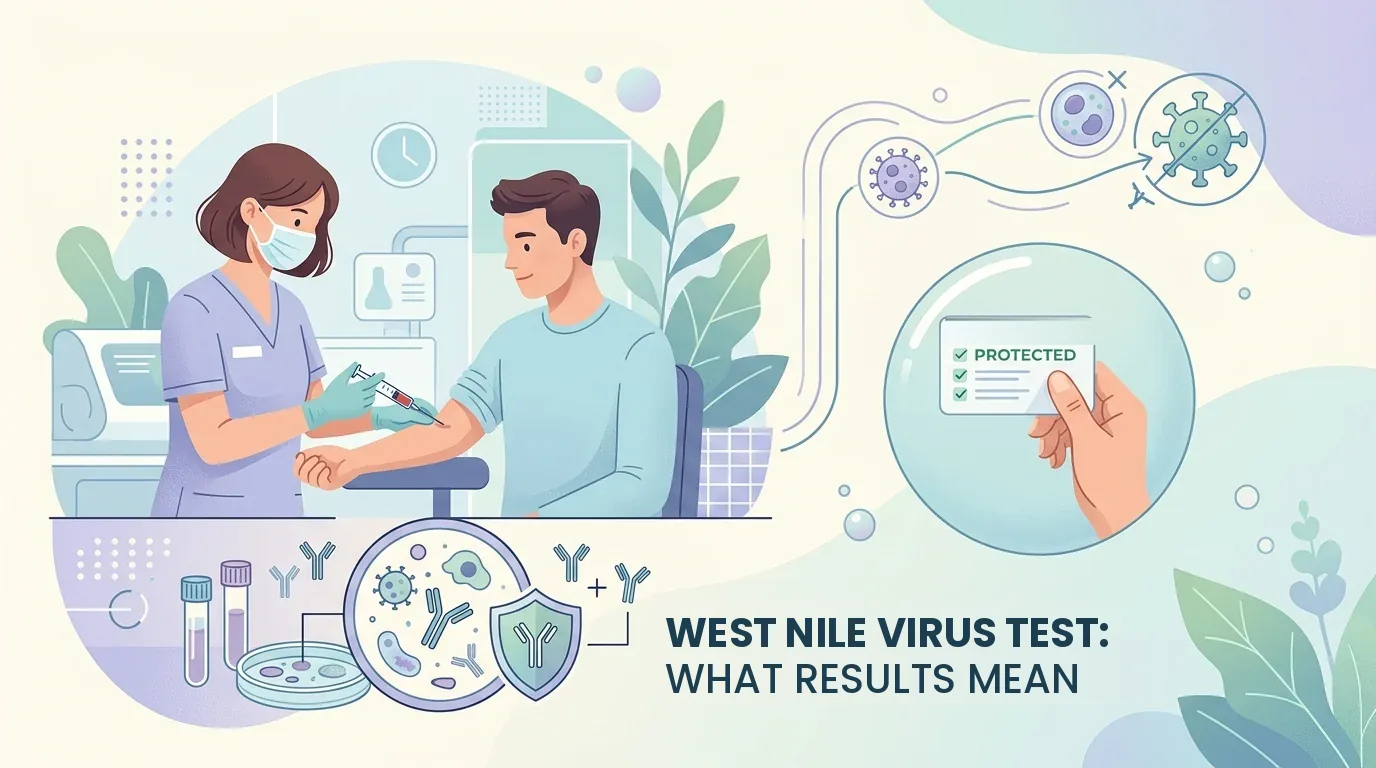
There is no single at-home check. A doctor orders the test, usually from a blood sample and sometimes from spinal fluid. The CDC recommends starting with an antibody test called West Nile virus IgM. IgM antibodies are the first antibodies the immune system makes against a new infection, which is why they point to a recent infection. If you want to understand this antibody class better, read our explainer on IgM levels and what high or low results mean and our overview of the serology test.
| Test | Sample | What it shows | Main limit |
|---|---|---|---|
| West Nile virus IgM | Blood or spinal fluid | A likely recent infection | Can be negative in the first days; can cross-react with related viruses |
| West Nile virus IgG | Blood | Past exposure | Alone, does not prove a current infection |
| RT-PCR (viral RNA) | Early blood, spinal fluid or tissue | The virus itself | Often negative in people with a normal immune system, because the virus clears quickly |
| Neutralization test (PRNT) | Two blood samples 2 to 3 weeks apart | Confirms which virus caused the infection | Done in specialized or public health labs, results take time |
Why timing changes the result
The CDC explains that IgM usually becomes detectable 3 to 8 days after symptoms start. A sample drawn within the first 8 days can therefore be negative even when the infection is real, and a second sample may be needed. Later, IgM can stay positive for 30 to 90 days, and sometimes longer, so a positive result occasionally reflects an infection from earlier in the season rather than the current illness.
Why a positive result may need confirmation
West Nile virus belongs to the flavivirus family, like dengue, Zika, yellow fever and St. Louis encephalitis viruses. Antibodies against one of these can react on a test for another. When results are unclear, or after travel or vaccination against a related virus, labs may run a neutralization test to identify the exact virus.
Which routine blood tests help, and which do not
A standard complete blood count or a CRP test cannot diagnose West Nile virus. These tests are not specific: many infections change the white blood cell count or inflammation markers. They still help doctors judge how sick someone is and rule out other causes of fever. Only a virus-specific antibody or molecular test can confirm West Nile infection. Blood donors are a special case: the US blood supply has been screened for West Nile virus since 2003, so transmission through transfusion is now rare.
There is no specific antiviral treatment and no human vaccine. Mild illness is treated with rest, fluids and fever relief; severe cases need hospital care. Prevention still relies on avoiding bites: insect repellent, long sleeves at dusk and dawn, and emptying standing water.
Latest scientific advances
Several studies published in 2026 refine how West Nile infection is diagnosed and monitored. A study in mBio followed blood donors infected with West Nile virus for up to a year. It found that the body builds strong, long-lasting protective antibodies, which explains why an antibody test can remain positive long after the illness. It also showed that antibodies made against one strain protect less well against another lineage of the virus that circulates in Europe, a challenge for future vaccines.
Research from Israel, published in the Journal of Clinical Virology, found that some people who tested positive for West Nile antibodies had in fact also met Usutu virus, a close cousin. In practice, this is why a positive antibody screen sometimes needs a confirmation test. A 2026 review in Tropical Medicine and Infectious Disease adds that in people with a severely weakened immune system, early antibody tests can stay negative; doctors may then rely on a direct search for the virus. Finally, CDC experts writing in the American Journal of Tropical Medicine and Hygiene argue that faster diagnostic tests, a human vaccine and preventive antibody treatments for high-risk patients are now needed.
When to talk to your doctor
- Seek urgent care for a high fever with a stiff neck, confusion, severe headache, new weakness, trouble walking or seizures, especially if you are over 60 or have a weakened immune system.
- See your doctor if a fever, headache or rash follows mosquito bites in an area where West Nile virus is circulating, and mention your outdoor exposure.
- Ask about a repeat test if your first antibody test was drawn in the first days of illness and you are still unwell.
- Bring up an earlier positive result if you are tested again: IgM can stay positive for months.
Glossary
- IgM antibodies: the first antibodies made against a new infection; a positive result suggests a recent infection.
- IgG antibodies: antibodies that appear after IgM and last for years; they show past exposure.
- RT-PCR: a test that detects the genetic material of the virus directly.
- Neuroinvasive disease: a severe form in which the virus affects the brain, spinal cord or their membranes.
- Flavivirus: a family of related viruses, including West Nile, dengue and Zika, that can cause cross-reacting antibody results.
- PRNT: plaque reduction neutralization test, a specialized lab test that confirms which flavivirus caused an infection.
FAQ
Is there a blood test for West Nile virus?
Yes. Doctors order a West Nile virus IgM antibody test on blood, and sometimes on spinal fluid. In some cases they add a test that looks for the virus's genetic material.
How soon after symptoms can West Nile virus be detected?
IgM antibodies usually appear 3 to 8 days after symptoms start. A very early negative result does not rule out infection, so a second sample may be needed.
Can I have West Nile virus without symptoms?
Yes. About 8 in 10 infected people never notice anything. Testing is generally reserved for people with symptoms, while blood donations are screened routinely.
Does a positive antibody test mean I am sick right now?
Not always. IgM can remain positive for months, and antibodies against related viruses can cross-react. Your doctor interprets the result together with your symptoms and timeline.
Is there a vaccine or treatment for West Nile virus?
No vaccine or specific antiviral is approved for people. Care focuses on relieving symptoms, with hospital support for severe forms.
Sources
- CDC: Symptoms of West Nile
- CDC: Clinical Testing and Diagnosis for West Nile Virus Disease
- CDC: West Nile virus key messages
- CDC: West Nile virus current year data (2026)
- Santé publique France: Chikungunya, dengue, Zika and West Nile virus in mainland France, bulletin of October 21, 2026
- California Department of Public Health: West Nile virus website
- Medical Daily: California West Nile cases reach 452 with 29 deaths (October 28, 2026)
- Longitudinal dynamics and lineage cross-reactivity of the human antibody response to West Nile virus. mBio, 2026 (via PubMed)
- Serological evidence of subclinical Usutu virus exposure among West Nile virus-seropositive individuals in Israel. Journal of Clinical Virology, 2026 (via PubMed)
- West Nile virus in people with HIV: immune vulnerability, neuroinvasive disease, and diagnostic challenges. Tropical Medicine and Infectious Disease, 2026 (via PubMed)
- Decreasing the burden of West Nile virus disease: the need for more prevention measures. American Journal of Tropical Medicine and Hygiene, 2026 (via PubMed)
Other articles
- Serology test: what antibody tests can tell you
- IgM (immunoglobulin M): high and low results explained
- Measles titer test: how to know if you are immune
- Meningitis: symptoms, causes and testing
- Flu shot 2026: who should get it
Understand your own blood test results with AI DiagMe
Have you received a blood count, an inflammation panel or an antibody result and want to understand what each value means? AI DiagMe turns your lab report into a clear, personalized explanation in minutes, so you can prepare the right questions for your doctor.