



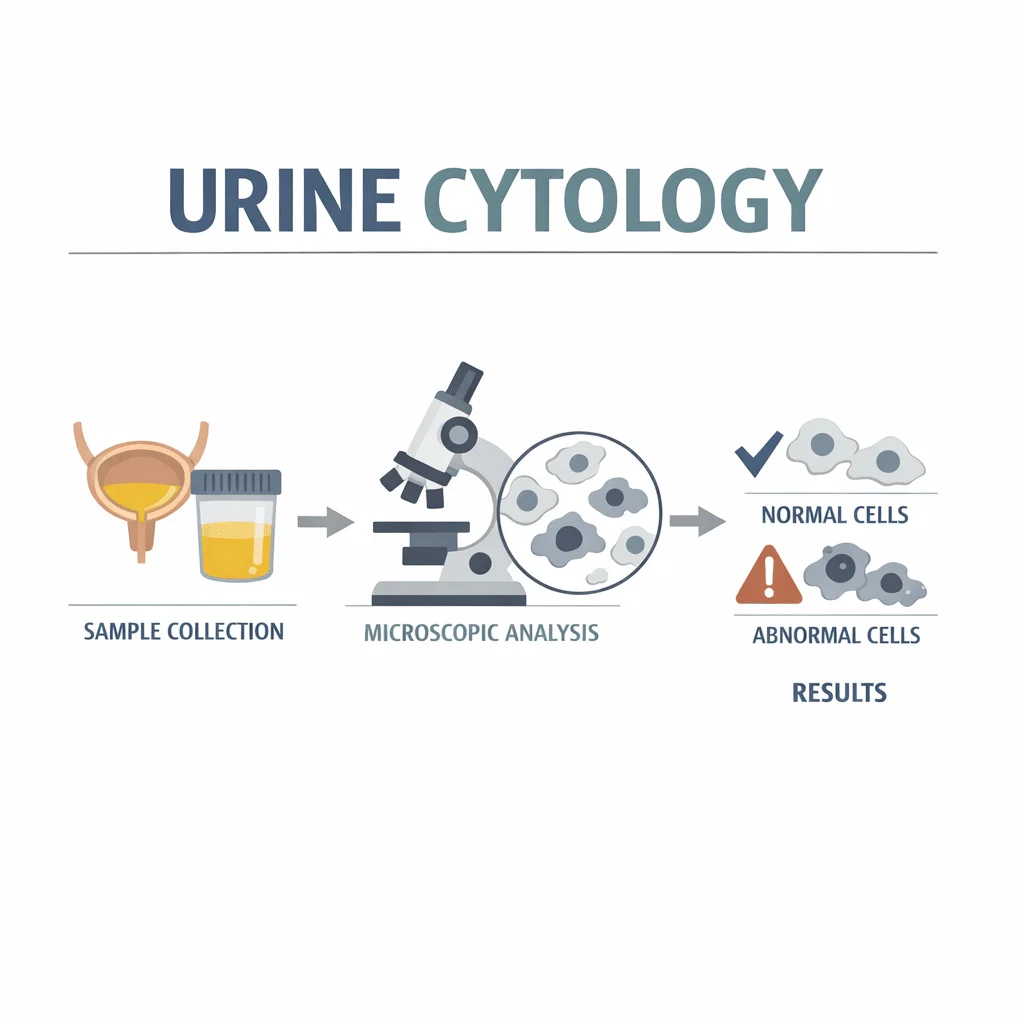
Urine cytology is a laboratory test that examines the cells your urinary tract sheds into your urine, hunting under a microscope for cells that look cancerous. It is not a routine screening test, and it reports a category rather than a number. Doctors order it most often when blood shows up in the urine, and to keep watch after treatment for bladder cancer. In this article you will learn what the test can and cannot see, why the laboratory asks you not to bring a first-morning sample, what each reporting category means in plain words, and which next step usually follows each result.
What urine cytology is, and what it is not
Your bladder, ureters and kidney drainage system are lined by a specialized layer called the urothelium. Like skin, it renews itself constantly, and worn-out cells drop into the urine passing over them. Urine cytology concentrates those loose cells onto a slide, stains them, and hands them to a cytopathologist, a doctor trained to judge cells by appearance alone.
The question is narrow: do any of these cells look like those of an aggressive urothelial cancer? Nothing in the sample says where in the tract they came from.
How urine cytology differs from a urinalysis
A urinalysis is a broad chemical and microscopic survey. It measures acidity, protein, glucose and blood, and counts the particles in the sediment; we explain what a full urinalysis report contains separately, and describe how the dipstick chemistry panel is read in its own guide.
Cytology overlaps with none of that. It is a cancer question asked of the cells only. A urinalysis can be entirely normal while cytology is abnormal, and the reverse happens just as often.
Which cells the laboratory is not interested in
Plenty of other cells reach a urine sample, and none are the target. Squamous cells shed from the urethra or vulva usually say more about how the sample was taken than about disease, and we explain what epithelial cells in a urine sample mean in a dedicated article. Cylindrical structures formed inside the kidney tubules belong to a different conversation, and we cover what casts in urine indicate about the kidneys elsewhere.
Why your doctor ordered urine cytology
There are three common reasons, and which one applies changes how much weight the result carries.
Blood in the urine
Visible blood, or blood found only under the microscope, is the single most frequent trigger. Most causes turn out to be benign, and we cover the many causes of blood in the urine in full elsewhere. Bladder cancer is nonetheless one of the possibilities that has to be excluded, and urine cytology helps do that. It is almost never used alone here.
Surveillance after bladder cancer treatment
This is where the test earns its keep. Once a urothelial cancer has been removed, the lining that produced it stays at risk, and patients enter a program of repeated bladder inspections. Cytology runs alongside them because it samples the whole lining, including flat patches of abnormal cells that never form a visible lump and are easy to miss with a camera.
Occupational and other exposures
A long history of exposure to certain industrial chemicals, particularly the aromatic amines once used in dye, rubber and textile manufacturing, raises lifetime risk; heavy long-term smoking is the other major factor. Cytology may be included in monitoring for these groups, although the National Cancer Institute notes that no urine test has been shown to reduce deaths when used to screen the general population.
How the urine cytology sample is collected, and why not first-morning urine
This is the step patients get wrong most often, usually by following instructions written for a different test.
The voided sample, and the first-morning trap
Most cytology is done on a voided specimen, meaning urine you pass normally into a sterile container. For many urine tests the concentrated first-morning sample is preferred. For cytology it is explicitly not. Cells that sat in your bladder overnight begin to break down, and a degenerated cell is hard to judge: the features the cytopathologist relies on, such as the shape of the nucleus and the texture inside it, blur and distort. Cleveland Clinic advises against the first-morning specimen for exactly this reason.
The laboratory wants a sample from later in the morning, once you have been up and passing urine for a while, so the cells are fresh. Some laboratories request samples on three separate days, because shedding is intermittent and one collection can miss the cells that matter.
Bladder washings and brushings
When a higher yield is needed, cells can be collected directly. During a cystoscopy, sterile fluid is instilled into the bladder and drawn back out several times, a technique called barbotage, which dislodges cells instead of waiting for them to fall off; the American Cancer Society notes that cytology is also performed on these bladder washings. If the concern lies higher up, cells can be sampled selectively from one ureter during a ureteroscopy. These methods yield more, and better preserved, material than a voided cup.
Practical points on the day
Avoid giving the sample during a menstrual period if possible, since blood makes the slide harder to read. Tell the requesting doctor about an active urinary infection, a recent catheter or bladder procedure, or any treatment given inside the bladder, since all of these change how cells look. We cover how a urinary tract infection is diagnosed and treated separately.
What each urine cytology result category means, and what usually follows
Most laboratories in the United States now report using a shared vocabulary called the Paris System for Reporting Urinary Cytology. It was designed to stop the same slide being described five different ways at five different hospitals, and it organizes everything around one question: is there high-grade urothelial carcinoma here? The table translates each category into plain words and shows the step that usually follows.
| Report category | What it means in plain words | Step that usually follows |
|---|---|---|
| Non-diagnostic (unsatisfactory) | The sample did not contain enough well-preserved cells for anyone to give an opinion. This is a comment on the specimen, not on you. | Repeat the collection, usually with clearer instructions on timing and volume. |
| Negative for high-grade urothelial carcinoma | No cells carrying the features of an aggressive urothelial cancer were seen. This is by far the most common result. | Reassuring, but it does not close the file. If bleeding or symptoms continue, the planned bladder inspection and imaging still go ahead. |
| Atypical urothelial cells | A few cells look slightly unusual, but not unusual enough to call anything. This is the gray zone, and it has many innocent explanations. | Read alongside the bladder inspection and imaging; often a repeat sample once any infection or irritation has settled. |
| Suspicious for high-grade urothelial carcinoma | The cells show several worrying features at once, but there are too few of them, or they are too damaged, for a confident call. | Prompt bladder inspection with biopsy of anything abnormal. |
| High-grade urothelial carcinoma | Cells with the appearance of an aggressive urothelial cancer are clearly present. | Urgent bladder inspection and biopsy. If the bladder looks normal, imaging of the kidneys and ureters follows, since the cells may come from higher up. |
| Low-grade urothelial neoplasm | A narrow and uncommon category, used only when one very specific cell cluster is seen. Most slow-growing tumors leave no cytology trace at all. | Bladder inspection. Cytology is not the tool that finds these growths, so a normal report here means little. |
Two notes. The categories are not a scale of severity running from mild to severe cancer; they are a scale of diagnostic confidence. And the wording of the negative category matters. It does not say negative for cancer. It says negative for high-grade urothelial carcinoma, which is the subject of the next section.
Strong on aggressive tumors, weak on slow-growing ones
The most important thing to understand about urine cytology is that its performance is lopsided, deliberately so. Aggressive, high-grade cancers shed cells that look obviously wrong: the nucleus swells and takes up most of the cell, its outline turns irregular, and the material inside clumps coarsely. A cytopathologist recognizes this reliably, and a report of high-grade carcinoma is very rarely mistaken.
Slow-growing, low-grade tumors are the opposite problem. Their cells look almost normal, perhaps slightly larger or more numerous, but without the changes that make a diagnosis possible. A low-grade tumor can sit visibly in the bladder while the cytology report reads negative, and that is not a laboratory error: those cells genuinely do not look like cancer down a microscope.
The sentence to take away: a negative urine cytology result does not rule out a slow-growing bladder tumor, and was never designed to. That is why the test is a companion to bladder inspection rather than a substitute for it, and why a negative report never cancels a scheduled cystoscopy.
Atypical urothelial cells: what that phrase actually means
If your report uses this wording, the cytopathologist saw cells with some abnormal features, but too few features, or too few cells, to move into a higher category. It is an honest statement of uncertainty, not a soft way of delivering bad news.
Many ordinary things make urothelial cells look unusual. Infection and inflammation swell them; we explain when bacteria in a urine sample need treating and describe what white blood cells in urine point to in separate guides. Fungal organisms irritate in the same way, and we set out how yeast in a urine sample is assessed elsewhere. Stones abrade the lining. A recent catheter, a recent instrument, pelvic radiotherapy, chemotherapy, or treatment instilled into the bladder all leave cells looking battered for weeks.
Because of that list, an atypical result is almost never acted on by itself. It is read next to your symptoms, your bladder inspection and your imaging, and usually prompts either a repeat sample after any treatable irritation clears, or continuation of the workup already planned. Waiting for that fuller picture is normal and correct, not a delay.
What happens after an abnormal urine cytology result
Cytology never has the last word. Its job is to raise or lower suspicion; something else confirms.
Cystoscopy, the reference standard
A cystoscope is a thin flexible tube with a camera, passed through the urethra to look directly at the bladder lining. Everything else is measured against it, because it both sees the lining and allows a biopsy of anything suspicious. It is done with local anesthetic gel and takes a few minutes. If cytology is abnormal but the bladder looks clear, that combination is itself informative: it points attention upstream.
Imaging of the upper tract
Because the same lining runs through the ureters and the kidney drainage system, a scan of the whole urinary tract is usually arranged when the result is concerning and cystoscopy is unrevealing. Cross-sectional imaging with contrast is the usual choice.
Repeat cytology and urine biomarker tests
Repeating the sample is often useful, especially where the first was scanty, degenerated or taken during an infection. Alongside it sit urine tests that look for molecular signals rather than cell appearance: tumor proteins, genetic changes and chromosomal abnormalities in shed cells. These add to the assessment rather than replace it, and we explain how tumor marker tests work and where they fall short in a separate article.
Questions worth asking
- Which reporting category did my sample fall into, and was the specimen adequate?
- Was this a voided sample or a bladder washing, and does that change how you read it?
- Did I have an infection or recent treatment when the sample was taken?
- Given this result, what would change your plan, and what would not?
Latest scientific advances
Research over the last three years has gone in two directions: measuring how well the shared reporting vocabulary works, and testing whether software or molecular methods can cover what microscopy misses.
The shared vocabulary reduced gray-zone reports, but did not fix the blind spot
A pooled review published in 2024 combined 64 studies and close to 100,000 urine samples to see what changed after laboratories adopted the Paris System. Those using it labeled fewer samples atypical and gave clearer signals when they did call something suspicious or high-grade. The authors were explicit that a negative report still does not reliably exclude an aggressive tumor.
What this means for you: a report reading negative for high-grade urothelial carcinoma is genuinely good news, but it is not a discharge letter. The bladder inspection your doctor arranged is still the part of the plan that answers the question.
The gray-zone report carries real, measurable weight
A 2026 study followed 170 samples forward and compared each urine cytology report with what was eventually found. Two pathologists reading the same slides agreed almost perfectly, which matters because inconsistency was the problem the Paris System set out to solve. An atypical report was eventually followed by an aggressive tumor in roughly half of cases, while a negative report was followed by one in fewer than one patient in a hundred. This was a single-center study, so the exact proportions will not transfer everywhere.
What this means for you: atypical is a genuine coin-toss category, which is why it triggers a closer look rather than reassurance. A negative report makes aggressive disease unlikely, and that is worth holding on to.
Software is starting to read the slides alongside the pathologist
A 2026 review gathered eleven studies applying image-recognition software to urine cytology slides and found consistently promising results for spotting aggressive disease, while noting the studies were small and used different methods. A separate 2026 study at a large United States hospital tested one such system on 200 slides. Software-assisted reading caught more of the cancers than microscopy alone and cut review time per slide by roughly two thirds, but also flagged more harmless samples as abnormal.
What this means for you: where software assistance is used, the trade-off is faster turnaround and a lower chance of a missed cancer, paid for with a slightly higher chance of a false alarm that a further test then resolves. These are early results and still need confirming.
Molecular urine tests detect what microscopy cannot see
A large 2026 analysis pooled 37 studies covering more than 7,000 patients and compared urine tests hunting for tumor DNA against conventional cytology. Tumor DNA testing detected urothelial cancer far more often while raising a comparable number of false alarms, which is exactly the microscope weakness with slow-growing tumors. The authors stopped short of recommending routine use. A European guideline panel reached a similar verdict for cancers of the upper urinary tract: several molecular urine tests look accurate, but the evidence base is still thin.
What this means for you: these tests may eventually reduce how often people in monitoring programs need a camera passed into the bladder. That is not where practice stands today, but it is a reasonable thing to ask your urologist about.
Glossary
| Term | Definition |
|---|---|
| Urothelium | The specialized lining of the bladder, ureters and kidney drainage system. It renews itself constantly, which is why its cells appear in urine. |
| Urothelial carcinoma | Cancer arising from that lining. It is the usual type of bladder cancer, and it can also arise higher up in a ureter or kidney. |
| Cytopathologist | A doctor who specializes in diagnosing disease from the appearance of individual cells rather than from a piece of tissue. |
| The Paris System | The shared reporting vocabulary most United States laboratories use for urine cytology, organized around detecting aggressive urothelial cancer. |
| High-grade urothelial carcinoma | An aggressive form of the cancer whose cells look markedly abnormal. It is the disease urine cytology is built to detect. |
| Low-grade urothelial neoplasm | A slow-growing growth of the same lining. Its cells look close to normal, which is why cytology usually misses it. |
| Voided specimen | Urine passed normally into a container, as opposed to urine collected through an instrument. |
| Bladder washing (barbotage) | A collection method in which sterile fluid is put into the bladder and drawn back out repeatedly to dislodge more cells than voiding alone provides. |
| Cystoscopy | Direct inspection of the bladder lining using a thin camera passed through the urethra. It is the reference standard for bladder cancer. |
| Hematuria | Blood in the urine, whether visible to the eye or detected only by testing. It is the most common reason for ordering urine cytology. |
Frequently asked questions
What exactly does a urine cytology test look for?
It looks for cells shed from the lining of the urinary tract that carry the visual hallmarks of an aggressive cancer: an enlarged nucleus, an irregular nuclear outline and coarse internal texture. It is not looking for bacteria, protein, sugar, blood or crystals, all of which belong to a urinalysis. It also does not measure anything, so there is no reference range and no number to compare against. The output is a category describing what the cytopathologist saw, and the categories are built around one question rather than a general survey of your urine.
How accurate is a urine cytology test?
Accuracy depends entirely on which disease you are asking about. For aggressive high-grade urothelial cancer, cytology is dependable, and a positive report is very rarely wrong. For slow-growing low-grade tumors it performs poorly, because those cells look close to normal under a microscope. A useful way to hold it: a positive result usually means something, while a negative result rules out aggressive disease far better than it rules out a slow-growing one. This is why cytology is used alongside bladder inspection rather than in place of it.
Why does the laboratory sometimes ask for three separate samples?
Cells are not shed at a steady rate. A tumor may release plenty on one day and almost none on the next, so a single specimen can miss cells that a second or third would have caught. Collecting on three separate days spreads that risk. Where three samples are requested, they should be on different days rather than three collections in one morning, and each should follow the same guidance: not the first urine of the day, and a reasonable volume rather than a token amount.
How is urine cytology different from a urinalysis or a urine culture?
All three use urine and answer different questions. A urinalysis is a broad chemical and microscopic survey used to detect infection, kidney problems, dehydration and metabolic changes. A urine culture grows any bacteria present to identify an infection and guide antibiotic choice. Urine cytology ignores all of that and examines cell appearance for signs of cancer. A patient with an infection can have a normal cytology result, and a patient with a completely normal urinalysis can have an abnormal one.
How long do urine cytology results take?
Cytology takes longer than most urine tests because a person, not a machine, produces the result. The sample must be processed, concentrated onto a slide and stained before a cytopathologist examines it, and difficult cases are often reviewed by a second specialist before the report is signed. A few working days to about a week is typical, though this varies by laboratory and by whether extra stains were needed. If the result is urgent, your clinical team can usually say when to expect it.
Can a urinary infection change the result?
Yes, and this is one of the more common explanations for an atypical report. Inflammation makes urothelial cells swell and their nuclei enlarge, which mimics some of the changes seen in cancer. Stones, recent catheters, recent bladder procedures and treatments given inside the bladder have the same effect. If you had an infection or a recent procedure around the time of collection, tell the doctor reading the report, because it may well be the reason for the wording, and a repeat sample once things have settled often reads clearly.
Sources
- American Cancer Society — Tests for Bladder Cancer — American Cancer Society, 2024. American Cancer Society
- National Cancer Institute — Bladder and Other Urothelial Cancers Screening (PDQ) — National Cancer Institute, 2025. National Cancer Institute
- Cleveland Clinic — Urine Cytology: What Is It, Purpose, Procedure and Results — Cleveland Clinic, 2024. Cleveland Clinic
- Farahani SJ, Li J, Minder B, Vielh P, Glisic M, Muka T — Impact of implementing the first edition of the Paris system for reporting: a systematic review and meta-analysis — Cytopathology, 2024. PubMed
- Gupta A, Chandra S, Verma T, Gupta A, Singh P, Dhayal IR, Srivastava A — The Paris System for urine cytology: prospective assessment of reproducibility, diagnostic accuracy, and malignancy risk — Diagnostic Cytopathology, 2026. PubMed
- Nabiyouni F, Chiou PZ — Enhancing urine cytopathology with artificial intelligence: a systematic review — American Journal of Clinical Pathology, 2026. PubMed
- Lajara S, Cuda J, Geisler DL, Staniszewski C, Dhir R, Khader SN, et al. — Enhancing urothelial carcinoma diagnosis with artificial intelligence-integrated urine cytology: biopsy-validated accuracy and efficiency gain — Cancer Cytopathology, 2026. PubMed
- Yajima S, Imasato N, Hashimoto T, Kobayashi S, Ishii G, Masuda H — Diagnostic performance of urinary tumor DNA in urothelial carcinoma: a systematic review and network meta-analysis — Urologic Oncology, 2026. PubMed
- Rai BP, Rajan K, Rajan P, Pradere B, Capoun O, Soukup V, et al. — Diagnostic accuracy of liquid-based biomarkers for detecting and risk stratifying upper tract urothelial cancers — European Urology Oncology, 2026. PubMed
Further reading
- What a change in urine color can signal
- How urine electrolyte results are interpreted
- What urine creatinine measures and why it appears on so many reports
- What a urine cortisol test measures
- How a urine drug screen result is produced and read
Understand your lab results with AI DiagMe
A urine cytology report arrives in words rather than numbers, and it usually lands alongside a urinalysis, a urine culture and a set of blood tests that do report numbers. Seeing how those pieces fit together makes a category like atypical far less frightening, and makes it clearer which questions to bring to your appointment. AI DiagMe reads your laboratory report and explains each line in plain language. It helps you understand your results; it does not diagnose you, and it does not replace your doctor.
Get your results interpreted in minutes