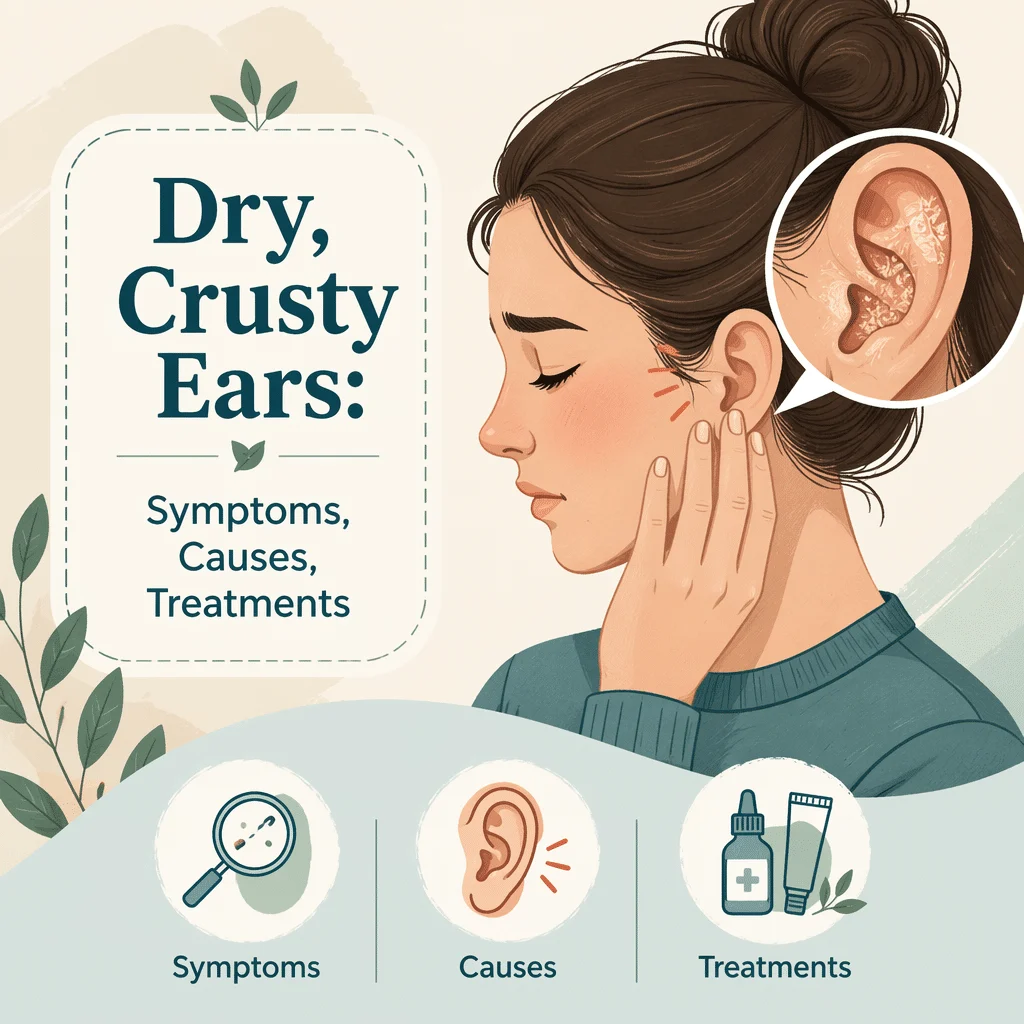
Dry crusty ears are common, and the single most useful clue is where on the ear the dryness actually sits. Flaking in the folds of the outer ear points somewhere different from crusting on an earlobe, deep in the canal, or in the crease behind the ear. Most causes are ordinary skin conditions that settle with gentle, patient care. A few need a clinician. And one of them — a rough patch that keeps scabbing over and never quite heals — should not be left to run. In this article you’ll learn how to read the location of the dryness, which everyday habits quietly make it worse, what genuinely helps, and the point at which a patch that will not settle deserves a professional look.
Why the spot on your ear narrows down the cause
Ear skin is not one uniform surface. The bowl and folds of the outer ear are rich in oil glands. The earlobe is soft and often pierced. The canal is warm, enclosed, and lined with skin so thin it tears easily. The crease behind the ear is dark, damp, and almost never inspected. Each of these microenvironments favors a different problem, which is why a location-first approach narrows things down faster than a list of symptoms.
The grid below is a starting point for orientation, not a diagnosis. Skin conditions overlap, and two can sit on the same ear at once.
| Where the dryness sits | What it often looks like | Causes to consider first | Sensible first steps |
|---|---|---|---|
| Outer ear and its folds | Greasy yellowish scale, or dry pink flaking in the bowl of the ear | Seborrheic dermatitis, eczema, psoriasis | Fragrance-free emollient, gentle cleanser, review if it keeps returning |
| Earlobe and piercing sites | Itchy redness, weeping or crusting in a ring around a stud | Contact allergy, most often to nickel | Change to implant-grade titanium jewelry, keep the site clean, ask about allergy testing |
| Inside the ear canal | Deep itching, flaking, sometimes damp crusting, tenderness or pain | Otitis externa, eczema of the canal, over-cleaning | Stop all cotton swabs, keep water out, see a clinician before using any drops |
| Behind the ear | Scaly crusting or a raw-looking split in the crease | Seborrheic dermatitis, psoriasis | Emollient, medicated treatment on clinical advice |
| Rim of the ear | A single rough patch that scabs, bleeds or slowly enlarges | Cumulative sun damage, actinic keratosis, skin cancer | Clinician examination rather than waiting it out |
The outer ear and its folds
The visible part of the ear, with its ridges and its central bowl, is one of the oiliest areas of the body. Scale that collects in those grooves is usually one of three long-running skin conditions.
Seborrheic dermatitis
This is the most frequent cause of flaking in the ear folds. It produces greasy, yellowish scale on a pink base, and it tends to run in cycles: quiet for months, then flaring in cold weather or during stressful stretches. It is linked to a yeast called Malassezia that lives harmlessly on everyone’s skin but provokes inflammation in some people. The same process causes dandruff, which is why people with a flaky scalp so often have flaky ears. Medicated shampoos containing selenium, zinc or coal tar, and antifungal creams, are the mainstays described by clinical services.
Eczema
Eczema in the ear looks drier and pinker than seborrheic dermatitis, itches more insistently, and often affects other flexural sites such as the elbows or the neck. It reflects a skin barrier that leaks moisture and reacts easily to irritants. Our guide explains in plain language how eczema affects the skin barrier. When the inflammation shows the fluid-in-the-skin pattern a pathologist recognizes, clinicians may use a more specific label, and our team covers the meaning of a spongiotic dermatitis result.
Psoriasis
Psoriasis produces thicker, more sharply bordered plaques with silvery scale, and it favors the rim of the ear and the crease behind it. It rarely appears on the ear alone, so it is worth checking elbows, knees, the scalp line and the nails for the same pattern. Our team describes the different types of psoriasis and their triggers.
The earlobe and piercing sites
Crusting confined to an earlobe, especially in a neat ring around a piercing, points strongly toward contact allergy rather than a general skin condition. Nickel is the classic culprit. It is present in a great deal of inexpensive jewelry, and sensitization frequently begins with a piercing, because metal sits in broken skin for weeks while the channel heals.
The tell is the pattern. Contact allergy traces the shape of whatever touched the skin: a circle where a stud sits, a line where a hoop rests, a smear along the top of the ear from a hair product or a spectacle arm. It itches rather than hurts, and it settles when the trigger goes. Switching to implant-grade titanium or surgical-grade steel is the practical first move.
Distinguishing an allergy from an infected piercing matters, because they are managed differently. Infection tends to be painful, warm, and increasingly swollen, with thick discharge, and it can worsen over days. Allergy itches, stays confined to the contact zone, and does not spread. Where the trigger is genuinely unclear, a clinician may arrange patch testing or blood work, and our team explains what an allergy blood test can and cannot show.
Inside the ear canal
The canal deserves its own rules, because the skin there is exceptionally thin and sits directly over cartilage and bone, with an eardrum at the end of it.
Otitis externa
Otitis externa, widely known as swimmer’s ear, is inflammation of the canal that often follows water trapped after swimming or bathing. It typically causes itching first, then tenderness that becomes surprisingly severe, and sometimes damp crusting or discharge. Mayo Clinic notes that the canal’s natural defenses, including earwax and a thin protective film, can be lost through injury or prolonged moisture. Our team also describes the symptoms of an ear infection in more detail.
Eczema of the canal, and the over-cleaning trap
Eczema can line the canal itself, producing a maddening deep itch and fine white flakes with no infection at all. Here the most common aggravating factor is the person’s own cleaning routine. Scratching an itch with a swab, a hairpin or a fingernail strips the protective film, which makes the skin itch more, which prompts more cleaning. MedlinePlus is unambiguous that you should never try to clean the ear by putting any object, such as a cotton swab, into the ear canal, and notes that attempts at removal can occasionally cause an infection in the canal.
Two further points are worth stating plainly. Ear candling is not a safe cleaning method and carries a real risk of burns and wax occlusion. And ear drops, including steroid and antibiotic preparations, are a clinician’s decision rather than a self-service purchase, because the right choice depends on what is actually inflamed and on whether the eardrum is intact. Some preparations are avoided altogether when a perforation is suspected. If dryness in the canal ever comes with bleeding, our team covers the possible causes of bleeding from the ear.
Behind the ear: the spot nobody checks
The crease behind the ear is a classic site for both seborrheic dermatitis and psoriasis, and it is the one place people almost never look. It is warm, sheltered, and easy to miss in a mirror. Scale builds quietly, and the fold can develop a painful split that stings when the skin moves.
It also catches whatever runs off the scalp and hair: shampoo, conditioner, styling product, hair dye. If flaking behind the ear tracks with a change of hair product, that is a meaningful clue. Ask someone to look, or use a hand mirror, rather than assuming the area is clear. Because ear skin rarely misbehaves in isolation, it helps to know how doctors approach a skin rash across the body.
When a dry crusty patch is not simply dry skin
This is the part most articles on dry crusty ears leave out, and it is the reason to read your ear carefully rather than just moisturizing it.
The rim of the ear takes a great deal of sun over a lifetime. It projects from the head, it is rarely covered by hair, and it is one of the most commonly missed spots when sunscreen goes on. Years of that exposure accumulate. The National Cancer Institute states that ultraviolet radiation from the sun, sunlamps and tanning booths causes damage that can lead to skin cancer.
Sun-damaged skin can develop actinic keratoses: small rough, scaly patches that feel like sandpaper and are often easier to feel than to see. They are considered precancerous, and clinical reference sources note that timely detection matters because an actinic keratosis can progress into invasive squamous cell carcinoma, with most squamous cell carcinomas arising from or alongside such areas. Only a minority ever transform, so this is a reason to have a patch looked at, not a reason to be frightened.
The practical rule is simple. Ordinary dry skin improves, at least somewhat, with a few weeks of consistent gentle care. A patch that behaves differently deserves examination. Be alert to a single patch that will not heal, one that repeatedly scabs over and bleeds with minor contact, a sore that seems to heal and then breaks down again, a lesion that slowly grows or thickens, or one that looks and feels quite unlike the skin around it. None of these findings means cancer by itself, and all of them are straightforward for a clinician to assess in a short appointment.
Everyday care that helps, and what to skip
For the ordinary causes, the approach is unglamorous and effective. Wash the outer ear with a gentle, fragrance-free cleanser rather than a foaming soap. Apply a plain emollient to the outer ear and behind it while the skin is still slightly damp. Fragrance-free matters, since fragrance is itself a frequent contact allergen. Pat the ears dry after swimming or showering and let trapped water drain by tilting the head. Treat a flaky scalp, because ear and scalp flaking usually travel together.
What to skip is equally important. No cotton swabs, hairpins or fingernails inside the canal, ever. No ear candling. No leftover prescription drops from a previous episode, and none belonging to someone else. No scrubbing or picking at scale, which prolongs the very inflammation you are trying to settle. And no daily deep cleaning, because over-cleaning is one of the most common causes of a dry, itchy canal in the first place.
When to see a doctor
- Pain in the ear, fever, or discharge that is thick, colored or foul-smelling
- Noticeable hearing loss, a blocked sensation that persists, or new ringing in the ear
- A patch that has not improved after two to four weeks of consistent gentle care
- Any patch that keeps scabbing over, bleeds easily, or is slowly getting bigger
- Rapidly spreading redness, swelling of the ear itself, or severe night-time ear pain
- Repeated outer-ear infections, particularly with diabetes or a weakened immune system
- Cracked or bleeding skin behind the ear that will not close
Where blood tests fit in
Honesty is useful here: there is no blood test for dry crusty ears. The diagnosis is made by looking at the ear, asking about the pattern, and occasionally by taking a swab or a small skin sample. Blood work becomes relevant only when the skin picture looks like part of something wider, or when infections keep returning.
In that situation a clinician may consider thyroid function, since an underactive thyroid commonly causes generally dry skin, and our team explains how to read thyroid test ranges. Iron status may be checked when dryness comes with hair thinning and fatigue, and our guide covers the markers in an iron studies panel. Blood sugar is often reviewed when outer-ear infections recur, and our team explains what glucose levels mean. Zinc is sometimes measured where skin healing is poor, and our guide covers the interpretation of a zinc blood test. Allergy testing has a place only when a contact trigger is genuinely suspected and cannot be identified from the history.
None of these tests diagnoses an ear condition. They describe the background against which the skin is behaving, which is a different and more modest job.
Latest scientific advances
Recent research has sharpened a few points that matter to anyone dealing with flaky ears. All of the studies below are recent reviews of existing evidence rather than single experiments, which makes them more reliable than any one trial.
Seborrheic dermatitis is genuinely common. A 2024 review that pooled 121 studies covering more than a million people estimated that roughly four adults in every hundred worldwide are affected. What this means for you: flaking in the ear folds is an ordinary finding, and it is one of the first things a clinician will think of.
Creams for eczema have been ranked head to head. A 2024 Cochrane review brought together 291 trials involving around 46,000 people and found that stronger topical steroids, tacrolimus and newer treatments known as JAK inhibitors — medicines that damp down an inflammatory signal inside skin cells — consistently ranked among the most effective. Reassuringly, short courses of topical steroid did not appear to thin the skin; thinning was reported only in a very small number of people using them for many months. What this means for you: short, targeted courses prescribed by a clinician are the normal approach, and the ear canal in particular remains a clinician’s call.
Nutrition may play a supporting role. A 2024 review of 13 studies, covering close to 14,000 people, found that people with seborrheic dermatitis tended to have lower blood levels of zinc and vitamins D and E. This is an association rather than proof of cause, and the authors were explicit that trials testing supplements are still needed. What this means for you: it is one reason a clinician might look at a wider blood picture instead of treating the skin in isolation, but it is not a reason to start supplements on your own.
Rough sun-damaged patches are hard to judge by eye. A 2024 review of how actinic keratosis is assessed found only slight to moderate agreement between clinicians using current visual methods, and confirmed that the condition matters because of its potential to progress to squamous cell carcinoma in people with fair skin and significant lifetime sun exposure. What this means for you: if trained clinicians find these lesions tricky to grade by sight, a persistent rough patch on your ear is not something to self-assess at home.
Ear drops are not interchangeable. A 2024 practice review aligned with United States ENT guidance emphasized that the choice of topical antibiotic and the technique used to deliver it both affect whether outer-ear infection resolves, and that stubborn cases need referral rather than repeat courses. What this means for you: the drops that worked for a friend may be the wrong drops for you.
Finally, a note on why blood sugar comes up. A hospital series of 140 patients with a rare, serious complication in which outer-ear infection spreads into nearby bone reported that all of them had poorly controlled diabetes. The complication itself is uncommon, and this was a descriptive study rather than a trial. What this means for you: it explains why a clinician may check blood sugar when an outer-ear infection keeps returning or causes pain that is notably worse at night.
Glossary
| Term | Definition |
|---|---|
| Actinic keratosis | A small rough, scaly patch caused by years of sun exposure. It is considered precancerous, meaning a minority can develop into a skin cancer over time. |
| Cerumen | The medical word for earwax. It is protective, trapping dust and bacteria, and normally clears itself without help. |
| Contact dermatitis | Skin inflammation caused by something touching the skin, either an irritant or an allergen such as nickel. It typically traces the shape of whatever made contact. |
| Emollient | A moisturizer that softens skin and helps it hold water. Fragrance-free versions are preferred on the ears. |
| Helix | The curved outer rim of the ear. Because it catches a lot of sun, it is a common site for sun-damaged skin. |
| Malassezia | A yeast that lives harmlessly on almost everyone’s skin but triggers inflammation in people prone to seborrheic dermatitis. |
| Otitis externa | Inflammation or infection of the ear canal, often called swimmer’s ear. Trapped moisture and canal injury are typical triggers. |
| Patch testing | A dermatology test in which small amounts of suspected allergens are applied to the back for a couple of days to identify a contact allergy. |
| Seborrheic dermatitis | A common long-running skin condition causing greasy yellowish scale in oil-rich areas such as the scalp, eyebrows, ear folds and the crease behind the ear. |
| Tympanic membrane | The eardrum, at the inner end of the ear canal. Whether it is intact changes which ear drops are safe to use. |
Frequently asked questions
Why is my ear crusty and wet at the same time?
Crusting that is also damp usually means the skin surface is broken and weeping rather than simply dry. Inflamed eczema, an infected scratch, an irritated piercing and otitis externa can all do this. The fluid dries into a yellowish crust, which then cracks and weeps again. Because a moist, broken surface is easier for bacteria to colonize, a combination of wetness, crusting and pain is worth having examined rather than treating with a moisturizer alone. Keep the area clean and dry, avoid picking at the crust, and see a clinician if there is pain, spreading redness or discharge.
Are the white flakes in my ear just dandruff?
Very often, yes, in the sense that they share a cause. Dandruff and seborrheic dermatitis of the ear are the same process appearing in two neighboring places, which is why treating only the ear tends to disappoint. Managing the scalp with a medicated shampoo usually improves the ears at the same time. Flakes that are thick, silvery and sharply edged are more suggestive of psoriasis, and flakes coming from deep inside the canal accompanied by itching may point to eczema of the canal instead.
Is a crusty ear piercing an infection or an allergy?
The pattern usually separates them. An allergy itches, stays within the zone the metal touches, and improves when the jewelry changes. An infection hurts, feels warm, tends to swell and spread beyond the immediate site, and often produces thicker discharge. Timing helps too: allergy can appear months or years after a piercing that was previously fine, whereas infection usually follows a recent piercing, a change of jewelry or a knock. Spreading redness, fever or increasing pain should be assessed promptly, particularly in upper-ear cartilage piercings.
Is crusty earwax normal?
Dry, flaky earwax is a normal variant. Earwax consistency is partly genetic, and some people naturally produce a drier, crumblier type that can look like crusting near the entrance to the canal. On its own, without itching, pain or hearing change, it needs nothing. The important thing is not to try to dig it out. Attempting to clean the canal tends to push wax deeper and can injure the skin. If wax genuinely blocks the canal and affects hearing, a clinician can remove it safely.
Can dry crusty ears affect my hearing?
Dry skin on the outer ear will not change your hearing. Sound can be muffled, though, if flakes and wax build up enough to obstruct the canal, or if the canal lining swells during otitis externa. That kind of hearing change is usually temporary and improves once the blockage or inflammation is treated. Hearing loss that persists, arrives suddenly, or comes with ringing or dizziness needs prompt medical assessment rather than home treatment, because those symptoms have causes unrelated to ear skin.
How long should I wait before seeing a doctor?
Two to four weeks of consistent gentle care is a reasonable trial for straightforward dryness on the outer ear. If there is no meaningful improvement in that window, a clinician can confirm what is actually going on and prescribe something more targeted. Do not run the clock down when there is pain, fever, discharge or hearing change, or when a patch keeps scabbing, bleeds on light contact, or is slowly enlarging. Those situations are assessed sooner rather than later.
Sources
- Mayo Clinic — Swimmer’s ear (otitis externa): symptoms and causes, 2025 — mayoclinic.org
- Cleveland Clinic — Seborrheic dermatitis: affected areas and treatment, 2024 — my.clevelandclinic.org
- MedlinePlus Medical Encyclopedia, National Library of Medicine — Ear wax blockage, 2025 — medlineplus.gov
- National Cancer Institute — Skin cancer: causes, prevention and treatment, 2025 — cancer.gov
- Marques E, Chen TM — Actinic keratosis — StatPearls, National Library of Medicine, 2023 — ncbi.nlm.nih.gov
- Polaskey MT, Chang CH, Daftary K, et al. — The global prevalence of seborrheic dermatitis: a systematic review and meta-analysis — JAMA Dermatology, 2024 — doi.org/10.1001/jamadermatol.2024.1987
- Lax SJ, Van Vogt E, Candy B, et al. — Topical anti-inflammatory treatments for eczema: a Cochrane systematic review and network meta-analysis — Clinical and Experimental Allergy, 2024 — doi.org/10.1111/cea.14556
- Woolhiser E, Keime N, Patel A, et al. — Nutrition, obesity and seborrheic dermatitis: systematic review — JMIR Dermatology, 2024 — doi.org/10.2196/50143
- Burstein SE, Maibach H — Actinic keratosis metrics — Archives of Dermatological Research, 2024 — doi.org/10.1007/s00403-024-03305-5
- Lee J, Yau S — Approach to otitis externa in general practice — Australian Journal of General Practice, 2024 — doi.org/10.31128/AJGP-01-24-7096
- Krishnakumar L, Vinayakumar V, Suchit Roy BR, et al. — Skull base osteomyelitis: marauders of the skull — Indian Journal of Otolaryngology and Head and Neck Surgery, 2023 — doi.org/10.1007/s12070-023-04405-w
Further reading
- Our team explains how to read a complete blood count
- This guide covers the causes and symptoms of low ferritin
- Our team describes the symptoms of a high TSH result
- This article explains the causes of tingling in the ear
- Our guide covers what happens during a blood test
Understand your lab results with AI DiagMe
Dry crusty ears are diagnosed by examining the skin, not by a blood test. Blood work matters only when the picture is part of something wider, and that is where results become hard to read on your own. AI DiagMe turns lab reports into plain language, whether the panel covers thyroid hormones, iron and ferritin, blood sugar or zinc, so you can arrive at your appointment understanding what the numbers describe. It helps you understand your results; it does not diagnose, and it does not replace your doctor.
Get your results interpreted in minutes