








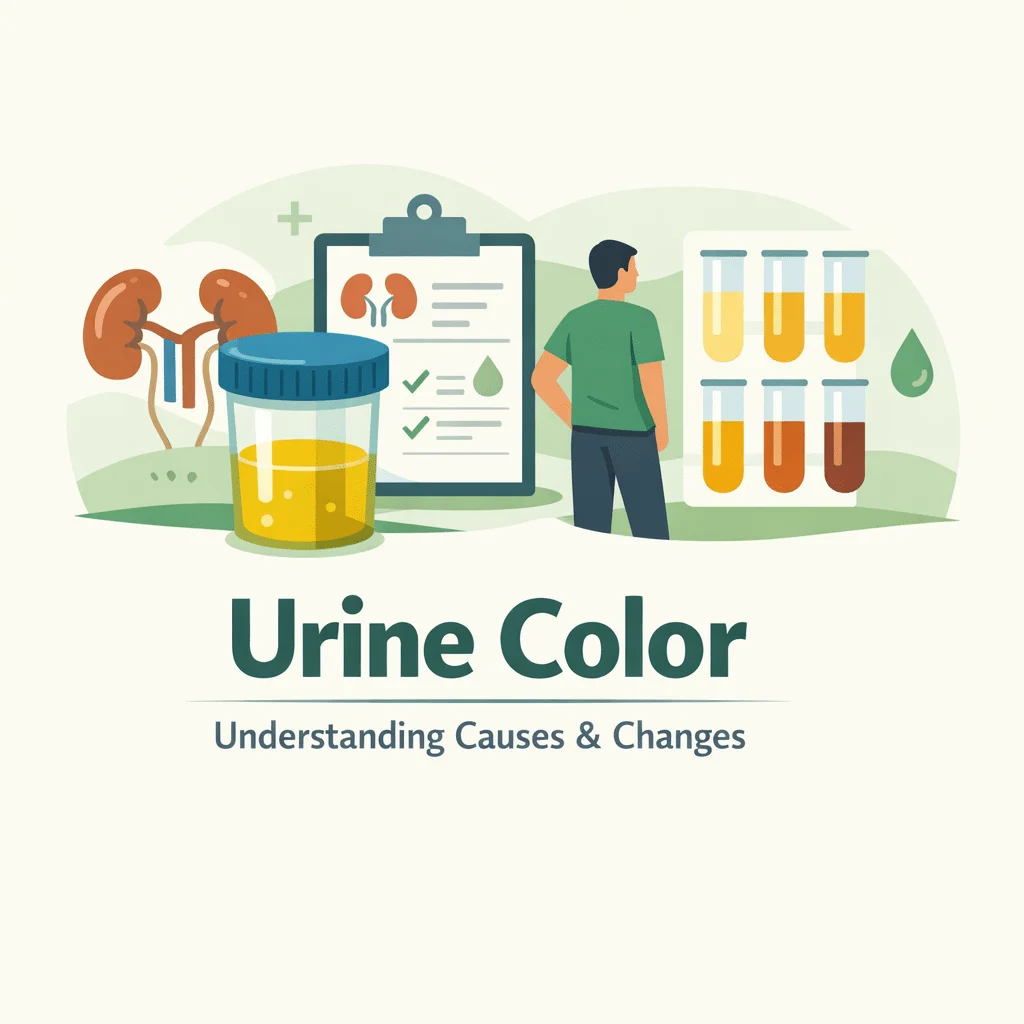
Your urine color shifts through the day, and most of those shifts mean nothing more than how much you drank and when. A few mean something else. In this article you will learn what each shade signals, from pale straw and dark amber through neon yellow, orange, red, brown, green and even purple, which ones a beet salad or a new prescription explains, and which ones deserve a phone call today. You will also find a shade-by-shade chart and a short list of same-day concerns. Color is a prompt to look further. On its own, it is never a diagnosis.
What urine color tells you, and what it cannot
The pigment behind the yellow
Urine owes its familiar yellow to urochrome, a pigment left behind when the body recycles worn-out red blood cells. The kidneys pass out a fairly steady amount of it each day, dissolved in whatever water is available. Drink generously and that fixed quantity spreads through more fluid, so urine color pales. Drink little and it concentrates, so urine color deepens. That single mechanism explains most of the day-to-day variation a healthy person notices.
Color is a prompt, not a test
What the eye cannot do is name a cause. A dark sample may reflect eight hours of sleep or a bile duct that is not draining, and the two look identical. Red may be blood or it may be last night’s beets. When a shade raises a question, the answer comes from the laboratory, and our team explains the chemical analysis of a urine sample. A test strip detects red cells long before urine looks pink, which is why one normal-looking sample never cancels out an alarming one.
A technician can also examine what settles out of the sample under a microscope, and we describe the tube-shaped particles formed inside the kidney tubules.
The hydration scale, from pale straw to dark amber
Where healthy urine usually sits
Across a normal day most people move between a very pale straw and a medium yellow. The first sample after a night’s sleep is the darkest, because the kidneys concentrate urine overnight to spare water; that is physiology working correctly, not a warning. Judge your urine color against the range you personally see over a week rather than one ideal shade, since diet, climate and medicines all move the baseline.
Urine that stays dark after a day of steady drinking deserves attention, especially with a dry mouth, dizziness on standing or passing much less than usual. Fluid loss affects circulation as well as the kidneys, and our library covers the link between dehydration and blood pressure.
The real limits of judging hydration by eye
Color charts are popular because they cost nothing, but they are blunt. Lighting, the container and the depth of the sample all change the reading. Vitamins, food dyes and several medicines override the hydration signal completely, and one sample reflects the last hour or two, not your week.
Why neon yellow is almost always the vitamins
A startling fluorescent yellow alarms a lot of people, and it is among the most harmless changes there is. Riboflavin, a B-group vitamin, is intensely yellow and is barely stored, so the surplus passes straight out. Multivitamins, B-complex tablets and energy drinks all produce it, and it fades a day or two after stopping. Our guide sets out the role and testing of vitamin B12.
A shade-by-shade urine color chart
The table below sets out what people most often see, the everyday explanations, the medical causes worth keeping on the list, and how quickly each shade should be looked at.
| Shade you see | Common harmless explanations | Possible medical causes | When to get checked |
|---|---|---|---|
| Pale, almost clear | A large volume drunk quickly; coffee or beer | Rarely, a hormone problem or diabetes | Only with constant large volumes and thirst |
| Straw to light yellow | Ordinary, well-hydrated urine | None; this is the usual range | No action needed |
| Dark yellow to amber | First sample of the morning; a hot day; hard exercise | Ongoing fluid loss from vomiting, diarrhea or fever | If it stays dark after a day of normal drinking |
| Neon bright yellow | B-group vitamins, especially riboflavin | None; the excess is simply passed out | No action needed; fades in a day or two |
| Orange | Phenazopyridine; rifampin; sulfasalazine; heavy beta-carotene | Bile pigment the liver is not clearing | Same week, sooner with yellow eyes or pale stools |
| Red or pink | Beets, blackberries, rhubarb; rifampin; menstrual blood on the sample | Blood from anywhere in the urinary tract: infection, stones, prostate, kidney disease, tumor | Promptly, at any age, even once, even when painless |
| Brown, tea or cola | Fava beans; metronidazole, nitrofurantoin; severe dehydration | Muscle breakdown after extreme exertion; liver or bile duct disease | Same day after a hard workout, or with muscle pain |
| Yellow-green or blue-green | Food coloring; methylene blue; propofol; amitriptyline | Certain bacterial infections | Same week if nothing explains it, sooner with fever |
| Purple, in a catheter bag | None; it does not occur in a fresh sample | Purple urine bag syndrome, a bacterial pigment reaction | Same day, so the urine can be tested |
| Cloudy or milky | A very concentrated sample; crystals forming as urine cools; discharge | Urinary infection or kidney stones | Same week, or same day with fever or back pain |
| Foamy or bubbly | A fast stream; a recently cleaned bowl | Protein leaking through the kidney filters | Same month if present at every visit |
Two rules make the chart safer. A harmless explanation only counts if it is actually present: beets explain pink urine if you ate beets, and not otherwise. And timing matters more than intensity.
Red, pink, brown and cola-colored urine
When red is food or medicine
Beets are the classic culprit, and roughly one person in seven turns convincingly pink after a normal portion. Blackberries and rhubarb do something similar. Among medicines, rifampin, an antibiotic used for tuberculosis, colors urine a vivid red-orange, and phenazopyridine, taken for burning during a bladder infection, does the same. If a medicine has changed your urine color, tell the person who prescribed it, and never stop taking it on your own.
When red is blood
It takes remarkably little blood to tint a whole bladderful, which is why visible red or pink can accompany something minor as easily as something serious. Infections, kidney stones, an enlarged prostate, inflammation inside the kidney and tumors all present this way, and the appearance itself does not sort them. Painless bleeding is not reassuring. We set out the causes and workup of blood in the urine.
The advice is simple. Visible blood in urine, at any age, even a single episode, even without pain, and even when the next sample looks normal, deserves prompt medical assessment. Do not wait to see whether it happens again. The workup may include imaging, a look inside the bladder, and a laboratory search for abnormal cells. Our guide covers the microscopic examination of cells shed into urine.
One innocent explanation deserves a mention: menstrual blood on the sample. Say so when the sample is taken, and repeat the test if there is any doubt.
Brown or cola after hard exercise
Brown urine after an unusually hard or unaccustomed effort, especially one with a lot of downhill running, is the pattern to know. Damaged muscle releases myoglobin, an oxygen-storing protein, into the blood; the kidneys filter it out and it stains urine the color of strong tea. This is rhabdomyolysis, and the risk is to the kidneys rather than the muscles. Our library explains what a raised myoglobin result means.
Dark brown urine after intense exertion, particularly with muscle pain out of proportion to the workout, weakness, or noticeably less urine than usual, is urgent-care-level and should be assessed the same day rather than slept on.
Brown from the liver, and from the pharmacy
When the liver or the bile ducts are not clearing bile pigment, it spills into the urine and darkens it toward cola or strong tea. The combination that matters is dark urine plus unusually pale stools plus a yellow tinge to the skin or the whites of the eyes. We explain what a total bilirubin result reflects. A companion guide covers how to read a liver panel.
Several medicines darken urine harmlessly, including metronidazole, nitrofurantoin and some antimalarials. Fava beans can too, and severe dehydration alone can push urine into a deep brown. Again, check with the prescriber rather than stopping the treatment.
Orange, green, blue and purple urine
Orange
Orange has three routine explanations and one that matters. Phenazopyridine turns urine a dense orange within hours and is by far the most common cause; rifampin and sulfasalazine do the same. Heavy beta-carotene intake can tint it, and plain concentration pushes amber toward orange. The explanation to take seriously is bile pigment, and the tell is the company it keeps: pale stools, itching, or yellowing of the eyes.
Yellow-green and blue-green
Green and blue-green shades are startling and usually trivial. Food coloring is a frequent cause. Methylene blue, used as a medical dye, is unmistakable. Propofol, a widely used anesthetic, tints urine green in some people after surgery, and amitriptyline, indomethacin and cimetidine have all been reported to do it. Some bacterial infections also change the urine color, usually with fever, burning or urgency.
Purple in a catheter bag
Purple essentially never appears in a freshly passed sample. It shows up in the tubing and bag of people with long-term catheters, where bacteria convert a compound derived from dietary tryptophan into red and blue pigments that mix to purple. It is alarming to look at and not dangerous in itself, but it signals a urinary infection and should be reported the same day.
Cloudy and foamy urine, where texture matters more than color
Cloudy or milky
Cloudiness is less a color change than a change in what the urine is carrying. A very concentrated sample often looks hazy, and crystals forming as urine cools can cloud it without meaning anything. Semen, vaginal discharge or mucus will do it too, and our guide covers the reasons mucus appears in a urine sample. The version needing attention is cloudy urine with fever, burning, urgency or flank pain, which points toward infection. We separately set out the meaning of bacteria found in urine.
Foamy or bubbly
Every stream makes bubbles. The distinction worth learning is between froth that disperses within a minute and a fine, persistent foam that sits on the surface visit after visit. Persistent foam can be the first outward sign that protein is leaking through the kidney filters, which matters most in people with diabetes or high blood pressure. Speed of flow and a recently cleaned bowl produce innocent foam, so the test is repetition. Elsewhere we look at the causes and significance of foamy urine.
What recent research says about reading urine color
Urine color has been studied seriously, mostly in athletes and outdoor workers, because it is the cheapest hydration check that exists.
Charts read one sample better than a whole day
In a 2025 study, 73 young adults collected every sample they passed over two days while researchers compared a printed color chart with a three-dimensional color model. Both sorted a freshly passed sample into dilute or concentrated reasonably well, and both did worse across a full 24 hours. What this means for you: one sample is a fair snapshot, not a grade for your whole day, and a dark first-of-the-morning sample is not evidence of long-term dehydration.
A 2024 review of non-invasive ways to assess hydration placed color charts alongside body-composition sensors and heart-based measurements, and concluded that none is precise on its own. What this means for you: read the sample in good light in a pale container, and combine urine color with thirst and how often you go.
Cola-colored urine after extreme exercise is uncommon but real
A 2024 systematic review pooled 15 studies of ultra-distance trail runners, 348 athletes in total. Markers of muscle damage rose steeply after these races, most of all on courses with long descents, since downhill running stresses muscle more than climbing. Yet confirmed exertional rhabdomyolysis was diagnosed in only one runner across all those studies. What this means for you: aching muscles after a hard effort are ordinary, aching muscles with dark brown urine are not, and that combination is the one to act on the same day.
Why visible blood is treated as an alarm feature
A 2025 clinical review of how blood in the urine is handled made a blunt point: visible blood is an alarm feature in its own right, and the harm usually comes from delay rather than from the bleeding. What this means for you: visible red, pink or cola-colored urine is worth a prompt appointment even if it happened once and nothing hurt.
Two color surprises with straightforward explanations
In a small 2026 study, every teenager taking mesalamine, a common bowel anti-inflammatory, watched their urine sample turn brown the moment household bleach was added. What this means for you: if you take mesalamine and the bowl turns brown after cleaning, that is a reaction with the cleaner rather than bleeding, so mention it to your prescriber rather than stopping the medicine.
Purple urine bag syndrome is recognized well enough to have its own name and a steady stream of published case reports in people with long-term catheters. What this means for you: purple staining in a catheter bag is a medical message rather than a plumbing fault, and it warrants a same-day call.
When to see a doctor about a change in urine color
Get seen the same day
- Any visible red, pink or cola shade that blood could explain, painful or not.
- Brown urine after intense exercise, especially with muscle pain, weakness or low output.
- Dark urine with pale stools, itching, or yellowing of the skin or eyes.
- Any color change with fever, chills, or pain in the back or side.
- Purple or blue staining in a urinary catheter bag.
- Passing almost no urine over the course of a day.
Book a routine appointment
- Cloudy urine that keeps coming back.
- Persistent foam at nearly every visit that does not disperse.
- Urine that stays dark despite a full day of drinking.
- An orange or green shade that no food, supplement or medicine accounts for.
- A change that started after a new prescription.
Usually settles on its own
- Neon yellow after a multivitamin, B-complex tablet or energy drink.
- Pink after beets, blackberries or rhubarb, clearing within a day or two.
- A dark first sample of the morning that lightens after a drink.
- Very pale urine after drinking a large volume quickly.
- Brief froth from a fast stream that disperses as you watch.
Bring three things to the appointment: when the change started, what else changed at the same time, including new medicines, supplements and foods, and whether anything hurts. Those answers shorten the investigation more than the shade itself.
Frequently asked questions
Which urine color is dangerous?
No shade is dangerous by itself, but three warrant quick action. Visible red or pink that blood could explain needs a prompt appointment at any age. Brown or cola after hard exercise, particularly with muscle pain or reduced output, needs same-day care. Dark urine alongside pale stools and yellowing eyes points at the liver or bile ducts and should not wait. Everything else, including bright yellow, orange from a known medicine, and pink after beets, is far more often explained by diet, supplements or a prescription than by disease.
Does dark urine always mean dehydration?
No. Dehydration is the most common reason, and dark urine that lightens within a few hours of drinking normally is almost always that. But bile pigment from liver or bile duct problems, myoglobin from damaged muscle, blood, and a number of medicines all darken urine independently of how much you have drunk. The distinguishing test is simple: rehydrate normally for a day. If the color returns to your usual range, hydration explained it. If it stays dark, something else does, and that deserves a look.
Can a urine color chart tell me whether I have an infection?
Not reliably. Urinary infections often produce cloudy urine and sometimes a stronger smell, but plenty of infections leave the color entirely normal, and plenty of cloudy samples have nothing to do with infection. Symptoms carry far more weight than shade here: burning, urgency, going often, or pain low in the abdomen or the back. An infection is confirmed by testing the sample, not by looking at it, so a chart can suggest a question but never close it.
Can urine color show a liver problem?
It can raise the possibility. When the liver or bile ducts are not clearing bile pigment, it passes into the urine and darkens it toward brown or deep orange. What makes this pattern recognizable is what accompanies it: stools that turn pale or clay-colored, itching, and a yellow tinge to the skin or the whites of the eyes. Dark urine on its own, without those companions, is much more likely to be concentration. Blood testing is what settles the question.
Why is my urine bright yellow?
Almost always B-group vitamins. Riboflavin is a strongly fluorescent yellow pigment, the body stores very little of it, and the surplus goes straight into the urine within a few hours of a supplement or a fortified energy drink. The effect can be striking enough to look artificial. It is harmless, it says nothing about your kidneys, and it fades within a day or two of stopping the supplement. If you are not taking anything that explains it, mention it at your next appointment rather than worrying about it.
How long should a change in urine color last before I call someone?
It depends entirely on the shade. Red, pink, cola-brown and purple do not get a waiting period; call about the first episode. Neon yellow, mild orange from a known medicine, and pink after beets can reasonably be watched for a couple of days to see whether they clear. Cloudiness, persistent foam and unexplained dark urine that outlast about a week of normal drinking are worth an unhurried appointment. When symptoms such as fever, pain or reduced output join in, the waiting period ends immediately.
Glossary of key terms
| Term | Definition |
|---|---|
| Urochrome | The yellow pigment that gives urine its usual color, left over when the body breaks down old red blood cells. It is also called urobilin. |
| Hematuria | Blood in the urine. It is called gross or visible hematuria when you can see it, and microscopic hematuria when only a laboratory can. |
| Myoglobin | A protein that stores oxygen inside muscle. When muscle is damaged it leaks into the blood, passes into the urine, and can stain it brown. |
| Rhabdomyolysis | Rapid breakdown of muscle tissue that releases its contents into the bloodstream. It can injure the kidneys and needs urgent care. |
| Bilirubin | An orange-yellow pigment made when red blood cells are recycled. The liver normally clears it; when it builds up it can darken urine and yellow the skin. |
| Phenazopyridine | A medicine taken for short periods to soothe burning during a urinary infection. It reliably turns urine bright orange. |
| Porphyria | A group of uncommon inherited conditions affecting how the body makes the pigment part of hemoglobin. Some forms can darken urine to a red-brown after it stands in light. |
| Proteinuria | Protein leaking into the urine because the kidney filters are not holding it back. Persistent foam can be an early outward sign. |
| Purple urine bag syndrome | A striking purple or blue staining of a urinary catheter bag caused by bacteria converting a dietary compound into colored pigments. |
| Diuretic | Anything that makes the kidneys pass more water, including some medicines as well as coffee and alcohol. |
Sources
- Mayo Clinic — Urine color: symptoms and causes, 2025. mayoclinic.org
- MedlinePlus, National Library of Medicine — Urine: abnormal color, 2024. medlineplus.gov
- National Institute of Diabetes and Digestive and Kidney Diseases — Hematuria (blood in the urine), 2024. niddk.nih.gov
- National Institute for Occupational Safety and Health, CDC — Signs and symptoms of rhabdomyolysis, 2024. cdc.gov
- Freire R, Schott KD, Butterick B, et al. — A 3D color model reports urine color similarly to a printed color chart with similar accuracy to determine a low vs. high urine concentration — Performance Nutrition, 2025. PubMed
- Tahar A, Zrour H, Dupont S, Pozdzik A — Non-invasive approaches to hydration assessment: a literature review — Urolithiasis, 2024. PubMed
- Lecina M, Castellar-Otín C, García-Giménez A, Pradas F — Exertional rhabdomyolysis and ultra-trail races: a systematic review highlighting the significant impact of eccentric load — Muscles, 2024. PubMed
- Szymkiewicz S — Clinical significance, differential diagnosis and initial management of hematuria in emergency and outpatient settings — Cureus, 2025. PubMed
- Zifman E, Schujovitzky D, Galai T — The effect of hypochlorous acid on urine color among pediatric ulcerative colitis patients treated with mesalamine — Minerva Gastroenterology, 2026. PubMed
- Pallath AM, Gopan G, Anoop TM — Purple urine bag syndrome — Clinical Medicine (London), 2023. PubMed
Further reading
- How to read a full urinalysis report
- What epithelial cells in a urine sample indicate
- How urine electrolyte results are interpreted
- Kidney stones: causes, symptoms and treatments
- How to understand a urine drug screen result
Understand your lab results with AI DiagMe
A change in urine color is the question, and a laboratory report is usually the answer. AI DiagMe reads that report back to you in plain language, whether it is a urine test looking for blood, protein or infection, a liver panel checking bilirubin and liver enzymes, or a muscle marker such as myoglobin after a hard effort. It helps you understand what the numbers mean and which ones your doctor will care about. It does not diagnose, and it does not replace your doctor.
Get your results interpreted in minutes